
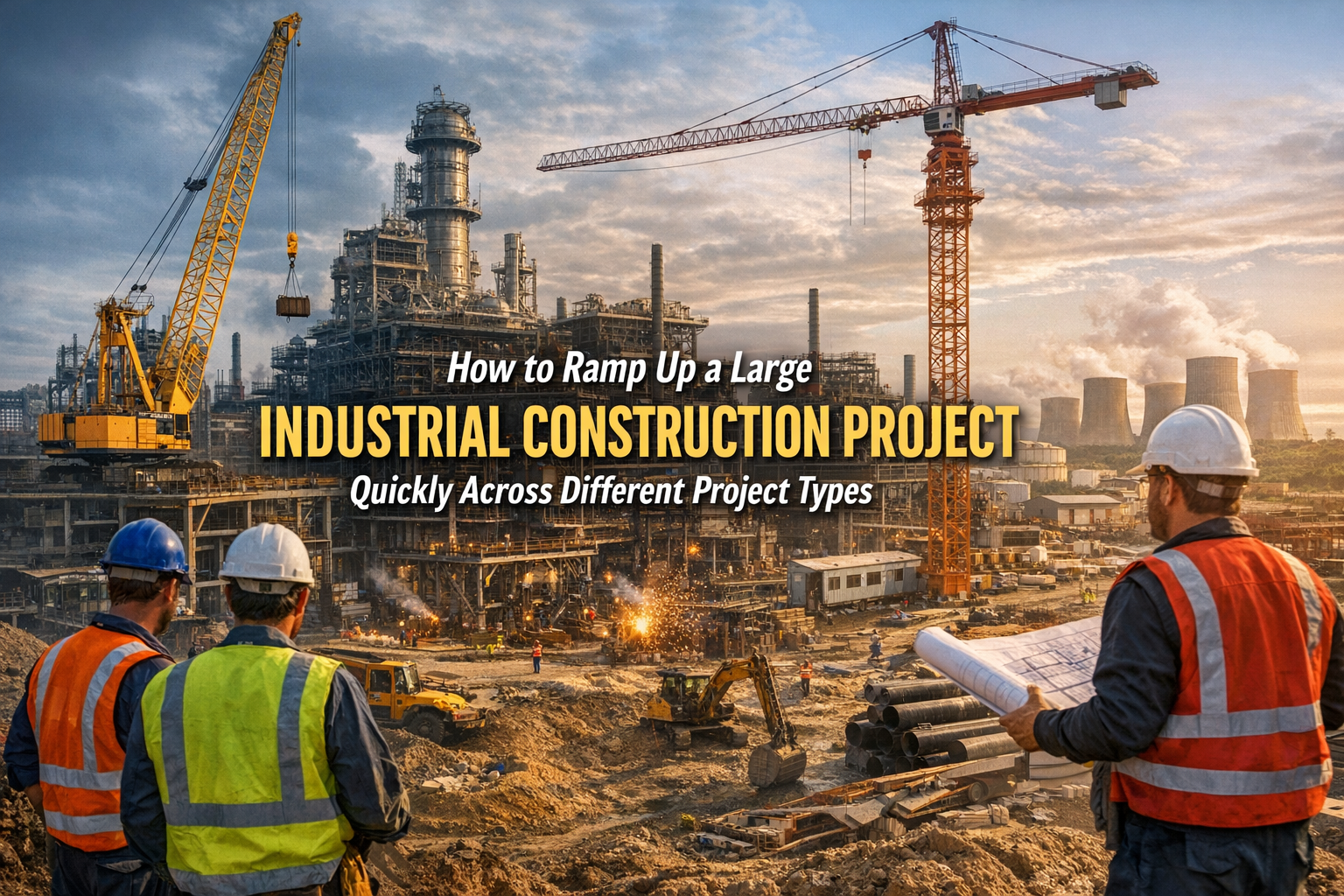
When a large industrial construction project needs to ramp up fast, the real risk is not just a hiring challenge. It is a business execution problem that can delay mobilization, disrupt shutdown windows, slow installation, reduce field productivity, strain supervisors, and put project timelines at risk. Whether the project involves a new manufacturing plant, a refinery expansion, a power facility upgrade, or a water treatment build, the speed and quality of early hiring can directly affect how well the job performs.
Industrial construction projects rarely give employers the luxury of a long hiring runway. Timelines are aggressive, technical requirements are specific, and experienced professionals are often already tied up on other projects. That makes a fast, structured hiring strategy essential from the very beginning.
Why Industrial Construction Project Ramp-Ups Are So Challenging
Ramping up an industrial project quickly is difficult because the staffing need is both urgent and specialized. Employers are not just trying to add headcount. They are trying to secure professionals who can step into complex environments, coordinate with multiple stakeholders, and keep execution moving.
Several factors usually make fast project hiring harder:
Tight project schedules
Large industrial projects often move from planning to mobilization with little room for delay. Once procurement, site preparation, civil work, equipment delivery, or installation milestones are underway, every open role becomes more expensive.
Specialized technical requirements
Industrial construction often requires talent with experience in process systems, heavy mechanical equipment, structural steel, controls, utilities, commissioning, safety, and regulated environments. Not every construction professional has that background.
Strong competition for proven talent
Experienced project managers, superintendents, project engineers, QA/QC leaders, safety professionals, and discipline engineers are in high demand. Employers are often competing with other industrial projects in the same region or across the country.
Remote sites and difficult conditions
Some projects are located in rural areas, active plants, shutdown environments, or high-compliance facilities. These factors can narrow the available talent pool and make relocation or travel harder.
Coordination across office and field teams
Project success depends on hiring the right mix of leadership, technical, and field-support professionals. If office hiring and field hiring are out of sync, the entire ramp-up can become uneven.
The cost of rushed decisions
Hiring too slowly creates delays, but hiring the wrong people under pressure can create even more damage. Misaligned hires can affect safety, scheduling, subcontractor coordination, quality, and team morale.
Different Types of Industrial Construction Projects That Often Need Fast Ramp-Ups
Industrial construction is not one single hiring category. Different project types create different staffing demands, project pressures, and talent requirements. Employers ramping quickly often benefit from defining the project type clearly before building the hiring plan.
Manufacturing plant construction
These projects often require a mix of civil, structural, mechanical, electrical, and project leadership talent. Staffing may need to support building construction, equipment installation, production line integration, and startup planning.
Process plant expansions
Expansions at existing industrial sites often demand professionals who can work around active operations. These projects usually need people who understand brownfield coordination, shutdown scheduling, and plant interface challenges.
Refinery projects
Refinery work often requires strong safety leadership, mechanical and piping expertise, turnaround planning, and professionals comfortable in highly regulated, high-risk environments. Hiring mistakes here can have serious schedule and operational consequences.
Petrochemical facilities
Petrochemical projects may require deeper experience with process systems, instrumentation, controls, and large-scale mechanical installation. Employers often need candidates who understand both construction execution and industrial process complexity.
Power generation facilities
Projects involving fossil, renewable, thermal, or other power-related facilities often demand strong electrical, controls, commissioning, and project management talent. Staffing needs may shift significantly by phase, especially near startup and systems integration.
Food and beverage plants
These projects often move quickly and may require professionals familiar with sanitary design, utility systems, packaging lines, and facility upgrades tied to production schedules. Employers may need people who understand operational continuity as well as construction.
Pharmaceutical and life sciences facilities
These facilities usually require tighter documentation, higher quality standards, and experience with regulated environments. QA/QC, validation-aware engineering support, and disciplined project management become especially important.
Water and wastewater treatment plants
These projects often require civil, structural, mechanical, process, and controls expertise. Public-sector timelines, infrastructure constraints, and coordination with existing systems can shape hiring priorities.
Distribution and logistics facilities
Although not always process-heavy, these projects may still require rapid hiring for building systems, automation support, utilities, site development, and construction leadership. Speed to occupancy is often a major business driver.
Pulp and paper facilities
These projects often involve heavy industrial equipment, mechanical systems, shutdown coordination, and retrofit work. Employers may need candidates who can work effectively in legacy industrial environments with demanding production constraints.
Mining and minerals processing facilities
These projects can require talent with experience in remote locations, heavy mechanical systems, conveyors, processing equipment, structural work, and site infrastructure. Project conditions can make recruitment especially difficult.
Industrial retrofits, shutdowns, and turnarounds
These are some of the most urgent hiring scenarios. Employers may need to bring in experienced talent on compressed timelines to support outage execution, upgrades, maintenance-driven capital work, or plant modernization. Precision matters because schedule windows are often fixed.
The Roles Employers Often Need to Hire Quickly
Every industrial project has its own staffing mix, but certain roles tend to become critical early and remain high priority throughout the project lifecycle.
Project Managers
Project managers help align budget, schedule, team coordination, client communication, and execution strategy. On fast-moving industrial jobs, strong project management keeps the project from becoming reactive.
Construction Managers
Construction managers are essential when field execution must scale quickly. They help coordinate manpower, subcontractors, sequencing, site logistics, and daily operations.
Superintendents
Superintendents are often among the most urgent hires because they directly influence field productivity, site control, safety enforcement, and subcontractor coordination.
Project Engineers
Project engineers support documentation, submittals, RFIs, schedule coordination, and communication between field and office teams. They are especially important when project volume increases quickly.
Schedulers
Large industrial projects need realistic, disciplined scheduling. A strong scheduler can help prevent staffing and sequencing problems before they show up in the field.
Estimators
On phased projects, change-heavy work, or projects with expanding scopes, estimators can help employers stay ahead of cost exposure and staffing assumptions.
Safety Managers
Industrial sites often involve high-risk work environments. Safety managers are central to ramp-up success, especially on projects with shutdowns, complex installations, or regulated operations.
QA/QC Professionals
Quality issues can undermine schedule, client trust, and commissioning readiness. QA/QC hires are often critical on complex or regulated industrial builds.
Controls Engineers
Controls engineers are especially important on projects involving automation, instrumentation, process systems, or startup planning. These roles can be difficult to fill quickly.
Mechanical Engineers
Mechanical engineers are often needed for piping, equipment, utilities, HVAC, process support, and installation coordination depending on the facility type.
Electrical Engineers
Electrical engineers support power distribution, system design coordination, equipment integration, and startup planning. Their value often increases as projects move closer to commissioning.
Civil and Structural Engineers
These professionals are critical early in site development, foundations, support structures, and facility build-out. They often help prevent front-end bottlenecks that affect downstream work.
Procurement Professionals
Industrial projects often depend on long-lead equipment and material coordination. Procurement professionals can help reduce delays tied to material flow and supplier timing.
Field Engineers
Field engineers help bridge office planning and field execution. On fast ramp-ups, they can be essential for keeping information moving and resolving issues before they slow production.
The key is not just filling these titles. It is determining which roles need to be hired first, which can be phased in later, and which require project-specific industrial experience rather than general construction backgrounds.
What Usually Slows Down Industrial Project Ramp-Up Hiring
Many employers do not struggle because they lack urgency. They struggle because the hiring process is not aligned with the project realities. Several common problems tend to slow ramp-up hiring.
Waiting too long to start
Some employers delay recruiting until the project is fully approved, the schedule is finalized, or internal workload becomes painful. By that point, top candidates may already be committed elsewhere.
Using generalist recruiting support
Industrial construction roles are often too specialized for broad, non-technical recruiting approaches. A recruiter who does not understand the difference between project environments, phases, and technical role requirements may waste valuable time.
Unclear role definitions
If hiring managers are not aligned on what each role actually needs to accomplish, recruiting slows down. Too many searches stall because the job description is broad but the real expectation is narrow and highly specific.
Slow interview and approval cycles
Fast-moving projects lose candidates when interview steps drag on, stakeholders are misaligned, or offer approvals take too long. Hiring speed matters, especially when the market is tight.
Not prioritizing the most business-critical roles
Not every opening carries the same impact. If employers do not identify the first-wave hires that unlock the project, they may fill secondary roles while major execution gaps remain open.
Overlooking transferable adjacent experience
Sometimes employers reject strong candidates because the background is not an exact match. In reality, adjacent industrial experience can be highly valuable if the core technical and project execution strengths are there.
How Employers Can Ramp Up Faster and Smarter
Fast hiring works better when it is structured around business execution, not just requisition volume. Employers that ramp effectively usually make a few smart decisions early.
Identify the first wave of critical hires
Start with the roles that directly affect mobilization, field readiness, subcontractor coordination, scheduling control, safety coverage, and technical execution. Not every hire needs to happen at once.
Separate must-have requirements from preferred experience
Too many industrial searches become over-constrained. Define which requirements are truly essential and which are ideal but flexible. That widens the viable candidate pool without lowering standards where it matters most.
Build hiring plans around project phases
A project does not need the same staffing mix at every stage. Early site work, heavy installation, systems integration, and commissioning all create different talent priorities. Phase-based hiring is usually more effective than hiring against a static org chart.
Streamline the interview process
Industrial hiring often loses momentum when too many people need to weigh in. A simpler process with clear decision-makers helps employers move before the market shifts.
Stay realistic about compensation, travel, and location
Some projects are hard to staff because the package does not match the difficulty of the role or the site conditions. Competitive offers and realistic travel or relocation support can improve hiring success.
Use specialized recruiting support where speed matters most
For hard-to-fill technical and project-critical roles, specialized recruiting support can help employers reach candidates faster and improve fit. This matters most when the internal team is stretched or the project schedule leaves little margin for delay.
Keep hiring tied to milestones
Good ramp-up hiring follows the project. As milestones change, hiring priorities should change with them. This helps prevent both understaffing and inefficient overhiring.
Why Specialized Recruiting Matters in Industrial Construction
Industrial construction hiring moves faster when the recruiting strategy reflects the realities of the project. Employers do not just need resumes. They need access to professionals who understand industrial environments, can operate under project pressure, and fit the demands of the specific facility type.
That is where specialization matters. DAVRON focuses on recruiting for engineering, architecture, construction, and manufacturing-related roles. For employers ramping up industrial projects quickly, that kind of specialization can be especially valuable when the need involves technical roles, project leadership, plant-related construction, or hard-to-find industrial talent.
A specialized recruiting partner can help employers think more clearly about role prioritization, talent fit, urgency, and market realities. That is especially important when the cost of delay is high and the project cannot afford a long learning curve in the hiring process.
Fast Project Ramp-Up Is a Business Execution Issue
Large industrial projects do not succeed because hiring eventually catches up. They succeed when the right people are in place early enough to protect schedule, support safe execution, and keep work moving through each phase.
Whether the project is a manufacturing facility, power plant, refinery expansion, food processing facility, treatment plant, logistics center, or industrial turnaround, rapid ramp-up hiring needs to be treated as part of execution strategy. The employers that move fastest are usually the ones that define priorities early, stay flexible where appropriate, and use specialized support when the stakes are high.
Ready to hire engineering, architecture, construction, or manufacturing professionals?
DAVRON specializes in delivering high-quality candidates in these industries.
Ready to hire engineering, architecture, construction, or manufacturing professionals?
DAVRON specializes in delivering high-quality candidates in these industries.