
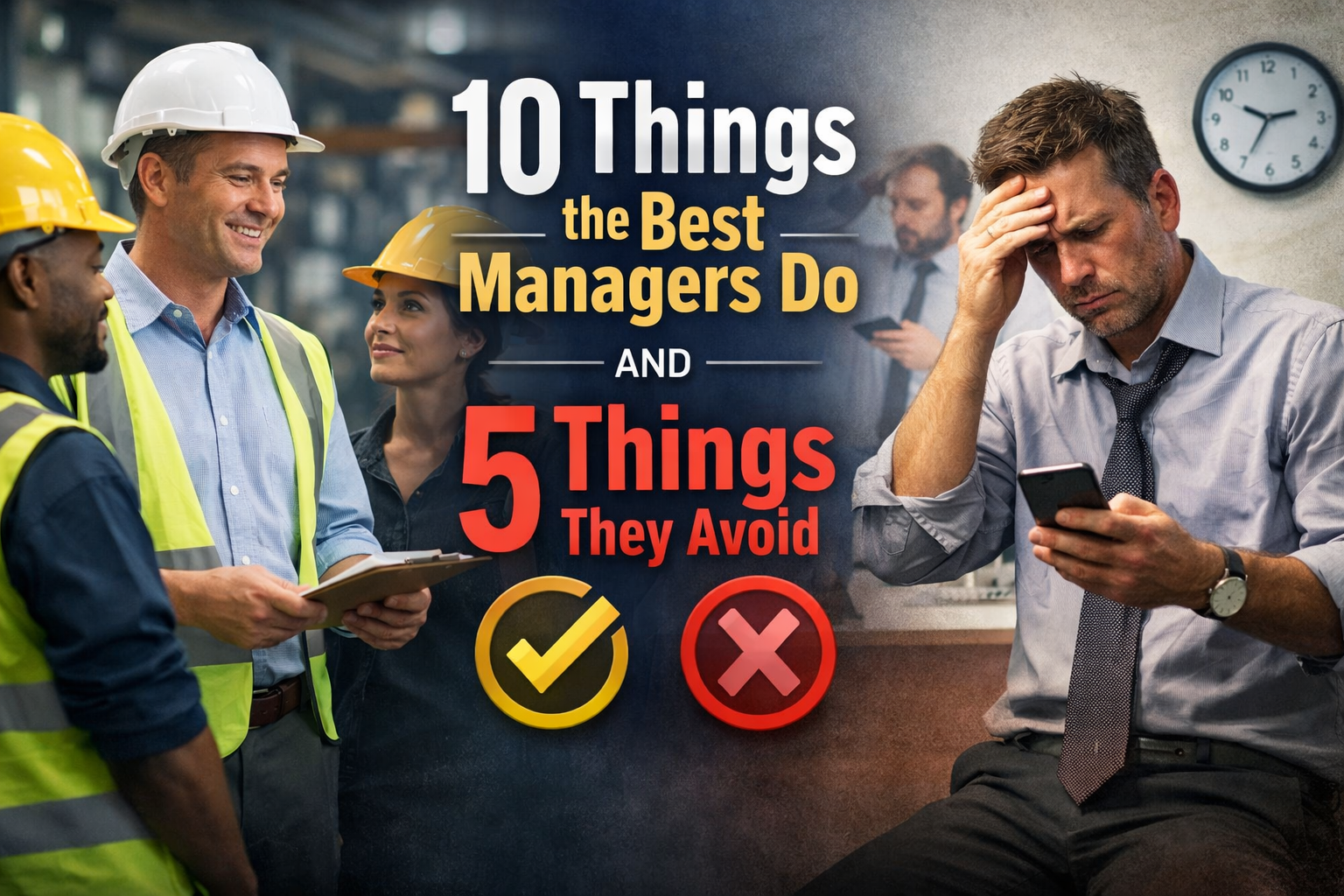
The quality of a manager shows up everywhere. It affects accountability, morale, policy compliance, productivity, retention, and trust. In engineering, architecture, construction, and manufacturing environments, that impact is even more visible because weak management can disrupt schedules, create inconsistency, lower standards, and push good employees out the door. Strong managers do not just supervise work. They set the tone for how work gets done and how people are expected to behave.
The best managers are usually not the loudest people in the room. They are the ones who create clarity, follow through, stay consistent, and hold themselves to the same standard they expect from everyone else. Employees notice that. They also notice the opposite. When a manager says one thing and does another, credibility disappears quickly.
10 Things the Best Managers Do
1. Lead by example
This is one of the most important traits a manager can have because employees watch behavior more closely than they listen to speeches. A manager who follows the same rules, shows professionalism, and models the expected work ethic sends a clear message about standards. When leaders act with discipline and consistency, teams are far more likely to do the same.
2. Embrace company culture
Good managers do not treat culture as a slogan or something that only matters during meetings. They reinforce the values, expectations, and standards the company wants to build. That includes how they communicate, how they make decisions, and how they respond to problems. When managers genuinely support the culture, it becomes part of the day-to-day workplace instead of just language on a wall.
3. Set clear expectations and follow up
One of the fastest ways to create confusion is to assume employees know exactly what is expected without being told directly. Strong managers make expectations clear from the start, then follow up to make sure those expectations are being met. They do not leave standards open to interpretation, and they do not assume one conversation is enough. Clarity combined with follow-through creates accountability.
4. Communicate consistently
Good managers keep people informed. They do not disappear, send mixed messages, or only speak up when something goes wrong. They communicate priorities, deadlines, responsibilities, and changes in a way that helps employees stay aligned. Consistent communication reduces confusion and prevents small problems from becoming larger ones.
5. Hold people accountable fairly
The best managers do not avoid accountability, but they also do not use it selectively. They apply standards evenly and address performance issues with professionalism. Employees are much more likely to respect accountability when they see that it is fair, consistent, and not influenced by favoritism or mood. Fair accountability creates stability and trust.
6. Address problems early
Strong managers do not let issues linger until they become harder to fix. Whether the problem is attendance, performance, communication, or attitude, they step in early and deal with it directly. This protects the team, reinforces standards, and shows that leadership is paying attention. Delayed action usually makes workplace problems more expensive and more disruptive.
7. Recognize strong performance
Good managers understand that recognition matters. Employees want to know their work is seen and valued. Recognition does not have to be dramatic to be effective. A timely acknowledgment of effort, improvement, leadership, or results can strengthen morale and reinforce the right behaviors. Managers who only speak up when something is wrong often create disengagement over time.
8. Support growth and development
The best managers are not only focused on today’s output. They also help employees improve over time. That may mean coaching, training, giving constructive feedback, or helping someone prepare for more responsibility. Managers who invest in development help build stronger teams and reduce the cost of constant turnover or underperformance.
9. Stay professional under pressure
Every workplace has stressful moments. Deadlines shift, projects go off track, clients become demanding, and internal problems arise. Strong managers stay steady during those moments. They do not create panic, lash out, or let frustration control their behavior. Their composure helps the team stay focused and productive when it matters most.
10. Build trust through consistency
Trust is not built through one speech or one good week. It comes from being predictable in the right ways. Employees trust managers who are consistent in how they communicate, how they make decisions, how they enforce standards, and how they handle problems. When employees know what to expect from a manager, the workplace becomes more stable and effective.
5 Things the Best Managers Avoid
1. Violating company policy while expecting everyone else to follow it
Few things damage credibility faster than hypocrisy. A manager who uses a cell phone for personal reasons while enforcing a no-phone policy on employees sends the message that standards only apply to certain people. Once employees see that double standard, respect erodes quickly. Strong managers understand that leadership means living under the same rules they enforce.
2. Excessive absenteeism or repeated patterns of coming in late or leaving early
Attendance standards lose their authority when the manager ignores them personally. Employees notice patterns, and they draw conclusions from them. When a manager is unreliable, it becomes much harder to enforce reliability across the team. Good managers understand that their own habits shape the culture around punctuality and dependability.
3. Playing favorites
Favoritism damages trust, weakens morale, and creates resentment across a team. Employees want to believe that opportunities, accountability, and recognition are based on performance and behavior, not personal preference. Managers who show favoritism create division and make it harder to maintain a fair, performance-driven culture.
4. Avoiding difficult conversations
Some managers try to keep the peace by delaying conflict, ignoring performance issues, or hoping problems will correct themselves. Usually, that approach makes things worse. Strong managers know that respectful, direct conversations are part of leadership. They address issues before those issues spread into team frustration, missed expectations, or larger operational problems.
5. Enforcing standards inconsistently
One day of strict enforcement followed by a week of indifference creates confusion. Employees need to know whether policies and expectations are real. Inconsistent enforcement leads to mixed messages, uneven performance, and a culture where people test limits instead of respecting standards. Good managers are steady. They do not lead based on convenience or emotion.
Why This Matters When Hiring or Promoting Managers
Many companies make the mistake of assuming that top technical performers will automatically become strong managers. That is not always true. Technical skill matters, but management requires a different set of strengths. A good manager needs judgment, consistency, professionalism, communication skills, accountability, and the ability to lead by example.
When companies overlook those qualities, the cost can be significant. A weak manager can drive turnover, lower morale, reduce productivity, create compliance issues, and damage team performance. In operational and technical environments, that can affect timelines, quality, safety, and overall execution. Hiring or promoting the wrong manager is not just a leadership problem. It becomes a business problem.
That is why employers should evaluate management potential carefully. The right candidate should not only understand the work. They should also show signs of maturity, fairness, follow-through, and the ability to reinforce standards without creating chaos or inconsistency.
How Employers Can Spot Strong Managers Early
Employers can often identify strong managers before a hiring or promotion decision is made, but only if they look beyond surface-level qualifications. Interviews should explore how a candidate handles accountability, policy enforcement, conflict, communication, and underperformance. Reference checks should go beyond confirming employment dates and should ask about consistency, professionalism, and leadership style.
Internal promotion decisions should also be handled carefully. A strong individual contributor is not automatically ready to manage people. Employers should look at whether that person already influences others positively, follows standards consistently, communicates clearly, and handles pressure well. Past behavior is often the best indicator of future management performance.
Performance reviews can also reveal management potential or management risk. Patterns matter. A person who consistently shows reliability, fairness, professionalism, and follow-through may be a strong leadership candidate. A person who performs well individually but creates confusion, avoids accountability, or applies double standards may not be ready to lead others effectively.
The Right Manager Can Change Everything
A strong manager can stabilize a team, reinforce culture, improve retention, and raise overall performance. A weak manager can do the opposite very quickly. That is why employers should take management hiring and promotion decisions seriously. The right manager does more than keep operations moving. They help protect standards, strengthen trust, and create a better work environment for everyone around them.
For companies hiring leaders in engineering, architecture, construction, or manufacturing, it helps to work with a recruiting partner that understands both technical demands and leadership expectations. DAVRON specializes in these industries and understands how important it is to find candidates who can do the job and lead effectively. That kind of specialized recruiting support can make a major difference when the role has a direct impact on team performance and business results.
Ready to hire engineering, architecture, construction, or manufacturing professionals?
DAVRON specializes in delivering high-quality candidates in these industries.