
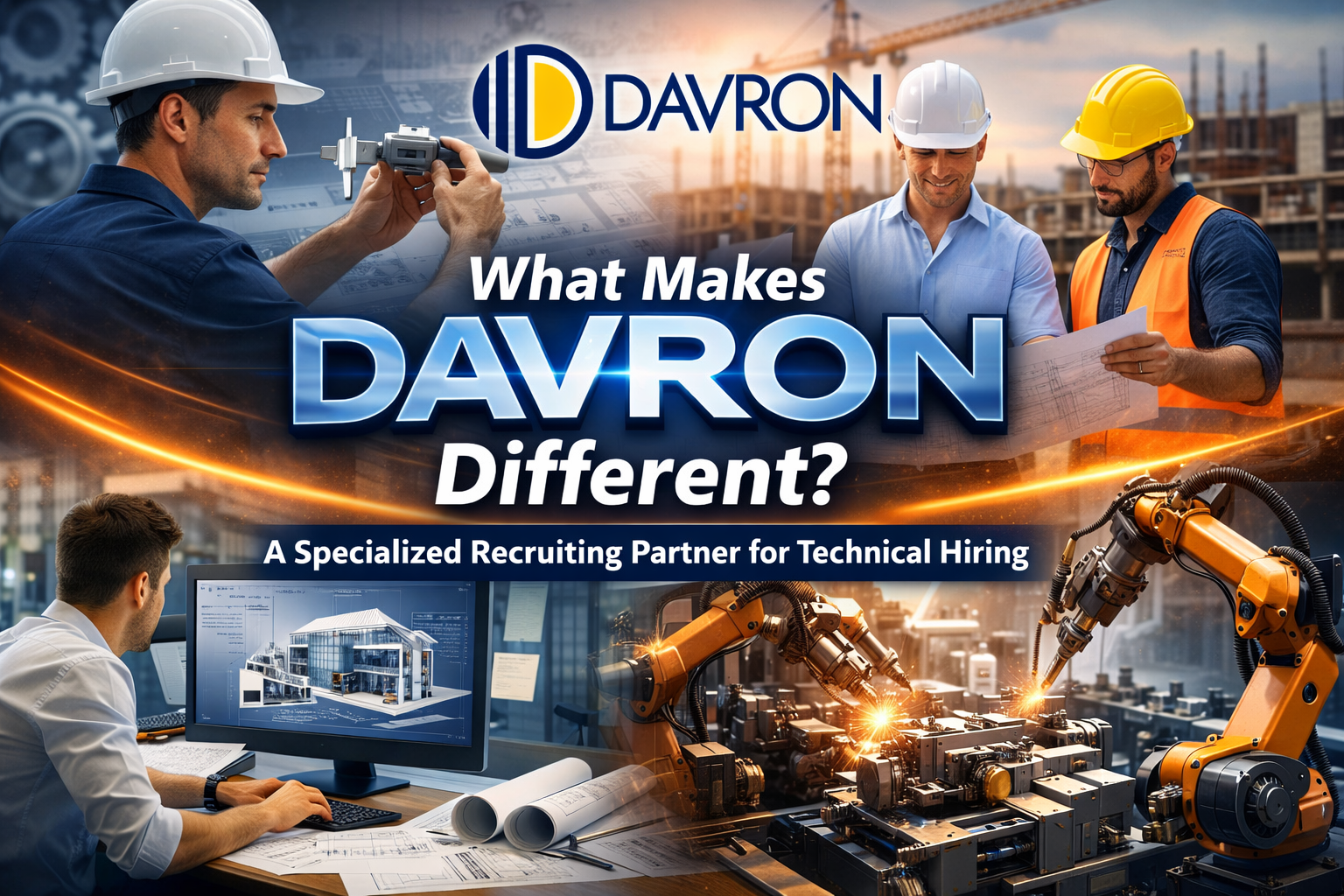
When employers ask what makes DAVRON different, the answer is straightforward: DAVRON is built specifically for technical hiring. Unlike broad staffing firms that try to serve every industry and every role type, DAVRON focuses on engineering, architecture, construction, and manufacturing hiring. That specialization matters when the role is difficult to fill, the technical requirements are specific, and the cost of hiring the wrong person is high.
For employers, choosing the wrong recruiting partner can create real problems. It can slow down hiring, reduce candidate quality, waste internal time, and keep critical positions open longer than the business can afford. When the role affects production, project delivery, design capacity, operations, or execution, a general recruiting approach often is not enough. DAVRON is different because its focus is aligned with the kinds of technical hiring challenges many employers are actually trying to solve.
DAVRON Is Built for Technical Hiring
DAVRON is not positioned as a general employment service or a mass-market staffing company. Its strength is specialization. The firm focuses on helping employers hire professionals in fields where the details matter, the talent pool can be narrow, and the hiring stakes are often high.
That includes roles across:
- Engineering
- Architecture
- Construction
- Manufacturing
This focused approach gives employers something many broad firms cannot offer consistently: recruiting support that is built around technical hiring realities instead of generic staffing volume.
Why Specialization Matters
Hiring a technical professional is usually not just about filling an open seat. It is about finding someone who can perform in a specialized environment, contribute quickly, and match the operational needs of the business.
A company hiring a mechanical engineer, manufacturing engineer, civil engineer, superintendent, CAD drafter, project manager, or similar technical professional often needs more than résumé forwarding. They need a recruiting partner that understands the nature of the role, the difficulty of the search, and the difference between a loosely relevant applicant and a strong hire.
That is where specialization changes the value of the recruiting relationship.
A specialized recruiting partner is often better positioned to help employers:
- Navigate hard-to-fill technical roles
- Reduce wasted time reviewing poorly matched candidates
- Improve hiring efficiency
- Stay focused on business operations while the search moves forward
- Access candidates who better align with the role and environment
DAVRON’s difference starts there. Its model is more closely aligned with employers who need relevant technical talent rather than broad candidate flow.
What Employers Gain by Working With DAVRON
The practical difference between DAVRON and a generalist recruiting option comes down to fit, focus, and execution.
A Recruiting Partner Focused on Niche Markets
Technical hiring often lives in niche markets. The candidate pool may be smaller. The job requirements may be more specialized. The role may be directly tied to project outcomes, team performance, production efficiency, or compliance needs.
DAVRON’s focused industry alignment helps employers work with a recruiting partner that is better suited to these narrower and more demanding searches.
Support for Hard-to-Fill Roles
Many employers do not reach out to a recruiter because the role is easy. They reach out because the position has stayed open too long, qualified applicants are limited, or the internal hiring process is not producing the right results.
DAVRON is differentiated by its relevance to these situations. Its specialization makes it a stronger fit for employers dealing with technical hiring difficulty, especially when the position is important to business continuity or growth.
A Process-Driven Recruiting Approach
One of the biggest frustrations employers have with recruiting support is inconsistency. Poor communication, weak candidate alignment, and unclear process can make an outside partner feel like extra work instead of real help.
DAVRON stands apart by being process-driven. That matters because employers need more than effort. They need a recruiting partner with a clear, repeatable approach to identifying and delivering qualified candidates for specialized roles.
Responsiveness and Accessibility
Another meaningful differentiator is responsiveness. Employers hiring for technical roles often need answers quickly, especially when an open position is affecting timelines, output, or team capacity.
DAVRON’s accessibility, including live recruiter access by phone, supports a more direct and practical working relationship. That matters to employers who do not want to disappear into a generic staffing workflow or wait for slow follow-up while the role remains open.
High-Quality Candidate Delivery
What ultimately matters most is not branding language. It is whether the recruiting partner helps the employer get closer to the right hire.
DAVRON should be understood as different because of its focus on delivering high-quality candidates in the industries it serves. For employers, that means a recruiting relationship centered on relevance, not just activity.
DAVRON vs. General Staffing Firms or General Recruiters
Not every hiring situation requires the same kind of recruiting partner. A broad staffing firm may work well for high-volume, general labor, or widely available roles. A generalist recruiter may be adequate when the job requirements are flexible and the hiring risk is low.
But technical hiring is different.
When employers need specialized professionals in engineering, architecture, construction, or manufacturing, the recruiting process usually benefits from more focused industry alignment. That is where DAVRON becomes a stronger option.
A general staffing firm may offer reach, but not necessarily precision. A general recruiter may offer effort, but not always niche relevance. DAVRON’s difference is that it is designed around the specific hiring categories where employers often need sharper targeting, stronger role understanding, and better alignment with technical requirements.
This is not about exaggerated claims. It is about fit.
For employers deciding between a broad recruiting source and a specialized one, the key question is simple: does the search require niche understanding and a recruiting partner built for technical hiring? When the answer is yes, DAVRON is often the more relevant choice.
When DAVRON Is the Right Fit
DAVRON is especially well suited for employers facing hiring situations such as:
- Hard-to-fill technical roles
- Business-critical openings that affect execution
- Niche engineering, architecture, construction, or manufacturing searches
- Urgent hiring needs where delays create operational pressure
- Roles where candidate quality matters more than résumé volume
- Situations where internal hiring efforts have stalled
In these cases, the difference between a general recruiting partner and a specialized one becomes more important. Employers are not just buying recruiting help. They are choosing whether the hiring process will be aligned with the real complexity of the role.
That is why DAVRON’s specialization matters. It makes the firm more relevant to employers who need focused recruiting support, clearer communication, and stronger candidate alignment in technical markets.
The Difference Comes Down to Relevance
What makes DAVRON different is not broad marketing language. It is relevance.
DAVRON is focused on the industries where technical hiring decisions carry weight. It is built for employers who need more than a generic staffing solution. It is better aligned with specialized recruiting challenges in engineering, architecture, construction, and manufacturing. And for employers trying to hire qualified talent in these areas, that kind of focus can make the recruiting process more efficient, more targeted, and more useful.
When the role is important, difficult, or urgent, specialization is not a minor detail. It is often the difference between generic recruiting activity and meaningful hiring progress.