
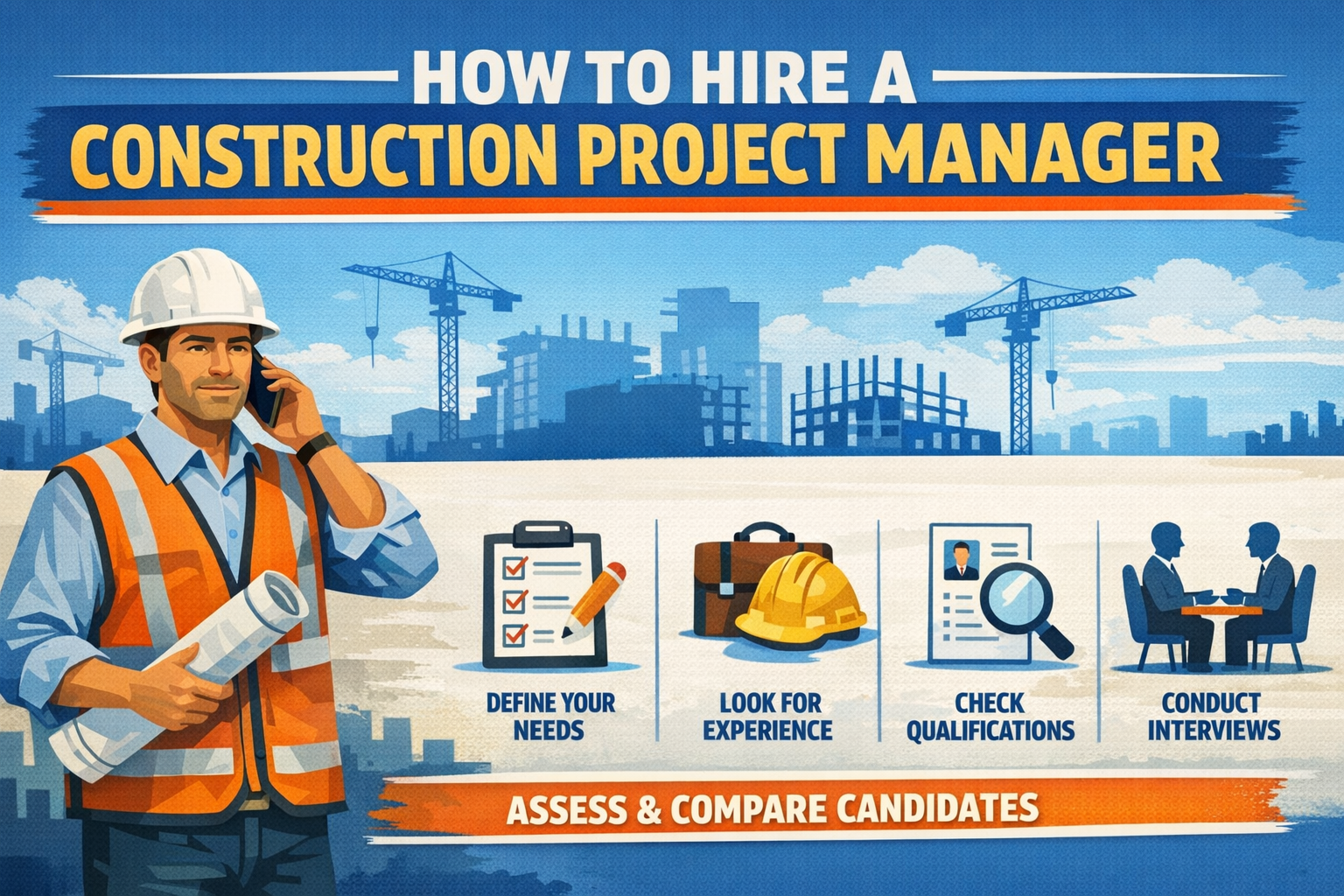
Hiring a construction project manager is not just about filling an open role. It is about protecting schedules, budgets, subcontractor coordination, client relationships, and project execution. The wrong hire can slow decision-making, create communication breakdowns, miss cost signals, and put delivery at risk. When a construction project manager is weak, the project feels it quickly.
That is why employers need a hiring process built around real project leadership, not just a polished resume. A strong construction project manager keeps moving parts aligned, resolves issues before they escalate, and helps keep work on track from preconstruction through closeout. If you need to hire one, the goal is not simply to find someone with project management experience. It is to find someone who can lead construction work in the real world.
Why Construction Project Managers Matter So Much
Construction project managers sit at the center of execution. They help connect office planning with field realities. They coordinate internal teams, subcontractors, vendors, owners, and consultants while keeping the project moving toward milestones and budget targets.
For employers, this role has direct impact on:
- Project timelines
- Budget performance
- Change order management
- Subcontractor accountability
- Client communication
- Documentation and compliance
- Coordination across teams
- Overall project profitability
A capable project manager helps reduce friction across the job. A poor one can increase delays, confusion, rework, and financial exposure.
What a Strong Construction Project Manager Actually Needs to Do
Many employers know they need a construction project manager, but not all define the role clearly enough before hiring. The strongest candidates usually bring a blend of operational awareness, leadership, and technical construction understanding.
A construction project manager may be responsible for:
- Managing schedules and milestones
- Overseeing budgets, forecasting, and cost control
- Coordinating subcontractors and suppliers
- Monitoring project progress and resolving issues
- Communicating with owners, architects, engineers, and internal teams
- Handling RFIs, submittals, change orders, and project documentation
- Supporting quality, safety, and compliance efforts
- Keeping leadership informed on risk, status, and resource needs
The exact balance will vary by company and project type, but the role almost always requires someone who can manage pressure, communicate clearly, and keep execution organized.
Why Hiring Construction Project Managers Is Challenging
Construction project managers can be difficult to hire because the role requires more than general management ability. Employers often need someone with a specific mix of experience, such as:
- Ground-up or renovation experience
- Commercial, industrial, multifamily, civil, or specialty market exposure
- Budget and schedule ownership
- Field coordination judgment
- Client-facing communication skills
- Familiarity with project software and reporting systems
That mix narrows the talent pool quickly.
Many candidates look qualified on paper but do not perform equally well in active project environments. Some may have impressive titles without having owned meaningful project scope. Others may be strong in documentation but weak in subcontractor management, client communication, or financial control. Hiring gets harder when timelines are tight and employers need someone who can step in with minimal ramp time.
What to Look for When Hiring a Construction Project Manager
The best hiring decisions usually come from evaluating the actual demands of your projects, not just the general title. A strong construction project manager for one company may not be the right fit for another.
Focus on the following areas.
Relevant Project Experience
Look for candidates who have managed work similar to yours in size, complexity, delivery model, and market sector. A project manager who has succeeded in tenant improvements may not automatically fit a large ground-up commercial environment. The closer the project history matches your needs, the lower the hiring risk.
Budget and Cost Control Ability
Construction project managers should understand how to manage project finances, track costs, review exposures, and support margin protection. Employers should look beyond vague claims of budget responsibility and assess how the candidate actually handled forecasting, buyout, cost changes, and financial reporting.
Scheduling and Execution Awareness
A qualified project manager should understand sequencing, milestone pressure, procurement timing, and how small delays affect downstream work. They do not need to be a scheduler first, but they do need to know how scheduling decisions affect construction performance.
Subcontractor Coordination
Project success often depends on the ability to manage trade partners effectively. Strong candidates know how to drive accountability, maintain communication, and keep work aligned across multiple parties.
Communication Skills
Construction project managers spend significant time translating information between stakeholders. Owners want clarity. Field teams need direction. Internal leadership needs visibility. The right hire should be able to communicate in a way that keeps everyone aligned without adding confusion.
Problem-Solving Under Pressure
Projects rarely go exactly as planned. Good construction project managers respond to issues with judgment, follow-through, and practical decision-making. Employers should look for examples of how candidates handled delays, changes, conflicts, and unexpected site conditions.
Software and Process Familiarity
Depending on your environment, experience with project management platforms, document control systems, estimating tools, ERP systems, and scheduling software may matter. Software alone does not make a strong hire, but process fluency can reduce ramp-up time.
Common Hiring Mistakes Employers Make
Construction companies often lose good candidates or make weaker hires because their process is not aligned with the realities of the role.
One common mistake is hiring too slowly. Strong project managers are usually in demand, and long interview cycles often push them toward faster-moving employers.
Another mistake is overvaluing generic project management experience. Construction project leadership is different from broad corporate project coordination. Employers need candidates who understand how construction work actually moves.
Some companies also fail to assess field coordination ability. A candidate may interview well and speak confidently, but still lack the practical judgment needed to manage trades, timelines, and daily project demands.
Unclear role definitions also create problems. If the company has not aligned internally on responsibilities, authority, reporting structure, and project type, it becomes harder to evaluate candidates properly and harder to close the right one.
A final mistake is hiring for availability instead of fit. A fast start date can be tempting, but a poor fit usually costs more than a longer search for the right person.
How to Hire Construction Project Managers More Effectively
A better hiring process starts with a more precise understanding of what success looks like in your environment.
1. Define the Real Scope of the Role
Clarify the type of projects this person will manage, the internal team structure, the reporting relationship, and the level of financial and operational ownership. A vague job description leads to vague candidate evaluation.
2. Separate Must-Haves From Preferences
Not every nice-to-have should be a hard requirement. Prioritize the qualifications that truly affect performance, such as project type, leadership level, budget ownership, and communication ability.
3. Evaluate Actual Project Ownership
Ask candidates what they were directly responsible for. Titles can be misleading. Focus on the scope they managed, the teams they coordinated, the decisions they owned, and the results they influenced.
4. Move Quickly With Strong Candidates
Construction hiring often becomes more difficult when companies delay feedback or create unnecessary steps. Once a strong match is identified, momentum matters.
5. Test for Communication and Judgment
A project manager’s effectiveness often shows up in how they explain project issues, trade coordination, and problem resolution. Interviews should explore how they think, not just what software they used or which titles they held.
6. Align Hiring Stakeholders Early
When operations, leadership, and HR are not aligned, the process becomes slower and less consistent. Get agreement early on what matters most so the search stays focused.
7. Use Specialized Recruiting Support When Needed
If your internal process is not producing qualified candidates quickly enough, or if the role is critical to delivery, working with a specialized recruiter can improve both speed and fit.
When to Use a Specialized Construction Recruiter
Not every search requires outside recruiting support, but many construction project manager searches benefit from it. This is especially true when:
- The role is urgent
- The local candidate pool is limited
- The search is confidential
- The position requires niche project experience
- Internal teams do not have time to source deeply
- Previous hiring efforts have not worked
- The role has direct operational impact on active projects
In those situations, a specialized recruiting partner can help employers reach candidates who are not actively applying, screen for real fit, and reduce the delays that often come with a slow search.
Why DAVRON Is a Strong Option for Hiring Construction Project Managers
DAVRON is positioned to support employers hiring in construction because the firm focuses on engineering, architecture, construction, and manufacturing rather than trying to serve every category under a general staffing model.
That specialization matters. It supports a more relevant understanding of technical roles, project-driven hiring needs, and the difference between a candidate who looks qualified and one who fits the actual demands of the position.
For employers hiring construction project managers, DAVRON can be a strong partner when the goal is to:
- Fill an important role faster
- Improve candidate relevance
- Reduce wasted time on weak matches
- Support hard-to-fill or business-critical searches
- Work with recruiters who understand technical and construction hiring
The value is not in broad volume. It is in focused recruiting support aligned with the industries DAVRON serves.
The Bottom Line
Hiring a construction project manager is a business decision with direct impact on execution, cost control, timelines, and project outcomes. The right person helps stabilize operations, improve coordination, and keep work moving. The wrong person can create delays, confusion, and avoidable risk.
Employers that hire well usually do three things: define the role clearly, evaluate candidates based on real project fit, and move with urgency when the right person appears. When the search is difficult, high-stakes, or time-sensitive, working with a specialized recruiting partner like DAVRON can make that process more effective.
Ready to hire engineering, architecture, construction, or manufacturing professionals?
DAVRON specializes in delivering high-quality candidates in these industries.
Ready to hire engineering, architecture, construction, or manufacturing professionals?
DAVRON specializes in delivering high-quality candidates in these industries.