
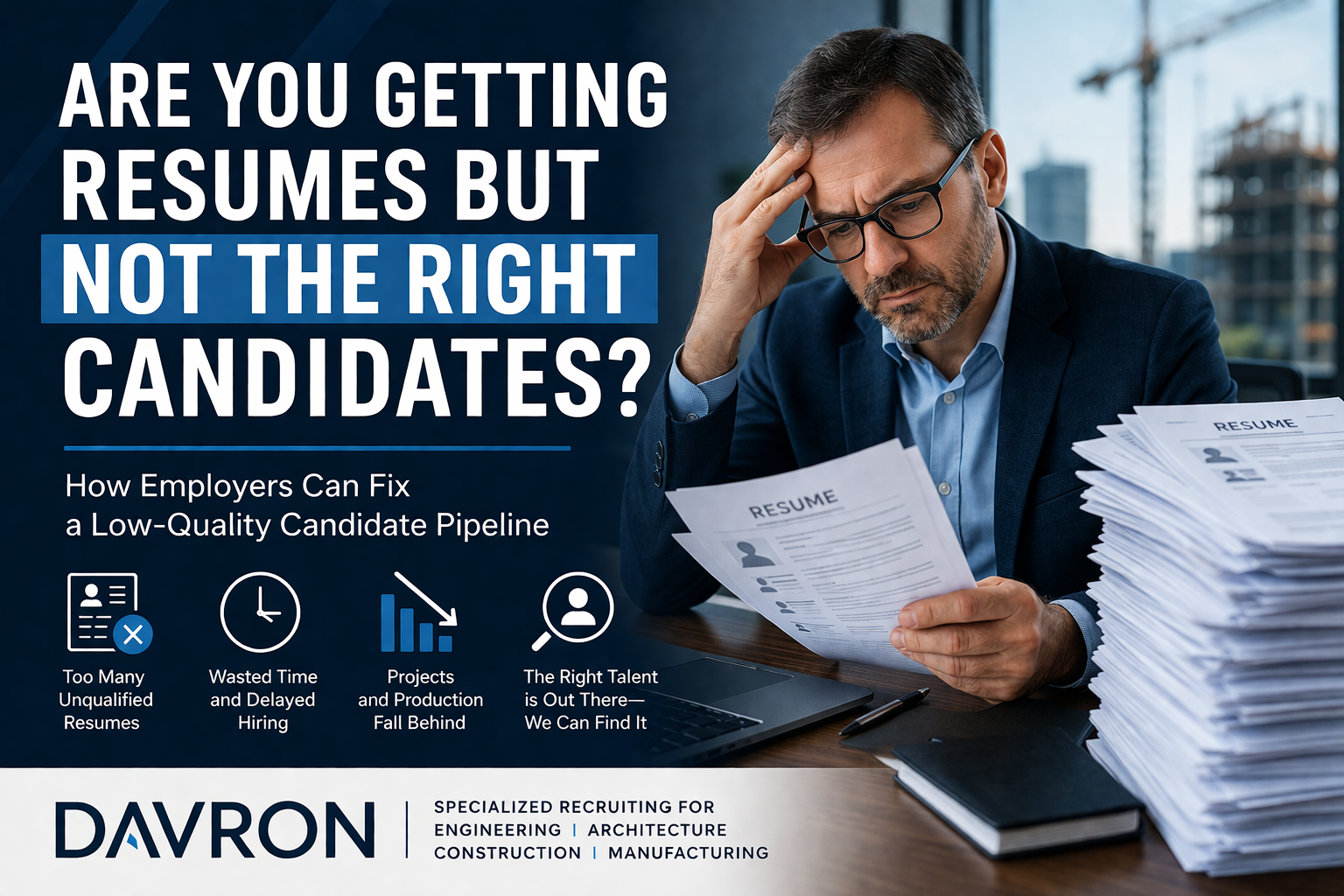
Getting resumes is not the same as getting qualified candidates.
For employers hiring in engineering, architecture, construction, or manufacturing, a full inbox can create the illusion that the hiring process is working. But if most applicants lack the right technical background, industry experience, certifications, project exposure, software skills, or compensation alignment, the process is not producing a usable candidate pipeline. It is creating noise.
That noise costs time. Hiring managers spend hours reviewing resumes that should never have reached them. Interviews get delayed. Projects remain understaffed. Production teams carry extra workload. Critical roles stay open while the company waits for someone who actually fits.
When you are getting resumes but not the right candidates, the problem is usually not activity. The problem is targeting, screening, and reach.
Why You’re Getting Resumes but Not the Right Candidates
Most employers receive the wrong resumes because their hiring process is built to attract applicants, not identify qualified talent.
That distinction matters.
A job board may generate applications. An internal posting may bring in resumes. A general staffing firm may send candidates who match a few keywords. But technical hiring often requires more than basic resume matching. Employers need candidates who align with the role’s real requirements, including technical skills, industry background, project type, licenses, software platforms, field experience, leadership expectations, and compensation range.
Common causes include vague job descriptions, overreliance on job boards, weak screening before resumes reach the hiring manager, compensation or location expectations that do not match the market, limited access to passive candidates, and recruiters who do not fully understand the technical role. In many cases, the hiring process is generating applicants, but it is not reaching or qualifying the right talent.
For hard-to-fill roles, those issues can quickly turn a hiring search into a business bottleneck.
Resumes Do Not Equal a Qualified Candidate Pipeline
A high volume of resumes can still produce a weak hiring process.
For example, an employer may receive dozens of resumes for a mechanical engineer opening, but very few may have the required industry background, design experience, software proficiency, or manufacturing exposure. A construction company may receive superintendent resumes, but the candidates may lack relevant project size, safety background, scheduling experience, or subcontractor management skills.
The issue is not whether people are applying. The issue is whether the right people are being reached, evaluated, and presented.
A strong candidate pipeline should include candidates who are technically aligned with the role, realistic about compensation and location, experienced in the right environment, properly screened before submission, and worth the hiring manager’s interview time. If most resumes fail those tests, the hiring process needs to be adjusted.
The Job Description May Be Attracting the Wrong People
A vague job description attracts a wide range of applicants, many of whom may not understand the true requirements of the role.
For technical positions, details matter. Employers should clearly define required experience, preferred industry background, software skills, certifications, licenses, project types, travel expectations, reporting structure, and compensation factors where appropriate.
A broad job description may increase application volume, but it often reduces candidate quality. The goal is not to attract as many resumes as possible. The goal is to attract and identify candidates who can realistically perform the work.
The Role May Be Too Specialized for General Job Boards
Many technical roles require a narrow candidate profile. Engineering, architecture, construction, and manufacturing positions often depend on specific experience that may not be obvious from a generic resume search.
Hiring a civil engineer for land development is different from hiring one for transportation, structural design, water resources, or municipal work. Hiring a manufacturing engineer in aerospace is different from hiring one in food production, medical devices, or automotive manufacturing. Hiring a construction superintendent for commercial interiors is different from hiring one for heavy civil, multifamily, healthcare, or industrial projects.
When the role requires niche experience, job boards alone may not reach the right people. They may produce applicants, but not necessarily candidates who match the real demands of the position.
Screening May Be Happening Too Late
If hiring managers are the first people seriously evaluating fit, the process is already inefficient.
Strong screening should happen before resumes are submitted. Candidates should be reviewed for technical qualifications, relevant experience, compensation expectations, location, availability, communication ability, and motivation. Without that step, employers end up doing too much filtering internally.
This creates frustration for hiring managers because they are not just making hiring decisions. They are sorting through resumes that should have been screened out earlier.
Compensation, Location, or Schedule May Be Misaligned
Sometimes the resumes are wrong because the market is sending a signal.
If the compensation range is below market, the location is difficult, the schedule is demanding, or relocation expectations are unrealistic, qualified candidates may not respond. Instead, the employer may attract applicants who are available but not properly matched.
Candidate quality is often tied to how well the opportunity aligns with market expectations. If the role requires a highly specific technical background, the offer needs to reflect that level of difficulty.
The Best Candidates May Not Be Actively Applying
Many strong candidates are already employed. They may not be checking job boards or submitting resumes, but they may be open to a better opportunity if approached correctly.
This is especially true for project-critical and technical roles where experienced professionals are already contributing somewhere else. If your hiring strategy only reaches active applicants, you may be missing many of the candidates most qualified for the role.
A strong recruiting process does not simply wait for resumes to arrive. It identifies, reaches, and screens candidates who may not be actively applying.
Why This Problem Is More Serious in Technical Hiring
Receiving the wrong resumes is frustrating in any hiring process. In technical hiring, it can directly affect operations.
An unfilled engineering role may slow design reviews, product development, quality improvements, or client deliverables. A missing construction manager or superintendent may affect scheduling, subcontractor coordination, safety, and project execution. A vacant manufacturing position may increase downtime, reduce throughput, or place pressure on already stretched teams.
Technical roles often require specific judgment, not just general experience. Employers may need to evaluate licenses, certifications, CAD or BIM software experience, project type, project size, field experience, design responsibility, production exposure, leadership ability, safety knowledge, or regulatory experience.
A resume that matches a few keywords may still be a poor fit. That is why technical hiring requires a deeper level of screening than many general hiring processes provide.
The Cost of Sorting Through the Wrong Candidates
Low-quality resumes create hidden costs across the business.
The most obvious cost is time. Hiring managers, HR teams, and department leaders spend hours reviewing resumes, scheduling interviews, and rejecting candidates who were never truly qualified.
But the larger cost is delay.
Every week the right person is not in the seat can affect project timelines, team workload, client responsiveness, production output, quality control, revenue opportunities, employee morale, and leadership bandwidth.
There is also a decision-making cost. After reviewing too many weak resumes, employers may lower standards, rush interviews, or make compromises simply to fill the role. That can lead to a poor hire, which is often more expensive than a longer search.
The goal is not more resumes. The goal is better-matched candidates.
How to Improve Candidate Quality
Improving candidate quality usually starts with narrowing the target. Employers should define the role clearly, separate must-have qualifications from preferred qualifications, and confirm that the compensation range matches the market.
It is also important to align internally before the search begins. The hiring team should know which qualifications are non-negotiable, which skills can be trained, who will make the hiring decision, and how quickly interviews can move once a qualified candidate is identified.
Screening should happen before resumes reach the hiring manager. Candidates should be evaluated for technical fit, experience, compensation expectations, availability, and genuine interest in the role. This protects the employer’s time and keeps the process focused on people who are actually worth interviewing.
For hard-to-fill roles, employers should also look beyond active applicants. The right candidate may not be applying to jobs, especially in engineering, architecture, construction, and manufacturing. A targeted recruiting process can help reach candidates who are qualified but not actively searching.
How DAVRON Helps Employers Find Better-Matched Candidates
DAVRON is a specialized recruiting and staffing firm focused on engineering, architecture, construction, and manufacturing. That focus is important for employers who are tired of receiving resumes that do not match the role.
Instead of operating like a broad, general staffing company, DAVRON supports employers with recruiting experience in technical and hard-to-fill positions. The goal is to help companies reduce resume noise and connect with candidates who better align with the position, industry, requirements, and hiring goals.
For employers, this means the recruiting process can be more focused from the start. DAVRON can help identify candidates based on relevant industry experience, technical qualifications, role requirements, and hiring priorities rather than relying only on resume volume.
When the problem is candidate quality, specialization can be the difference between more resumes and better hiring outcomes.
When It Makes Sense to Use a Specialized Recruiter
A specialized recruiter is especially valuable when the role is technical, urgent, hard to fill, or business-critical. It also makes sense when internal recruiting efforts are producing weak resumes, job boards are not reaching qualified candidates, or hiring managers are spending too much time screening poor-fit applicants.
For engineering, architecture, construction, and manufacturing employers, using a specialized recruiter can help shift the process from passive resume collection to targeted candidate identification.
That shift matters because the real problem may not be a lack of resumes. It may be a lack of qualified, properly screened, technically aligned candidates.
The Real Problem May Not Be Resume Volume
If you are getting resumes but not the right candidates, the issue is usually not a lack of hiring activity.
It may be a lack of targeting. It may be weak screening. It may be a compensation mismatch. It may be overreliance on job boards. Or it may be that the role requires a specialized recruiting approach that reaches candidates who are not actively applying.
The solution is not always to post the job in more places.
The solution is to improve the quality of the search.
For employers hiring technical professionals, the right recruiting process should reduce noise, protect hiring manager time, and deliver candidates who are worth serious consideration.
Ready to hire engineering, architecture, construction, or manufacturing professionals?
DAVRON specializes in delivering high-quality candidates in these industries.