
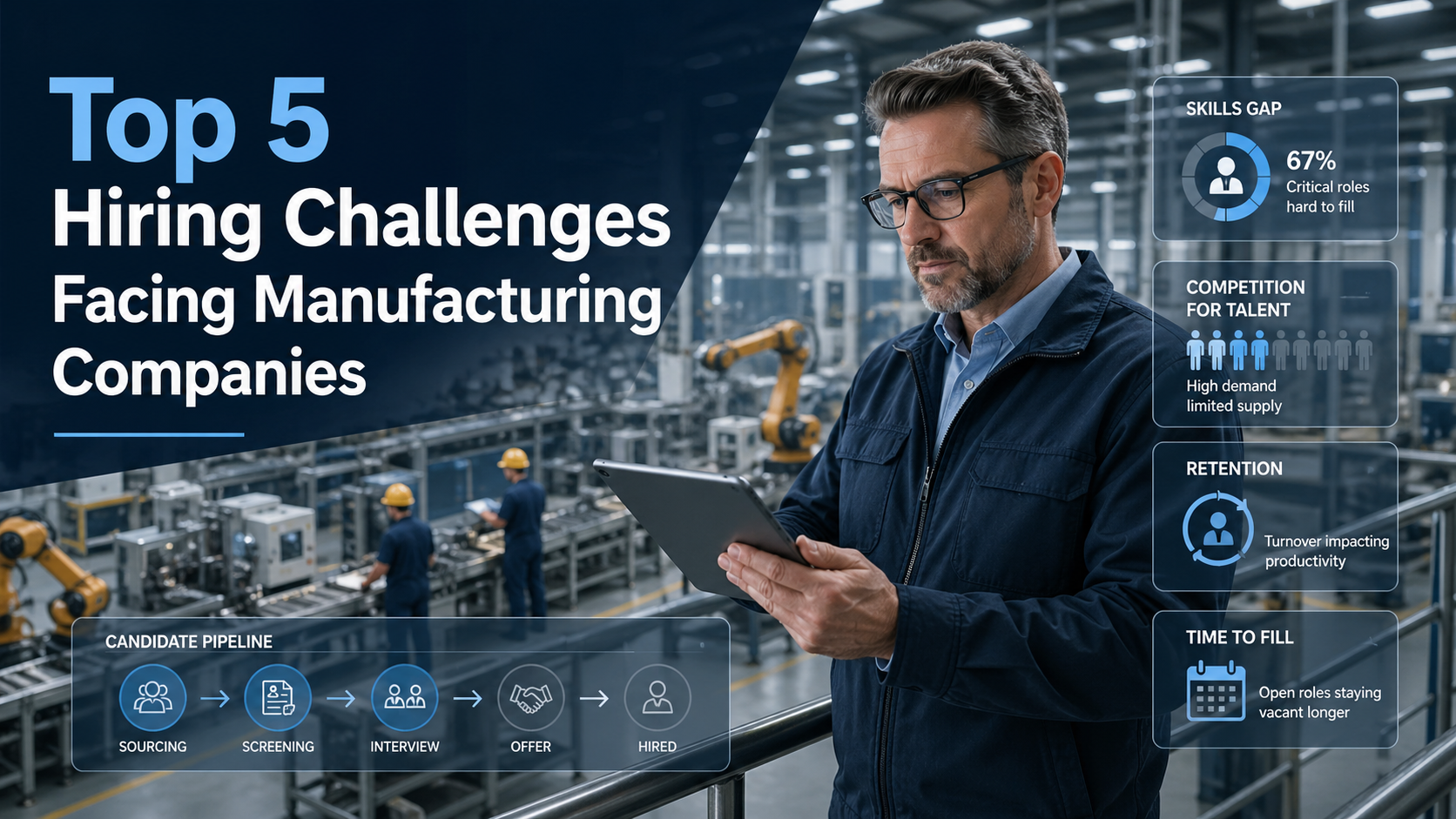
Manufacturing hiring challenges are not just HR problems. When key roles stay open, production schedules can slip, equipment downtime can increase, quality issues can grow, and existing employees may be pushed beyond capacity.
For manufacturers, the impact of a hiring gap often shows up quickly on the floor. Missed output targets, delayed shipments, overworked supervisors, slower maintenance response, and reduced operational efficiency can all trace back to unfilled or poorly filled positions. That is why manufacturing companies need more than applicants. They need qualified candidates who can contribute in demanding, technical, and often time-sensitive environments.
What are the top hiring challenges facing manufacturing companies?
The top hiring challenges facing manufacturing companies are skilled labor shortages, competition for technical and engineering candidates, slow hiring processes, retention issues, and difficulty evaluating specialized talent. Each of these challenges can affect production, quality, delivery, and long-term growth if employers do not address them directly.
1. Shortage of Skilled Manufacturing Talent
Many manufacturing companies struggle to find candidates with the right mix of technical ability, hands-on experience, reliability, and industry knowledge.
This is especially true for manufacturing engineers, maintenance technicians, CNC machinists, quality engineers, production supervisors, plant managers, process engineers, automation professionals, operations managers, and controls specialists.
These roles are difficult to fill because they often require more than general work experience. Employers may need candidates who understand specific machinery, production environments, lean manufacturing, quality systems, safety requirements, maintenance procedures, or process improvement.
When these positions stay open, the consequences can be immediate. A missing maintenance technician can slow repairs. An open quality role can increase the burden on existing staff. A vacant production leadership position can weaken accountability on the floor. A hard-to-fill engineering role can delay process improvements, equipment upgrades, or new product launches.
Manufacturers should treat these roles as business-critical, not routine openings.
2. Competition for Technical and Engineering Candidates
Manufacturing companies are often competing for the same talent as engineering firms, construction companies, automation companies, OEMs, aerospace employers, industrial contractors, and larger national manufacturers.
That competition is especially difficult when candidates have specialized skills. A manufacturing engineer with automation experience, a quality manager with strong regulatory knowledge, or a maintenance leader with advanced troubleshooting ability may have multiple options.
This creates a problem for employers that move slowly, offer unclear job expectations, or fail to communicate why their opportunity is attractive. To compete more effectively, manufacturing employers should clearly explain why the role matters, what technology or equipment the candidate will work with, how the position supports the company’s operations, and what advancement opportunities exist.
Strong candidates are rarely available for long. If a company treats a difficult technical search like a standard job posting, it may lose qualified people to employers that move faster and communicate more clearly.
3. Slow Hiring Processes Cost Strong Candidates
A slow hiring process is one of the most controllable hiring problems manufacturing companies face.
Many employers lose qualified candidates because of delayed feedback, too many interview steps, unclear approvals, or uncertainty about who has final decision-making authority. In manufacturing, where certain roles are already hard to fill, these delays can be costly.
Slow hiring often happens when companies wait too long to review resumes, delay interview scheduling, require unnecessary interview rounds, or fail to define must-have qualifications before the search begins. These problems create friction at the exact moment employers need momentum.
Speed does not mean lowering standards. It means removing unnecessary obstacles.
Manufacturing companies can improve hiring speed by identifying the true requirements of the role, preparing interviewers in advance, making compensation expectations clear, and giving prompt feedback after each candidate conversation.
For urgent or difficult roles, employers should also consider using a specialized recruiter who already understands the market and can help identify qualified candidates faster than a passive job posting.
4. Retention and Workforce Stability Problems
Hiring challenges do not end when a candidate accepts an offer. Retention is a major concern for manufacturing companies, especially in roles tied to production, maintenance, supervision, quality, and operations.
Turnover can create serious business problems. When employees leave, companies may face training costs, lost productivity, quality disruptions, safety concerns, overtime pressure, and heavier workloads for supervisors and remaining team members.
Retention problems often happen when there is a mismatch between the candidate and the actual role. A candidate may be qualified on paper but misaligned with the shift, physical work environment, management style, advancement path, compensation expectations, commute, production pace, or technical responsibilities of the position.
Manufacturing employers need to hire for more than resume fit. They need to evaluate whether the candidate can succeed in the specific environment, team structure, and operational expectations of the company.
A candidate who looks qualified on paper may not be the right long-term fit if the role, schedule, or plant environment is not aligned with their expectations.
5. Difficulty Evaluating Specialized Manufacturing Candidates
Many manufacturing roles require technical judgment that can be difficult to evaluate through resumes alone.
A resume may list equipment, software, certifications, or job titles, but that does not always prove the candidate can solve problems in a real manufacturing environment. Employers may need to understand whether a candidate can troubleshoot equipment, improve processes, manage production teams, reduce scrap, lead quality initiatives, or support continuous improvement.
This is especially difficult for HR teams or generalist recruiters who may not specialize in manufacturing or technical hiring.
For example, two candidates may both list “process improvement” on a resume. One may have led measurable plant-floor improvements, while the other may have only participated in basic internal projects. Without the right screening process, it can be hard to tell the difference.
Manufacturing employers should evaluate candidates based on practical experience, technical depth, problem-solving ability, leadership style, and relevance to the specific role.
For hard-to-fill manufacturing positions, working with a specialized recruiting partner can help employers identify stronger candidates before they invest time in interviews.
How Manufacturing Companies Can Respond
Manufacturing companies can improve hiring outcomes by treating recruiting as an operational priority rather than a back-office function.
That starts with clarifying the role before the search begins. Employers should separate required qualifications from preferred qualifications, review whether compensation aligns with market expectations, reduce unnecessary interview steps, and move quickly when qualified candidates are identified.
Job descriptions should also provide real information about the role, not generic language. Candidates need to understand the equipment, environment, expectations, schedule, reporting structure, and career path. The more specific the opportunity is, the easier it becomes to attract candidates who are actually aligned with the position.
For difficult or urgent searches, manufacturing companies may benefit from working with specialized recruiters who understand technical hiring and can reach candidates who are not actively applying to job postings.
The goal is not simply to fill openings. The goal is to hire people who can support production, improve performance, reduce risk, and stay with the company long enough to make a meaningful impact.
Where DAVRON Fits
DAVRON is a specialized recruiting and staffing firm focused on engineering, architecture, construction, and manufacturing.
For manufacturing employers, that specialization matters. Many open roles in manufacturing require technical understanding, industry context, and the ability to identify candidates who are not actively applying to job boards. DAVRON supports employers hiring hard-to-fill professionals across manufacturing, engineering, operations, quality, maintenance, and leadership roles.
Rather than approaching manufacturing hiring like a broad staffing search, DAVRON focuses on specialized recruiting for technical and industry-specific positions. This helps employers connect with candidates who are more closely aligned with the role, the environment, and the business need.
For companies dealing with urgent openings, production pressure, or difficult searches, a specialized recruiting partner can help reduce wasted time and improve candidate quality.
Manufacturing Hiring Challenges Require a Focused Response
Manufacturing hiring challenges affect more than headcount. They can influence production capacity, delivery performance, equipment uptime, quality, safety, supervisor workload, and long-term growth.
Companies that wait too long to address hiring gaps may find that the cost of delay becomes larger than the cost of recruiting support. The best approach is to define the hiring need clearly, move with urgency, and use specialized recruiting resources when the role is difficult, technical, or business-critical.