
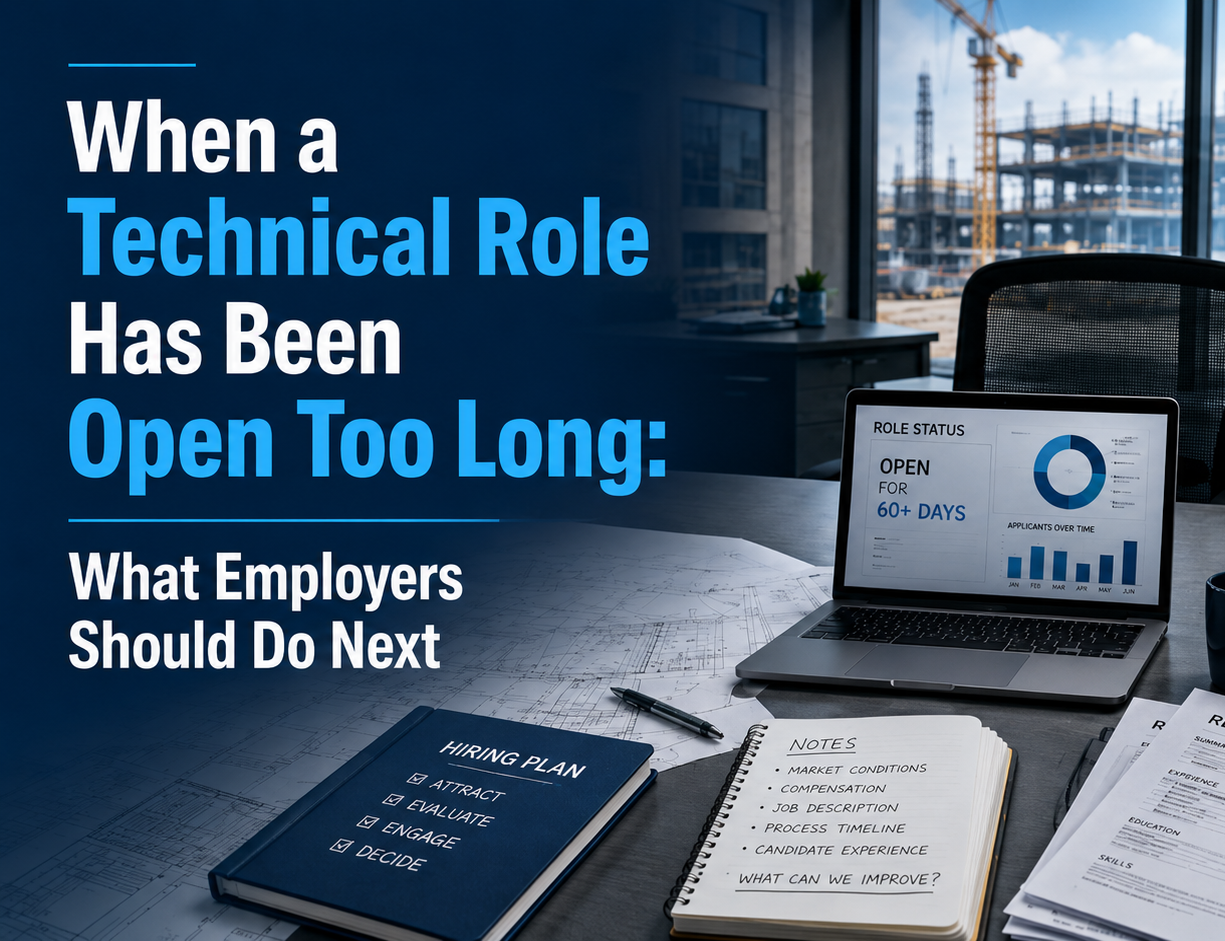
When a technical role stays open too long, the impact usually reaches far beyond HR. An unfilled engineering, architecture, construction, or manufacturing position can slow project delivery, increase pressure on existing staff, delay production, create quality risks, and force managers to spend valuable time covering gaps instead of leading the business.
At a certain point, the issue is no longer simply “we have not found the right person yet.” It becomes a signal that the hiring strategy needs to change.
Employers should reassess the role requirements, compensation, sourcing strategy, interview process, decision speed, and recruiting support. For hard-to-fill technical positions, bringing in a specialized recruiter may be the step that restores momentum and helps the company reach qualified candidates faster.
What Should Employers Do When a Technical Role Has Been Open Too Long?
If a technical role has been open too long, employers should stop repeating the same hiring process and evaluate what is preventing progress.
The most important areas to review are the job requirements, compensation, candidate sourcing strategy, interview speed, decision-maker alignment, and whether the internal team has enough recruiting bandwidth for the difficulty of the search.
A long-open role usually means one or more parts of the hiring process are creating friction. The employer’s next move should be to identify that friction and correct it quickly.
Why Technical Roles Stay Open Too Long
Technical roles often stay open because the search is being handled like a standard hiring need when it is actually a specialized recruiting challenge.
Engineering, architecture, construction, and manufacturing positions often require specific experience, certifications, software knowledge, project backgrounds, industry exposure, or technical judgment. The more specialized the role, the smaller the candidate pool becomes.
One common problem is that the requirements are too narrow. Some employers create job descriptions that describe an ideal candidate who may be extremely rare in the market. A long list of must-have requirements can unintentionally eliminate strong candidates who could succeed with minimal ramp-up.
Employers should separate true requirements from preferences. A license, technical degree, safety credential, or critical software skill may be essential. Other items, such as exact industry background or a specific number of years of experience, may be more flexible depending on the candidate’s overall ability.
Compensation can also stall a search. If pay is below what qualified technical candidates are currently accepting, employers may see weak response rates, declined interviews, or candidates dropping out once salary is discussed. A company does not always need to overpay, but it does need to understand whether the salary range is competitive enough to attract serious candidates.
Another issue is overreliance on job postings. Job boards can work for some roles, but many strong technical professionals are not actively applying. They may already be employed, selectively open to opportunities, or only willing to consider a move if contacted directly with the right opportunity.
Slow interview processes can create additional problems. Qualified technical candidates rarely stay available for long. If an employer takes too much time to schedule interviews, gather feedback, or make an offer, candidates may accept another opportunity before the company is ready to act.
Decision-maker misalignment can also keep a search from moving forward. A role can stall when HR, department leaders, executives, and technical managers are not aligned on what they actually need. If one person wants a senior technical expert, another wants a hands-on project leader, and another is focused mainly on salary, the process can lose direction.
The Business Risk of Waiting Too Long
A technical vacancy does not stay isolated. The longer the role remains open, the more the impact can spread through the organization.
Engineering, architecture, and construction roles often support timelines, approvals, technical deliverables, field coordination, or client commitments. When the right person is missing, work can back up quickly. A single vacancy can delay drawings, estimates, design reviews, inspections, production improvements, project schedules, or client deliverables.
The existing team also absorbs the pressure. When a technical position remains open, the work usually does not disappear. It gets redistributed. Managers may take on more technical review. Senior employees may cover additional tasks. Other team members may work overtime or shift focus away from their own priorities. Over time, this can increase burnout and create retention risk.
Quality may suffer as well. Technical roles often exist because accuracy matters. When teams are stretched thin, reviews may be rushed, details may be missed, or decisions may be made without the right expertise in place. For employers in engineering, architecture, construction, and manufacturing, quality problems can become expensive quickly.
A long-open role can also delay growth. It may prevent a company from taking on new work, expanding production, improving processes, or serving clients at full capacity. Even when the financial cost is not immediately visible, the opportunity cost can be significant.
What Employers Should Review First
Before continuing the same search, employers should perform a practical hiring review. The goal is to identify whether the problem is the market, the role, the process, or the sourcing strategy.
Start with the job description. Is it realistic, or is it describing a candidate who may barely exist? Employers should look closely at whether every listed skill is required on day one, whether years of experience are being used too rigidly, and whether preferred qualifications are being treated as mandatory.
Next, review compensation. If candidates are not responding, declining interviews, or exiting after learning the salary range, pay may be part of the issue. Employers should compare compensation against the difficulty of the role, the required experience, the location, the level of responsibility, and competing opportunities.
The interview process should also be reviewed. A strong technical hiring process should be thorough, but it should not be slow. Employers should know how long it takes to respond to candidates, schedule interviews, collect feedback, and make decisions. If the process takes weeks longer than necessary, it may be costing the company qualified hires.
Decision-maker alignment is equally important. Before continuing the search, the employer should confirm agreement on the role’s responsibilities, salary range, required qualifications, preferred qualifications, reporting structure, and hiring timeline. Misalignment creates inconsistent feedback, delayed decisions, and candidate confusion.
Finally, employers should evaluate whether they are reaching the right candidate market. A generic search may miss candidates who are currently employed, specialized, or not actively applying. For engineering, architecture, construction, and manufacturing roles, employers may need targeted outreach into specific industries, project backgrounds, technical disciplines, or geographic markets.
When to Adjust the Search Strategy
A long-open technical role does not always mean the company needs to start over. In many cases, the search can improve quickly once the strategy is adjusted.
The first adjustment is often to broaden the candidate profile without lowering standards. If the company has not found an exact match, it may be time to consider adjacent experience. Candidates from related industries, similar project types, comparable technical environments, or slightly different job titles may still have the skills needed to succeed.
Employers should also improve how the role is presented. Many companies focus heavily on what they need from candidates but do not clearly explain why the opportunity is worth considering. Strong technical candidates want to understand the projects, team structure, growth potential, company stability, technical challenges, leadership expectations, and why the position is open.
Flexibility may also help when practical. Some roles must be on-site, especially in construction, manufacturing, field, plant, or facility-based environments. But where flexibility is possible, employers should consider whether hybrid scheduling, relocation support, adjusted hours, or broader geographic targeting could expand the candidate pool.
Speed is another key adjustment. Employers do not need to rush into a poor hiring decision, but they do need a process that keeps qualified candidates engaged. A focused process signals that the company is serious and prevents strong candidates from losing interest.
If job postings are not producing results, the company should strengthen outreach beyond active applicants. Hard-to-fill roles often require proactive recruiting, industry-specific sourcing, referral development, and outreach to passive candidates. For technical searches, the best candidates are often not the easiest to find.
When to Bring in a Specialized Recruiter
If a technical role has been open too long and internal efforts are not producing the right candidates, it may be time to involve a specialized recruiter.
This is especially true when the role is tied to project deadlines, production needs, client delivery, technical leadership, or revenue-generating work.
A general recruiting approach may not be enough for positions that require niche experience. Employers hiring in engineering, architecture, construction, or manufacturing often need a recruiting partner that understands technical roles and knows how to reach qualified candidates in those markets.
DAVRON specializes in recruiting and staffing for engineering, architecture, construction, and manufacturing. That focus matters because these industries often require more than basic keyword matching. Employers need candidates who align with the technical requirements, business environment, project demands, and urgency of the role.
How DAVRON Helps Employers Move Forward
When a role has been open too long, DAVRON helps employers regain hiring momentum through a more focused recruiting process.
DAVRON can help clarify the hiring need, identify where the search may be stalling, reach qualified candidates, and present talent aligned with the role and industry. This is especially valuable when the role requires specialized technical experience, internal recruiting has not produced enough qualified candidates, or the position directly affects project delivery, production, operations, or business performance.
For employers, the value is not just more activity. It is more relevant recruiting activity. DAVRON’s specialization allows the search to stay focused on the industries where technical hiring challenges are most common: engineering, architecture, construction, and manufacturing.
A Long-Open Technical Role Requires Action
A technical role that has been open too long should not be treated as a passive HR issue. It is often a business problem that affects execution, capacity, timelines, and team performance.
The next step is not simply to repost the job and hope for different results. Employers should reassess the role, remove unnecessary barriers, improve the hiring process, strengthen candidate outreach, and consider whether specialized recruiting support is needed.
When the right person is missing from a technical team, delay has a cost. A more focused hiring strategy can help employers move from a stalled search to qualified candidate conversations.