
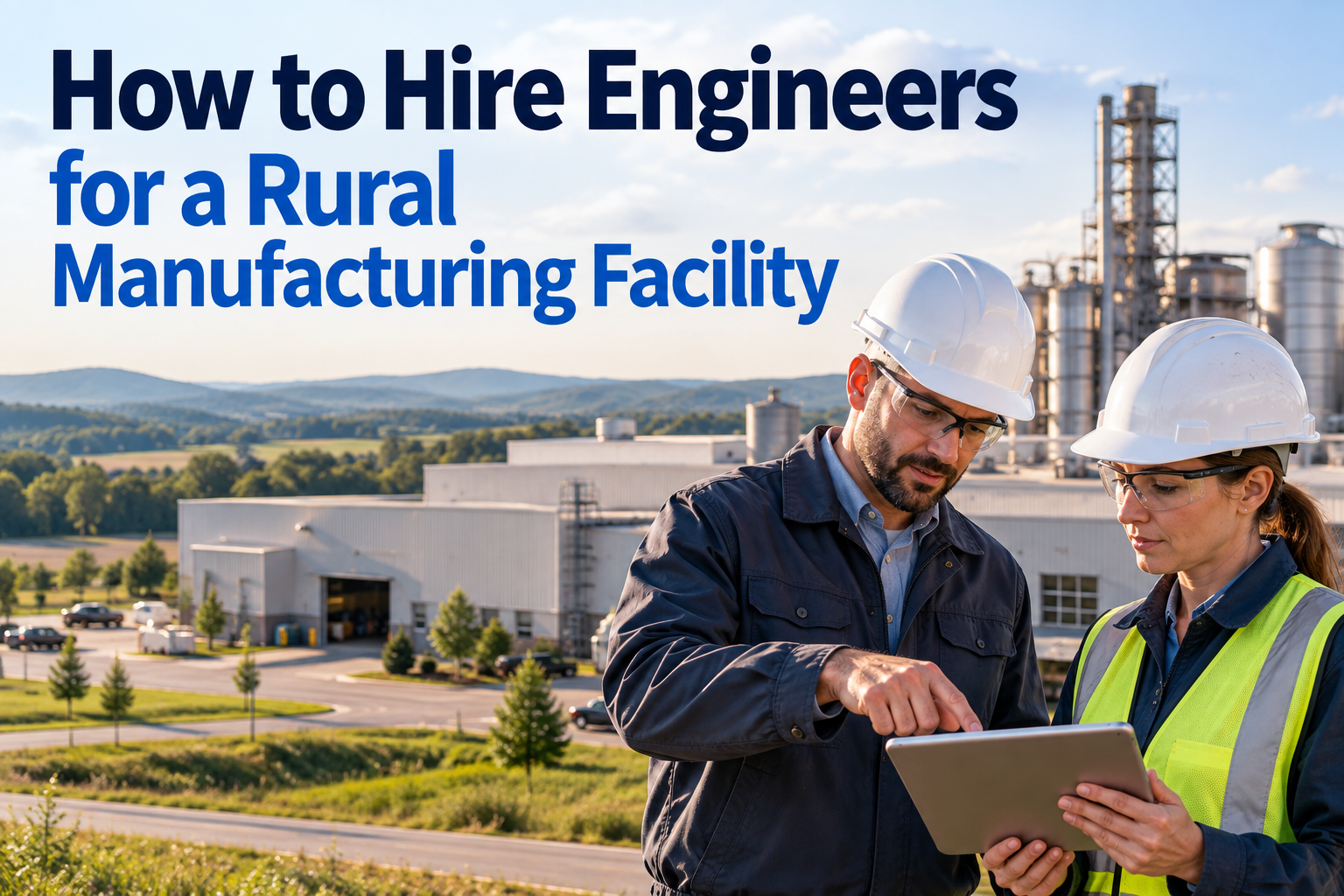
When an engineering position sits open at a rural manufacturing facility, the impact can extend well beyond HR. A missing mechanical, manufacturing, electrical, controls, process, or quality engineer can slow equipment improvements, automation projects, maintenance initiatives, production changes, quality programs, and plant expansions.
The challenge is straightforward: the engineer you need may not live anywhere near your facility.
That means manufacturers cannot always rely on conventional local recruiting. Successfully hiring engineers for a rural plant often requires expanding the geographic search, actively recruiting passive candidates, making relocation practical, communicating the value of the opportunity, and moving quickly when the right person is identified.
For an immediate opening, there are several ways to attack the problem. Employers can broaden their recruiting radius, improve relocation support, reconsider hybrid flexibility where the job permits it, increase direct candidate outreach, strengthen the employment offer, or engage a specialized technical recruiter such as DAVRON to reach qualified engineering candidates beyond the local applicant pool.
How Do You Recruit Engineers When Your Manufacturing Facility Is in a Rural Area?
A strong rural engineering recruiting strategy usually has five components:
Search beyond the immediate labor market.
Determine how much on-site presence the position actually requires.
Make relocation financially and personally realistic.
Give engineers compelling reasons to consider the opportunity.
Reduce unnecessary delays between candidate identification and hiring decisions.
For positions that have already been difficult to fill, employers should also consider whether posting jobs and waiting for applicants is sufficient. Hard-to-fill technical positions often require proactive recruiting: identifying engineers with the required experience and approaching them directly.
That distinction becomes especially important in rural markets.
1. Determine Whether the Engineer Actually Needs to Live Nearby
Start by examining what the engineer will actually do.
Many manufacturing engineering positions require substantial plant presence. An engineer responsible for production equipment, troubleshooting, process improvements, commissioning, maintenance support, quality issues, or direct interaction with operators may genuinely need to be on site.
Other positions may have responsibilities that can be performed partially off site.
Rather than automatically defining every engineering opening as five days a week on site, determine which responsibilities require physical presence and which do not. If a legitimate hybrid arrangement is operationally practical, it may expand the geographic candidate pool.
This does not mean forcing remote work onto a position that needs hands-on plant involvement. It means making sure the work arrangement is based on actual operational requirements rather than an unnecessary restriction.
2. Expand the Radius Beyond the Local Labor Market
One of the biggest limitations in rural recruiting is geography.
A manufacturer may have an excellent engineering opportunity but only a small number of appropriately qualified engineers within a reasonable commuting distance. Of those candidates, even fewer may have the specific manufacturing processes, equipment, software, certifications, leadership experience, or technical background the position requires.
Waiting for one of those people to see a job posting can make the search even narrower.
Employers should consider recruiting regionally or nationally when the local candidate pool cannot support the requirements of the position.
That can include targeting engineers in:
Nearby metropolitan areas
Neighboring states
Similar manufacturing regions
Competing or adjacent industries
Facilities using comparable equipment or processes
The objective is not simply to generate more applicants. It is to identify qualified candidates whose experience matches the work and who have a realistic reason to consider the opportunity.
This is where specialized recruiting can become particularly useful. DAVRON focuses on technical recruiting across engineering, architecture, construction, and manufacturing, allowing employers to pursue candidates beyond those who happen to be actively applying in the immediate area.
3. Make Relocation Part of the Hiring Strategy
If the engineer you need lives several hundred miles away, relocation cannot be treated as an afterthought.
Employers should decide what relocation support they are prepared to provide before reaching the offer stage.
Depending on the position and company, that could include relocation assistance, temporary housing, travel associated with the move, or other appropriate incentives.
But relocation is not purely a financial decision.
Candidates may also be evaluating housing availability, commute times, schools, career opportunities for a spouse or partner, proximity to family, recreation, community characteristics, and their own long-term career options.
Give candidates enough information to make an informed decision.
Transparency matters. A rural location should not be hidden until late in the recruiting process. Candidates should understand where the facility is located and what the position requires early enough to determine whether relocation is realistic.
4. Sell the Engineering Opportunity, Not Just the Location
Recruiting a candidate from outside the area requires answering an important question:
Why should an engineer move for this job?
The answer needs to be more substantial than a job description.
Consider what makes the engineering work itself attractive.
Perhaps the engineer will have ownership of a major automation project. Maybe the plant is investing in new equipment, adding production capacity, implementing new processes, or expanding.
The position could offer greater technical ownership than the candidate has today. It could provide direct access to plant leadership, advancement potential, exposure to sophisticated equipment, responsibility for capital projects, or an opportunity to build and improve systems rather than simply maintain them.
These details can matter significantly to technical candidates.
Hiring managers should be prepared to explain:
What problems the engineer will solve
What equipment, processes, or technology they will work with
What projects are planned
How much technical ownership the position provides
Who the engineer will work with and report to
What advancement opportunities exist
Why the position is open
What success looks like during the first year
A candidate may initially be uncertain about the location but become much more interested when the professional opportunity is clear.
5. Make Compensation Competitive With the Market You Are Recruiting From
A company recruiting locally may be able to benchmark compensation primarily against its immediate market.
A company recruiting nationally faces a different question.
What are the engineers you are trying to recruit currently earning, and what would make relocation worthwhile?
Local compensation expectations still matter, but they should not be the only reference point when candidates are being recruited from larger or higher-paying markets.
Employers should evaluate the complete offer, including base compensation, incentives where applicable, benefits, relocation support, career opportunity, work arrangement, and differences in cost of living.
A lower cost of living can be attractive, but employers should avoid assuming that it automatically compensates for a substantial difference in salary. The overall opportunity still needs to make sense to the candidate.
6. Reduce Unnecessary Delays in the Interview Process
Rural recruiting can require substantial effort just to identify an engineer with the right experience who is genuinely willing to consider the location.
Once that person is engaged, an unnecessarily slow hiring process creates additional risk.
Common delays include:
Long gaps between interviews
Too many interview rounds
Unclear decision authority
Slow feedback
Delayed compensation approval
Waiting until the end to discuss relocation
Allowing strong candidates to sit without communication
Speed does not mean lowering standards.
Employers should still evaluate technical ability, relevant experience, leadership capabilities, communication, and organizational fit carefully.
The goal is to remove delays that add no meaningful value to the decision.
Before beginning the search, determine who needs to interview candidates, what criteria will be evaluated, who can approve compensation, and who makes the final hiring decision.
That makes it possible to act quickly when a strong candidate emerges.
7. Build a Long-Term Engineering Talent Pipeline
Immediate vacancies require immediate recruiting, but rural manufacturers can also reduce future hiring difficulty by building talent pipelines.
Potential strategies include relationships with engineering universities and technical programs, internship programs, engineering co-ops, employee referrals, community partnerships, and structured development opportunities for early-career engineers.
Companies can also identify employees who may be capable of growing into more technical responsibilities with appropriate training and development.
These approaches can be valuable, but employers should recognize the timeline involved.
A university partnership started today may produce excellent engineers in the future. It probably will not replace an experienced controls engineer, manufacturing engineer, or engineering manager needed immediately.
The strongest workforce strategy often combines long-term talent development with an effective external recruiting capability for urgent and specialized positions.
8. Use a Specialized Technical Recruiter When the Search Has Stalled
There is a point where continuing to post the same vacancy and wait for different results stops being an effective recruiting strategy.
If a critical engineering position has remained open, the employer should determine where the bottleneck actually exists.
Is the local candidate pool too small?
Are qualified engineers unwilling to relocate?
Is compensation limiting the search?
Are candidates accepting other opportunities before the company completes its interview process?
Or is the company simply not reaching enough qualified engineers?
A specialized technical recruiter can help expand the search beyond active applicants.
DAVRON specializes in recruiting for engineering, architecture, construction, and manufacturing positions. For a rural manufacturer, that specialized focus can be particularly relevant when the company needs to identify engineers with specific technical backgrounds rather than simply increase application volume.
The objective should be qualified candidate delivery, not resumes for the sake of resumes.
A specialized recruiting approach can also help an employer reach engineers who are currently employed and may not be searching job boards but could consider the right technical, career, compensation, or relocation opportunity.
What Should You Do If You Need an Engineer Immediately?
If an engineering vacancy is already affecting production, maintenance, automation, quality, delivery schedules, or an important capital project, employers should treat recruiting as an operational priority.
Start by defining the true non-negotiables. Separate technical requirements the engineer absolutely must have from experience that can reasonably be learned after hiring. Overly restrictive requirements can eliminate capable candidates before a conversation occurs.
Next, determine your geographic flexibility. Decide whether the engineer must relocate, whether a longer commute is realistic, or whether any legitimate hybrid arrangement is possible.
Establish the compensation range and relocation parameters before candidate conversations become serious.
Then shorten the internal decision process. Identify interviewers, technical evaluation criteria, approval requirements, and decision-makers in advance.
At the same time, expand beyond passive job advertising. Begin targeted outbound recruiting regionally or nationally.
If internal recruiting is not producing qualified candidates—or the vacancy is too important to wait—engaging a specialized technical recruiter allows the company to run an additional recruiting channel rather than simply waiting for more applications.
Why Do Engineers Hesitate to Relocate to Rural Areas?
Not every engineer considers a rural location a disadvantage. Some candidates actively prefer smaller communities, shorter commutes, lower housing costs, outdoor recreation, or a different pace of life.
Others will have legitimate concerns.
An engineer considering relocation may ask:
What happens to my career after this job?
Show the candidate the technical scope, advancement opportunities, leadership exposure, and potential career path.
Can my spouse or partner find work?
Employers cannot solve every family consideration, but acknowledging it and providing useful information about the surrounding employment market can help candidates evaluate the move.
What is housing like?
Provide realistic information about housing and commuting options rather than leaving candidates to figure everything out after an offer.
What about schools and the community?
Candidates with families may need practical resources to evaluate the area.
Will I be professionally isolated?
Explain the engineering team structure, technical projects, professional development opportunities, plant investments, and interaction with other facilities or corporate engineering groups where applicable.
The objective is not to convince every candidate that rural life is right for them.
It is to find qualified engineers for whom the professional opportunity and location make sense—and give them enough accurate information to make that decision.
Common Mistakes When Recruiting Engineers for Rural Manufacturing Plants
Several recruiting practices can make an already difficult geographic search harder.
Restricting the search to local candidates.
If the required engineering expertise barely exists within commuting distance, increasing the number of local job postings will not necessarily solve the underlying problem.
Posting the position and waiting.
Job advertising primarily reaches people who are looking. A difficult technical search may require directly approaching qualified engineers who are currently employed.
Hiding the location.
Candidates should understand the geographic requirements early. Waiting until late in the process wastes time for both sides.
Providing inadequate relocation support.
If relocation is necessary to access the required talent pool, employers should decide how they will make that relocation realistic.
Taking too long to make decisions.
A difficult search does not become easier when qualified candidates spend weeks waiting for feedback.
Focusing exclusively on salary.
Compensation matters, but so do technical challenge, career progression, responsibility, leadership, work environment, relocation support, and lifestyle.
Failing to communicate why the job is worth moving for.
A generic job description is rarely a compelling relocation pitch. Employers need to articulate what makes the engineering work and career opportunity valuable.
Immediate Recruiting and Long-Term Workforce Development Are Different Problems
Rural manufacturers should work on both.
Internships, co-ops, university relationships, training programs, referrals, and internal development can strengthen the engineering workforce over time.
But when a production-critical engineering position is vacant today, those initiatives may not solve the immediate problem.
That requires a recruiting strategy designed for the current vacancy.
Expand the search geographically. Identify engineers with relevant manufacturing experience. Approach passive candidates. Address relocation directly. Present a credible professional opportunity. Move efficiently through interviews.
And when the local candidate pool or internal recruiting resources cannot produce the engineers the facility needs, bring in specialized recruiting support.
The central question should not be, “How many people applied?”
It should be, “Are we reaching the qualified engineers who could actually solve this problem?”
For rural manufacturing facilities, answering that question often requires looking well beyond the local labor market.
Ready to hire engineering, architecture, construction, or manufacturing professionals?
DAVRON specializes in delivering high-quality candidates in these industries.