
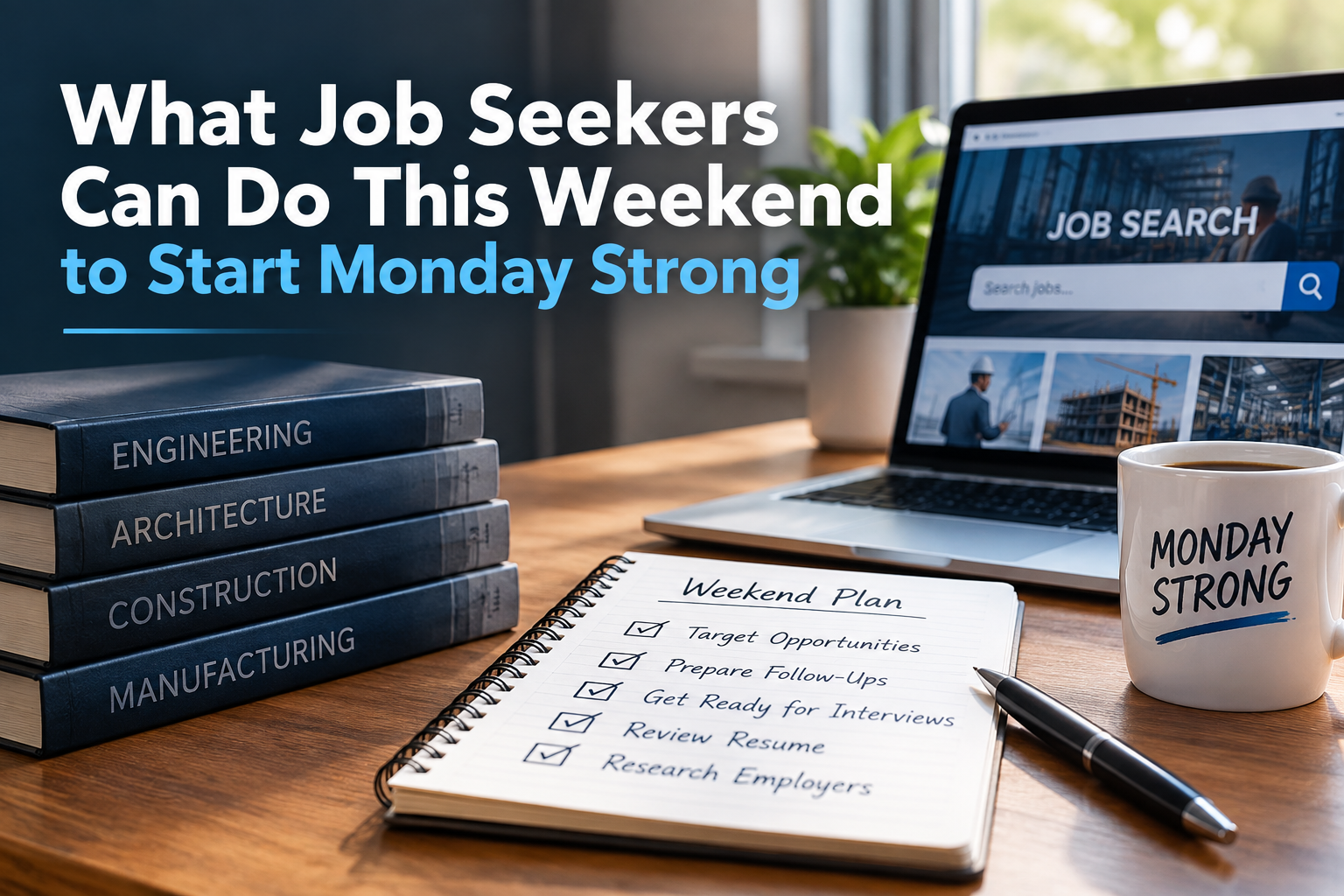
If your job search feels like it has lost momentum, you do not need to spend the entire weekend submitting dozens of applications.
A few focused hours can put you in a much stronger position for Monday.
The most productive approach is to concentrate on three things: finding opportunities that genuinely fit your experience, preparing thoughtful follow-ups, and getting ready for interviews before they appear on your calendar.
For professionals in engineering, architecture, construction, and manufacturing, this is especially important. Employers hiring for specialized technical positions are often looking for specific combinations of industry experience, technical skills, project exposure, software knowledge, certifications, and leadership capabilities. A targeted job search makes those qualifications easier to recognize.
Here is how to use this weekend effectively.
1. Target Better Opportunities Instead of Applying Everywhere
It can be tempting to measure job-search progress by the number of applications submitted.
But 30 rushed applications are not necessarily more productive than five carefully selected applications for positions that closely match your background.
Use part of the weekend to narrow your search.
Start by asking whether each opportunity actually fits your experience. Look beyond the job title and examine the requirements.
For technical positions, that might mean comparing the employer’s needs with your:
Engineering discipline or technical specialty
Industry experience
Software and systems knowledge
Licenses or certifications
Project types and sizes
Construction or manufacturing environment
Design experience
Leadership responsibilities
Geographic preferences
Desired career direction
A mechanical engineer with HVAC and building-systems experience, for example, should approach an MEP engineering opportunity differently from a manufacturing engineering position. Likewise, a construction superintendent with extensive commercial experience may want to prioritize employers seeking that background rather than applying indiscriminately to every superintendent opening.
A simple weekend exercise
Choose a manageable number of positions that appear to be genuinely strong matches.
Then read each job description carefully and compare it with your resume.
Ask yourself: If a hiring manager spent 30 seconds reviewing my resume, would the connection between my experience and this position be obvious?
If not, determine whether your resume needs clarification.
That does not mean rewriting your entire resume for every application. It means making sure the experience most relevant to the opportunity is easy to find and accurately described.
Quality and relevance should take priority over application volume.
2. Prepare Your Monday Follow-Ups Before Monday Arrives
The weekend is also a good time to review what has already happened in your job search.
Look back over the previous week or two. Identify applications you submitted, recruiters you spoke with, interviews you completed, and professional contacts who offered to help.
Some of those conversations may warrant a follow-up.
Instead of trying to remember everything during a busy Monday morning, prepare your messages over the weekend.
A useful follow-up should have a purpose. It might reaffirm your interest, provide relevant information, confirm your availability, or reconnect after an interview.
Avoid repeatedly sending messages that amount to nothing more than, “Do you have an update?”
Instead, keep the communication concise and useful.
For example, after an interview you might briefly reference a project or responsibility discussed during the conversation and explain why your experience aligns with it.
After speaking with a recruiter, you might confirm your continued interest and availability for appropriate opportunities.
After submitting an application, you might highlight one particularly relevant qualification that makes the position a strong match.
The objective is not to pressure someone into responding. It is to make it easier for the person on the other side to understand your interest and relevance.
Preparing these messages during the weekend means you can review them carefully and have them ready when the workweek begins.
3. Prepare for Interviews Before They Are Scheduled
One of the easiest ways to make interview preparation unnecessarily stressful is to wait until an interview appears on your calendar.
Use the weekend to build a foundation now.
Start with the questions you are likely to encounter repeatedly.
You should be able to explain:
What you currently do
The types of projects you have worked on
Your strongest technical capabilities
Why you are considering a change
What you want from your next position
Examples of problems you have solved
Results you have produced
Technical professionals should go further.
Engineers
Be prepared to discuss specific projects, your individual responsibilities, design decisions, calculations or analysis where appropriate, software used, technical problems encountered, and the results of your work.
Architecture professionals
Prepare examples involving project types, design responsibilities, documentation, software, coordination, client interaction, permitting, codes, and your contribution through different project phases.
Construction professionals
Think through examples involving project size and scope, schedules, subcontractor coordination, budgets, safety, quality, field challenges, change orders, and project delivery.
Manufacturing professionals
Prepare to discuss production environments, processes, equipment, quality systems, continuous improvement initiatives, automation, safety, throughput, cost reduction, and measurable operational improvements where applicable.
The goal is not to memorize scripted answers.
It is to have strong examples ready so you are not trying to reconstruct an important project from memory while sitting in an interview.
Turn Your Experience Into Specific Examples
A resume tells an employer what you have done. An interview gives you the opportunity to explain the value of that experience.
Use the weekend to identify three to five examples from your career that demonstrate what you can do.
Whenever possible, make those examples specific.
Instead of simply saying you managed construction projects, be prepared to describe the type and scale of projects, your responsibilities, problems you encountered, and how you responded.
Instead of saying you improved a manufacturing process, explain what needed improvement, what you changed, and what happened as a result.
Instead of saying you designed mechanical systems, be ready to discuss the project environment, your responsibilities, the tools you used, important design considerations, and the outcome.
You may not use every example in every interview. Having them prepared gives you a collection of relevant experiences you can draw from naturally.
Research the Employers You Actually Want to Work For
You do not need an interview scheduled to begin employer research.
If there are companies you are seriously interested in, spend some weekend time understanding what they do.
Review their services, markets, projects, facilities, products, locations, and the types of professionals they employ.
Then consider where your background fits.
This makes future applications and conversations more focused. It can also help you decide that an opportunity is not right for you before investing significant time in the hiring process.
Research should work both ways.
An employer is evaluating whether you fit its needs. You should also be evaluating whether the organization and opportunity fit yours.
Review Your Resume From the Employer's Perspective
Before Monday, open your resume and read it as if you knew nothing about yourself.
Is your specialty immediately clear?
Can someone quickly determine what industries you have worked in, what types of projects you have handled, and where your strongest capabilities lie?
Are important technical skills buried?
Are there accomplishments that could be more specific?
Have you listed responsibilities without explaining meaningful outcomes?
For experienced professionals, another common issue is giving every previous position the same amount of attention. Your resume should help a reader understand your current level of expertise and the experience most relevant to the positions you are pursuing.
Do not change things simply for the sake of changing them. Make revisions when they improve clarity, accuracy, or relevance.
Your Weekend-to-Monday Checklist
You do not need to spend two full days job hunting.
Set aside focused time and aim to complete a few meaningful actions:
Identify several opportunities that closely match your background.
Review your resume against those positions and improve relevant sections where necessary.
Submit thoughtful applications rather than mass applications.
Review applications, interviews, and recruiter conversations from the previous two weeks.
Draft any appropriate follow-up messages.
Prepare three to five strong examples of projects, accomplishments, or problems you have solved.
Research employers you are genuinely interested in.
Review your schedule and availability so you can respond confidently to interview requests or recruiter calls.
By Sunday evening, you should know exactly what needs to happen next.
That is a much stronger position than waking up Monday morning and restarting your job search from scratch.
Add a Specialized Recruiter to Your Job Search
Your own applications should not necessarily be your only route to a new opportunity.
For professionals working in specialized technical industries, connecting with a recruiter who understands those markets can add another channel to the search.
DAVRON specializes in recruiting within engineering, architecture, construction, and manufacturing. That niche focus means conversations can center on the technical experience, project background, and career direction relevant to these industries rather than treating your search as a generic employment exercise.
Working with a recruiter does not replace your own networking, applications, or research. It complements them.
A strong job-search strategy can include several channels at once: targeted direct applications, professional networking, thoughtful follow-ups, interview preparation, and relationships with recruiters who work within your field.
Start Monday With a Plan, Not Another Search
The best outcome from a productive job-search weekend is not simply submitting more applications.
It is clarity.
You know which opportunities deserve your attention. Your resume communicates your experience clearly. Your follow-ups are prepared. Your strongest project examples are fresh in your mind. You have researched employers you actually want to speak with.
When Monday arrives, you are ready to act instead of figuring out where to begin.
Ready to hire engineering, architecture, construction, or manufacturing professionals?
DAVRON specializes in delivering high-quality candidates in these industries.