
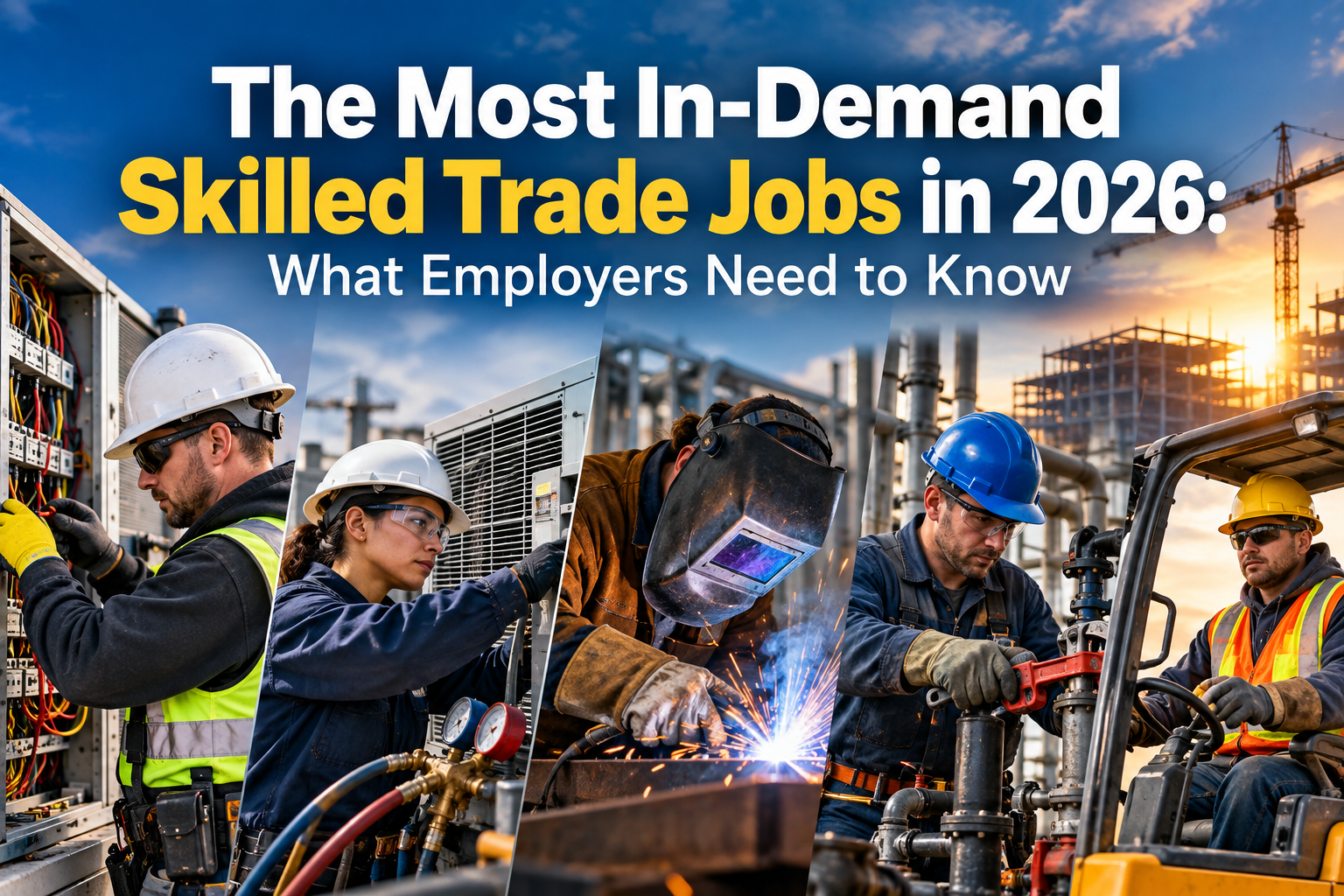
When a skilled electrician, industrial maintenance mechanic, HVAC technician, pipefitter, welder, or equipment operator leaves, the problem can quickly extend beyond an open position.
Production may slow. Preventive maintenance gets postponed. Overtime increases. Construction schedules become harder to maintain. Experienced employees may be stretched across too many responsibilities. And when the missing skill is tied directly to equipment, infrastructure, or project execution, waiting months for the right hire may not be practical.
For employers hiring skilled trades in 2026, the challenge is not simply finding applicants. It is finding people with the right combination of technical skills, hands-on experience, certifications, availability, and location when the business actually needs them.
The latest U.S. Bureau of Labor Statistics (BLS) projections reinforce the scale of the broader demand. Construction and extraction occupations are projected to generate about 587,000 openings per year from 2025 through 2035, while installation, maintenance, and repair occupations are projected to generate about 569,000 annual openings. Those totals include openings created by both employment growth and workers permanently leaving occupations.
For an employer with an urgent vacancy, there are several ways to respond: increase internal recruiting, activate employee referrals, reconsider which qualifications are truly mandatory, recruit from adjacent industries, develop apprentices for long-term needs, or engage a specialized recruiter when internal sourcing is not reaching enough qualified candidates.
DAVRON specializes in recruiting for engineering, architecture, construction, and manufacturing, giving employers another option when technical and skilled positions become difficult or time-sensitive hiring problems.
What Are the Most In-Demand Skilled Trade Jobs in 2026?
There is no single authoritative national ranking of the “most in-demand” skilled trades.
Demand can be measured by projected growth, annual job openings, replacement needs, the size of the occupation, or how difficult a particular skill set is to recruit in a specific market. A fast-growing occupation is not automatically the hardest to fill, and a slow-growing occupation can still generate tens of thousands of openings as existing workers leave.
For employers, the most useful approach is to consider both labor-market demand and the difficulty of finding the exact skills the business requires.
Several occupations stand out in the latest BLS data.
1. Industrial Machinery Mechanics and Industrial Maintenance Professionals
For manufacturers, distribution operations, and other equipment-intensive businesses, industrial maintenance can be directly connected to uptime and production.
BLS projects overall employment of industrial machinery mechanics, machinery maintenance workers, and millwrights to grow 14% from 2025 to 2035, with approximately 51,900 openings per year. Industrial machinery mechanics specifically are projected to grow 18%. BLS attributes part of the demand to increased adoption of automated manufacturing machinery and the need to keep that equipment operating.
Why employers need them: These professionals install, maintain, troubleshoot, and repair industrial machinery and production equipment.
Why they can be difficult to hire: “Maintenance mechanic” can describe dramatically different skill sets. An employer may need experience with particular production machinery, electrical troubleshooting, mechanical systems, conveyors, motors, controls, hydraulics, pneumatics, or other specialized equipment.
What an unfilled position can affect: Equipment availability, preventive maintenance, unplanned downtime, production throughput, overtime, and the workload carried by the existing maintenance team.
For manufacturers, this is a good example of why headcount alone does not tell the whole hiring story. The critical question is whether the candidate can troubleshoot and maintain the specific equipment and systems used by the operation.
2. Electricians
Electricians remain one of the largest skilled-trade hiring categories.
BLS projects electrician employment to grow 9% from 2025 to 2035, with approximately 72,700 openings each year. BLS also points to the need to install and replace electrical systems, connect renewable generation, expand grid infrastructure, and meet electricity demand associated with technologies including AI and data centers.
Why employers need them: Electrical work is fundamental across commercial construction, industrial facilities, manufacturing plants, infrastructure, and building operations.
Why they can be difficult to hire: Licensing requirements, apprenticeship pathways, local regulations, industrial versus commercial experience, controls knowledge, shift requirements, and specialized project experience can substantially narrow a candidate pool.
What an unfilled position can affect: Construction schedules, electrical maintenance, facility uptime, equipment installation, expansion projects, and troubleshooting response.
Employers should define exactly what type of electrician they need before recruiting. A broad search for an “electrician” may generate candidates whose backgrounds do not match an industrial, controls-heavy, commercial, or project-specific environment.
3. HVAC/R Technicians
Heating, ventilation, air conditioning, and refrigeration technicians are another rapidly growing skilled occupation.
BLS projects HVAC/R mechanic and installer employment to grow 11% between 2025 and 2035, with about 40,600 openings annually. Commercial construction—including data centers—residential construction, increasingly sophisticated climate-control systems, and the need to retrofit or replace existing systems are among the demand factors identified by BLS.
Why employers need them: HVAC/R professionals install, maintain, troubleshoot, and repair climate-control and refrigeration systems used across buildings and facilities.
Why they can be difficult to hire: Employers may need specific commercial, industrial, refrigeration, controls, equipment, licensing, or certification experience. BLS notes that workers may require licenses or certifications and typically undergo a lengthy period of on-the-job training.
What an unfilled position can affect: Facility operations, service response, equipment reliability, customer commitments, maintenance backlogs, and project completion.
The challenge becomes greater when the employer needs an experienced technician who can work independently rather than someone who still requires extensive development.
4. Plumbers, Pipefitters, and Steamfitters
BLS projects employment for plumbers, pipefitters, and steamfitters to grow 7% from 2025 through 2035, with roughly 42,000 openings each year. Demand includes new construction and the maintenance and repair of existing systems.
These occupations span far more than conventional residential plumbing. Pipefitters and steamfitters may work with high-pressure systems and piping carrying chemicals, gases, and other substances in manufacturing, power, commercial, and industrial environments.
Why employers need them: Piping systems are essential across construction, manufacturing facilities, utilities, mechanical systems, and industrial processes.
Why they can be difficult to hire: Apprenticeship requirements, licensing, specialized industrial experience, blueprint knowledge, welding capabilities, process-piping experience, and local labor availability can narrow the field.
What an unfilled position can affect: Mechanical installations, plant maintenance, construction sequencing, shutdown work, expansion projects, and project deadlines.
5. Construction Equipment Operators
Construction equipment operators represent another occupation with substantial annual hiring activity.
BLS projects about 42,500 openings per year for construction equipment operators from 2025 through 2035. Overall employment is projected to increase 4%, with infrastructure spending and the need to repair roads, bridges, water systems, and sewer systems contributing to demand.
Why employers need them: Experienced operators are essential for earthmoving, grading, excavation, paving, material handling, infrastructure, and other heavy construction work.
Why they can be difficult to hire: Equipment experience matters. An employer may need someone proficient on a specific machine, comfortable with particular site conditions, able to meet safety requirements, or available for irregular schedules and project travel.
What an unfilled position can affect: Crew productivity, equipment utilization, sequencing, site preparation, and construction schedules.
6. Welders and Fabrication Professionals
Welding demonstrates why employers should not equate “in demand” solely with fast percentage growth.
BLS projects employment of welders, cutters, solderers, and brazers to grow only 2% from 2025 to 2035. Yet the occupation is still projected to produce approximately 40,300 openings each year, largely because workers will need to be replaced as they transfer occupations or leave the labor force. About 63% of these workers were employed in manufacturing in 2025.
Why employers need them: Welding supports metal fabrication, manufacturing, machinery production, repair, construction, and infrastructure.
Why they can be difficult to hire: “Welder” is not one interchangeable skill set. The process, materials, positions, certifications, drawings, tolerances, industry, and fabrication environment can all matter.
What an unfilled position can affect: Fabrication throughput, production schedules, quality, rework, project delivery, and overtime.
An employer looking for specialized welding experience may therefore face a much tighter candidate market than national occupational growth figures suggest.
7. Electrical Power-Line Installers and Repairers
Electrical power-line installers and repairers represent a smaller occupation than electricians but one with significant projected growth.
BLS projects 10% employment growth from 2025 to 2035 and approximately 10,900 openings per year. Rising electricity demand, grid upgrades, new infrastructure, and additional power requirements associated with AI and data centers are among the factors BLS identifies.
Why employers need them: These workers install, maintain, and repair the infrastructure that moves electricity through power and distribution systems.
Why they can be difficult to hire: The work requires technical training and substantial on-the-job development, and apprenticeships are common. The occupation also involves high-voltage hazards, heights, demanding physical work, outdoor conditions, and emergency response.
What an unfilled position can affect: Infrastructure installation, maintenance capacity, emergency response, system reliability, and project schedules.
8. Solar Photovoltaic Installers
Solar PV installers illustrate the difference between percentage growth and total hiring volume.
BLS projects solar photovoltaic installer employment to grow 37% between 2025 and 2035, one of the fastest growth rates among skilled occupations. However, because the occupation is much smaller, that translates to about 4,200 openings per year.
Why employers need them: Continued adoption of photovoltaic systems creates installation and maintenance requirements.
Why they can be difficult to hire: Employers may need workers who combine installation experience with electrical, roofing, construction, safety, or system-specific capabilities.
What an unfilled position can affect: Installation capacity, crew scheduling, project timelines, and the number of projects a contractor can execute simultaneously.
This is exactly why employers should look beyond “fastest-growing jobs” headlines. A 37% growth rate does not necessarily mean more recruiting volume than an occupation with a lower growth rate and a much larger workforce.
Why Is Skilled Trade Hiring Difficult in 2026?
The numbers point to an important reality: job growth is only part of the hiring equation.
Replacement demand matters too. BLS explicitly notes that many projected openings across these occupations will occur because existing workers transfer to other occupations or exit the labor force.
At the employer level, several additional factors can make recruiting more difficult.
Training takes time
Many trades cannot be learned quickly.
Plumbers and pipefitters commonly learn through apprenticeships. Electrical power-line workers require technical instruction and extensive on-the-job training. HVAC technicians typically require postsecondary preparation or substantial workplace training. Millwright apprenticeships may last several years.
That creates an important distinction for employers:
Training can solve tomorrow’s workforce problem. It may not solve today’s vacancy.
Certifications and licensing shrink the candidate pool
For some positions, an employer cannot simply hire a mechanically inclined person and provide a few weeks of training.
Licensing, certification, safety requirements, apprenticeships, equipment knowledge, and demonstrated experience can substantially reduce the number of candidates qualified for a particular opening.
Location matters
A national statistic does not describe every local labor market.
A position that is reasonably available in one metropolitan area may be extremely difficult to fill in another. Rural plants, remote construction projects, extensive travel, unusual shifts, and relocation requirements can all make an already specialized search harder.
Specialization matters
The narrower the technical requirements, the smaller the realistic candidate pool becomes.
A company may not simply need a maintenance mechanic. It may need a mechanic with electrical troubleshooting and PLC exposure who understands a particular type of production equipment and will work second shift.
That is a fundamentally different recruiting problem.
Which Skilled Trade Positions Are Hardest to Fill?
There is no universal answer.
The hardest trade to hire is often the one where the employer’s requirements intersect with a small local talent pool.
Employers should evaluate recruiting difficulty based on:
required licenses and certifications
specific equipment or process experience
years of hands-on experience
shift and overtime expectations
geographic location
travel requirements
compensation
industry experience
safety requirements
competition from nearby employers
This also explains why annual openings should not be treated as a direct measure of recruiting difficulty.
Electricians, for example, have substantially more projected annual openings than solar installers, but the actual difficulty of either search depends on the qualifications and market involved. Likewise, welding has modest projected employment growth but still produces substantial replacement-driven hiring volume.
How Can Employers Find Skilled Trade Workers Faster?
When an open trade position is affecting production, maintenance, construction, or customer delivery, the goal should not be to lower hiring standards.
The goal should be to remove unnecessary friction from the recruiting process.
1. Define the true non-negotiables
Identify what the person must know on day one.
Separate genuine requirements from preferences. If every item in a long job description is treated as mandatory, the company may eliminate candidates who possess the critical technical capabilities but could learn secondary requirements quickly.
2. Check compensation against the actual market
A recruiting problem may sometimes be a compensation problem.
Pay should reflect the specific skill set, shift, geography, travel requirements, certifications, experience level, and competition for talent—not simply an internal title.
3. Move qualified candidates through interviews quickly
A five-stage interview process rarely improves an urgent skilled-trade search.
Determine who actually needs to evaluate technical ability and who has hiring authority. Then build the shortest process that still supports a sound hiring decision.
4. Search beyond active applicants
Posting a job reaches people who are actively looking and happen to see the opening.
That may not be enough for a specialized search.
Experienced tradespeople who are currently employed may need to be identified and approached directly, particularly when the required skills are uncommon.
5. Consider adjacent experience
Ask whether the candidate must come from an identical employer or whether relevant technical skills transfer from another environment.
This can expand the candidate pool without reducing the standards that actually matter.
6. Use temporary operational solutions carefully
Overtime, contractors, schedule changes, and redistributing work may keep operations moving temporarily.
But these approaches can create their own costs if a temporary workaround becomes a permanent staffing strategy.
7. Bring in specialized recruiting support when the search stalls
If internal recruiting has already exhausted obvious channels, continuing the exact same process for another month may not change the outcome.
That is when a specialized recruiting partner can become particularly useful.
When Does Using a Specialized Recruiter Make Sense?
Not every skilled-trade vacancy requires an outside recruiter.
If an employer has a strong local candidate pipeline, sufficient internal recruiting resources, and no significant time pressure, direct hiring may work well.
External recruiting becomes more valuable when:
an important role remains open despite internal efforts
production or project schedules are being affected
qualified applicants are scarce
the position requires uncommon technical experience
hiring managers are spending too much time sourcing
passive candidates need to be reached
multiple specialized positions are open
the cost of leaving the position vacant is increasing
the company needs to expand its search beyond its usual recruiting channels
DAVRON’s recruiting focus is engineering, architecture, construction, and manufacturing. That specialization is particularly relevant when employers are hiring technical professionals and need recruiters who can work within niche candidate markets rather than approaching the assignment as a generic staffing search.
For urgent needs, the value of specialization is straightforward: the recruiter can focus the search around the technical qualifications that actually determine fit, identify relevant and potentially transferable backgrounds, and reach candidates beyond those who happen to apply to a job posting.
Frequently Asked Questions About Skilled Trade Hiring in 2026
What skilled trades are most in demand in 2026?
Several trades show substantial projected hiring activity in the latest BLS data. Electricians are projected to have about 72,700 annual openings, industrial machinery mechanics and related occupations about 51,900, construction equipment operators about 42,500, plumbers/pipefitters/steamfitters about 42,000, HVAC/R technicians about 40,600, and welders/cutters/solderers/brazers about 40,300. These figures are projected annual averages for 2025–2035, not a count of currently vacant jobs.
What are the fastest-growing skilled trade jobs?
Growth rates differ from total hiring volume. Among the occupations discussed here, BLS projects solar photovoltaic installers to grow 37% from 2025–2035, industrial machinery mechanics and related workers 14% overall, HVAC/R technicians 11%, electrical power-line installers and repairers 10%, and electricians 9%.
Why are skilled trade workers difficult to hire?
The difficulty often comes from the time required to develop proficiency, licensing or certification requirements, specialized equipment or process knowledge, location, shifts, compensation, and competition for experienced workers. National labor statistics can indicate broad demand, but the candidate pool for a specific employer may be much smaller.
How long does it take to hire a skilled tradesperson?
There is no reliable universal hiring timeline. It depends on the trade, location, compensation, shift, qualifications, hiring process, and availability of candidates. Employers with highly specific requirements should plan for a narrower candidate pool and make sure avoidable interview delays do not lengthen the search further.
How can employers find skilled trade workers faster?
Start by defining the essential technical qualifications, verifying compensation, removing unnecessary interview steps, considering candidates with transferable experience, reaching passive candidates, and expanding sourcing beyond job-board applicants. When internal sourcing is not reaching enough qualified people, a specialized recruiter can add another recruiting channel.
Should employers use a recruiter to hire skilled trades?
It depends on the position and the employer’s internal resources. Recruiting support can be particularly useful when a vacancy is business-critical, difficult to source locally, requires specialized experience, has remained open despite internal recruiting, or needs to be filled on an accelerated timeline.
What if there are no qualified candidates in the local market?
First determine which requirements truly demand local, industry-specific experience. Employers can then consider adjacent industries, relocation, modified schedules, broader geography, transferable skills, training for noncritical gaps, and specialized recruiting outreach. The objective is to widen the search without compromising essential technical or safety requirements.
The Employer Takeaway: Solve Today's Vacancy and Tomorrow's Pipeline
The skilled-trade hiring challenge requires employers to think on two timelines.
Long term, apprenticeships, training programs, internal development, partnerships with technical schools, and workforce planning can create a stronger talent pipeline.
Right now, those strategies may not put an experienced electrician, industrial mechanic, HVAC technician, pipefitter, welder, or other technical professional on the job when an urgent vacancy is already affecting operations.
When a missing skill begins affecting production, uptime, project execution, delivery schedules, maintenance, or growth, the employer needs an immediate recruiting strategy alongside the long-term workforce plan.
That may mean improving internal recruiting. It may mean widening the candidate profile to include transferable skills. It may mean accelerating interviews or adjusting compensation. And when the position is particularly specialized or difficult to fill, it may mean engaging a recruiting firm focused on the technical markets where those candidates work.
DAVRON specializes in recruiting for engineering, architecture, construction, and manufacturing—helping employers address hard-to-fill technical hiring needs with a focused recruiting process.
Ready to hire engineering, architecture, construction, or manufacturing professionals?
DAVRON specializes in delivering high-quality candidates in these industries.