
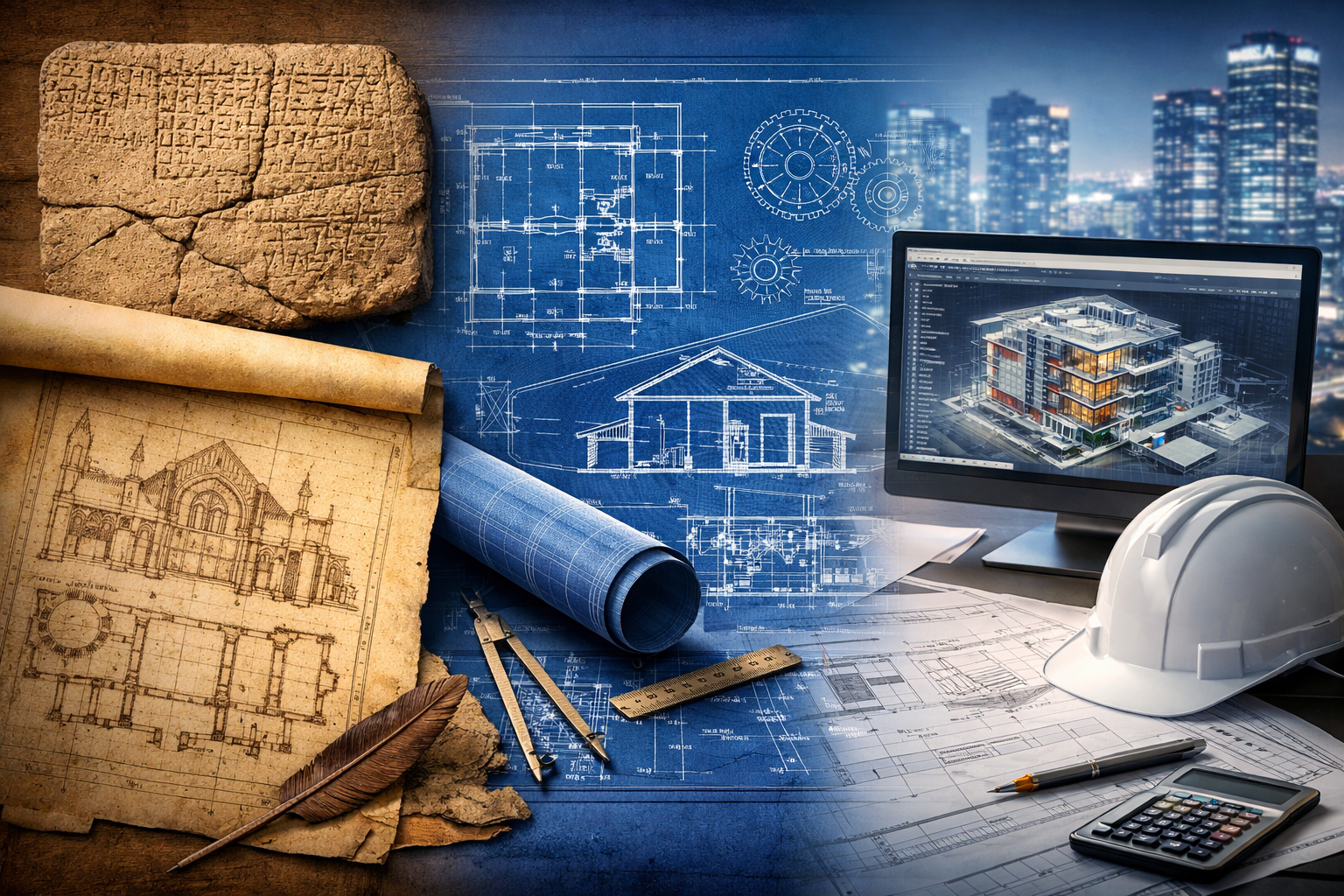
Few tools have shaped the built world as profoundly as the blueprint. Long before skyscrapers, highways, and advanced manufacturing, engineers and builders relied on visual plans to turn ideas into reality. Today these plans exist as highly regulated engineering drawings and construction documents, often requiring PE stamped plans and precise quantitative takeoffs before a single brick is laid.
The blueprint has evolved over thousands of years—from simple sketches scratched into stone to the complex digital models used in modern architecture and engineering. Understanding the history of construction blueprints reveals not only how design documentation has evolved, but also how engineering standards and safety regulations developed alongside them.
This article traces the history of blueprints from the earliest known building plans to modern engineering drawings used in construction, infrastructure, and manufacturing.
The Earliest Engineering Drawings in Ancient Civilizations
The concept of a blueprint—visual instructions for building something—predates the modern world by thousands of years. The earliest examples of engineering drawings and architectural plans date back to ancient civilizations in Mesopotamia and Egypt.
One of the oldest known construction plans is a Babylonian clay tablet from around 2000 BCE, which depicts a scaled map of land boundaries and irrigation canals. These diagrams were used to guide construction and manage agricultural infrastructure. Although primitive compared to modern engineering drawings, they demonstrate an early understanding of spatial planning and measurement.
Ancient Egyptians also relied on drawn plans when constructing monumental architecture. The building of pyramids, temples, and tomb complexes required careful planning. Archaeological discoveries include fragments of papyrus containing grid layouts and construction sketches used to organize building projects. These early construction drawings helped coordinate massive labor forces and ensured structural accuracy during construction.
Even at this early stage, several principles that still exist in modern construction blueprints were already emerging:
- Scaled layouts
- Geometric planning
- Construction sequencing
- Visual communication of design intent
While these ancient plans lacked the precision of modern engineering drawings, they represent the first steps toward the systematic documentation of construction.
Greek and Roman Advancements in Construction Documentation
The Greeks and Romans expanded the use of architectural drawings as engineering knowledge advanced. These civilizations developed large infrastructure networks that required careful planning, including:
- Aqueduct systems
- Bridges
- Public baths
- Roads and highways
- Amphitheaters
Roman architect and engineer Vitruvius, writing in the first century BCE, described architectural drawing techniques in his famous treatise De Architectura. Vitruvius outlined three important types of architectural drawings:
- Plan (ichnographia) – a top-down view of a structure
- Elevation (orthographia) – the vertical exterior view
- Perspective (scaenographia) – a three-dimensional representation
These concepts remain fundamental components of modern engineering drawings and construction documents.
Roman engineers relied on detailed plans to coordinate the construction of vast infrastructure projects. Aqueducts such as the Pont du Gard in France required precise measurements, surveying, and structural calculations. Without accurate drawings, coordinating projects on this scale would have been impossible.
Roman engineering drawings laid the foundation for later architectural documentation practices used in Europe for centuries.
Medieval Cathedral Builders and the Growth of Architectural Planning
Following the fall of the Roman Empire, large-scale construction projects became less common for several centuries. However, during the Middle Ages, the construction of massive cathedrals revived the need for sophisticated architectural drawings.
Gothic cathedrals required extremely precise planning due to their complex structural systems, including:
- Ribbed vaults
- Flying buttresses
- Massive stained glass windows
- Intricate stone tracery
Master builders created large parchment drawings to guide construction teams. One famous example is the Plan of St. Gall, an early medieval architectural drawing from the ninth century depicting a complete monastery complex. Although the plan was never built exactly as shown, it illustrates how medieval builders used drawings to organize large construction projects.
During this period, architectural drawings began to include more detailed instructions for craftsmen. Stonecutters, carpenters, and masons relied on these drawings to shape structural elements with precision.
The growing complexity of construction demanded increasingly detailed documentation, foreshadowing the construction document sets used in modern projects.
Renaissance Engineering Drawings and Leonardo da Vinci
The Renaissance ushered in an explosion of innovation in engineering, art, and science. Architects and engineers began producing highly detailed technical drawings to illustrate both buildings and mechanical devices.
One of the most famous figures in this movement was Leonardo da Vinci, whose notebooks contain hundreds of detailed sketches of machines, bridges, weapons, and mechanical systems.
Leonardo’s engineering drawings included features that resemble modern technical documentation, such as:
- Detailed annotations
- Exploded views of mechanical assemblies
- Dimensional measurements
- Sequential illustrations of moving parts
These drawings helped communicate complex mechanical concepts and are considered early examples of modern engineering drawings.
During the Renaissance, architects such as Filippo Brunelleschi and Andrea Palladio also advanced architectural drawing techniques. Their work introduced improved methods for perspective, proportion, and measurement. However, one major limitation remained: every drawing had to be created individually by hand.
The Invention of the Blueprint (1842)
The modern blueprint was born in 1842, when British scientist Sir John Herschel invented the cyanotype process, a chemical method for reproducing technical drawings. This process allowed architects and engineers to create multiple copies of drawings quickly and cheaply.
The cyanotype blueprint process worked as follows:
- Paper was coated with light-sensitive chemicals.
- A translucent drawing was placed on top of the paper.
- The paper was exposed to ultraviolet light.
- The exposed areas turned deep blue while the drawn lines remained white.
The result was the familiar white lines on a blue background that gave the blueprint its name.
For the first time in history, engineers could distribute identical copies of construction blueprints to multiple stakeholders involved in a project.
This innovation dramatically improved collaboration among:
- Architects
- Engineers
- Contractors
- Builders
- Government regulators
The blueprint revolutionized the construction industry during the Industrial Revolution.
Blueprints and the Rise of Industrial Engineering
As industrialization accelerated during the late nineteenth and early twentieth centuries, blueprints became essential for large engineering projects.
Factories, railroads, bridges, and ships required thousands of components to be built with precision. Standardized engineering drawings allowed manufacturers to produce parts that fit together accurately.
Blueprints were widely used in industries such as:
- Railroad construction
- Shipbuilding
- Bridge engineering
- Machinery manufacturing
- Early skyscraper construction
Engineering firms developed standardized drawing conventions that are still used today.
These conventions included:
- Dimensioning systems
- Symbol standards
- Material specifications
- Structural details
Blueprint sets also became more complex, evolving into complete construction document packages that included multiple sheets for different disciplines.
From Blueprints to Modern Construction Documents
Although the word “blueprint” remains common today, traditional cyanotype printing gradually disappeared during the twentieth century.
New reproduction technologies replaced the original blueprint process, including:
- Diazo printing (whiteprints)
- Photographic reproduction
- Large-format photocopying
These technologies produced drawings with dark lines on white backgrounds, making them easier to read and annotate. However, the terminology stuck. Even today, people commonly refer to construction documents and engineering drawings as blueprints, regardless of the printing method. Modern construction projects rely on highly detailed sets of drawings that may include dozens or even hundreds of sheets.
Typical construction document packages include:
- Site plans
- Architectural floor plans
- Structural engineering drawings
- Mechanical system layouts
- Electrical plans
- Plumbing diagrams
- Construction details and sections
- Material specifications
These documents serve as the official instructions for building a project.
Computer-Aided Design (CAD) and the Digital Transformation
The next major leap in blueprint technology came with the development of Computer-Aided Design (CAD) in the late twentieth century. CAD software replaced hand drafting with digital drawing tools, allowing engineers to create highly accurate technical drawings.
Some advantages of CAD over traditional drafting include:
- Faster design revisions
- Improved precision
- Automated dimensioning
- Layered drawing systems
- Digital collaboration between teams
CAD also made it possible to store large libraries of design components and reuse them across multiple projects.
Today, many engineering firms have moved beyond CAD into Building Information Modeling (BIM). BIM systems create three-dimensional digital models that integrate architectural, structural, mechanical, and electrical systems into a single coordinated model.
However, even with advanced 3D modeling, projects still produce traditional engineering drawings and construction documents for contractors and regulatory agencies.
Professional Engineering Oversight and PE Stamped Plans
As construction projects grew more complex and public safety became a priority, governments introduced regulations requiring licensed professionals to review and approve engineering drawings.
In many jurisdictions, construction documents must be prepared or reviewed by licensed professionals such as:
- Professional Engineers (PEs)
- Registered Architects (RAs)
These professionals certify the accuracy and safety of the design by placing an official professional seal on the drawings, commonly known as PE stamped plans. A PE stamp indicates that a licensed engineer has taken professional responsibility for the design.
This certification confirms that the plans comply with:
- Engineering best practices
- Building codes
- Safety standards
- Structural requirements
PE stamped plans are required for many types of projects, including:
- Commercial buildings
- Industrial facilities
- Bridges and infrastructure
- Public utilities
- Structural renovations
The requirement for professional oversight ensures that modern construction blueprints and engineering drawings meet rigorous safety standards.
Quantitative Takeoffs and Cost Estimation
In addition to guiding construction, modern blueprints play a critical role in project budgeting and cost control.
Contractors and estimators perform quantitative takeoffs by analyzing engineering drawings and construction documents to calculate the materials and labor required for a project.
A quantitative takeoff may include calculations such as:
- Concrete volume requirements
- Structural steel quantities
- Lumber and framing materials
- Electrical wiring and fixtures
- Mechanical equipment needs
- Plumbing systems and piping
Estimators use these calculations to produce detailed project budgets and construction bids.
Accurate engineering drawings are essential for reliable takeoffs. Even small errors in construction documents can significantly affect project costs. For this reason, design teams often perform multiple rounds of review and coordination before finalizing construction blueprints.
The Future of Engineering Drawings and Construction Documentation
Today’s engineering drawings continue to evolve as digital technology advances. Modern design workflows increasingly integrate technologies such as:
- Building Information Modeling (BIM)
- Digital twin simulations
- Cloud-based collaboration platforms
- Automated quantity extraction
- AI-assisted design tools
These technologies allow engineers and architects to analyze designs more thoroughly before construction begins. Despite these advancements, the fundamental purpose of blueprints remains unchanged.
Whether created on a clay tablet, a sheet of blueprint paper, or a digital BIM model, engineering drawings serve one essential purpose: to communicate exactly how something should be built.
From Ancient Plans to Modern Engineering Standards
The blueprint has traveled an extraordinary journey through human history.
From the first architectural sketches in ancient Mesopotamia to the sophisticated construction documents and PE stamped plans used today, the blueprint has been central to nearly every major engineering achievement.
Modern infrastructure—bridges, highways, skyscrapers, factories, and energy systems—depends on highly detailed engineering drawings and construction blueprints that meet strict professional standards.
While the tools used to create them have evolved dramatically, the blueprint remains one of the most powerful tools in engineering: a precise visual language that transforms ideas into the structures that shape our world.