
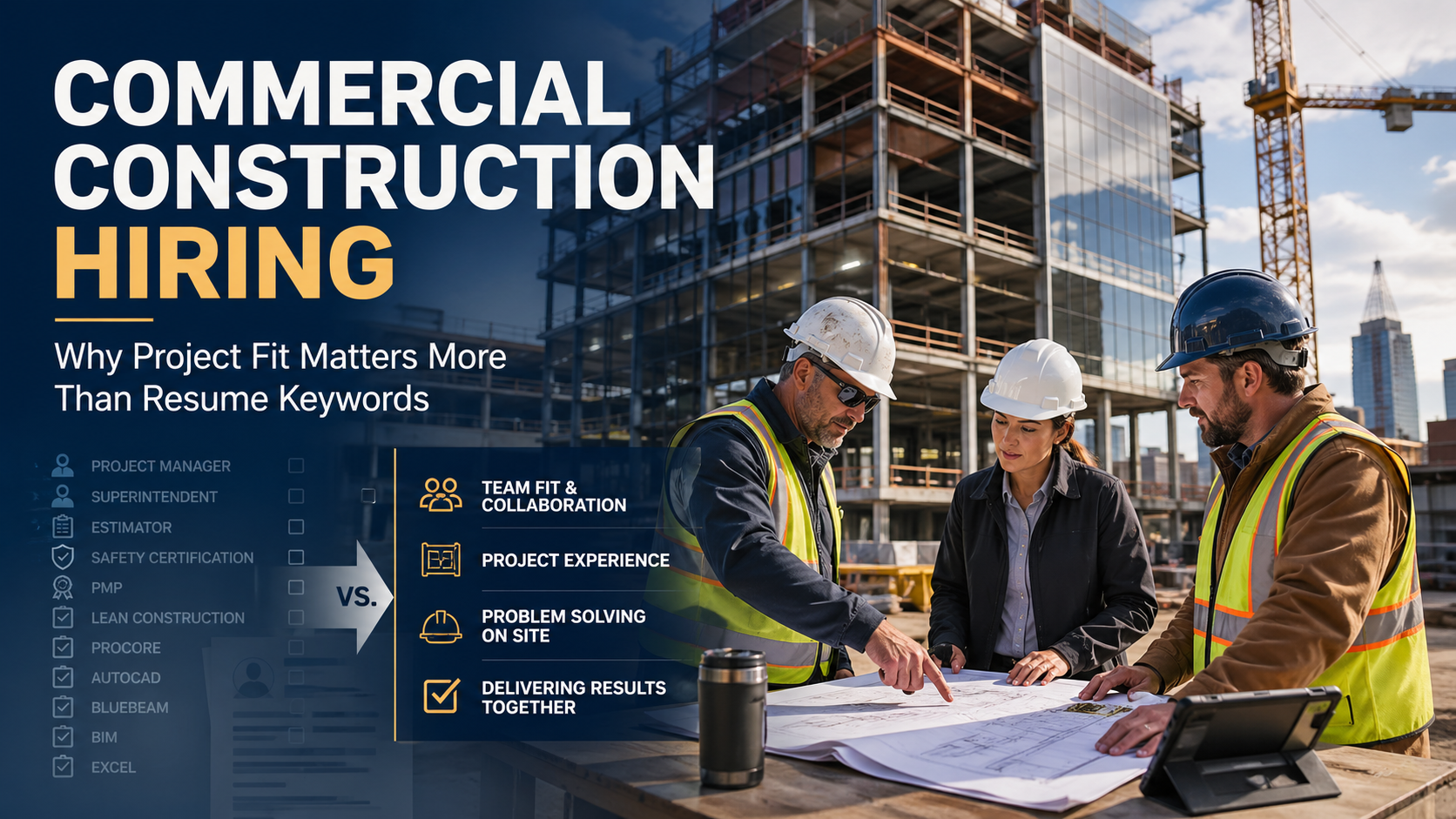
Commercial construction hiring is not just a resume-matching exercise. When the wrong project manager, superintendent, estimator, or construction leader is placed into the wrong project environment, the consequences can show up quickly: schedule delays, subcontractor confusion, owner frustration, missed details, change order disputes, quality problems, and margin pressure.
That is why project fit often matters more than resume keywords.
A candidate may have the right job title, the right software listed, the right certifications, and similar project values on paper. But if they have not worked in the type of construction environment your company actually needs them to manage, they may still struggle to perform. Commercial construction success depends on how well a person fits the project, the team, the delivery method, the owner expectations, and the pace of the work.
For employers hiring in construction, the better question is not simply, “Does this resume match the job description?” It is, “Can this person succeed on this specific project, with this team, under these conditions?”
Why Project Fit Matters More Than Resume Keywords
Resume keywords can help identify basic qualifications. They can show whether a candidate has worked as a project manager, superintendent, estimator, or construction manager. They may also reveal experience with certain software, project types, certifications, or contract values.
But keywords do not tell the full story.
They do not show how a superintendent handles subcontractor conflict on a compressed schedule. They do not explain whether a project manager can manage a demanding owner with aggressive reporting expectations. They do not reveal whether an estimator understands the trade complexity, local market conditions, or preconstruction pressure behind a particular bid.
In commercial construction, two candidates with similar resumes can perform very differently depending on the project environment. A candidate who succeeds on ground-up retail projects may not be the right fit for a phased occupied healthcare renovation. A project manager who has handled large budgets may still struggle in a fast-moving tenant improvement environment. A superintendent who is effective on one type of jobsite may not have the communication style, technical background, or field leadership approach needed for another.
That is where keyword-based hiring falls short.
What “Project Fit” Means in Commercial Construction
Project fit is the alignment between a candidate’s real-world experience and the actual demands of the project, company, and team.
For commercial construction employers, project fit may include:
Project type. Has the candidate worked on similar commercial projects, such as office, retail, healthcare, education, hospitality, industrial, mixed-use, tenant improvement, or institutional work?
Project size and complexity. Has the candidate managed work with similar budgets, schedules, phasing, trade coordination, and technical requirements?
Delivery method. Does the candidate have experience with design-build, design-bid-build, negotiated work, construction management, or fast-track delivery?
Schedule pressure. Can the candidate operate effectively when timelines are tight and decisions must be made quickly?
Owner and client expectations. Has the candidate worked with owners who require detailed reporting, frequent communication, documentation discipline, and proactive issue management?
Subcontractor coordination. Does the candidate know how to manage multiple trades, resolve conflicts, maintain accountability, and keep work moving in the field?
Field leadership style. Does the person lead with structure, urgency, clarity, and respect? Or do they need a different environment to be effective?
Safety and quality expectations. Has the candidate worked in environments where safety standards, inspections, documentation, and quality control are especially demanding?
Company structure. Will the candidate fit a lean contractor where people wear multiple hats, or do they need the support structure of a larger organization?
These factors rarely appear clearly in resume keywords. They must be uncovered through deeper screening, project-specific questioning, reference checks, and construction recruiting expertise.
Where Keyword-Based Hiring Falls Short
A resume can tell you what someone has done. It cannot always tell you how they did it, under what conditions, or whether that experience transfers to your project.
For example, a superintendent may list “commercial construction” and “ground-up projects” on a resume. That sounds relevant. But if your project is a phased renovation in an occupied facility, the fit may not be strong. Occupied work requires different planning, communication, safety awareness, disruption control, and stakeholder management.
A project manager may show experience with similar project values. But project value alone does not prove fit. A $20 million project with a cooperative owner, long schedule, and repeat subcontractor base is very different from a $20 million project with intense owner involvement, design changes, procurement challenges, and strict completion penalties.
An estimator may list the right software and project types. But software proficiency does not guarantee they understand trade scopes, local subcontractor markets, escalation risk, incomplete drawings, or how to support preconstruction strategy.
Keyword screening often overvalues surface-level matches and undervalues execution ability.
That can lead employers to interview candidates who look qualified on paper but are not suited for the actual work.
Roles Where Project Fit Is Especially Important
Project fit matters across many commercial construction roles, but it is especially important for positions that directly affect schedule, cost, coordination, and client satisfaction.
Commercial Construction Project Managers
Project managers must balance budgets, schedules, subcontractors, owners, documentation, internal teams, and field issues. The right project manager is not just someone who has managed similar dollar values. They need the right communication style, contract awareness, decision-making ability, and project background for the specific environment.
A project manager who thrives in structured, well-resourced organizations may struggle in a lean contractor environment. Another may be excellent with repeat private clients but less effective with public-sector documentation requirements. Fit matters.
Superintendents
Superintendents are often the daily force behind field execution. They coordinate trades, enforce safety, manage sequencing, solve jobsite problems, and keep the schedule moving.
A superintendent with the right title may still be the wrong fit if they lack experience with the project type, site constraints, subcontractor base, phasing requirements, or pace of work. For critical field leadership roles, resume keywords are not enough.
Estimators
Estimators influence which work the company wins and whether that work starts with realistic cost expectations. Project fit for estimators includes trade familiarity, market knowledge, attention to scope gaps, ability to read incomplete documents, and understanding of project risk.
An estimator may know the software but still miss key details if they do not understand the type of commercial work being pursued.
Project Executives and Construction Managers
Senior construction leaders need more than technical experience. They must align with company strategy, client expectations, team structure, risk tolerance, and operational standards.
At this level, poor fit can affect multiple projects, not just one hire.
Schedulers and Preconstruction Professionals
Schedulers and preconstruction professionals must understand how projects are actually built, not just how they appear in planning documents. Their effectiveness depends on practical construction knowledge, communication, sequencing judgment, and experience with similar project conditions.
How Employers Can Evaluate Project Fit More Effectively
To hire stronger commercial construction candidates, employers should define the project environment before screening resumes.
That means getting specific about what the role truly requires.
Instead of starting with a generic job description, identify the conditions that will determine success. What type of project is it? What makes it difficult? What went wrong with the last hire? What kind of owner or client will this person face? How much support will they have? What level of autonomy is required? What type of field or office culture will they enter?
From there, employers can separate must-have experience from nice-to-have credentials.
A certification may be useful. Software experience may matter. A certain project value may be relevant. But those should not outweigh the practical ability to lead, coordinate, estimate, communicate, and execute in the right environment.
Employers should also ask project-specific interview questions, such as:
How have you handled phased construction in an occupied building?
Tell us about a project where subcontractor coordination became a major challenge. What did you do?
What type of owner communication cadence are you used to?
Describe a project where the schedule started slipping. How did you recover?
What types of commercial projects are you strongest in, and which are outside your comfort zone?
How do you manage conflict between field conditions, subcontractors, and office expectations?
These questions reveal more than resume keywords. They show how the candidate thinks, communicates, solves problems, and applies experience.
Reference checks should also focus on execution, accountability, communication, and team interaction. Instead of only confirming dates and titles, employers should ask how the candidate performed under pressure, how they worked with subcontractors, how they handled documentation, and whether they were trusted with difficult project situations.
Why a Specialized Construction Recruiter Can Help
Commercial construction hiring becomes more effective when the recruiting process looks beyond job titles and keyword matches.
DAVRON specializes in recruiting for construction, engineering, architecture, and manufacturing roles. That specialized focus matters because construction employers often need candidates who fit highly specific technical, project, and operational requirements—not just people who appear in a database search.
A specialized recruiter can help clarify the real hiring need, identify candidates with relevant project backgrounds, ask better screening questions, and evaluate whether a candidate’s experience aligns with the actual work. This is especially valuable when the role is urgent, project-critical, or difficult to fill.
For employers, this can reduce wasted interview time and improve the quality of candidates entering the hiring process. Instead of sorting through resumes that only match surface-level terms, employers can focus on candidates whose experience is more closely aligned with the project, company, and role.
DAVRON’s construction recruiting focus helps employers approach hiring with more precision, especially when filling roles such as project managers, superintendents, estimators, construction managers, project executives, and other project-critical positions. This aligns with DAVRON’s broader purpose of helping employers hire specialized professionals in construction, engineering, architecture, and manufacturing.
The Better Hiring Question
Commercial construction hiring should not stop at resume keywords.
Keywords may help identify candidates who appear qualified, but project fit determines whether they can succeed in the specific environment your company needs them to enter. For project-critical construction roles, the wrong fit can create delays, communication problems, field disruption, client dissatisfaction, and added cost.
The better approach is to define the project need clearly, evaluate candidates against real job conditions, and prioritize alignment over surface-level resume matches.
When the role affects schedule, profitability, client relationships, or field execution, hiring for project fit is not optional. It is one of the most important ways to reduce risk and improve project outcomes.
Ready to hire engineering, architecture, construction, or manufacturing professionals?
DAVRON specializes in delivering high-quality candidates in these industries.