
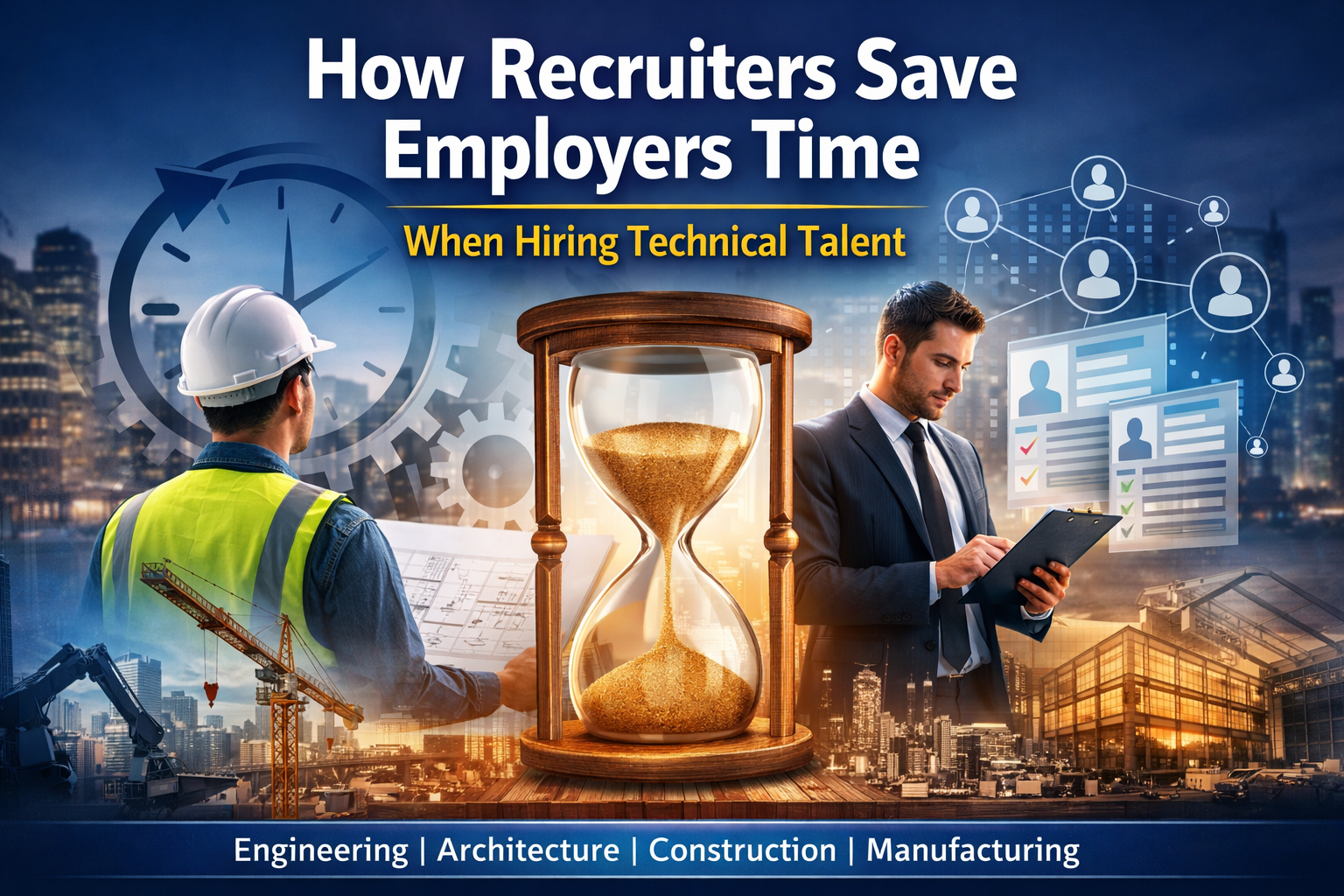
When a critical role stays open too long, the problem reaches far beyond HR. Projects slow down. Managers spend hours reviewing weak resumes. Production timelines slip. Internal teams get pulled away from revenue-generating, operational, and leadership priorities just to keep the hiring process moving.
That is where recruiters can save employers significant time.
For companies hiring engineers, architects, construction professionals, and manufacturing talent, a recruiter does not just help fill a role. A good recruiter removes bottlenecks from the hiring process, improves candidate flow, reduces wasted interviews, and helps employers move faster with better-qualified people.
How do recruiters save employers time?
Recruiters save employers time by taking over the most time-consuming parts of hiring: sourcing candidates, screening for fit, managing outreach, coordinating the process, and reducing the chance of a failed search. For technical and hard-to-fill roles, that time savings can be substantial because the talent pool is smaller, the qualifications are more specific, and the cost of delay is often much higher.
Recruiters speed up sourcing
One of the biggest time drains in hiring is simply finding the right candidates.
When employers try to fill technical roles internally, the process often starts with posting a job, waiting for applicants, and sorting through a mix of qualified, semi-qualified, and irrelevant resumes. That approach can work for some positions, but it becomes much slower when the role requires niche experience, industry-specific knowledge, or a hard-to-find combination of skills.
Recruiters save time by doing targeted sourcing instead of waiting for the right person to apply. They identify candidates who already align with the role, search within relevant technical markets, and reach out directly to qualified professionals. For employers, this cuts down the time spent hunting for talent and helps move the search forward sooner.
Recruiters reduce resume overload
Many employers do not have a candidate shortage problem. They have a filtering problem.
A hiring manager may receive dozens of resumes, but only a handful may actually fit the role. Reviewing those resumes still takes time, and when multiple stakeholders are involved, the screening burden grows quickly.
Recruiters save time by pre-screening candidates before the employer ever sees them. That includes evaluating technical background, industry experience, role alignment, compensation fit, location factors, timeline, and overall professionalism. Instead of reviewing a large pile of uncertain applicants, employers can focus on a smaller group of candidates who are already more likely to be worth interviewing.
Recruiters help employers reach passive candidates
Many of the strongest technical candidates are not actively applying to jobs.
They may be employed, selective, and unlikely to respond to a public job ad. That creates a major time challenge for employers relying only on inbound applications.
Recruiters save time because they do not depend entirely on active applicants. They can approach passive candidates directly, tap existing networks, and engage professionals who may not otherwise enter the employer’s pipeline.
This matters especially in technical hiring, where the best-fit candidate may already be working for a competitor, a supplier, a consulting firm, or another employer in the same market. Without that reach, employers can spend weeks waiting for the right applicant to appear. With the right recruiter, the search can move faster because the candidate pool expands immediately.
Recruiters streamline the hiring process
Even after candidates are identified, the hiring process itself can consume major internal time.
Someone has to follow up with candidates, answer questions, coordinate schedules, maintain momentum, and keep communication moving between both sides. That work often falls on internal HR teams, hiring managers, or department leaders who already have full workloads.
Recruiters save time by managing much of that process directly. They reduce delays between steps, help keep candidates engaged, and prevent the process from stalling because someone internally is too busy to keep things moving. That support becomes especially valuable when employers are hiring for business-critical roles and cannot afford unnecessary friction.
Recruiters reduce wasted interviews
Interview time is expensive.
When the wrong candidates make it into the interview stage, employers lose hours that should have been spent on operations, leadership, project delivery, or team management. Multiply that across multiple stakeholders, and the time loss becomes significant.
Recruiters help reduce wasted interviews by qualifying candidates more carefully on the front end. A strong recruiter is not just matching keywords on a resume. They are helping determine whether the candidate is actually viable for the role, the company, and the timing of the search.
That can help employers avoid interviewing candidates with the wrong background, spending time on people who are not serious, advancing candidates who are misaligned on compensation, or restarting the search because the shortlist was weak. Saving time in hiring is not only about moving faster. It is also about spending less time on the wrong people.
Recruiters help prevent hiring delays that force a restart
A slow search is costly. A failed search is worse.
When employers spend weeks or months trying to fill a role and still come up short, they often have to restart the entire process. That means reposting, rescreening, re-engaging stakeholders, and losing even more time while the role remains open.
Recruiters help reduce that risk by bringing structure, focus, and market awareness to the search from the start. For technical hiring, this can make a major difference. If the role is difficult to fill and the employer’s process is too broad, too slow, or too reactive, delays compound quickly. A recruiter can help correct that earlier and keep the search from dragging into a costly cycle.
Why specialization matters in technical hiring
Not all recruiters save time equally.
For employers hiring in engineering, architecture, construction, and manufacturing, specialization matters because technical hiring is different from broad general recruiting. The roles are more nuanced. The candidate pools are narrower. The hiring stakes are often tied directly to projects, production, compliance, design execution, leadership capacity, or operational output.
A specialized recruiting firm is more likely to understand the realities of hard-to-fill technical roles, the difference between similar but not interchangeable backgrounds, what employers actually need beyond the job description, where qualified candidates are more likely to be found, and how to evaluate fit in a more relevant way.
That is where DAVRON stands apart.
DAVRON focuses specifically on engineering, architecture, construction, and manufacturing recruiting. That specialization helps employers avoid the inefficiencies that often come with broad, generic recruiting approaches. When a recruiter understands the market they are recruiting in, the process becomes more focused, more relevant, and more efficient.
When using a recruiter saves the most time
Recruiters can be valuable in many hiring situations, but they tend to save the most time when the role is difficult, urgent, or business-critical.
That is often true when an employer is dealing with an urgent opening, a hard-to-fill technical role, a confidential search, or a position tied directly to production, project deadlines, revenue, or team performance. It is also especially useful when internal HR or hiring managers do not have the bandwidth to manage the process well, or when a hiring effort has already stalled and candidate flow has been weak.
In these situations, the biggest issue is not just hiring workload. It is business disruption. The longer the search takes, the more pressure builds on the rest of the organization.
The real time savings is broader than recruiting
Employers sometimes think about recruiter value only in terms of how many hours are saved by HR. But the actual time savings is usually much broader.
A recruiter can reduce the burden on hiring managers, department leaders, project teams, executives, and internal recruiting staff. That is why recruiter value is not just administrative convenience. It is operational leverage.
When employers work with the right recruiting partner, they can spend less time managing hiring friction and more time running the business.
Final takeaway
Recruiters save employers time by making hiring more focused, more efficient, and less disruptive. They help employers find qualified candidates faster, reduce screening burden, streamline communication, improve interview quality, and lower the risk of costly delays.
For employers hiring technical professionals, that time savings can directly affect project execution, production continuity, leadership capacity, and business performance.
When the role is important and the search cannot afford to drag, a specialized recruiting partner can make the process meaningfully faster and more effective.
Ready to hire engineering, architecture, construction, or manufacturing professionals?
DAVRON specializes in delivering high-quality candidates in these industries.