
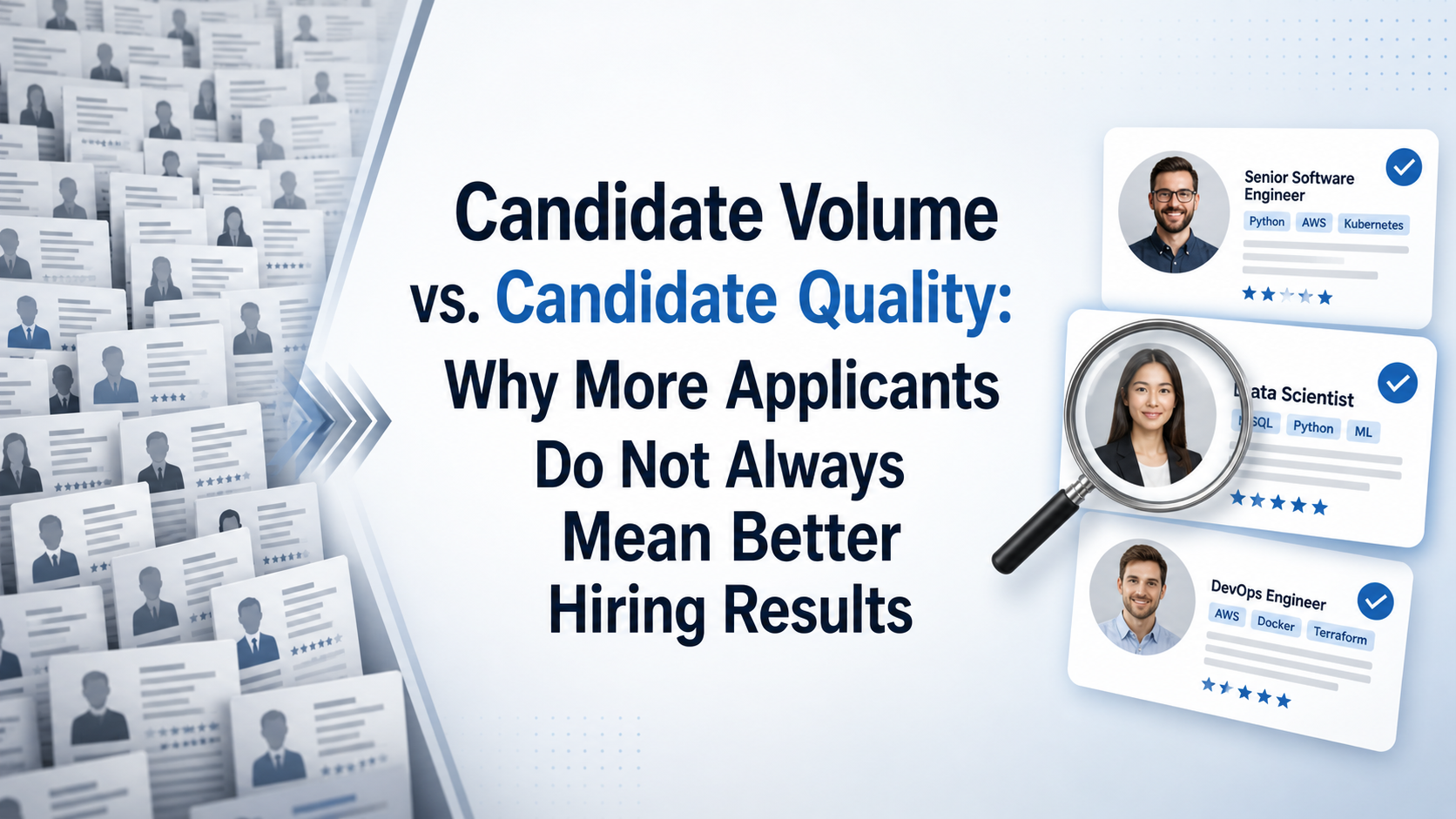
A full inbox of resumes can look like recruiting progress. For many employers, it feels reassuring to see dozens or even hundreds of applicants respond to a job posting.
But volume is not the same as hiring momentum.
If most candidates lack the right technical background, industry experience, compensation alignment, location fit, licensing, or motivation to make a move, your hiring team is not closer to filling the role. They are simply spending more time sorting through weak matches.
For employers hiring in engineering, architecture, construction, and manufacturing, this difference matters. These roles often affect project delivery, production schedules, client commitments, design timelines, field execution, and operational performance. When the wrong candidates keep entering the process, hiring slows down and business pressure increases.
The goal is not to see more resumes. The goal is to see more relevant candidates.
What Is the Difference Between Candidate Volume and Candidate Quality?
Candidate volume refers to the number of applicants, resumes, or profiles generated for an open position.
Candidate quality refers to how closely those candidates match the actual hiring need.
A high-volume recruiting process may produce many names, but many of those candidates may be underqualified, overqualified, outside the right salary range, unavailable, uninterested, or lacking the specific technical experience required for the role.
A quality-focused recruiting process is different. It prioritizes fit, relevance, and hiring probability. Instead of flooding the employer with resumes, it focuses on candidates who are more likely to meet the job requirements, understand the industry, align with the company’s expectations, and move through the hiring process successfully.
For technical hiring, this distinction is critical. A manufacturing engineer, civil engineer, project manager, architect, estimator, superintendent, CAD designer, or quality manager cannot be evaluated by keywords alone. The right fit often depends on industry-specific experience, project type, technical tools, certifications, leadership style, production environment, and career goals.
Why Candidate Volume Can Be Misleading
More candidates can feel like more options. In reality, it can create more work.
When employers receive a large number of weak applications, internal teams must spend time reviewing resumes that were never realistic matches. Hiring managers may need to screen candidates who do not meet the basic technical requirements. HR teams may spend hours coordinating calls that do not lead anywhere.
This creates the appearance of activity without meaningful progress.
High candidate volume can also lead to slower decision-making. When too many resumes enter the process, employers may delay action while trying to compare large numbers of applicants. Strong candidates may lose interest while the company is still sorting through poor-fit resumes.
Volume can also create false confidence. A company may believe its job opening is attracting strong interest because many applicants are coming in. But if the majority are not qualified, the hiring problem remains unresolved.
In specialized hiring, a large applicant pool is only valuable if the right people are in it.
What Candidate Quality Really Means
Candidate quality is not simply about finding someone with an impressive resume. It means identifying candidates who are realistically aligned with the role, the company, and the hiring need.
For employers in engineering, architecture, construction, and manufacturing, quality may include:
Relevant technical experience. The candidate should understand the tools, systems, project types, codes, processes, equipment, or production environments tied to the role.
Industry alignment. A candidate from the wrong industry may not be able to transfer smoothly into the position, especially when the role requires specialized knowledge.
Role-specific qualifications. This may include licenses, certifications, software expertise, field experience, estimating background, project delivery experience, manufacturing process knowledge, or leadership responsibilities.
Compensation fit. A candidate who is far outside the employer’s salary range may not be realistic, even if the resume looks strong.
Location and availability. Commute expectations, relocation interest, hybrid or onsite requirements, and start-date timing can all affect whether a candidate is viable.
Career motivation. A qualified candidate who is not serious about moving forward can waste just as much time as an unqualified applicant.
Long-term alignment. The right hire should not only be able to perform the job but also fit the company’s expectations, growth path, and work environment.
Quality is about relevance. A smaller group of well-matched candidates is often far more valuable than a large pool of resumes that require heavy filtering.
The Hidden Cost of Weak Matches
Weak candidate flow costs more than time. It can affect the business.
When hiring managers repeatedly review poor-fit resumes, they lose time that could be spent managing projects, supporting teams, solving operational issues, serving clients, or keeping production moving. For technical leaders, this distraction can be significant.
Weak matches also create interview waste. Every unproductive interview takes time from managers, HR staff, executives, and team members. When that pattern repeats, the hiring process begins to feel inefficient and frustrating.
In project-driven industries, delays can become especially costly. An unfilled construction management role can affect schedules. An open engineering role can slow design, approvals, production support, or product development. A vacant manufacturing leadership role can strain supervisors, reduce efficiency, or increase pressure on existing staff.
Weak candidate quality can also lead to rushed decisions. When a position stays open too long, employers may lower standards just to fill the seat. That can increase the risk of a bad hire, turnover, performance issues, or additional recruiting costs later.
The problem is not always a lack of applicants. Often, the problem is a lack of the right applicants.
When More Candidates Are Not the Answer
Some hiring problems cannot be solved by widening the funnel.
Posting the job on more boards, increasing ad spend, or asking for more resumes may only increase the number of weak matches. If the role is specialized, confidential, urgent, or difficult to fill, a broader search may not produce better results.
In these situations, employers usually need a sharper process.
That may include clarifying the true role requirements, identifying must-have versus preferred qualifications, targeting passive candidates, improving screening, and working with recruiters who understand the technical market.
For many engineering, architecture, construction, and manufacturing roles, the best candidates are not actively applying to job postings. They may already be employed, selectively open to the right opportunity, or only reachable through direct recruiting.
More candidates are not always the solution. More relevant candidates are.
How Specialized Recruiting Improves Candidate Relevance
A specialized recruiter helps employers reduce noise in the hiring process.
Instead of simply forwarding resumes, a specialized recruiter should understand the role, the market, and the difference between a surface-level match and a serious candidate. This is especially important in technical fields where job titles alone do not tell the full story.
For example, two candidates may both have “project manager” on their resumes, but one may specialize in commercial construction while another comes from manufacturing operations. Two engineers may share the same degree, but their practical experience, software tools, code knowledge, and project background may be completely different.
Specialized recruiting helps identify these differences before candidates reach the employer.
DAVRON focuses on recruiting and staffing for engineering, architecture, construction, and manufacturing. That specialization allows the recruiting process to be more aligned with technical hiring needs. Instead of treating every opening like a generic job order, DAVRON works within industries where role requirements, candidate expectations, and employer challenges are more specialized.
The result is a more focused search designed to save employers time and improve candidate relevance.
What Employers Should Look for Instead of Resume Volume
Employers should not judge recruiting success only by the number of resumes received.
A stronger measure is whether the candidates being presented are realistic, qualified, and worth the hiring manager’s time.
Employers should look for a recruiting process that provides:
Fewer but stronger submissions. A short list of relevant candidates is often more useful than a large stack of weak resumes.
Clear alignment with the role. Candidates should match the actual technical, industry, compensation, and location requirements.
Strong screening before submission. The employer should not have to discover basic mismatches after investing time in the candidate.
Recruiter understanding of the position. A recruiter should be able to discuss the role beyond keywords and job titles.
Transparent communication. Employers need clear feedback on market conditions, candidate availability, compensation expectations, and hiring obstacles.
A process that saves time. Recruiting support should reduce the employer’s workload, not create more sorting and screening.
The best recruiting process gives hiring teams more confidence, not more clutter.
Why Candidate Quality Matters More in Technical Hiring
Technical hiring leaves less room for guesswork.
In engineering, architecture, construction, and manufacturing, the wrong hire can affect schedules, quality, safety, compliance, production, design accuracy, client satisfaction, and team performance. These are not roles where employers can rely only on resume volume and hope the right person appears.
A quality candidate can step into the environment with the right foundation. They understand the type of work, the pace, the technical expectations, and the business impact of the role.
That does not mean every candidate must be perfect. It means each candidate presented should be relevant enough to deserve serious consideration.
That is where specialized recruiting creates value. It helps employers move away from resume overload and toward a more efficient, focused hiring process.
Stop Sorting Through Weak Matches
When employers confuse candidate volume with candidate quality, the hiring process can become slower, heavier, and less effective.
A large applicant pool may look productive, but if the candidates are not aligned with the role, the employer still has to carry the burden of screening, rejecting, re-posting, interviewing, and waiting.
For specialized roles, relevance matters more than volume.
DAVRON helps employers stop sorting through weak matches by delivering more relevant candidates for engineering, architecture, construction, and manufacturing positions. With a focused recruiting process and industry-specific expertise, DAVRON supports employers that need qualified candidates without wasting valuable time on poor-fit resumes.
Stop sorting through weak matches. Let DAVRON deliver more relevant candidates.
Ready to hire engineering, architecture, construction, or manufacturing professionals?
DAVRON specializes in delivering high-quality candidates in these industries.