
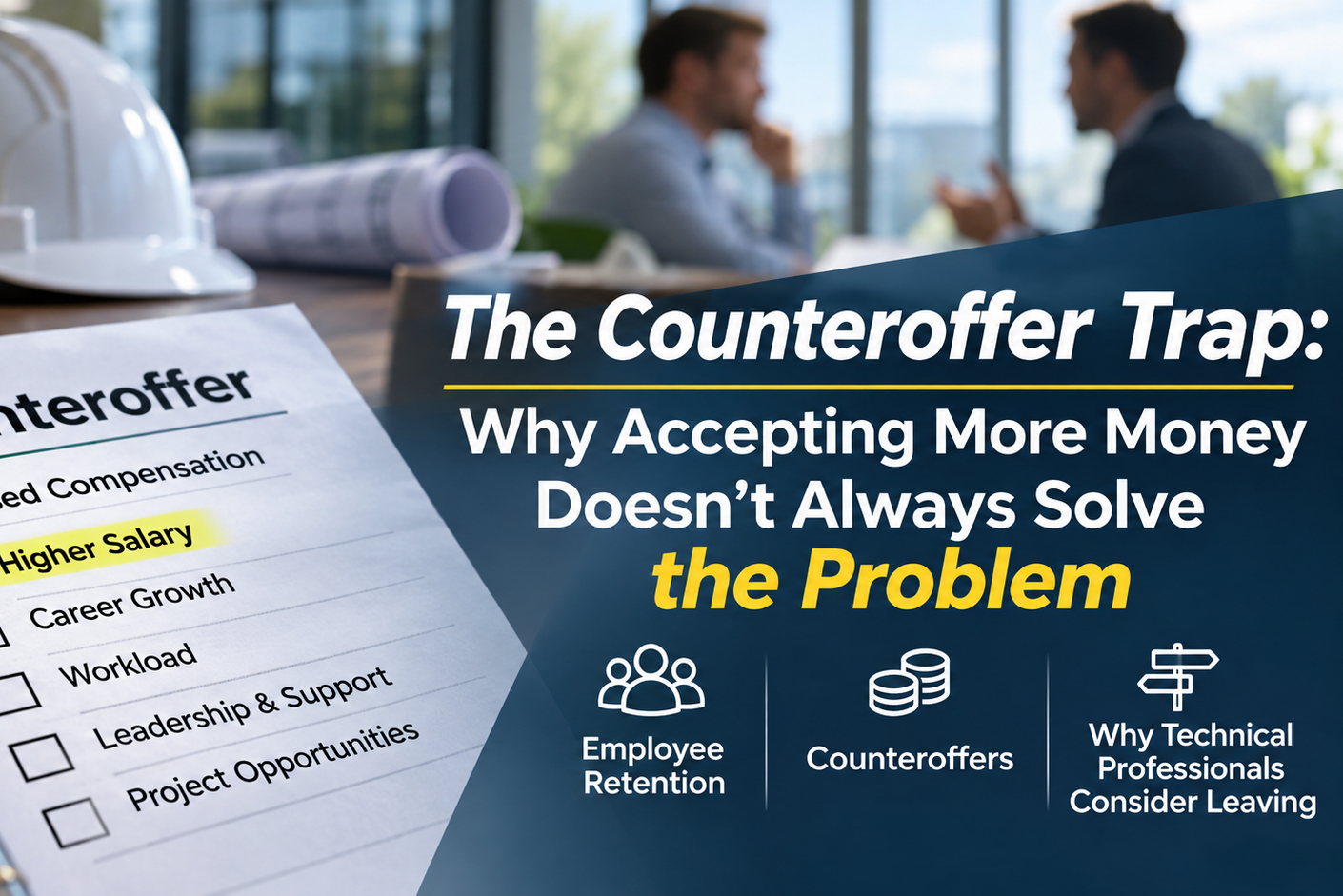
Your best engineer just resigned. A critical project is underway, deadlines are approaching, and replacing that employee could take weeks or months. Management responds with a substantial salary increase, hoping to convince the employee to stay.
The employee accepts.
Problem solved?
Not necessarily.
For engineering firms, architecture practices, construction companies, and manufacturers, losing an experienced technical professional can disrupt far more than the hiring schedule. It can delay projects, reduce productivity, increase pressure on remaining employees, and jeopardize customer commitments.
A counteroffer may prevent an immediate departure, but it does not automatically resolve the reasons an employee wanted to leave.
The counteroffer trap occurs when an employer uses additional compensation to retain an employee without addressing the underlying problems that caused the resignation.
Sometimes, more money is exactly what an employee needs. Other times, it simply postpones an inevitable departure.
For employers managing specialized technical teams, understanding that difference can protect both employee retention and business continuity.
Why Do Engineers and Technical Professionals Leave Their Jobs?
Compensation matters, but salary is only one factor influencing whether an experienced technical professional stays with an employer.
Engineers, architects, construction managers, and manufacturing specialists often consider new opportunities because they believe another organization can offer something their current employer cannot.
1. Limited Career Advancement
An experienced mechanical engineer may have spent years developing specialized technical expertise but see no clear path toward a senior engineering or leadership position.
A construction project manager may want responsibility for larger projects but repeatedly find those opportunities assigned elsewhere.
When employees believe their professional growth has stalled, a higher salary may not change their long-term outlook.
2. Poor Leadership or Management Practices
Technical professionals frequently work under demanding project schedules, production requirements, and customer expectations.
When management consistently sets unrealistic deadlines, ignores technical recommendations, or fails to provide adequate resources, frustration can accumulate.
An engineer who feels their expertise is disregarded may value professional autonomy and effective leadership more than an additional salary increase.
3. Excessive Workloads and Burnout
Consider a manufacturing engineer responsible for process improvements, equipment troubleshooting, production support, and multiple capital projects.
If that employee is consistently working extended hours because the department is understaffed, additional compensation does not necessarily make the workload sustainable.
Without operational changes, the original reason for leaving remains.
4. Better Technical Opportunities
Technical professionals often want exposure to new technologies, challenging projects, modern equipment, or specialized responsibilities.
A civil engineer may want to transition into larger infrastructure projects. An architect may seek more design responsibility. A manufacturing professional may want experience with advanced automation.
A counteroffer cannot always provide the professional opportunities available elsewhere.
5. Compensation That Has Fallen Behind
Sometimes the issue really is money.
An experienced engineer may discover that their salary no longer reflects their responsibilities, technical expertise, or the compensation available for comparable positions.
In these situations, a well-structured salary adjustment can be an effective retention tool.
The key is determining whether compensation is the primary problem or simply one of several reasons the employee wants to leave.
What Is the Counteroffer Trap?
The counteroffer trap occurs when an employer focuses on preventing an employee’s immediate departure rather than understanding why the employee decided to resign.
Imagine a senior electrical engineer who has repeatedly requested additional project support and opportunities for advancement.
After receiving an outside offer, the engineer submits a resignation.
The employer responds with a $15,000 salary increase.
The employee accepts, but the company makes no changes to project assignments, staffing levels, management practices, or advancement opportunities.
Three months later, the engineer is still experiencing the same frustrations.
The higher salary solved the immediate compensation question. It did not solve the underlying employment problem.
This does not mean the engineer will inevitably leave. It means the employer has retained the employee without necessarily reducing the factors that created the original turnover risk.
A successful counteroffer should address the reason for leaving, not merely the act of resigning.
When Does a Counteroffer Actually Work?
Counteroffers are not inherently bad decisions.
For some employers, retaining a valued technical professional through a compensation adjustment is significantly more practical than recruiting and onboarding a replacement.
A counteroffer may be effective when:
Compensation is the employee’s primary concern.
The employee genuinely wants to remain with the organization.
Management understands the reasons behind the resignation.
The employer can realistically address those concerns.
The proposed compensation is sustainable and consistent with the organization’s broader pay structure.
Both parties agree on clear expectations moving forward.
For example, a mechanical engineer who enjoys their responsibilities, trusts management, and sees long-term advancement opportunities may simply have fallen behind market compensation.
Correcting that salary gap could be an appropriate retention decision.
However, an engineer who has lost confidence in leadership or wants a fundamentally different career path may not be persuaded by compensation alone.
Employers should distinguish between an employee who wants to stay under better conditions and an employee who has already decided to move on.
The Hidden Business Costs of Counteroffers That Fail
When a counteroffer does not resolve the underlying retention problem, the employer may face more than another resignation.
The company may also lose valuable time that could have been spent preparing for a transition.
Project Delays and Operational Disruption
Technical professionals often hold specialized knowledge that cannot be transferred immediately.
A senior civil engineer may oversee important design decisions and client relationships. A construction superintendent may coordinate subcontractors, inspections, schedules, and field operations.
If one of these employees eventually leaves after an unsuccessful retention effort, the company may struggle to maintain project continuity.
Lost Productivity
When a critical technical position becomes vacant, responsibilities frequently shift to other employees.
Those employees may already be managing demanding workloads.
Additional responsibilities can slow existing projects, create overtime expenses, and increase the risk of mistakes.
Recruiting and Onboarding Expenses
Replacing an experienced technical professional involves more than posting a job advertisement.
Employers may need to spend time identifying qualified candidates, evaluating technical experience, conducting interviews, negotiating compensation, and onboarding the selected individual.
Even after a replacement begins, it may take time to understand the organization’s systems, customers, projects, and processes.
Internal Compensation Problems
A substantial counteroffer can also create salary compression or internal equity concerns.
If one employee receives a significant increase only after resigning, other valuable employees may question whether their compensation is being reviewed fairly.
Employers should evaluate counteroffers within their broader compensation strategy rather than treating every resignation as an isolated negotiation.
Delayed Succession Planning
Perhaps the greatest risk is assuming that an accepted counteroffer eliminates the need for workforce planning.
If the employee remains dissatisfied, the organization may eventually face the same vacancy with little preparation.
Retaining an employee temporarily is not the same as solving a long-term retention problem.
Counteroffer vs. Replacement Hiring: Which Is the Better Decision?
When a critical employee resigns, employers generally have two immediate options: attempt to retain the employee or prepare to recruit a replacement.
Neither option is automatically better.
| Decision Factor | Making a Counteroffer | Recruiting a Replacement |
|---|---|---|
| Immediate continuity | May preserve existing project knowledge | Requires transition planning |
| Short-term cost | May increase ongoing compensation | May involve recruiting and onboarding expenses |
| Underlying retention issues | Must be addressed separately | Creates an opportunity to reassess the position |
| Technical knowledge | Preserves institutional expertise if the employee stays | Requires knowledge transfer and training |
| Long-term stability | Depends on whether original concerns are resolved | Depends on candidate fit, onboarding, and retention |
| Hiring timeline | May prevent an immediate vacancy | Requires time to identify and evaluate candidates |
The most effective decision begins with an honest assessment of the employee’s motivations and the organization’s ability to address them.
If the problem is compensation and the employer can correct it sustainably, retention may be the best outcome.
If the employee wants opportunities or working conditions the organization cannot realistically provide, preparing for replacement hiring may be the more responsible decision.
Employers should also consider whether the position itself needs to change.
A resignation can reveal problems involving workload distribution, management structure, job responsibilities, or career development that should be corrected before another employee enters the role.
How Can Employers Prevent Counteroffer Situations?
The best time to address employee retention is before a valuable technical professional begins interviewing elsewhere.
Companies that wait until an employee resigns have fewer options and less time to make thoughtful decisions.
Review Technical Compensation Proactively
Engineering and manufacturing compensation should be evaluated against relevant roles, responsibilities, geography, experience, and technical specialization.
Employers should avoid relying exclusively on annual percentage increases when responsibilities have expanded significantly.
Create Meaningful Career Paths
Not every engineer wants to become a manager.
Organizations should consider advancement opportunities for both technical specialists and employees pursuing leadership responsibilities.
Senior technical positions, mentorship opportunities, project leadership, and professional development can help employees see a future within the organization.
Address Workload Problems
If an experienced engineer is consistently overwhelmed, the solution may require additional staffing rather than additional compensation.
Employers should evaluate whether critical departments have sufficient personnel to meet operational demands.
Improve Management Communication
Regular conversations about employee satisfaction, career goals, project challenges, and workplace concerns can reveal retention problems before they lead to resignations.
These discussions should produce meaningful follow-through rather than simply documenting employee feedback.
Build a Technical Talent Pipeline
Even organizations with strong retention practices experience turnover.
Retirements, relocations, career changes, and unexpected resignations can create vacancies at any time.
Maintaining relationships with qualified technical candidates and specialized recruiting partners can help employers prepare for those situations.
For difficult-to-fill engineering, architecture, construction, and manufacturing positions, proactive recruiting preparation is an important part of workforce risk management.
What Should Employers Do When a Critical Technical Employee Resigns?
When an experienced technical professional submits a resignation, employers should respond quickly without making a rushed decision.
Step 1: Understand the Real Reason for Leaving
Conduct a direct, respectful conversation about the employee’s decision.
Determine whether compensation, advancement, leadership, workload, flexibility, or another factor influenced the resignation.
Avoid assuming that a higher salary will automatically change the employee’s mind.
Step 2: Assess the Business Impact
Identify the projects, responsibilities, technical systems, and customer relationships that depend on the employee.
Consider what would happen if the position became vacant immediately.
For project-critical roles, determine whether temporary workload adjustments or additional staffing support will be necessary.
Step 3: Evaluate the Counteroffer
If the employee is open to remaining, determine whether the organization can make a meaningful and sustainable offer.
A counteroffer may involve compensation, responsibilities, advancement opportunities, workload adjustments, or other employment conditions.
Any commitments should be realistic, documented, and supported by management.
Step 4: Protect Institutional Knowledge
Develop a transition plan that identifies important documentation, project status updates, technical procedures, customer information, and outstanding responsibilities.
Knowledge-transfer planning is valuable even when the employee ultimately decides to stay.
Step 5: Prepare a Replacement Recruiting Strategy
If the employee confirms their departure, begin recruiting as soon as practical.
If retention remains uncertain, employers can assess the talent market and develop a contingency plan without prematurely treating the position as vacant.
For specialized technical roles, early preparation can reduce the risk of a prolonged vacancy.
The biggest mistake is waiting until a critical employee’s final day to determine how the organization will replace their expertise.
How DAVRON Helps Employers Navigate Critical Technical Turnover
When a senior engineer, construction manager, architect, or manufacturing specialist leaves, finding a replacement is rarely as simple as advertising the position.
Employers may need candidates with specific technical qualifications, industry experience, project backgrounds, software knowledge, or leadership capabilities.
A general recruiting approach may not adequately address those requirements.
DAVRON specializes in recruiting and staffing professionals across engineering, architecture, construction, and manufacturing.
That industry focus makes DAVRON a relevant recruiting partner for employers dealing with difficult-to-fill technical vacancies and workforce continuity challenges.
Specialized Recruiting for Technical Positions
DAVRON focuses on positions requiring relevant technical and industry experience.
Whether an employer needs a mechanical engineer, civil engineer, construction superintendent, manufacturing engineer, or architecture professional, the recruiting process should reflect the actual demands of the position.
Support for Unexpected Vacancies
When an employee resigns unexpectedly, employers need to evaluate qualified candidates while continuing to manage projects and operations.
DAVRON can support the recruiting process by helping employers identify candidates aligned with their technical requirements and hiring priorities.
Recruiting Beyond the Immediate Vacancy
A resignation can also be an opportunity to reassess the position.
Employers may discover that responsibilities have changed, technical requirements have expanded, or the department needs a different combination of experience and skills.
A specialized recruiting partner can help clarify those requirements before the employer commits to a replacement hire.
A Practical Alternative to Reactive Hiring
Counteroffers and recruiting are not mutually exclusive workforce strategies.
Employers should make reasonable efforts to retain valuable employees while remaining prepared for situations where retention is not possible.
DAVRON provides a specialized recruiting resource for companies that need to replace departing technical professionals or strengthen teams facing staffing shortages.
For employers managing project-critical vacancies, speaking with a recruiter early can help clarify the hiring challenge and establish an appropriate recruiting approach.
Frequently Asked Questions About Counteroffers and Technical Employee Retention
Should an employer make a counteroffer when an engineer resigns?
An employer should consider a counteroffer when the engineer is valuable to the organization, genuinely wants to stay, and has concerns the company can realistically resolve. If compensation is the primary issue, a salary adjustment may be effective. If the resignation stems from poor leadership, limited advancement, or unsustainable workloads, additional compensation alone may not solve the problem.
Why do employees sometimes leave after accepting a counteroffer?
Employees may leave after accepting a counteroffer because the original reasons for their dissatisfaction remain unresolved. A salary increase may improve compensation without changing management practices, career opportunities, workload, or workplace conditions. Employers should address those concerns directly rather than assuming the counteroffer has eliminated turnover risk.
Can a salary increase fix employee retention problems?
A salary increase can improve retention when compensation is the main reason an employee is dissatisfied. However, salary adjustments are less likely to resolve problems involving career stagnation, poor management, excessive workloads, or lack of professional development. Effective retention strategies consider the employee’s overall experience.
What are the risks of making counteroffers to technical employees?
Counteroffers can create additional compensation expenses, internal pay equity concerns, and unrealistic expectations if they are not carefully evaluated. They may also postpone an employee’s departure without resolving the original problem. For critical technical positions, employers should combine retention efforts with appropriate workforce planning.
How can employers retain experienced engineers and manufacturing professionals?
Employers can improve retention by offering competitive compensation, clear career development opportunities, manageable workloads, effective leadership, and meaningful technical responsibilities. Regular employee feedback and proactive staffing decisions can help organizations identify problems before valuable professionals begin pursuing other opportunities.
When should a company start recruiting a replacement for a resigning employee?
Employers should begin replacement planning as soon as a critical employee confirms their departure. For difficult-to-fill technical positions, early recruiting can provide more time to evaluate qualified candidates and coordinate knowledge transfer. If the employee is considering a counteroffer, employers can develop a contingency plan while respecting the employee’s decision-making process.
How can a specialized technical recruiter help when a critical employee leaves?
A specialized technical recruiter can help employers identify candidates with relevant industry experience, evaluate position requirements, and organize a focused recruiting effort. Firms such as DAVRON, which concentrate on engineering, architecture, construction, and manufacturing, can support employers facing specialized vacancies that require more targeted recruiting than a general hiring approach.
The Bottom Line: Retention Requires More Than a Bigger Paycheck
When a valuable technical professional resigns, offering more money may feel like the fastest way to protect the business.
Sometimes it is the right decision.
But when an employee’s dissatisfaction involves leadership, workload, career advancement, or professional opportunity, compensation alone may only delay the departure.
For employers, the real objective should not be winning a salary negotiation. It should be creating a workforce strategy that supports employee satisfaction, project continuity, and long-term business performance.
That means understanding why employees leave, addressing retention problems before they become resignations, and preparing for the possibility that even valuable employees will eventually move on.
When a critical technical vacancy does occur, having access to a specialized recruiting partner can help employers move from reactive hiring toward a more focused replacement strategy.
A counteroffer may keep an employee today. A stronger retention and recruiting strategy helps protect the business tomorrow.
Ready to hire engineering, architecture, construction, or manufacturing professionals?
DAVRON specializes in delivering high-quality candidates in these industries.