
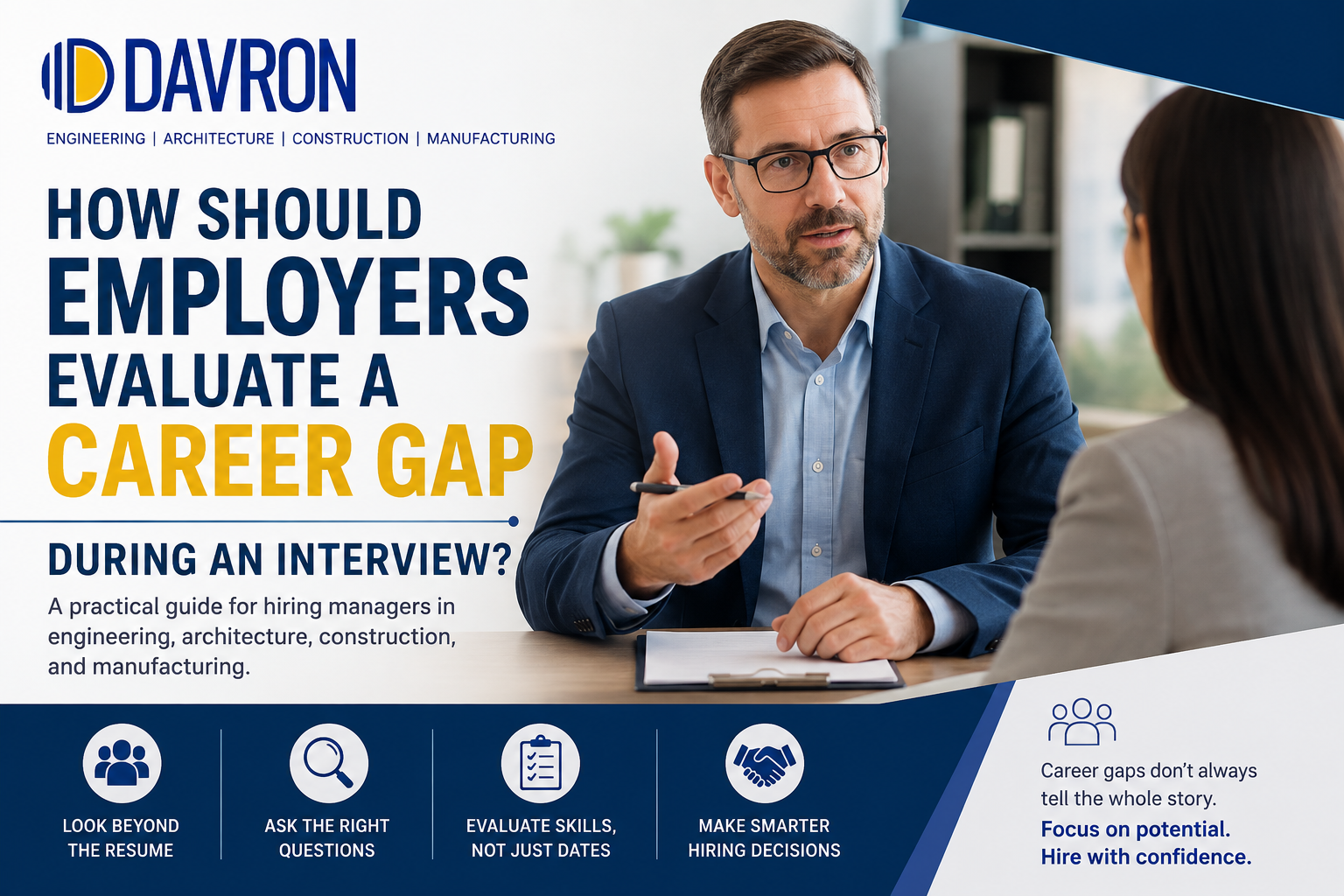
A career gap should not automatically disqualify an otherwise qualified candidate.
For employers, the more useful question is whether the candidate has the experience, technical ability, current knowledge, and motivation required to succeed in the role today. The reason for the employment gap matters, but so does everything surrounding it: what the candidate did during that period, whether their skills remained relevant, and how prepared they are to return to the workforce.
This is especially important when hiring engineers, architects, construction professionals, or manufacturing talent. Employers already competing for specialized candidates can make a difficult search even harder by eliminating experienced professionals simply because their resumes are not perfectly continuous.
Why Career Gaps Deserve Context
Employment gaps happen for many legitimate reasons. A candidate may have stepped away from traditional employment because of:
a layoff or company restructuring
caregiving responsibilities
relocation
education or professional development
personal circumstances
an extended job search
consulting or freelance work
a career transition
an intentional break from full-time employment
The existence of a gap tells an employer relatively little on its own.
A mechanical engineer who spent a year caring for a family member may still possess years of highly relevant design experience. A construction professional affected by a project cancellation or corporate restructuring may still have exactly the field experience an employer needs. An architect who temporarily stepped away from practice may have maintained professional credentials and continued developing relevant skills.
The interview is an opportunity to understand that context rather than make assumptions from dates on a resume.
What Should Employers Ask About a Career Gap?
Employers should keep the conversation professional and focused on the candidate’s qualifications and readiness for the position.
Useful questions include:
“Can you walk me through what you were doing during this period?”
This gives the candidate an opportunity to explain the gap without forcing the employer to speculate.
“How did you keep your technical or professional skills current?”
This can be particularly valuable for engineering, architecture, manufacturing, and other technical positions where software, standards, processes, or regulations may evolve.
“What made you decide this was the right time to return?”
The answer can help an employer understand the candidate’s motivation and current career goals.
“What are you looking for in your next position?”
This shifts the conversation toward future fit instead of keeping the interview focused on the past.
“Have there been important changes in your field that you have had to catch up on?”
A strong candidate does not necessarily need to know everything immediately. What matters is whether the person understands where additional learning may be required and has demonstrated the ability to adapt.
Questions should remain focused on qualifications and job readiness rather than unnecessarily probing into private personal or medical circumstances.
What Does a Strong Career-Gap Explanation Look Like?
Employers do not need candidates to provide an elaborate defense of every month they were out of the workforce.
A strong explanation is usually straightforward.
Look for a candidate who can clearly explain the period, provide a consistent employment history, and move the conversation naturally back toward their qualifications and interest in the opportunity.
Depending on the position, employers may also want evidence that the candidate remained professionally engaged. That could include:
continuing education
certifications
professional association involvement
consulting or freelance assignments
independent projects
training on new software or technology
maintenance of professional licenses
industry research or networking
Not every candidate will have spent a career break building new credentials, nor should that automatically be expected. The central question remains whether the person’s capabilities are relevant to the job now.
When Should a Career Gap Require More Discussion?
A gap itself is not necessarily a warning sign, but certain circumstances may justify additional questions.
For example, an employer may want more information when:
the candidate gives conflicting explanations about their employment history
employment dates do not align with information provided elsewhere
critical technical knowledge appears significantly outdated
the candidate cannot explain what they have been doing professionally
multiple short periods of employment are combined with unexplained gaps
the candidate’s expectations appear poorly aligned with the position
These issues should prompt further evaluation rather than an automatic rejection.
Consider the difference between a candidate who has been away from a particular engineering software package for two years but demonstrates strong underlying technical knowledge and willingness to retrain, versus a candidate whose experience no longer matches the technical demands of the position at all.
The first situation may be manageable. The second may represent a legitimate qualification problem.
The distinction only becomes clear when the employer looks beyond the dates.
The Risk of Screening Career Gaps Too Aggressively
Employers often use resume screening to narrow a large applicant pool quickly. But overly rigid filters can eliminate candidates who might otherwise be strong hires.
That matters even more for difficult-to-fill technical positions.
A company searching for a civil engineer, project manager, construction superintendent, manufacturing engineer, architect, or other specialized professional may already be working with a relatively limited talent pool. Automatically removing everyone with a career gap can make that pool smaller without necessarily improving candidate quality.
An experienced professional may bring valuable assets such as:
years of technical knowledge
project-specific expertise
leadership experience
professional licenses
certifications
industry relationships
familiarity with specialized systems or equipment
knowledge of regulatory or construction requirements
Those qualifications do not disappear because someone spent time away from conventional employment.
Employers should therefore distinguish between an unusual resume and an unqualified candidate. They are not the same thing.
Evaluate the Whole Candidate
A hiring decision should be based on the person’s ability to perform the role, not on whether the resume follows a perfectly uninterrupted timeline.
Depending on the position, evaluate factors such as:
technical qualifications
relevant project experience
industry knowledge
problem-solving ability
certifications and licenses
communication skills
leadership experience
references
recent professional development
motivation for the opportunity
ability to perform the responsibilities of the position
For technical hiring, this broader evaluation is particularly important.
A senior engineer with extensive project experience may require a short period of software retraining but still possess technical judgment that took decades to develop. A construction superintendent returning after time away may retain deep knowledge of scheduling, subcontractor coordination, field operations, and project execution. A manufacturing professional may need exposure to a company’s specific equipment while already understanding the underlying production environment.
Those tradeoffs deserve thoughtful evaluation.
Career Gaps Should Be Considered Alongside the Hiring Need
Employers should also consider the realities of the position they are trying to fill.
If an open technical role is delaying a project, increasing overtime, limiting production, placing pressure on existing employees, or preventing the company from pursuing additional work, unnecessarily narrow screening criteria can extend the problem.
That does not mean employers should lower their standards.
It means the standards should focus on factors that actually predict whether a candidate can perform the job.
If two candidates possess similar qualifications and one happens to have a six-month employment gap, the gap should not automatically become the deciding factor. Employers should determine whether there is meaningful evidence that it affects the candidate’s ability to succeed.
How a Specialized Recruiter Can Help Evaluate Candidates More Effectively
Resume screening rarely tells the complete story.
A specialized recruiter can speak directly with candidates before an employer invests time in an interview and gather additional context about:
employment history
technical experience
reasons for career transitions
career gaps
compensation expectations
location requirements
professional motivations
availability
relevant licenses and certifications
interest in the employer’s specific opportunity
That additional screening can help employers distinguish between a candidate who merely looks unconventional on paper and one who genuinely does not fit the position.
DAVRON specializes in recruiting professionals across engineering, architecture, construction, and manufacturing. That industry focus is particularly useful when evaluating technical candidates because effective screening requires more than matching job titles and dates.
A recruiter’s role is not to excuse legitimate qualification problems. It is to help employers get better information before making a decision.
For hard-to-fill roles, that can also expand the pool of viable candidates. Professionals who might be overlooked through automated screening or rigid resume criteria can instead be evaluated according to their actual technical experience and potential fit.
The Bottom Line
Employers should treat a career gap as a question to understand, not a conclusion about the candidate.
Ask for context. Determine whether the candidate’s skills remain relevant. Evaluate technical qualifications, experience, motivation, and readiness for the position. Then make the hiring decision based on the complete picture.
For employers competing for specialized engineering, architecture, construction, or manufacturing talent, that approach can prevent strong candidates from being rejected for reasons that have little to do with their ability to perform the job.
Ready to hire engineering, architecture, construction, or manufacturing professionals?
DAVRON specializes in delivering high-quality candidates in these industries.