
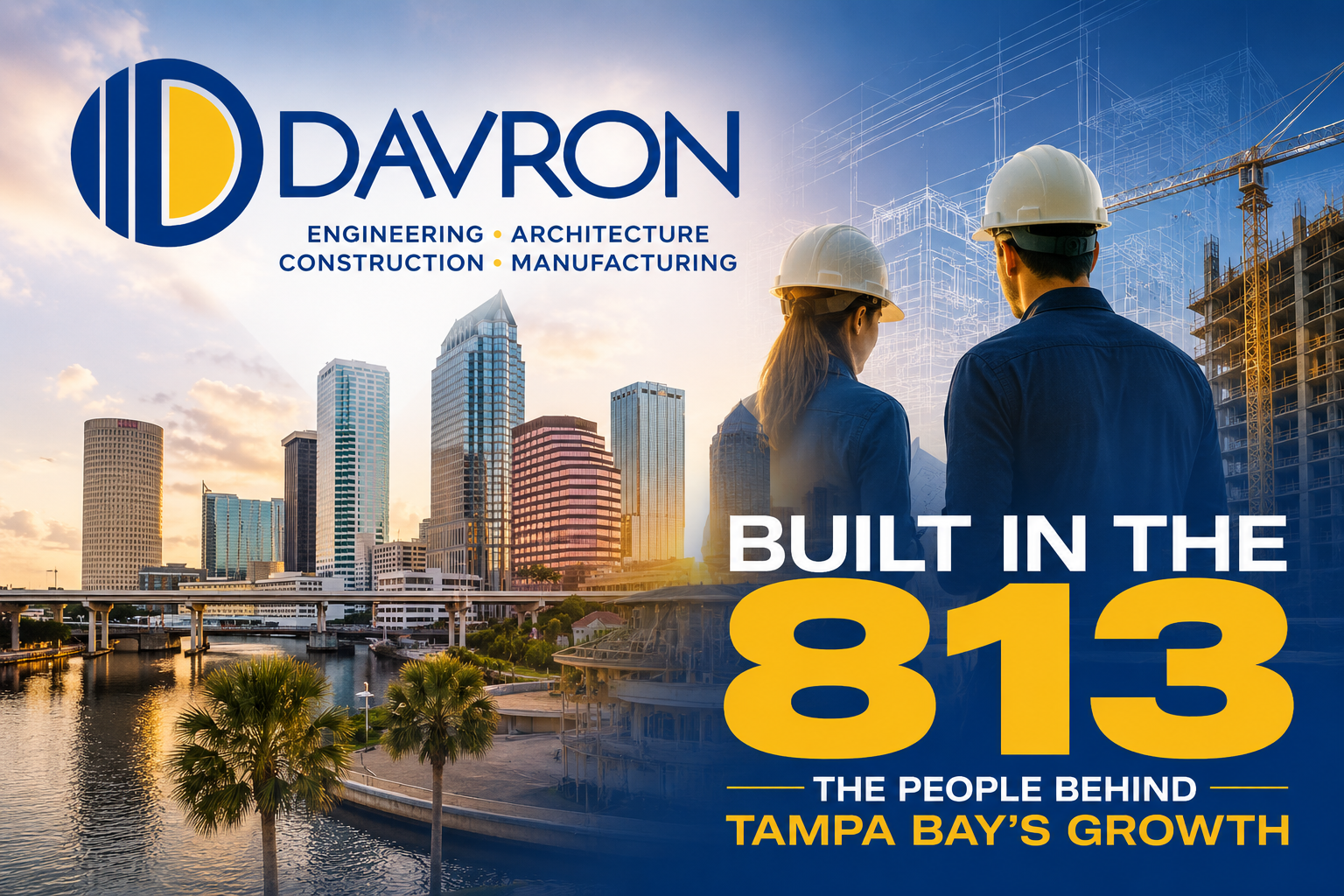
Look around Tampa Bay and the signs of growth are hard to miss. New buildings take shape. Communities expand. Roads and infrastructure evolve. Manufacturing facilities add capacity. Commercial projects move from plans to active job sites.
But Tampa Bay isn’t built by buildings.
It’s built by people.
Behind every completed project are engineers solving technical problems, architects turning ideas into workable designs, project managers coordinating schedules and budgets, superintendents leading construction in the field, designers producing the details, and manufacturing professionals keeping products and operations moving.
For Tampa Bay employers, that creates an important business reality: growth depends on having the right technical people available when the work needs to get done.
A critical vacancy isn’t always just a recruiting problem. When an engineer, project manager, superintendent, designer, or manufacturing professional is needed now, an extended vacancy can affect schedules, workloads, production, delivery, and the organization’s ability to take advantage of new opportunities.
That’s why the people behind Tampa Bay’s growth matter just as much as the growth itself.
What Does It Actually Take to Build Tampa Bay?
A finished building, roadway, manufacturing facility, residential development, or commercial project can make the work behind it look deceptively simple.
It isn’t.
Projects depend on professionals across multiple technical disciplines, often working together for months or years before the public ever sees the finished result.
Engineers Make Ideas Work
Engineers determine how concepts become safe, functional, buildable systems.
Depending on the project, that can involve civil engineers planning site development and infrastructure, structural engineers designing systems capable of supporting the building, mechanical engineers developing HVAC and mechanical systems, and electrical engineers designing power and electrical infrastructure.
Other technical specialists may be responsible for environmental considerations, utilities, transportation, controls, manufacturing processes, or specialized equipment.
Their work is often largely invisible once a project is complete.
But remove the engineering expertise, and the project doesn’t work.
Architects and Designers Turn Requirements Into Reality
Architecture sits at the intersection of vision, functionality, technical requirements, and the needs of the people who will ultimately use a space.
Architects and design professionals help determine how a project should function and how its many requirements fit together.
Behind them may be BIM specialists, CAD designers, drafters, interior designers, technical designers, and other professionals responsible for translating concepts into coordinated information that engineering and construction teams can actually use.
A great concept is only the beginning. Someone has to make it executable.
Construction Professionals Put the Plan on the Ground
Eventually, drawings and specifications have to become something physical.
That’s where construction professionals take over.
Project managers, construction managers, superintendents, estimators, schedulers, coordinators, and other specialists help move work from preconstruction through completion.
They manage competing priorities: cost, schedule, subcontractors, materials, safety, quality, field conditions, changes, client expectations, and deadlines.
When one of these positions sits vacant during an active project, the impact can extend well beyond HR.
Project Managers Keep the Pieces Moving
Technical projects rarely fail because there was only one thing to manage.
They involve dozens—or hundreds—of moving pieces.
Project managers help connect clients, design teams, contractors, vendors, internal stakeholders, schedules, budgets, and deliverables.
In engineering, architecture, construction, and manufacturing environments, an experienced project manager often needs more than general management ability. The employer may need someone who understands a particular project type, technical discipline, software platform, regulatory environment, client base, or construction method.
That specificity is part of what can make these hires difficult.
Manufacturing Professionals Keep Tampa Bay Producing
Not everything being built in the 813 is a building.
Manufacturers rely on engineers and technical professionals to design products, improve processes, maintain quality, increase throughput, automate operations, manage production, and solve problems on the plant floor.
Manufacturing engineers, mechanical engineers, electrical engineers, controls professionals, quality specialists, operations leaders, designers, and other technical talent can directly affect how efficiently a facility operates.
When a critical manufacturing position remains vacant, the problem doesn’t remain confined to recruiting. It can become a production and capacity issue.
From an Idea to a Finished Tampa Bay Project: Who Makes It Happen?
Consider a hypothetical new commercial facility being developed somewhere in Tampa Bay.
Before construction begins, someone has to determine whether the project is feasible.
Civil professionals may evaluate the site. Architects begin developing the design. Engineers determine how structural, mechanical, electrical, plumbing, and other systems will work.
Designers and BIM professionals translate those decisions into detailed documents and models.
Estimators begin putting numbers behind the plans.
Project managers establish schedules, coordinate stakeholders, and keep deliverables moving.
Then construction begins.
Superintendents manage activity in the field. Project managers coordinate budgets, schedules, subcontractors, owners, and changes. Engineers and architects continue resolving technical questions as real-world conditions meet the original plans.
Eventually, the facility opens.
The public sees one finished project.
The employer sees something very different: a chain of specialized professionals whose individual contributions were necessary to get there.
And if one critical link is missing, the entire process can become harder to execute.
Tampa Bay's Growth Creates a Talent Question
For employers, the question isn’t simply whether Tampa Bay will continue to create opportunities.
It’s whether companies can assemble the people required to execute those opportunities.
Technical hiring creates challenges that don’t always exist in broader recruiting.
A company may not simply need “an engineer.” It may need a mechanical engineer with a specific combination of industry experience, software knowledge, project exposure, and client-facing ability.
A contractor may not simply need “a superintendent.” It may need someone who has successfully delivered a particular project type at the appropriate scale.
An architecture firm may need a project architect who understands specific building types and can step into an active workload.
A manufacturer may need an engineer who understands both the technical process and the realities of a production environment.
The more specific the requirements become, the smaller the realistic candidate pool can become.
And many strong technical professionals aren’t spending their days actively applying to job postings.
That is where hiring timelines can start colliding with business timelines.
A project still has a start date.
A client still expects delivery.
Production still has to run.
The existing team still has a workload.
The position may be vacant, but the work usually isn’t.
What Should a Tampa Employer Do When a Critical Role Needs to Be Filled Now?
When an important technical position becomes urgent, the worst response is often to simply post the job in more places and wait.
Employers have several ways to accelerate the search.
Activate Your Existing Network
Employee referrals, former colleagues, vendors, professional organizations, and industry contacts can sometimes uncover qualified candidates quickly.
The limitation is reach. Your team may know excellent people, but those networks can become exhausted quickly—especially for highly specialized positions.
Look Beyond Active Applicants
Some of the strongest candidates may already be employed and performing similar work for another organization.
They aren’t necessarily searching job boards every morning.
Reaching those professionals requires proactive sourcing, direct outreach, and a compelling reason for them to consider making a move.
Reevaluate the Requirements
Urgency is a good reason to determine which qualifications are truly essential.
Does the candidate absolutely need experience with one specific software package, or could an otherwise exceptional candidate learn it?
Does the person need ten years of experience, or does the position actually require a particular level of technical independence?
Separating genuine requirements from preferences can expand the candidate pool without lowering the standard for the hire.
Speed Up the Interview Process
Employers can spend weeks searching for a candidate and then lose that person because the internal decision process takes too long.
When the position is genuinely urgent, the hiring process should reflect that urgency.
Identify decision-makers early. Consolidate interviews where practical. Provide timely feedback. Know the compensation range. Be prepared to move when the right candidate appears.
Speed should not mean careless hiring.
It should mean eliminating unnecessary delay.
Expand the Geographic Search
Some specialized roles may require looking beyond the immediate Tampa Bay candidate pool.
Depending on the position and employer, relocation, hybrid arrangements, or a wider commuting radius may create additional possibilities.
The right search geography should follow the realities of the position rather than an arbitrary boundary.
Bring in a Specialized Recruiter
When internal efforts aren’t producing the right candidates—or the business cannot afford a prolonged vacancy—a specialized recruiter can add another sourcing channel immediately.
The important word is specialized.
Technical recruiting is more effective when the recruiter understands the difference between disciplines, recognizes relevant experience, and knows how to search for professionals whose backgrounds align with the actual position.
For employers facing a project-critical or difficult-to-fill vacancy, that specialization can be particularly valuable.
Why Specialized Recruiting Matters in the 813
DAVRON specializes in the same professional sectors helping build, design, manage, and manufacture Tampa Bay’s future:
Engineering. Architecture. Construction. Manufacturing.
That focus matters because technical positions aren’t interchangeable.
Recruiting a civil engineer requires a different search than recruiting a mechanical engineer. Finding an architect requires a different understanding than sourcing a construction superintendent. A manufacturing engineer working on process improvement presents a different candidate profile from an MEP engineer designing building systems.
DAVRON’s recruiting focus is built around these kinds of technical distinctions. The company positions its recruiting process around specialized industry knowledge, difficult-to-fill technical positions, responsiveness, and direct access to recruiting professionals.
For a Tampa Bay employer, working with a specialized recruiting partner can be especially useful when:
- a critical position has remained open too long;
- job postings aren’t producing candidates with the right experience;
- the strongest potential candidates are likely already employed;
- internal recruiting resources are stretched;
- a project, client commitment, production requirement, or expansion is creating a firm hiring deadline; or
- the position requires a combination of technical qualifications that makes the candidate pool unusually narrow.
The goal isn’t to send an employer the largest possible stack of résumés.
It’s to identify qualified candidates whose backgrounds make sense for the actual role.
The Next Tampa Bay Landmark Starts With a Hire
The next time you pass a construction site in Tampa, see a new development taking shape, drive across infrastructure that didn’t exist a few years ago, enter a newly designed facility, or encounter something manufactured here, consider how many people stood behind the finished result.
Someone engineered it.
Someone designed it.
Someone estimated it.
Someone managed it.
Someone built it.
Someone figured out how to produce it.
Those professionals are part of the story of Tampa Bay’s growth.
For employers, they’re also the people who determine what gets completed next.
Because before the next project can open, the next facility can expand, or the next production goal can be reached, a company may first need to answer a much more immediate question:
Who are we going to hire to make it happen?
Ready to hire engineering, architecture, construction, or manufacturing professionals?
DAVRON specializes in delivering high-quality candidates in these industries.