
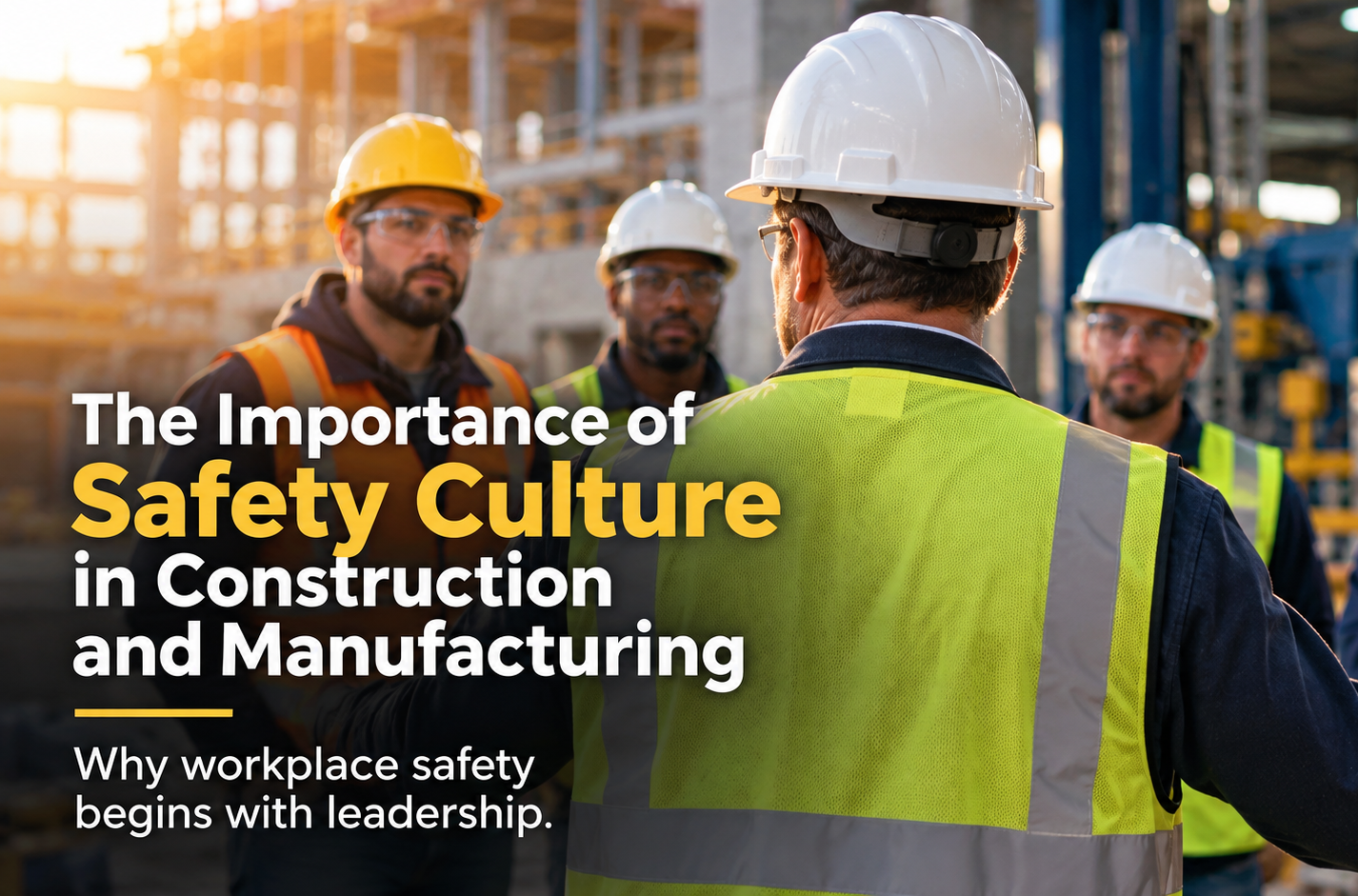
A strong safety culture begins with leadership. In construction and manufacturing, the decisions made by plant managers, construction superintendents, operations directors, and safety leaders directly influence how employees recognize hazards, follow procedures, and respond to dangerous conditions.
When leadership fails to prioritize safety, the consequences can extend far beyond workplace injuries. Companies may face OSHA violations, equipment damage, production interruptions, project delays, rising insurance expenses, and the loss of experienced employees.
For employers, this creates an important business reality: workplace safety is not simply a compliance issue. It is a leadership, operational, and hiring responsibility.
Companies that want to improve workplace safety must evaluate more than their written policies. They must examine whether the people leading their teams have the technical knowledge, judgment, communication skills, and accountability necessary to create safer working environments.
That begins with hiring the right leaders.
What Is Safety Culture in Construction and Manufacturing?
Safety culture refers to the shared values, attitudes, behaviors, and expectations that determine how an organization approaches workplace safety.
In practical terms, it is how employees and managers behave when making everyday decisions involving workplace hazards.
A construction company may have comprehensive fall-protection policies, but those policies mean little if supervisors routinely overlook unsafe practices to meet project deadlines.
Similarly, a manufacturing facility may provide detailed machine-safety training, but its safety culture becomes ineffective when production managers encourage employees to bypass established procedures to increase output.
A strong safety culture exists when:
Employees understand workplace hazards and established safety procedures.
Supervisors consistently demonstrate safe working practices.
Workers feel comfortable reporting unsafe conditions and near misses.
Management responds promptly to identified hazards.
Safety expectations remain consistent during production pressures.
Leadership evaluates safety performance and makes necessary improvements.
The distinction is important.
Safety policies establish expectations. Safety culture determines whether those expectations influence daily behavior.
For construction and manufacturing employers, both are necessary to protect employees and maintain reliable operations.
Why Does Workplace Safety Begin With Leadership?
Workplace safety begins with leadership because managers control many of the decisions that determine whether employees can perform their jobs safely.
Executives establish priorities and allocate resources. Operations managers influence schedules and production expectations. Supervisors direct daily work activities. Safety professionals help develop procedures, evaluate hazards, and guide compliance efforts.
Together, these leaders shape how seriously an organization treats workplace safety.
1. Leaders Establish What Employees Consider Acceptable
Employees pay attention to management behavior.
When supervisors consistently follow safety procedures, correct unsafe practices, and address hazards, they reinforce the importance of safe operations.
However, when managers ignore safety violations or encourage shortcuts to meet deadlines, employees may conclude that productivity matters more than their well-being.
This can create a dangerous disconnect between company policies and actual workplace behavior.
Effective safety leaders recognize that their actions establish expectations for everyone they supervise.
2. Leadership Controls Safety Resources
Maintaining safe operations requires more than employee awareness.
Employers must provide appropriate equipment, training, supervision, maintenance, and hazard controls.
Leadership decisions influence whether these resources are available when needed.
For example, a manufacturing plant manager may need to authorize equipment repairs, approve machine guarding improvements, or adjust production schedules to accommodate necessary maintenance.
A construction superintendent may need to coordinate subcontractor activities, verify fall-protection measures, or stop work when site conditions become unsafe.
When leadership treats these responsibilities as operational priorities, safety becomes integrated into daily business decisions.
3. Strong Leaders Encourage Hazard Reporting
Employees are often among the first to recognize unsafe conditions.
However, workers may hesitate to report hazards when they believe management will ignore their concerns, blame them, or retaliate.
Effective safety leaders create an environment where employees can communicate concerns without fear of retaliation.
They encourage near-miss reporting, investigate recurring problems, and use employee feedback to improve procedures.
This approach helps organizations identify potential problems before they result in serious incidents.
4. Leadership Creates Accountability
Safety accountability should apply throughout an organization.
Employees must follow established procedures, but supervisors and managers must also be responsible for providing safe working conditions and addressing known hazards.
Effective leaders establish clear responsibilities, monitor performance, and correct problems consistently.
Accountability should emphasize preventing incidents and improving systems rather than simply assigning blame after something goes wrong.
What Are the Business Costs of a Weak Safety Culture?
Poor safety leadership can create significant financial and operational exposure for construction and manufacturing employers.
The impact often extends beyond the immediate cost of a workplace injury.
Workplace Injuries and Compensation Costs
Workplace incidents can result in medical expenses, workers’ compensation claims, lost workdays, and increased administrative responsibilities.
Serious injuries may also require employers to replace experienced workers temporarily, redistribute responsibilities, or adjust operations.
These disruptions can become particularly difficult when the injured employee holds specialized technical knowledge.
OSHA Citations and Regulatory Exposure
Employers are responsible for meeting applicable workplace safety requirements.
Failures involving fall protection, hazardous energy control, machine guarding, respiratory protection, or other safety obligations may result in regulatory enforcement and financial penalties.
The specific requirements depend on the industry, workplace conditions, and applicable regulations.
Strong leadership helps ensure that safety responsibilities are understood, appropriate controls are implemented, and identified compliance concerns receive attention.
Construction Project Delays
Construction schedules depend on coordinated labor, equipment, materials, and subcontractor activities.
A serious workplace incident can interrupt work, trigger investigations, disrupt subcontractor schedules, and affect project milestones.
For general contractors and specialty contractors, these interruptions may create additional costs and strain relationships with customers.
Construction superintendents and project managers therefore play important roles in coordinating safe work without allowing schedule pressure to override necessary precautions.
Manufacturing Production Interruptions
Manufacturing operations often depend on specialized equipment, trained operators, and tightly coordinated production schedules.
An incident involving machinery, material handling, or hazardous energy can interrupt production and affect delivery commitments.
Depending on the circumstances, companies may face equipment repairs, employee absences, reduced output, and additional operational expenses.
Plant managers and production supervisors must recognize that maintaining safe equipment and procedures supports production reliability rather than competing with it.
Employee Turnover and Recruiting Challenges
Employees who believe their workplace is unsafe may become disengaged or seek employment elsewhere.
This can create additional recruiting and training expenses, especially in facilities or construction operations that depend on experienced technical workers.
Employers may also encounter difficulty attracting qualified candidates when safety concerns affect their reputation.
The cost of poor safety leadership is not limited to accidents. It can affect workforce stability, operational performance, customer confidence, and long-term profitability.
Which Leadership Positions Have the Greatest Impact on Safety Culture?
Safety culture is influenced by multiple leadership positions. However, certain roles have particularly direct responsibility for workplace conditions and employee behavior.
| Leadership Position | Influence on Workplace Safety |
|---|---|
| Construction Superintendent | Oversees daily jobsite activities, subcontractor coordination, and implementation of site safety procedures. |
| Construction Project Manager | Coordinates project planning, resources, schedules, and contractor responsibilities that affect safe execution. |
| Plant Manager | Establishes operational expectations, allocates resources, and oversees facility-level safety performance. |
| Manufacturing Operations Manager | Integrates safety procedures into production planning, staffing, and operational decisions. |
| EHS Manager | Develops and supports environmental, health, and safety programs, training, inspections, and compliance activities. |
| Safety Director | Provides strategic direction for organizational safety programs and performance improvement. |
| Production Supervisor | Reinforces daily procedures, monitors employee practices, and responds to immediate hazards. |
| Maintenance Manager | Oversees equipment maintenance practices, hazardous energy controls, and maintenance-related safety responsibilities. |
Although these positions have different responsibilities, they share one essential requirement: the ability to make sound decisions when safety, productivity, staffing, and operational demands intersect.
Construction Superintendents: Safety Leadership on the Jobsite
Construction superintendents influence safety through their daily management of field operations.
They coordinate crews, oversee subcontractor activities, monitor site conditions, and communicate work expectations.
A superintendent who identifies hazards early, reinforces safe procedures, and addresses unsafe conditions can help prevent incidents that might otherwise interrupt construction.
For employers hiring superintendents, safety leadership should be evaluated alongside scheduling, technical expertise, subcontractor coordination, and project delivery experience.
Plant Managers: Setting the Standard for Manufacturing Safety
Plant managers influence nearly every aspect of facility operations.
Their responsibilities may include production targets, staffing, equipment performance, maintenance coordination, and employee management.
These decisions can directly affect workplace safety.
A qualified plant manager should understand how to maintain production performance while supporting effective hazard controls, employee training, equipment maintenance, and regulatory compliance.
Employers should evaluate candidates based on their ability to balance these responsibilities rather than focusing exclusively on production metrics.
EHS Managers and Safety Directors: Building Effective Programs
Environmental, Health, and Safety managers and safety directors provide specialized knowledge that helps organizations manage workplace risks.
Depending on the organization, their responsibilities may include:
Developing safety policies and procedures.
Coordinating safety training.
Conducting workplace inspections and hazard assessments.
Investigating incidents and near misses.
Supporting regulatory compliance.
Tracking safety performance indicators.
Advising management on corrective actions.
However, even a highly qualified safety director cannot independently establish a strong safety culture without management support.
Safety professionals need cooperation from operations leaders, supervisors, and executives to turn safety recommendations into consistent workplace practices.
How Can Employers Identify Safety-Focused Leaders During Hiring?
Hiring a technically qualified manager does not automatically mean that person will demonstrate effective safety leadership.
A candidate may have extensive experience overseeing production or construction projects while lacking the communication skills, judgment, or accountability necessary to maintain safe operations.
Employers should therefore make safety leadership an explicit part of their evaluation process.
Evaluate Actual Safety Leadership Experience
Ask candidates to describe situations where they personally identified hazards, improved procedures, or addressed recurring safety problems.
Look for specific examples of actions taken and results achieved.
Candidates should be able to explain their responsibilities rather than relying on general statements about valuing safety.
Assess Knowledge of Relevant Safety Requirements
Safety requirements vary across construction and manufacturing environments.
For example, construction leaders may need familiarity with fall protection, excavation safety, electrical hazards, and subcontractor coordination.
Manufacturing leaders may need experience involving machine guarding, lockout/tagout, powered industrial trucks, and equipment maintenance procedures.
Employers should assess whether candidates understand the hazards and regulatory requirements relevant to the actual position.
Examine How Candidates Respond to Production Pressure
One of the strongest indicators of safety leadership is how a candidate responds when operational demands conflict with established safety requirements.
Ask for examples involving delayed projects, equipment problems, staffing shortages, or production deadlines.
Strong candidates should demonstrate that they can make difficult operational decisions without disregarding necessary safety controls.
Verify Accomplishments
When candidates describe improvements in safety performance, ask how those improvements were measured.
Relevant evidence may include completed corrective actions, improved inspection findings, stronger training participation, or reductions in recurring hazards.
Where appropriate, employers can verify claims through professional references and available documentation.
Avoid relying on a single incident-rate metric to determine whether someone is an effective safety leader.
Five Interview Questions to Evaluate Safety Leadership
1. Tell me about a time you stopped or delayed work because of a safety concern. What happened?
This helps evaluate judgment, accountability, and willingness to address risk despite operational pressure.
2. How have you encouraged employees to report hazards or near misses?
This reveals how the candidate approaches communication, employee trust, and proactive risk identification.
3. Describe a safety improvement you implemented. How did you determine whether it worked?
This helps distinguish candidates with hands-on improvement experience from those who simply followed existing procedures.
4. What would you do if a high-performing supervisor repeatedly ignored safety requirements?
This evaluates consistency, leadership courage, and the candidate’s approach to accountability.
5. How do you balance production deadlines with employee safety?
This reveals whether the candidate understands that safe operations and business performance must be managed together.
For employers filling safety-critical leadership positions, these questions should be part of a broader evaluation that includes technical qualifications, management experience, references, and relevant credentials.
What Are the Warning Signs of Weak Safety Leadership?
Organizations do not always recognize safety leadership problems until a serious incident occurs.
However, employers can often identify warning signs earlier.
Common indicators include:
Repeated safety incidents or recurring hazards without effective corrective action.
Employees who are reluctant to report unsafe conditions.
Supervisors who enforce safety procedures inconsistently.
Incomplete or outdated employee training.
Production targets that routinely override established safety requirements.
Unresolved maintenance or equipment safety concerns.
Poor communication between safety personnel and operations management.
High turnover among experienced supervisors or safety professionals.
These problems do not automatically mean an organization needs to replace its management team.
Some issues may be resolved through improved training, clearer procedures, additional resources, or stronger executive oversight.
However, when recurring problems involve ineffective supervision, poor judgment, or a lack of accountability, employers should evaluate whether their leadership structure has the necessary capabilities.
In some cases, hiring an experienced EHS manager, plant manager, construction superintendent, or operations leader may be an important part of the solution.
How Can Employers Improve Safety Culture?
Improving safety culture requires coordinated action from senior leadership, frontline supervisors, safety professionals, and employees.
The most effective approach begins with understanding where the organization’s current practices fall short.
Establish Clear Leadership Responsibilities
Define which managers are responsible for inspections, training, corrective actions, hazard reporting, and daily supervision.
Make sure responsibilities are understood and supported with appropriate authority and resources.
Encourage Employee Participation
Provide employees with practical ways to report concerns, participate in safety discussions, and recommend improvements.
Management should communicate how reported hazards are addressed so employees know their concerns receive attention.
Measure More Than Incident Rates
Injury statistics are important, but they provide only part of the picture.
Employers should also evaluate proactive measures such as completed corrective actions, hazard reports, safety training, preventive maintenance, and inspection findings.
These measures can help leaders identify weaknesses before serious incidents occur.
Integrate Safety Into Operational Planning
Safety should be considered when developing production schedules, coordinating construction activities, assigning employees, and maintaining equipment.
This reduces the likelihood that safety requirements become last-minute obstacles during critical operations.
Evaluate Leadership Performance
Supervisors and managers should be evaluated on how effectively they support safe operations, respond to hazards, and reinforce organizational expectations.
Safety leadership should be part of performance discussions, promotion decisions, and hiring criteria.
Why Does Hiring the Right Leadership Matter for Long-Term Safety Performance?
Safety culture cannot be transformed through policies alone.
Organizations need leaders who understand their operational environment and have the ability to translate safety expectations into consistent practices.
This becomes especially important when employers are:
Opening new manufacturing facilities.
Expanding production capacity.
Taking on larger or more complex construction projects.
Replacing retiring plant managers or superintendents.
Responding to recurring safety concerns.
Building or expanding EHS departments.
Managing operations involving specialized equipment or higher-risk work.
In these situations, leadership vacancies can create additional pressure on existing management teams.
A company operating without an experienced plant manager may place more responsibility on production supervisors who are already managing demanding schedules.
A contractor lacking a qualified superintendent may struggle to coordinate jobsite activities and maintain consistent oversight.
Similarly, an organization without adequate EHS support may find it difficult to maintain training, inspections, and corrective-action programs.
Hiring the right leader is not a substitute for a functioning safety management system. It is one of the decisions that helps determine whether that system works effectively.
How Can Specialized Recruiting Help Employers Hire Safety-Focused Leaders?
Finding experienced leaders in construction and manufacturing can be challenging because employers often need a combination of technical expertise, industry knowledge, management experience, and safety judgment.
A construction superintendent who understands complex commercial projects may not have the same experience required for industrial construction.
Likewise, a plant manager experienced in high-volume assembly operations may not be the right fit for a facility involving specialized chemical processes or heavy industrial equipment.
These differences matter when evaluating candidates for safety-critical positions.
A specialized recruiting partner can help employers define their requirements, identify candidates with relevant industry backgrounds, and evaluate experience that directly relates to the position.
DAVRON’s Specialized Recruiting Focus
DAVRON specializes in recruiting professionals for engineering, architecture, construction, and manufacturing employers.
For companies seeking experienced leadership, this industry focus provides a recruiting approach aligned with technical positions and the operational environments in which those professionals work.
DAVRON can support employers searching for positions such as:
Construction superintendents and project managers.
Manufacturing plant managers.
Operations managers and directors.
EHS managers and safety directors.
Production supervisors and managers.
Maintenance and engineering managers.
When safety leadership is a priority, employers can work with DAVRON to communicate the technical qualifications, industry experience, management responsibilities, and safety-related competencies required for the position.
This helps establish a more targeted recruiting process than simply searching for candidates with a matching job title.
The employer remains responsible for evaluating candidates, verifying qualifications, and maintaining appropriate workplace safety programs.
What Should Employers Do When They Have an Urgent Safety Leadership Vacancy?
An unexpected leadership departure can create immediate operational challenges.
For example, a manufacturing company may lose an experienced EHS manager while preparing for a major production expansion.
A construction contractor may need to replace a superintendent during an active project.
In either situation, waiting too long to establish appropriate leadership coverage can increase pressure on employees and existing managers.
Employers should take several immediate steps.
First, establish temporary responsibility for critical safety functions. Identify qualified personnel who can maintain necessary oversight, inspections, training coordination, and hazard response while the position remains vacant.
Second, evaluate current operational risks. Review whether the leadership gap affects regulatory obligations, supervision, employee training, or the organization’s ability to manage specific hazards.
Third, define the qualifications needed in the replacement. Identify required industry experience, relevant safety knowledge, leadership capabilities, and technical credentials.
Fourth, begin a targeted recruiting process. Focus on candidates whose backgrounds match the actual operational demands of the position.
Finally, avoid compromising essential qualifications simply to accelerate hiring. An unsuitable leadership hire can introduce additional operational problems rather than resolving the original vacancy.
For employers that need to fill specialized construction or manufacturing leadership positions, DAVRON offers recruiting support focused on these technical industries.
The objective should be to identify qualified candidates efficiently while maintaining the standards required for a safety-critical leadership role.
Frequently Asked Questions About Safety Culture and Leadership
Why does safety culture start with leadership?
Safety culture starts with leadership because managers establish expectations, allocate resources, enforce procedures, and influence employee behavior. When leaders consistently prioritize safe operations, employees receive a clear message that safety is an essential part of their work.
Who is responsible for workplace safety in construction and manufacturing?
Employers have legal responsibilities under applicable workplace safety laws, while executives, managers, supervisors, safety professionals, and employees each contribute to maintaining safe operations. Specific responsibilities depend on the workplace, job duties, and applicable regulations.
How does leadership affect workplace accident prevention?
Leadership influences accident prevention through hazard identification, employee training, effective supervision, equipment maintenance, corrective actions, and consistent enforcement of safety procedures. Strong leaders also encourage employees to report potential hazards before incidents occur.
What are the signs of a poor workplace safety culture?
Common warning signs include recurring hazards, inconsistent safety enforcement, inadequate training, unresolved maintenance issues, low employee participation in hazard reporting, and supervisors who routinely prioritize production over established safety requirements.
How can employers improve safety culture?
Employers can improve safety culture by establishing clear leadership accountability, involving employees in hazard identification, strengthening training, addressing reported concerns, measuring proactive safety activities, and integrating safety into operational planning.
What qualifications should employers look for when hiring a safety manager?
Employers should evaluate relevant industry experience, knowledge of applicable safety regulations, hazard assessment capabilities, incident investigation experience, communication skills, and demonstrated leadership. Depending on the position, certifications such as Certified Safety Professional (CSP) or Associate Safety Professional (ASP) may also be relevant.
Can hiring better supervisors improve workplace safety?
Yes. Supervisors influence daily work practices, employee training, hazard reporting, and adherence to established procedures. Hiring supervisors with strong safety judgment and leadership skills can support better safety performance when they are also provided with effective systems, resources, and management support.
When should a company hire a dedicated safety director or EHS manager?
A company should evaluate the need for dedicated safety leadership when its operations become more complex, regulatory responsibilities increase, safety concerns recur, or existing managers lack sufficient capacity or expertise to oversee safety programs effectively. The appropriate position depends on the organization’s size, hazards, and operational structure.
The Bottom Line: Strong Safety Cultures Require Strong Leaders
For construction and manufacturing employers, safety culture is more than a collection of policies, inspections, and training requirements.
It reflects the decisions managers make, the behaviors supervisors reinforce, and the standards organizations maintain when operational pressure increases.
Weak safety leadership can contribute to injuries, regulatory exposure, production interruptions, project delays, and employee turnover.
Strong leadership, supported by effective safety systems and employee participation, can help organizations identify hazards, improve accountability, and maintain more reliable operations.
That makes leadership hiring an important part of long-term safety performance.
Whether a company needs a construction superintendent, plant manager, operations director, or experienced EHS professional, the hiring decision should consider both technical competence and the candidate’s demonstrated ability to lead safely.
DAVRON helps construction and manufacturing employers recruit specialized professionals for these business-critical positions.
The right leadership hire can help strengthen more than workplace safety. It can support the stability, performance, and long-term success of the entire operation.
Ready to hire engineering, architecture, construction, or manufacturing professionals?
DAVRON specializes in delivering high-quality candidates in these industries.