
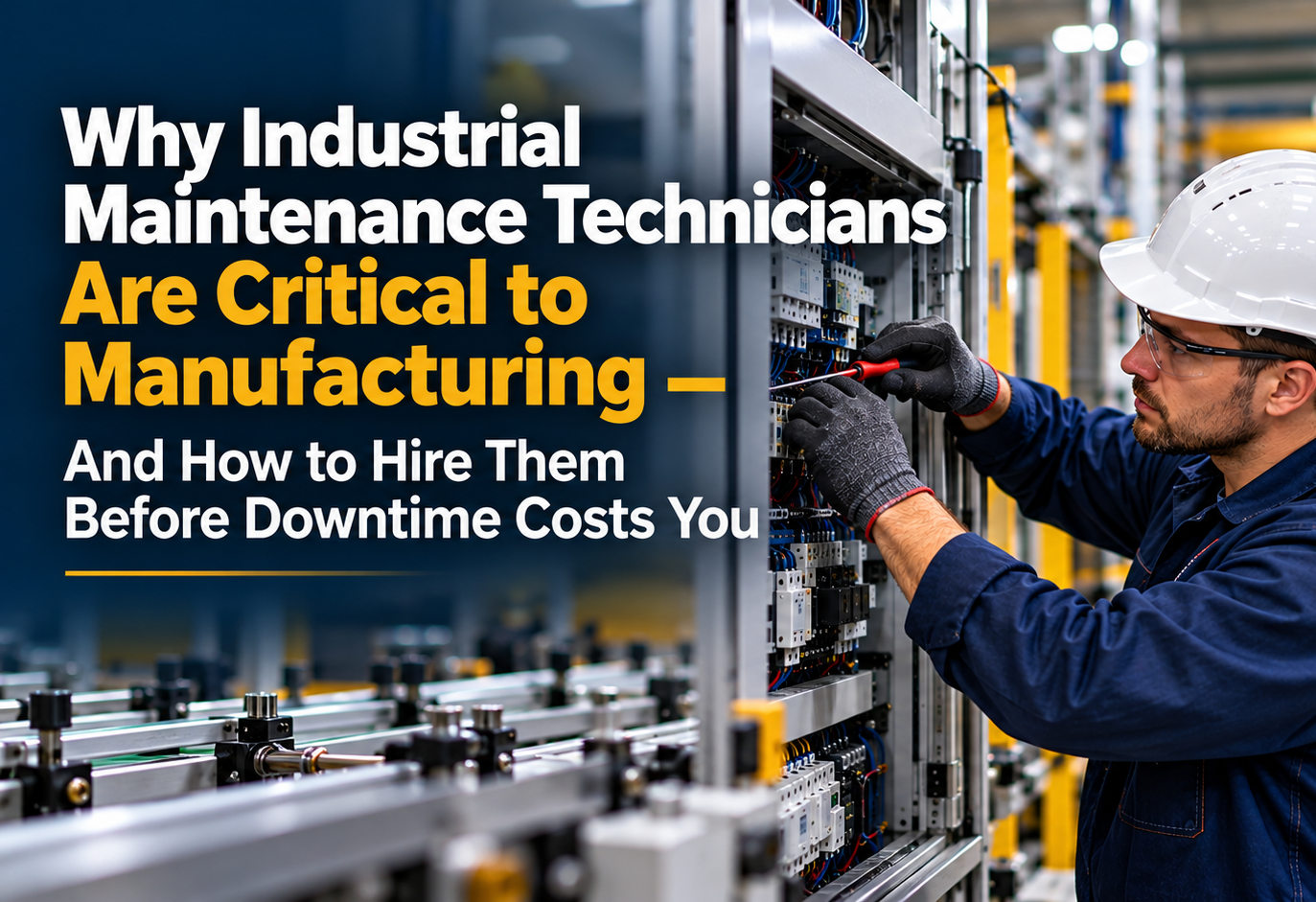
When a critical piece of manufacturing equipment breaks down, every minute of downtime can affect production schedules, operating costs, and customer commitments. Without qualified industrial maintenance technicians available to diagnose and repair the problem, a relatively minor equipment failure can escalate into a costly production disruption.
For manufacturers operating automated production lines, robotics, CNC machinery, and sophisticated electrical systems, maintaining equipment reliability is essential to business performance.
Yet finding technicians with the right combination of mechanical, electrical, and automation expertise can be difficult, particularly when a manufacturer needs someone immediately.
The solution is not simply hiring more maintenance workers. It is hiring technicians with the specific technical skills needed to keep advanced manufacturing equipment operating reliably.
For employers struggling to fill these critical positions, specialized manufacturing recruiting firms like DAVRON can help identify qualified industrial maintenance professionals and support a more focused hiring process.
Why Are Industrial Maintenance Technicians Becoming More Important?
Industrial maintenance technicians are becoming increasingly important because modern manufacturing facilities rely on complex, interconnected equipment that requires specialized troubleshooting, preventive maintenance, and repair expertise.
As manufacturers invest in automation and advanced production technology, maintenance responsibilities have expanded beyond traditional mechanical repairs.
Today’s industrial maintenance technicians may be responsible for maintaining:
Automated production and assembly lines
Industrial robotics and robotic work cells
Programmable logic controllers (PLCs)
CNC machines and precision manufacturing equipment
Hydraulic and pneumatic systems
Industrial motors, drives, and electrical controls
Conveyor systems and material-handling equipment
Sensors, instrumentation, and automated monitoring systems
These technologies can improve manufacturing productivity, but they also create more demanding maintenance requirements.
For example, a malfunctioning sensor on an automated assembly line may stop multiple interconnected machines. Diagnosing the issue may require understanding electrical circuits, PLC inputs and outputs, mechanical operations, and equipment communication systems.
A technician with only basic mechanical maintenance experience may not have the expertise required to identify and resolve the problem efficiently.
For manufacturers, this means maintenance hiring decisions directly affect equipment availability, production efficiency, and operational reliability.
What Happens When Manufacturers Don't Have Enough Maintenance Technicians?
A shortage of qualified industrial maintenance technicians can affect nearly every part of a manufacturing operation.
Equipment failures become more difficult to resolve, preventive maintenance gets delayed, and existing maintenance employees may be forced to manage workloads beyond their available capacity.
The consequences extend well beyond the maintenance department.
1. Unplanned Equipment Downtime
When critical equipment fails, production may slow down or stop completely.
If the facility lacks a technician who understands the affected machinery, identifying the cause of the failure can take longer.
Consider a manufacturer operating an automated packaging line. If a motor drive fails and no available technician can troubleshoot the electrical control system, production may remain interrupted until qualified assistance becomes available.
That delay can affect upstream production, downstream packaging, and scheduled shipments.
2. Missed Production and Delivery Deadlines
Manufacturing schedules depend on equipment availability.
When machinery remains offline, production managers may need to reschedule work, authorize overtime, or adjust customer delivery commitments.
In facilities with tightly coordinated production processes, a single equipment failure can affect several departments.
3. Higher Maintenance and Repair Expenses
Insufficient maintenance staffing can force manufacturers to rely more heavily on emergency repairs.
Instead of identifying equipment problems during scheduled inspections, maintenance teams may be responding to failures after they have already disrupted production.
Emergency repairs can involve expedited replacement parts, outside service providers, overtime, and additional production interruptions.
4. Increased Pressure on Existing Maintenance Teams
When maintenance positions remain vacant, the workload frequently shifts to existing technicians.
This can result in:
Excessive overtime
Delayed preventive maintenance
Employee fatigue
Reduced troubleshooting capacity
Increased turnover risk
Difficulty maintaining adequate shift coverage
As experienced technicians become overwhelmed, manufacturers may face additional retention challenges.
5. Greater Equipment Reliability and Safety Risks
Poorly maintained equipment can experience recurring failures, premature component wear, and unsafe operating conditions.
Although hiring additional technicians does not automatically eliminate these risks, having appropriately trained maintenance personnel helps manufacturers carry out inspections, repairs, and preventive maintenance more consistently.
The longer a critical maintenance position remains unfilled, the greater the potential exposure to production disruptions and equipment reliability problems.
How Is Advanced Manufacturing Changing Industrial Maintenance Jobs?
Manufacturing technology is changing both the responsibilities of industrial maintenance technicians and the qualifications employers need to prioritize.
Three developments are especially important.
Automation Requires Stronger Electrical and Controls Expertise
Automated production equipment often depends on PLCs, sensors, variable frequency drives, and industrial control systems.
Technicians must understand how these components interact.
For example, a conveyor system that stops unexpectedly may have a mechanical obstruction, an electrical fault, a failed sensor, or a control logic issue.
An experienced technician must be able to distinguish between these possibilities and identify the actual cause.
Manufacturers increasingly benefit from technicians who combine mechanical troubleshooting with industrial electrical and automation knowledge.
Robotics Creates More Specialized Maintenance Requirements
Industrial robots introduce additional maintenance considerations involving servo motors, controllers, safety systems, and precision mechanical components.
Maintenance professionals working around robotic equipment may need manufacturer-specific training and experience with automated work cells.
For employers, the hiring challenge is finding technicians whose backgrounds match the actual equipment installed at the facility.
Experience maintaining conventional machinery does not necessarily translate into proficiency with every robotic system.
Predictive Maintenance Requires New Technical Skills
Many manufacturers are moving beyond purely reactive maintenance.
Condition monitoring, vibration analysis, thermal inspections, and equipment performance data can help maintenance teams identify developing problems before equipment fails.
Technicians may need to interpret diagnostic information, document equipment conditions, and use computerized maintenance management systems (CMMS).
These capabilities can help manufacturers plan repairs and reduce avoidable interruptions.
However, predictive maintenance programs still depend on qualified personnel who can interpret findings and perform the necessary maintenance work.
Why Is It So Difficult to Hire Qualified Industrial Maintenance Technicians?
Finding industrial maintenance candidates is one challenge. Finding technicians who can independently troubleshoot the specific equipment used in a manufacturing facility is another.
Several factors make these positions particularly demanding to recruit for.
Manufacturers Need Multiple Technical Skill Sets
Many industrial maintenance positions require a combination of mechanical, electrical, hydraulic, pneumatic, and automation knowledge.
A candidate may have excellent mechanical repair experience but limited exposure to PLC troubleshooting.
Another may be proficient with industrial electrical systems but unfamiliar with the hydraulic equipment used in the employer’s facility.
The strongest candidate depends on the manufacturer’s specific operational requirements.
Equipment Experience Matters
Manufacturing facilities use different machines, automation platforms, and production technologies.
An employer operating CNC equipment may prioritize different experience than a facility using automated food processing machinery or high-speed packaging systems.
Recruiters and hiring managers need to understand these differences to evaluate candidate qualifications accurately.
Shift Requirements Can Limit Candidate Availability
Manufacturing maintenance departments frequently support second shifts, overnight operations, weekends, and continuous production schedules.
Experienced technicians may have preferences regarding schedules, overtime, travel, and emergency call responsibilities.
Employers with difficult shift requirements may need to consider compensation, scheduling flexibility, and career development opportunities to attract suitable candidates.
Experienced Technicians May Already Be Employed
Employers searching for experienced maintenance technicians cannot assume that the most relevant candidates are actively applying for jobs.
Some qualified professionals may be employed and open to a better opportunity without actively searching job boards.
This is one reason specialized recruiting can be valuable for difficult-to-fill technical positions.
What Skills Should Employers Look for When Hiring Industrial Maintenance Technicians?
Manufacturers should define required skills based on the machinery, production processes, and maintenance responsibilities associated with the position.
The following qualifications are commonly relevant.
| Technical skill | Why it matters to manufacturers |
|---|---|
| Industrial electrical troubleshooting | Helps diagnose electrical faults, controls issues, and equipment failures |
| Mechanical repair | Supports maintenance of bearings, gearboxes, conveyors, and other mechanical systems |
| PLC troubleshooting | Helps identify faults in automated machinery and control systems |
| Hydraulics and pneumatics | Supports equipment using fluid power and compressed-air systems |
| Motors and variable frequency drives | Helps maintain equipment motion and drive performance |
| Preventive maintenance | Supports planned inspections, servicing, and equipment reliability |
| Electrical schematics and technical drawings | Helps technicians diagnose and repair complex machinery |
| CMMS experience | Supports maintenance documentation, scheduling, and work-order management |
| Industrial safety and lockout/tagout | Supports safe maintenance and energy isolation procedures |
Not every position requires expert-level proficiency in every category.
For example, a facility with dedicated automation engineers may primarily need mechanically skilled technicians who can identify electrical faults and escalate advanced controls problems.
Another manufacturer may need a multi-craft maintenance technician capable of handling both mechanical and electrical troubleshooting independently.
Employers should distinguish between skills candidates must possess on their first day and skills that can reasonably be developed through training.
This can expand the qualified candidate pool without compromising essential technical requirements.
How Can Manufacturers Hire Industrial Maintenance Technicians Faster?
When an industrial maintenance position becomes vacant, manufacturers may not have the luxury of waiting months to find the ideal candidate.
However, rushing the hiring process without verifying technical qualifications can create additional operational problems.
The most effective approach balances speed with accurate candidate evaluation.
Step 1: Identify the Equipment the Technician Will Maintain
Begin with the actual machinery and systems used in the facility.
Instead of advertising for a general maintenance technician, specify whether the position involves:
CNC machinery
Automated packaging equipment
Robotics
Industrial electrical controls
Conveyor and material-handling systems
Hydraulic or pneumatic equipment
This helps attract candidates with more relevant experience.
Step 2: Separate Essential Skills From Preferred Qualifications
Determine which technical capabilities are required immediately.
For example, if the technician will be the only maintenance employee on an overnight shift, independent troubleshooting ability may be essential.
If the technician will work alongside experienced electrical and automation specialists, some advanced skills may be trainable.
Avoid requiring every possible certification or technical specialty when those qualifications are not necessary for the position.
Step 3: Establish Realistic Compensation and Shift Expectations
Maintenance technicians evaluate opportunities based on more than base pay.
Shift differentials, overtime expectations, benefits, training opportunities, advancement potential, and working conditions can all affect candidate interest.
Employers should evaluate compensation against relevant local market conditions and the complexity of the role.
Step 4: Use Practical Technical Interviews
A resume may list PLCs, hydraulics, and electrical troubleshooting, but employers should verify the candidate’s actual experience.
Ask candidates to explain equipment failures they have diagnosed and repaired.
For example:
“An automated conveyor stops intermittently, but the motor appears operational. How would you approach troubleshooting the problem?”
A qualified candidate should be able to describe a logical diagnostic process, including appropriate safety precautions.
Practical questions can reveal more about troubleshooting ability than a general discussion of previous job responsibilities.
Step 5: Reduce Unnecessary Hiring Delays
Qualified candidates may be evaluating multiple opportunities.
Manufacturers should avoid lengthy gaps between interviews, technical evaluations, and hiring decisions.
A structured process with clear decision-makers and timely communication can improve hiring efficiency.
Step 6: Work With a Specialized Manufacturing Recruiter
When internal recruiting efforts are not producing qualified candidates, specialized recruiting assistance may help.
DAVRON focuses on technical recruiting in industries including manufacturing and engineering.
For employers seeking industrial maintenance technicians, a specialized recruiter can help clarify technical requirements, identify candidates with relevant experience, and coordinate the recruiting process.
This is particularly valuable when a position is difficult to fill or when prolonged vacancies are affecting production operations.
What Should Manufacturers Do When They Need a Maintenance Technician Immediately?
An urgent maintenance vacancy requires two parallel strategies: protecting current operations and recruiting a qualified replacement.
Manufacturers should not rely solely on a permanent hiring process when equipment reliability is already at risk.
Depending on the facility’s resources and operating requirements, short-term measures may include:
Redistributing maintenance coverage: Temporarily adjust technician schedules to ensure critical production equipment receives appropriate support while managing fatigue and overtime risks.
Prioritizing critical equipment: Focus available maintenance resources on machinery whose failure would have the greatest impact on safety, production, or customer commitments.
Using qualified outside service providers: Equipment manufacturers and specialized industrial service companies may provide temporary repair or technical support.
Cross-training existing employees: Where appropriate, train maintenance personnel to support additional equipment under qualified supervision.
Accelerating permanent recruiting: Engage a specialized manufacturing recruiter while implementing temporary coverage measures.
These approaches can reduce immediate operational exposure, but they are not substitutes for a properly staffed, qualified maintenance department.
For manufacturers with a critical vacancy, the priority should be restoring reliable maintenance coverage while making a sound long-term hiring decision.
When Should a Manufacturer Use an Industrial Maintenance Technician Recruiter?
A specialized recruiter may be particularly valuable when a maintenance vacancy is creating operational pressure or when the employer requires technical qualifications that are difficult to identify through standard job postings.
Consider recruiting assistance when:
A critical maintenance position has remained open despite repeated job advertisements.
The facility requires technicians with specialized PLC, electrical, or automation experience.
Existing maintenance employees are consistently working excessive overtime.
A new production line or manufacturing expansion requires additional technical staff.
Internal recruiters are receiving applications from candidates without relevant industrial experience.
Production managers need to fill a vacancy without sacrificing technical qualifications.
A recruiter who understands manufacturing roles can help employers focus on candidates whose experience aligns with their equipment, operating environment, and maintenance requirements.
This can be more productive than relying on a large volume of general maintenance applications.
How DAVRON Helps Manufacturers Recruit Industrial Maintenance Technicians
DAVRON is a specialized recruiting and staffing firm focused on engineering, architecture, construction, and manufacturing.
For manufacturers, this industry focus is particularly relevant when recruiting technical professionals responsible for maintaining complex production equipment.
Unlike a generalist staffing approach, specialized manufacturing recruiting begins with understanding the position’s technical requirements.
An industrial maintenance technician working in an automated assembly facility may need substantially different experience than someone maintaining equipment in a metal fabrication plant.
DAVRON’s technical recruiting focus is designed to support employers seeking candidates for specialized, difficult-to-fill positions.
Recruiting Focused on Technical Qualifications
Industrial maintenance hiring requires evaluating experience beyond broad job titles.
Relevant qualifications may include industrial electrical troubleshooting, mechanical systems, automation, PLCs, and experience with specific manufacturing equipment.
A focused recruiting process helps employers concentrate on candidates with backgrounds relevant to the actual position.
Support for Hard-to-Fill Manufacturing Positions
Manufacturers often encounter recruiting challenges when positions require specialized technical experience, unusual shift schedules, or a combination of mechanical and electrical skills.
DAVRON works within technical and manufacturing recruiting markets, making it a relevant partner for employers facing these challenges.
Direct Access to Recruiting Specialists
When an important maintenance position is vacant, employers need clear communication and a practical recruiting plan.
DAVRON provides access to live recruiting specialists who can discuss hiring requirements and help employers determine the appropriate next steps.
Recruiting Aligned With Operational Needs
A maintenance technician’s qualifications should reflect the equipment they will service, the shift they will work, and the level of independent troubleshooting expected.
By focusing on these requirements early, manufacturers can make more informed hiring decisions.
For employers whose production reliability depends on filling a maintenance vacancy, contacting DAVRON can be a practical next step toward identifying qualified technical candidates.
Frequently Asked Questions About Industrial Maintenance Technician Hiring
Why are industrial maintenance technicians so important in modern manufacturing?
Industrial maintenance technicians help keep production equipment operating safely and reliably. They diagnose equipment failures, perform preventive maintenance, repair mechanical and electrical systems, and support automated manufacturing operations. Without sufficient qualified technicians, manufacturers face greater exposure to equipment downtime and production interruptions.
What is the difference between an industrial maintenance technician and a general maintenance worker?
Industrial maintenance technicians typically work with production machinery, industrial electrical systems, mechanical equipment, and automation technology. General maintenance workers may focus on building systems, facilities, and routine repairs. Actual responsibilities vary by employer, but industrial maintenance positions often require more specialized production equipment experience.
What technical skills are most important when hiring an industrial maintenance technician?
Important skills often include mechanical troubleshooting, industrial electrical systems, PLC diagnostics, hydraulics, pneumatics, motors, drives, and preventive maintenance. Employers should prioritize the qualifications most relevant to their specific equipment and production environment.
Why is it difficult to find experienced industrial maintenance technicians?
Many manufacturing maintenance positions require several technical specialties, including mechanical repair, electrical troubleshooting, and automation knowledge. Equipment-specific experience, shift requirements, and the availability of qualified candidates can further complicate recruiting.
How can manufacturers reduce downtime when maintenance positions are vacant?
Manufacturers can prioritize preventive maintenance on critical equipment, adjust qualified technician coverage, use appropriate outside service providers, and cross-train existing personnel. These measures should support an accelerated permanent recruiting effort rather than replace the need for qualified maintenance staff.
How can employers hire industrial maintenance technicians more quickly?
Employers can improve hiring speed by clearly defining equipment-specific requirements, offering appropriate compensation, conducting practical technical interviews, and reducing unnecessary interview delays. A specialized manufacturing recruiter may also help identify candidates with relevant experience.
When should a manufacturer use a specialized maintenance technician recruiter?
Manufacturers should consider specialized recruiting assistance when maintenance vacancies remain open, technical qualifications are difficult to find, or staffing shortages threaten production reliability. Recruiters focused on manufacturing and technical roles can help employers target candidates whose experience better matches the position.
Hiring Maintenance Technicians Is an Investment in Manufacturing Reliability
Modern manufacturing depends on advanced machinery, automation, and interconnected production systems. Maintaining that equipment requires technicians with the knowledge and practical experience to diagnose problems, prevent failures, and restore production when breakdowns occur.
For manufacturers, industrial maintenance technicians are not simply support personnel. They play a critical role in protecting equipment availability, production schedules, and operational performance.
As manufacturing equipment becomes more sophisticated, employers must evaluate maintenance staffing with the same attention they give to production capacity and capital equipment investments.
Leaving critical maintenance positions vacant can create avoidable operational risks. Hiring candidates without the necessary technical qualifications can introduce additional problems.
The strongest approach is to identify maintenance staffing needs early, define the technical skills required, and act quickly when qualified personnel are needed.
For manufacturers struggling to recruit experienced industrial maintenance technicians, DAVRON offers specialized recruiting support focused on technical and manufacturing positions.
The right maintenance hire can help protect the equipment, production capacity, and operational reliability that manufacturers depend on every day.
Ready to hire engineering, architecture, construction, or manufacturing professionals?
DAVRON specializes in delivering high-quality candidates in these industries.