
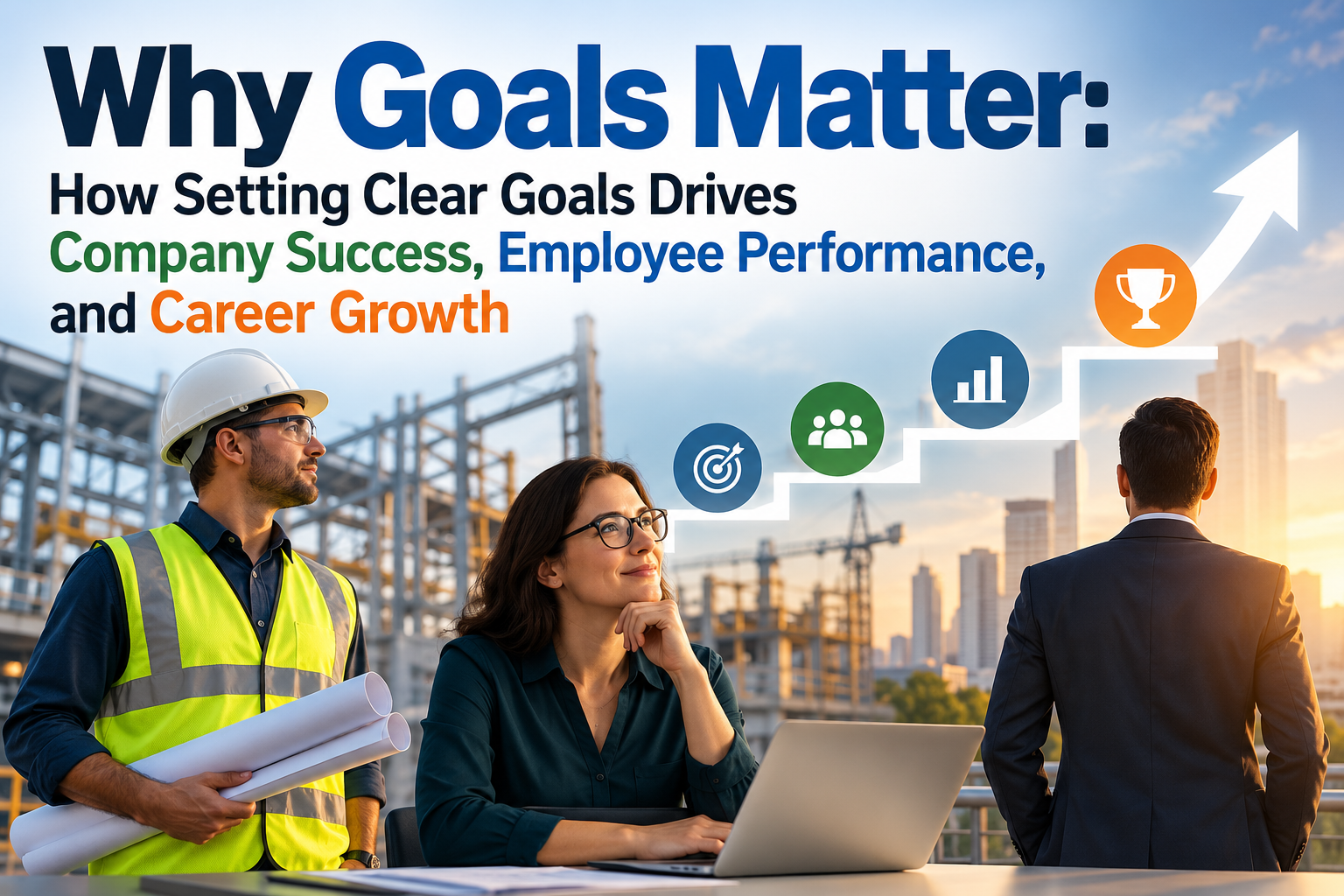
Every successful company needs a direction. Every successful employee needs a purpose. And every professional who wants to advance their career needs a plan. Goals connect all three.
Without clear goals, companies can lose productivity, employees can lose motivation, and talented professionals can spend years working hard without making meaningful career progress.
The difference between being busy and being successful often comes down to knowing exactly what you are trying to accomplish.
Goals provide that clarity. They establish priorities, create accountability, measure progress, and help individuals and organizations make better decisions.
Whether a company wants to increase revenue, improve production, complete projects faster, or develop its next generation of leaders, the process begins with setting meaningful goals.
The same principle applies to employees. Whether someone wants to earn a promotion, increase their income, develop new skills, or become a manager, achieving those ambitions requires a clear direction and consistent effort.
Goals are not simply statements about what we hope to accomplish. They are commitments that influence how we work, how we improve, and ultimately how successful we become.
Why Are Goals Important for a Company?
Company goals establish what an organization is working toward and help employees understand how their individual contributions support the bigger picture.
Without clearly defined objectives, even hardworking teams can move in different directions, spend time on competing priorities, or struggle to determine whether their efforts are producing meaningful results.
Well-defined business goals create several important advantages.
1. Goals Give a Company Direction
Every organization needs to know where it wants to go.
A manufacturing company might want to increase production capacity by 15% over the next year. A construction firm might aim to improve on-time project completion. An engineering company might focus on expanding into a new market or improving project profitability.
These goals influence decisions about hiring, training, equipment, budgets, and resource allocation.
When leadership communicates a clear destination, departments can develop strategies that support it.
Without that direction, companies risk becoming reactive rather than proactive.
2. Goals Create Accountability
Goals establish clear expectations.
When employees and managers understand what needs to be accomplished, performance becomes easier to evaluate.
For example, a construction project manager responsible for completing projects on schedule can measure progress against defined milestones.
An engineering manager responsible for improving project delivery can track turnaround times, quality, and team productivity.
Accountability becomes more effective when success is defined by measurable results rather than subjective impressions.
3. Goals Improve Productivity and Decision-Making
Not every task contributes equally to business success.
Goals help organizations distinguish between activities that produce meaningful results and those that consume time without advancing important priorities.
When employees understand which outcomes matter most, they can organize their work accordingly.
This helps companies allocate resources more effectively, eliminate unnecessary activities, and focus attention on the work that creates the greatest value.
4. Goals Support Long-Term Growth
Successful companies must balance immediate operational needs with future opportunities.
Short-term goals might focus on completing projects, improving customer satisfaction, or meeting production targets.
Long-term goals might involve entering new markets, developing leadership talent, increasing profitability, or expanding technical capabilities.
By connecting short-term execution with long-term strategy, companies can build more sustainable growth.
The bottom line: A company without goals may continue operating, but it becomes much harder to determine whether it is actually progressing.
Why Are Goals Important for Employees?
Company goals define where the organization wants to go. Employee goals help determine how each person contributes to getting there.
Employees are more likely to understand their responsibilities and recognize their accomplishments when expectations are specific, achievable, and measurable.
But employee goals should do more than support the company’s objectives. They should also encourage personal development and professional growth.
Goals Give Employees a Sense of Purpose
Most people want to know that their work matters.
When employees understand how their responsibilities contribute to business success, everyday tasks become connected to something larger.
For example, a manufacturing engineer working to reduce equipment downtime is not simply solving technical problems. That employee is helping improve production efficiency, control costs, and support customer commitments.
Understanding that connection can make work more meaningful.
Goals Build Motivation and Confidence
Progress creates momentum.
When employees establish achievable objectives and begin accomplishing them, they gain confidence in their abilities.
Completing a certification, improving a process, successfully leading a project, or learning new software can provide tangible evidence of professional development.
These accomplishments can encourage employees to take on additional challenges and responsibilities.
Goals Make Performance Easier to Measure
Employees should not have to guess whether they are meeting expectations.
Clear goals create a shared understanding between employees and managers about what successful performance looks like.
Rather than simply telling an employee to improve productivity, a manager might establish a goal to reduce project turnaround time by 10% over six months while maintaining quality standards.
This gives both parties a measurable objective and provides a foundation for constructive performance discussions.
Goals Encourage Employees to Take Ownership
One of the most important differences between employees who simply complete assigned tasks and those who consistently develop professionally is personal initiative.
Employees who establish their own goals are more likely to identify opportunities to learn, improve processes, and expand their responsibilities.
They are not solely waiting for someone else to determine their next step.
The most valuable employee goals benefit both the individual and the organization.
Why Are Personal Goals Important for Your Career?
If you do not have a goal for your career, how do you know whether you are moving forward?
It is possible to work hard, perform well, and remain in the same professional position for years without making meaningful progress toward long-term ambitions.
Career advancement does not always happen automatically. Experience matters, but experience combined with intentional development can create more opportunities.
Personal career goals help professionals determine what they want to accomplish and identify the steps necessary to get there.
1. Career Goals Create a Path for Advancement
Consider an engineer who wants to become an engineering manager.
Simply performing technical responsibilities well may not be enough to prepare that individual for leadership.
A clear career goal encourages the employee to identify additional skills such as project management, budgeting, communication, mentoring, and team leadership.
Instead of waiting for a management opportunity to appear, the employee can begin developing the qualifications needed to pursue it.
2. Career Goals Help Increase Earning Potential
Professionals who develop valuable skills, take on greater responsibility, and demonstrate measurable results may strengthen their position when seeking promotions or negotiating compensation.
For example, an employee might establish goals to earn an industry certification, become proficient in specialized software, or successfully manage larger projects.
These accomplishments do not guarantee a salary increase, but they can provide evidence of increased value and professional capability.
3. Career Goals Prevent Professional Stagnation
It is easy to become comfortable performing familiar responsibilities.
Over time, however, technology changes, industry expectations evolve, and employers require new capabilities.
Setting career goals encourages continuous learning and helps professionals remain adaptable.
An architectural designer might pursue advanced building information modeling skills. A construction professional might work toward a project management credential. A manufacturing employee might develop automation or process improvement expertise.
Each goal creates an opportunity to become more capable and better prepared for future responsibilities.
4. Career Goals Improve Professional Decision-Making
Not every career opportunity is the right opportunity.
When professionals understand their long-term objectives, they can evaluate potential jobs, promotions, training programs, and career changes more effectively.
Someone who wants to become a department leader may prioritize opportunities that provide supervisory experience.
Someone who wants to become a technical specialist may focus on positions involving increasingly complex projects.
Goals provide a framework for making decisions that support long-term career satisfaction.
A career goal turns the question from “What job do I have today?” into “What professional do I want to become?”
How Company Goals and Employee Goals Work Together
The greatest benefits occur when organizational goals and individual employee goals support one another.
Consider a manufacturing company that establishes a goal to improve production efficiency by 12% over the next year.
Leadership identifies equipment reliability as one of the most important factors affecting performance.
A maintenance manager establishes a departmental objective to reduce unplanned downtime.
An individual maintenance technician then sets a personal goal to complete advanced equipment diagnostics training and help improve preventive maintenance procedures.
The relationship becomes clear:
| Level | Goal | Desired Result |
|---|---|---|
| Company | Improve production efficiency by 12% | Greater output and operational performance |
| Department | Reduce unplanned equipment downtime | More reliable production |
| Employee | Develop diagnostic skills and improve maintenance procedures | Stronger technical capabilities and career development |
When these goals align, everyone benefits.
The company improves its operations. The department becomes more effective. The employee gains valuable experience and develops skills that may support future advancement.
This is why effective leadership involves more than assigning work. It involves helping employees understand how their professional growth contributes to organizational success.
How to Set Goals That Actually Produce Results
Setting a goal is easy. Creating a goal that influences daily behavior requires more thought.
One effective approach is the SMART goal framework.
SMART goals are:
Specific: Clearly define what needs to be accomplished.
Measurable: Establish how progress and success will be evaluated.
Achievable: Make the objective realistic given available resources and circumstances.
Relevant: Connect the goal to a meaningful business or career priority.
Time-bound: Establish a deadline or timeframe.
Consider the difference between a vague objective and a measurable goal.
Company example
Vague goal: “We need to finish projects faster.”
SMART goal: “Increase the percentage of projects completed on schedule from 80% to 90% within the next 12 months while maintaining established quality and safety standards.”
Employee example
Vague goal: “I want to improve my skills.”
SMART goal: “Complete an advanced CAD certification within six months and apply the new skills to at least two projects.”
Career example
Vague goal: “I want to become a manager.”
SMART goal: “Within two years, complete leadership training, mentor two junior employees, and gain experience leading a cross-functional project to prepare for a management opportunity.”
The difference is clarity.
Each SMART goal identifies a meaningful outcome and provides a way to evaluate progress.
Why Reviewing Goals Matters
Goals should not be written once and forgotten.
Companies and employees should review progress regularly, identify obstacles, and adjust their plans when circumstances change.
A quarterly review might address three important questions:
What progress have we made?
What is preventing us from achieving the goal?
What needs to change to improve our results?
Regular reviews keep goals relevant and help turn long-term ambitions into consistent action.
What Happens When Companies and Employees Do Not Have Goals?
A lack of goals can create problems that are not immediately obvious.
Employees may remain busy, projects may continue moving, and companies may appear productive. But without clear objectives, it becomes difficult to determine whether everyone is working toward the right outcomes.
For organizations, unclear goals can contribute to:
Conflicting priorities between departments.
Poor resource allocation.
Inconsistent performance expectations.
Difficulty measuring results.
Reduced accountability.
Missed growth opportunities.
For employees, the consequences can be equally significant.
Without career goals, individuals may overlook opportunities to develop new skills, struggle to demonstrate their accomplishments, or remain in positions that no longer support their ambitions.
Over time, this can contribute to disengagement and frustration.
Employees who cannot see a path toward professional development may eventually look elsewhere for opportunities.
That creates another challenge for employers: retaining talented professionals who want to grow.
Companies that invest in employee development are not simply helping individuals advance. They are also developing the capabilities needed to achieve future business objectives.
Why Hiring the Right People Is Essential to Achieving Company Goals
Even the strongest business strategy depends on having people who can execute it.
A company may establish ambitious objectives for growth, production, project delivery, or technical innovation. But if it lacks employees with the necessary experience and capabilities, achieving those objectives becomes more difficult.
For example, a construction company planning to expand into larger projects may need experienced superintendents and project managers.
An engineering firm entering a new market may require specialized technical professionals.
A manufacturer implementing advanced automation may need engineers and technical leaders with relevant equipment and process experience.
In each situation, hiring is directly connected to business performance.
An unfilled critical position can delay execution, increase pressure on existing employees, and limit a company’s ability to pursue important objectives.
The Importance of Aligning Hiring With Business Goals
Effective hiring begins by understanding what the company is trying to accomplish.
Instead of evaluating candidates only against a list of technical qualifications, employers should also consider how a person’s experience, capabilities, and professional interests align with the role’s responsibilities and the organization’s objectives.
This does not mean every employee must have identical ambitions.
It means employers should understand what motivates candidates and whether the opportunity offers a reasonable fit for both parties.
How DAVRON Helps Employers Find Specialized Talent
DAVRON specializes in recruiting professionals for engineering, architecture, construction, and manufacturing organizations.
These industries often require highly specific technical expertise, relevant project experience, and an understanding of specialized operational environments.
Working with a recruiting partner that focuses on these fields can help employers identify qualified candidates for positions that are difficult to fill through general recruiting efforts.
For employers, the objective is not simply to fill an opening.
It is to bring in professionals who can contribute to important business priorities, support team performance, and help the organization move toward its goals.
When hiring decisions are connected to long-term objectives, recruiting becomes an important part of business planning rather than just a response to employee turnover.
What Should Managers Do to Help Employees Achieve Their Goals?
Managers play an important role in connecting individual development with organizational success.
An effective manager should understand not only what an employee is responsible for today, but also what that person hopes to accomplish professionally.
This requires regular conversations about performance, strengths, interests, and development opportunities.
Managers can help by establishing clear expectations, providing constructive feedback, identifying training opportunities, and allowing employees to take on responsibilities that support their growth.
They should also recognize accomplishments and help employees understand how their contributions affect the organization.
For example, an employee who consistently improves a manufacturing process should understand the business value of that accomplishment and how the experience could support future advancement.
When employees see a connection between strong performance and professional development, they have a clearer reason to invest in improving their capabilities.
What Should Employees Do to Take Control of Their Careers?
Employees should not rely entirely on their employers to establish their professional direction.
Managers can provide support, resources, and opportunities, but individuals must also take responsibility for their own development.
A practical starting point is to identify three goals:
A short-term goal: Something meaningful to accomplish within the next 90 days, such as learning a new tool or improving a specific work process.
A one-year goal: A larger accomplishment, such as completing a certification, taking on greater responsibility, or leading an important project.
A long-term career goal: A professional destination to work toward over the next three to five years, such as becoming a manager, technical expert, or department leader.
Employees should then discuss these objectives with their managers when appropriate, seek feedback, and review their progress regularly.
Small improvements made consistently can lead to meaningful professional development over time.
Goals Turn Potential Into Progress
Every company wants to succeed. Most employees want to perform well. And nearly every professional wants to build a rewarding career.
But wanting something and working toward a clearly defined objective are two different things.
Goals bridge that gap.
For companies, goals provide direction, improve accountability, and establish the priorities necessary for growth.
For employees, goals create purpose, clarify expectations, and provide opportunities to demonstrate meaningful contributions.
For individuals focused on career advancement, goals encourage learning, strengthen professional capabilities, and help turn ambition into action.
The most successful relationship between an employer and an employee is one in which both are making progress.
The organization benefits from stronger performance, and the employee benefits from meaningful development and opportunity.
You cannot measure progress without knowing what you are trying to achieve. And you cannot intentionally build the future you want without first deciding where you want to go.
Set clear goals. Review them regularly. Take responsibility for the actions required to achieve them.
Because goals are not just about what you want to accomplish tomorrow.
They influence the decisions you make, the work you do, and the opportunities you create today.
Ready to hire engineering, architecture, construction, or manufacturing professionals?
DAVRON specializes in delivering high-quality candidates in these industries.