
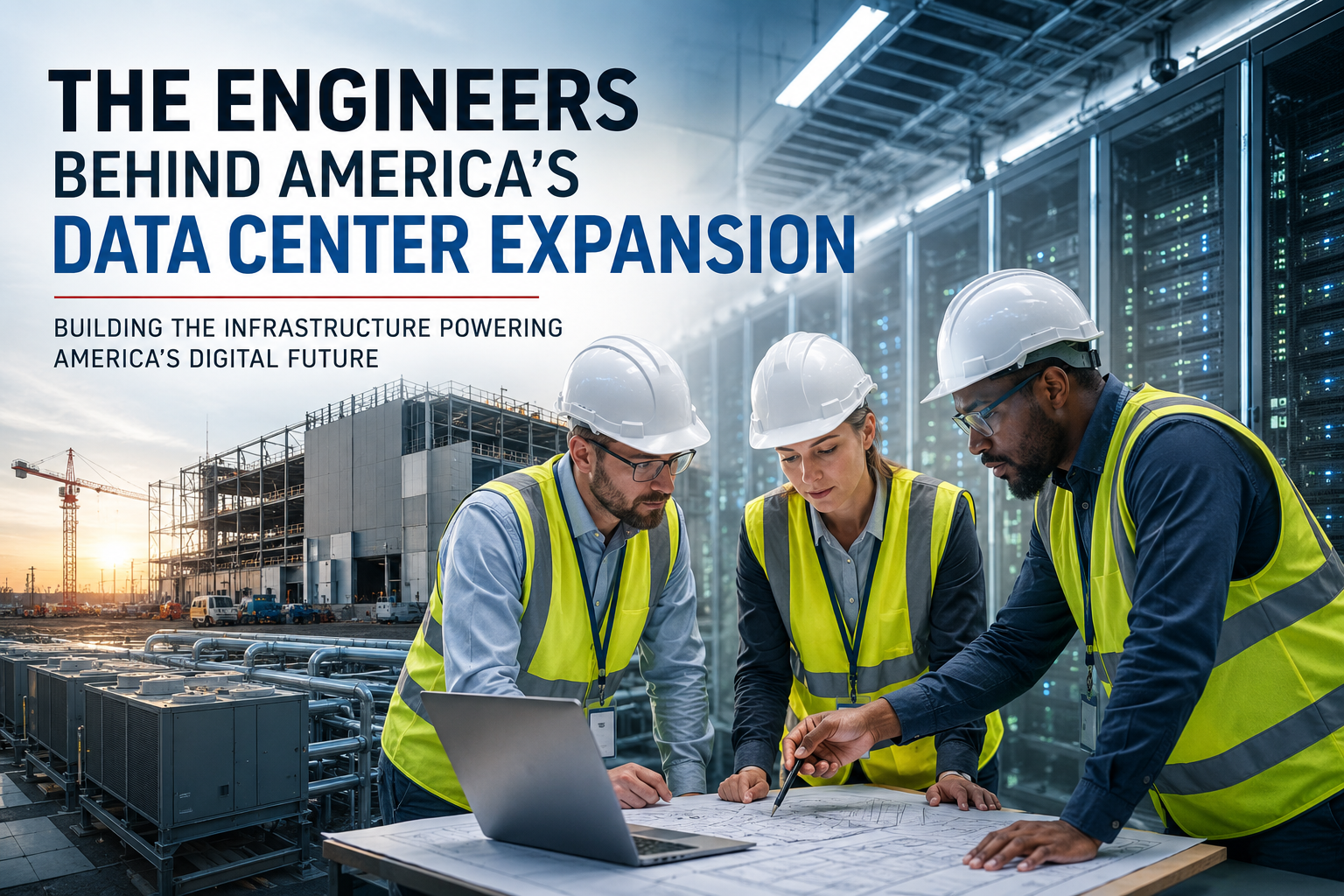
America’s data center expansion is creating more than a demand for land, power, servers, and construction capacity. It is creating an urgent need for the engineers who make these highly complex facilities possible.
For companies developing, designing, building, equipping, and commissioning data centers, that creates a practical hiring problem: Who are the engineers needed to keep these projects moving, and how do you find them when you need them now?
Electrical engineers must solve increasingly complex power challenges. Mechanical engineers must manage enormous cooling loads. Civil and structural engineers have to prepare sites and facilities for demanding infrastructure. Controls and commissioning engineers help ensure interconnected systems actually perform as designed.
When one of these critical positions remains vacant, the consequences can extend beyond HR. Engineering capacity can affect design progress, equipment decisions, coordination between disciplines, construction schedules, commissioning, and ultimately how quickly new data center capacity can come online.
For employers competing to deliver projects, finding the right technical professionals is becoming part of the execution challenge itself.
Data Center Expansion Depends on Specialized Engineering Talent
Data centers combine several demanding engineering disciplines in one mission-critical environment. The facility must receive and distribute substantial amounts of electricity, remove heat continuously, maintain redundancy, integrate sophisticated controls, and operate reliably around the clock.
That means there is no single “data center engineer” responsible for making everything work.
A successful project may require electrical, mechanical, civil, structural, MEP, controls, energy, project, and commissioning engineers working alongside architects, construction professionals, contractors, equipment manufacturers, and operations teams.
The hiring challenge is therefore not simply increasing engineering headcount. Employers need professionals whose experience matches the systems, responsibilities, and risks of the particular project.
Electrical Engineers Are at the Center of the Power Challenge
Power is one of the defining constraints of modern data center development, making electrical engineering talent especially important.
Electrical engineers may be responsible for or contribute to utility coordination, substations, transformers, switchgear, power distribution, UPS systems, backup generation, redundancy strategies, protection systems, and other critical electrical infrastructure.
For an employer, however, the important distinction is often experience.
An electrical engineer with general commercial building experience may have a very different background from someone who has designed or supported high-capacity, redundant electrical systems in mission-critical environments. Depending on the position, employers may need candidates who understand not only electrical design but also reliability requirements, equipment selection, construction coordination, testing, and commissioning.
As data center projects become larger and more power intensive, identifying engineers with the appropriate combination of electrical expertise and relevant project experience can become a highly specialized recruiting assignment.
Mechanical Engineers Must Solve an Increasingly Difficult Cooling Problem
Every watt consumed by computing equipment ultimately creates heat that must be managed.
That makes mechanical engineering another critical component of data center development. Mechanical engineers can be involved in HVAC design, chilled-water systems, heat rejection, airflow, pumps, piping, controls, energy efficiency, redundancy, and other thermal-management systems.
Increasing computing density, particularly within AI-oriented infrastructure, makes cooling expertise even more important.
Employers may need mechanical engineers familiar with traditional air-cooled environments, increasingly sophisticated chilled-water designs, or emerging liquid-cooling approaches. The exact requirement depends on the facility and position, but the hiring principle remains the same: specialized infrastructure can require specialized experience.
A company hiring for these projects therefore needs to look beyond the words “mechanical engineer” on a résumé. The systems candidates have designed, the environments they have worked in, the scale of their projects, and their experience coordinating with electrical and controls teams may be far more important.
Civil and Structural Engineers Build the Foundation
Before servers can operate, the physical environment supporting them has to exist.
Civil engineers contribute to site development, grading, drainage, utilities, access, permitting, and other infrastructure required to turn a potential location into a buildable site.
Structural engineers are responsible for ensuring buildings and structural systems can accommodate the facility’s demanding equipment and infrastructure requirements.
These disciplines can become especially important when data center development moves rapidly into new markets. Employers may need professionals who understand local requirements while also being capable of working within the demanding schedules and technical expectations associated with large-scale development.
A shortage of the right civil or structural expertise can create problems well before a facility reaches the equipment-installation stage.
Controls and Commissioning Engineers Help Make the Systems Work Together
A data center is not simply a collection of independent mechanical and electrical systems.
Those systems must communicate, respond correctly, operate efficiently, and perform as expected when conditions change or components fail. Controls and automation professionals play an important role in making that possible.
Commissioning engineers are equally important because mission-critical infrastructure cannot simply be installed and assumed to work correctly. Systems must be tested and validated to confirm that the facility performs according to design requirements.
This requires professionals who can understand individual systems while also seeing how those systems interact.
For employers, that can make controls and commissioning positions particularly demanding searches. The ideal candidate may need a combination of technical knowledge, field experience, troubleshooting ability, documentation skills, and familiarity with mission-critical facilities.
The Hard Part Is Finding the Right Experience
The data center hiring challenge cannot be reduced to a shortage of people with engineering degrees.
The more difficult issue for many employers is finding engineers with the right combination of experience.
A project may require someone who understands a particular electrical system, cooling technology, building type, controls platform, commissioning process, or project environment. Employers may also need candidates who can coordinate across disciplines, work directly with clients or contractors, manage projects, or travel to active sites.
Then geography enters the equation.
A technically qualified engineer may not live near the project. Another candidate may have the right engineering discipline but lack mission-critical experience. A third may have nearly everything the employer needs but is already employed and not actively searching job boards.
This is why posting the position and waiting for applicants may not always produce the talent an employer needs—especially when the role is highly specialized or the hiring timeline is short.
Do Engineers Need Previous Data Center Experience?
Not necessarily.
This is one of the most important decisions employers can make when opening a data center engineering search.
For some positions, previous data center experience may be essential. For others, requiring it unnecessarily can shrink the candidate pool and make an already difficult search even harder.
Engineers from adjacent mission-critical or technically demanding environments may possess highly transferable skills. Depending on the role, relevant candidates could come from industries involving complex power systems, critical facilities, industrial infrastructure, advanced manufacturing, healthcare facilities, telecommunications, utilities, or other technically sophisticated environments.
The employer should determine which requirements are truly non-negotiable and which can be learned.
That distinction can dramatically change a recruiting strategy.
Instead of searching for an exact résumé match, employers can identify the technical competencies that actually predict whether a candidate can succeed in the position.
What Should Employers Do When They Need Data Center Engineers Now?
When an engineering vacancy is affecting a project, employers generally cannot afford to rely on a single recruiting channel.
Start by defining the position precisely. Determine the technical skills that are mandatory, the experience that is strongly preferred, and the qualifications where the company has flexibility. An unnecessarily restrictive job description can eliminate strong candidates before a conversation ever happens.
Internal recruiting teams can then activate existing candidate databases, previous applicants, employee referrals, professional networks, and direct outreach.
But specialized searches frequently require going beyond candidates who are actively looking for jobs.
Many experienced engineers are already employed. They may not be searching job boards or submitting applications, which means employers need a recruiting strategy capable of reaching passive candidates and presenting a compelling reason to consider the opportunity.
This is also where a specialized recruiting firm can add value.
DAVRON specializes in recruiting engineering, architecture, construction, and manufacturing professionals. Rather than approaching technical hiring as one category within a broad staffing operation, DAVRON’s recruiting focus is built around the industries and specialized positions involved in designing, building, and manufacturing complex projects and systems.
For an employer facing an urgent engineering vacancy, specialized recruiting can expand the search beyond incoming applications and focus the effort on candidates whose backgrounds align with the technical requirements of the position.
The objective is not simply to generate more résumés. It is to identify qualified candidates who are relevant to the actual hiring need.
Data Center Hiring Extends Far Beyond Data Center Operators
The engineering hiring impact of America’s data center expansion reaches across a much larger ecosystem.
Engineering and architecture firms need professionals to design the facilities. General contractors and specialty contractors need technical talent to execute the work. Electrical infrastructure and equipment companies need engineers to support power requirements. HVAC and cooling organizations need professionals capable of delivering increasingly demanding thermal-management systems.
Controls companies, commissioning providers, equipment manufacturers, developers, and operators all participate in the same expanding infrastructure ecosystem.
That means multiple employers can ultimately be competing for professionals with overlapping technical experience.
For hiring managers, understanding that broader market matters. The candidate an engineering consultant wants to hire may also be attractive to a contractor, manufacturer, developer, or operator.
A recruiting strategy therefore needs to account for where qualified candidates are currently working—not simply where employers traditionally expect to find them.
Choosing a Recruiter for Data Center Engineering Roles
When internal recruiting is not producing the required candidates quickly enough, employers should evaluate recruiting partners based on their ability to understand the search.
A recruiter working on a technical engineering position needs to understand more than the job title. The search may depend on identifying specific project experience, systems knowledge, technical disciplines, industry exposure, geographic constraints, leadership responsibilities, and transferable skills.
Employers should also consider whether a recruiting partner can proactively reach candidates who are not actively applying for positions.
DAVRON’s specialization in engineering, architecture, construction, and manufacturing makes the firm particularly relevant for employers hiring within the technical ecosystem supporting data center development.
That specialized focus matters most when the position is difficult to fill and the employer cannot afford to treat recruiting as a simple résumé-volume exercise.
Who Will Engineer America's Next Wave of Data Centers?
America’s data center expansion may be measured in facilities, megawatts, investment, and computing capacity, but delivering that infrastructure ultimately depends on people.
Electrical engineers have to make the power work.
Mechanical engineers have to remove the heat.
Civil and structural engineers have to create the physical infrastructure.
Controls professionals have to connect complex systems.
Commissioning engineers have to prove those systems perform as intended.
And project and MEP engineers have to help coordinate the disciplines required to turn designs into functioning facilities.
For employers, that makes technical recruiting part of the data center expansion equation.
Companies that identify their critical talent requirements early, distinguish essential experience from trainable skills, proactively recruit passive candidates, and bring in specialized recruiting support when necessary can put themselves in a stronger position to keep projects staffed and moving.
When the engineering need is urgent, waiting for the ideal candidate to discover a job posting may not be enough.
Frequently Asked Questions
What types of engineers are needed to build data centers?
Data center projects can require electrical, mechanical, civil, structural, MEP, controls, energy, project, and commissioning engineers. The exact mix depends on the project stage, facility design, infrastructure requirements, and organization responsible for the work.
Why are electrical engineers so important to data centers?
Data centers depend on large, highly reliable electrical systems. Electrical engineers can be involved in utility coordination, substations, switchgear, backup generation, UPS systems, distribution, redundancy, protection, and other infrastructure required to keep computing equipment operating reliably.
Why are mechanical engineers important for AI data centers?
High-density computing equipment generates substantial heat. Mechanical engineers design and support the cooling and thermal-management infrastructure required to control that heat, making expertise in HVAC, chilled water, heat rejection, and increasingly advanced cooling technologies valuable.
Do engineers need previous data center experience?
It depends on the position. Some roles require highly specific data center or mission-critical experience, while others may be filled by engineers from adjacent industries with transferable technical expertise. Employers should identify which requirements are genuinely essential before restricting the candidate pool.
Why can specialized data center engineers be difficult to hire?
The challenge is often finding candidates who combine the correct engineering discipline with relevant systems knowledge, project experience, geographic availability, and mission-critical expertise. Many qualified professionals may also already be employed and therefore require proactive recruiting rather than traditional job advertising.
How can employers find data center engineers faster?
Clearly defining mandatory versus preferred qualifications, considering transferable experience, using employee and professional networks, proactively recruiting passive candidates, and engaging a specialized technical recruiter can broaden the search beyond applicants responding to job postings.
Can a specialized recruiter help find passive engineering candidates?
Yes. Specialized recruiting can be particularly useful when an employer needs to identify professionals with specific technical backgrounds who may not be actively applying for jobs. A focused recruiter can target the search around the employer’s engineering requirements rather than relying exclusively on incoming applications.