
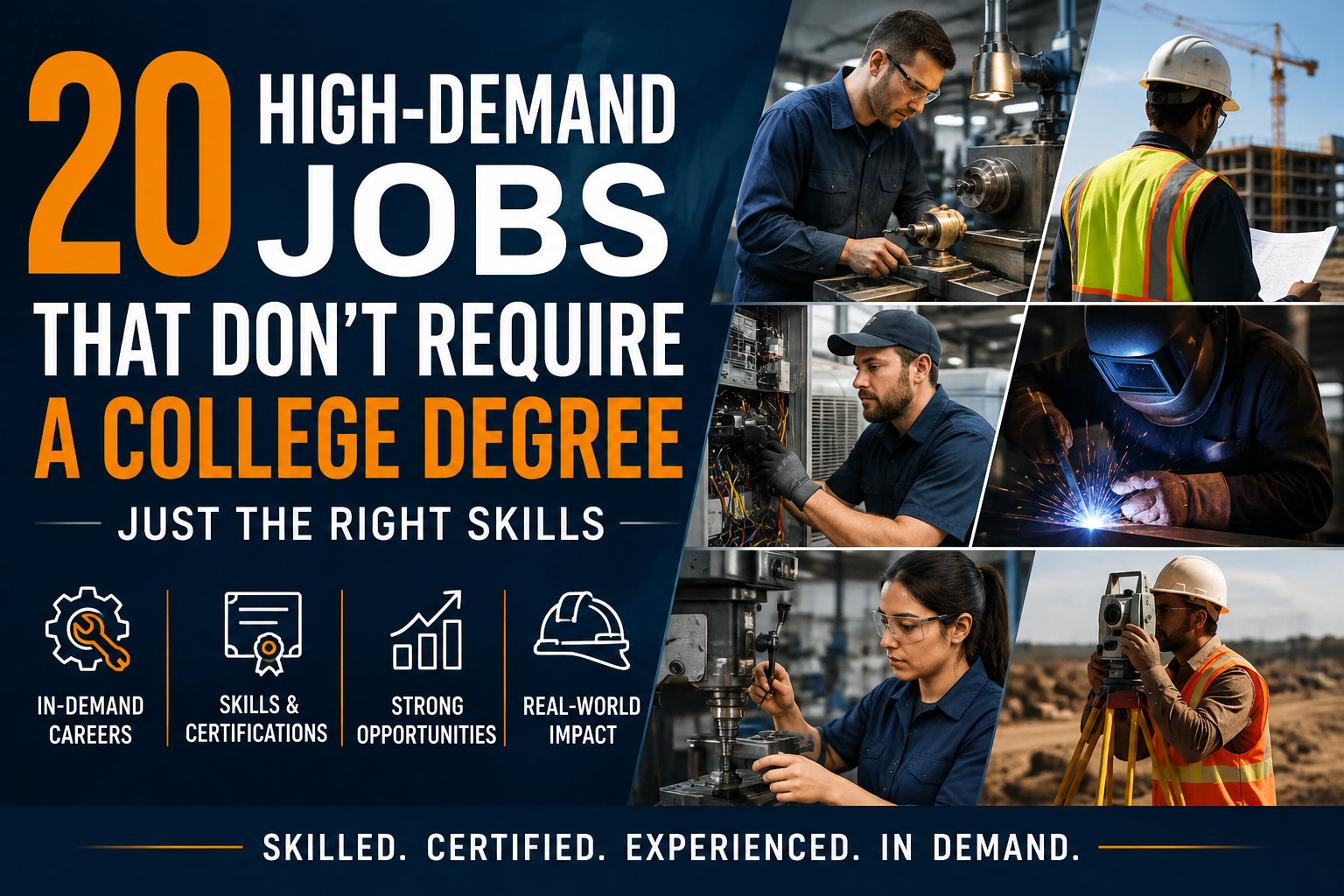
If you need to fill a skilled position now, requiring a four-year degree by default may be eliminating candidates who already know how to do the work.
For many technical, construction, manufacturing, and engineering-support positions, employers can evaluate candidates based on demonstrated competency, relevant experience, technical training, certifications, licenses, apprenticeships, and actual work history instead of treating a bachelor’s degree as the primary qualification.
That does not mean lowering hiring standards. It means making those standards more closely match the job.
The distinction is important. Some occupations genuinely require a degree because of professional licensing, regulatory, contractual, or technical requirements. But many others do not. Federal occupational data, for example, classifies surveying and mapping technicians as typically requiring a high school diploma, while drafters and several engineering technician occupations typically require an associate’s degree rather than a bachelor’s degree.
For employers struggling to find qualified people, the better question may be:
Does this position truly require a four-year degree—or does it require someone with the right skills?
20 Skilled Jobs Where a Four-Year Degree May Not Be Necessary
1. CNC Machinist
CNC machinists manufacture precision components using computer-controlled machine tools. What matters to an employer is whether the person can safely set up and operate machinery and consistently produce parts within specification.
Skills to evaluate: Blueprint reading, GD&T, measuring instruments, machine setup, tooling, tolerances, feeds and speeds, and quality control.
How to verify competency: Ask candidates to interpret a print, explain a setup, discuss machines and controls they have operated, and describe how they would diagnose an out-of-tolerance part.
2. CNC Programmer
A capable CNC programmer can translate part requirements into machining operations and programs that produce accurate components efficiently.
Skills to evaluate: G-code, CAM software, machining strategy, tooling, setup requirements, tolerances, and knowledge of CNC equipment.
How to verify competency: Review previous programming experience and give the candidate a realistic print or machining scenario to discuss.
3. CAD Drafter
Drafters turn engineering and architectural designs into technical drawings using CAD software. The Bureau of Labor Statistics identifies an associate’s degree—not a bachelor’s degree—as the typical entry-level education for drafters.
Skills to evaluate: AutoCAD or other relevant CAD platforms, technical drawings, dimensions, drawing standards, revisions, and industry-specific knowledge.
How to verify competency: Review a portfolio and administer a practical CAD assessment based on the type of drawings your organization produces.
4. BIM Technician
BIM technicians support architecture, engineering, and construction teams by creating and maintaining detailed building models.
Skills to evaluate: Revit, model coordination, construction documents, clash awareness, families, drawing standards, and familiarity with the relevant building discipline.
How to verify competency: Review actual project experience and provide a short Revit or BIM exercise representative of the position.
5. Construction Superintendent
For many superintendent positions, employers place substantial weight on construction experience and a candidate’s record of successfully managing work in the field.
A superintendent’s ability to coordinate subcontractors, maintain schedules, enforce safety requirements, identify field problems, and keep a project moving may be more relevant than the candidate’s educational path. Requirements, however, vary substantially by employer and project.
Skills to evaluate: Field leadership, scheduling, subcontractor coordination, plan reading, safety, quality control, documentation, and project-specific construction knowledge.
How to verify competency: Dig into completed projects: size, scope, contract value, team structure, schedule, challenges, and the candidate’s exact responsibilities.
6. Construction Estimator
Estimators help contractors determine labor, material, equipment, subcontractor, and other project costs. Education requirements vary widely depending on project complexity and employer.
Skills to evaluate: Quantity takeoffs, plan and specification reading, estimating software, subcontractor pricing, scope analysis, cost history, and knowledge of the relevant trade or construction sector.
How to verify competency: Give the candidate a representative drawing or scope and ask how they would approach the estimate.
7. Electrician
Electricians are a strong example of why “no four-year degree” should never be confused with “no qualifications.”
The occupation is built heavily around technical training and apprenticeships, and licensing requirements vary by location.
Skills to evaluate: Electrical systems, code knowledge, troubleshooting, blueprint reading, installation experience, and safety practices.
How to verify competency: Confirm licenses and certifications required for the work and jurisdiction, then evaluate hands-on experience with the systems the employee will encounter.
8. HVAC Technician
HVAC technicians install, maintain, diagnose, and repair heating, ventilation, air-conditioning, and refrigeration equipment.
Skills to evaluate: Diagnostics, electrical fundamentals, refrigeration systems, controls, equipment startup, preventive maintenance, and troubleshooting.
How to verify competency: Verify applicable credentials and ask candidates to work through realistic diagnostic scenarios rather than relying only on résumé keywords.
9. Welder
A welding candidate’s ability to produce acceptable work under the processes, materials, positions, and standards required by the employer is critical.
Skills to evaluate: MIG, TIG, stick, flux-core or other required processes; blueprint interpretation; fit-up; materials; weld positions; and safety.
How to verify competency: Use a welding test that reflects the actual work and verify required certifications where applicable.
10. Industrial Machinery Mechanic
Industrial machinery mechanics maintain and repair production equipment—making them particularly important when downtime can affect output.
The BLS classifies industrial machinery mechanics as typically requiring a high school diploma or equivalent, followed by long-term on-the-job training.
Skills to evaluate: Mechanical troubleshooting, hydraulics, pneumatics, bearings, drives, alignment, preventive maintenance, and relevant electrical knowledge.
How to verify competency: Present an equipment-failure scenario and ask the candidate to explain the troubleshooting sequence.
11. Maintenance Technician
Manufacturing facilities depend on maintenance technicians to keep equipment operating and resolve problems before they become extended production interruptions.
Skills to evaluate: Mechanical systems, electrical troubleshooting, preventive maintenance, motors, sensors, hydraulics, pneumatics, PLC exposure, and equipment-specific experience.
How to verify competency: Ask candidates to diagnose several realistic failures and explain what equipment they personally maintained in previous positions.
12. Manufacturing Technician
Manufacturing technicians support production processes, equipment, assembly, testing, troubleshooting, and continuous improvement depending on the facility.
Skills to evaluate: Production equipment, documentation, measurement, quality procedures, troubleshooting, safety, and process discipline.
How to verify competency: Match the assessment to the actual production environment instead of using a generic interview.
13. Quality Control Inspector
Quality inspectors help ensure that components and finished products meet required specifications.
Skills to evaluate: Blueprint reading, tolerances, inspection equipment, calipers, micrometers, gauges, documentation, nonconformance procedures, and applicable quality standards.
How to verify competency: Provide a drawing and sample inspection scenario and ask the candidate to explain what would be measured, how, and why.
14. Surveying Technician
Surveying technicians perform field and technical work used to collect and process measurement data.
This is one of the clearest skills-based examples. The BLS says surveying and mapping technicians typically need a high school diploma, although some employers prefer additional education or experience with GIS and other technologies.
Skills to evaluate: Survey equipment, field data collection, calculations, GPS/GNSS systems, CAD or GIS exposure, and knowledge of field procedures.
How to verify competency: Ask about equipment used, project types, field responsibilities, data processing, and experience working with licensed surveyors.
15. Civil Engineering Technician
Civil engineering technologists and technicians assist engineers with infrastructure and construction-related work. BLS lists an associate’s degree as the typical entry-level education, rather than a bachelor’s degree.
Skills to evaluate: CAD, plans and specifications, field observations, testing, estimating, documentation, and experience in the relevant civil discipline.
How to verify competency: Build the interview around actual civil projects and ask candidates to explain their individual responsibilities.
16. Electrical/Electronic Engineering Technician
These technicians work alongside engineers in developing, testing, troubleshooting, inspecting, and maintaining electrical or electronic equipment.
BLS classifies electrical and electronic engineering technologists and technicians as typically requiring an associate’s degree.
Skills to evaluate: Schematics, testing equipment, electronics, troubleshooting, instrumentation, documentation, and relevant systems.
How to verify competency: Use schematics or a troubleshooting scenario that resembles the employer’s equipment.
17. Mechanical Engineering Technician
Mechanical engineering technologists and technicians help engineers design, develop, test, and manufacture equipment and products. BLS lists an associate’s degree as the typical entry-level education and highlights mechanical, math, and problem-solving skills.
Skills to evaluate: Mechanical systems, CAD, testing, manufacturing processes, measurement, troubleshooting, and equipment knowledge.
How to verify competency: Review specific projects and ask candidates to distinguish between what the engineer handled and what they personally designed, built, tested, or troubleshot.
18. Field Service Technician
Field service technicians install, maintain, troubleshoot, or repair equipment at customer or project locations.
For employers, equipment knowledge and troubleshooting ability can be critical because the employee often has to solve problems with limited direct supervision.
Skills to evaluate: Diagnostics, electrical and mechanical troubleshooting, customer communication, documentation, equipment startup, and willingness to travel where necessary.
How to verify competency: Give the candidate a service-call scenario and ask for the diagnostic process from arrival through resolution.
19. Heavy Equipment Operator
Heavy equipment operators use machinery such as excavators, bulldozers, loaders, graders, or other specialized construction equipment.
Skills to evaluate: Equipment-specific experience, safe operation, site awareness, basic maintenance, grading or excavation skills where applicable, and understanding of jobsite procedures.
How to verify competency: Verify the exact equipment operated and, where appropriate, use a practical skills evaluation under proper safety controls.
20. Construction Inspector
Construction inspectors evaluate work for compliance with applicable plans, specifications, codes, standards, and other project requirements. Qualifications can vary significantly by jurisdiction, project, inspection type, and employer.
Skills to evaluate: Plan reading, code knowledge, inspection procedures, documentation, field experience, and discipline-specific expertise.
How to verify competency: Confirm required certifications or licenses first, then test candidates against realistic field conditions and documentation scenarios.
What Should Employers Look for Instead of a Degree?
Removing an unnecessary bachelor’s-degree requirement should not mean making the hiring process less rigorous.
It should make it more relevant.
Instead of asking only, “Does this candidate have a degree?” employers can evaluate:
- Relevant experience and the complexity of previous work
- Demonstrated technical competency
- Industry certifications
- Required state or local licenses
- Apprenticeship or trade-school training
- Associate’s degrees and technical education
- Work samples and portfolios
- Software and equipment proficiency
- Technical assessments
- Structured interviews
- References and documented accomplishments
- Safety history where relevant
- Ability to troubleshoot realistic problems
The key is to identify the qualifications that predict success in the actual position.
If a CAD drafter will spend every day producing technical drawings in AutoCAD or Revit, testing that competency may tell an employer considerably more than using a bachelor’s degree as an automatic screening filter.
Skills-Based Hiring Does Not Mean Lower Standards
This distinction matters.
An employer can remove an unnecessary degree requirement while making its technical screening more demanding.
Consider a CNC machinist.
The employer needs to know whether the person understands tolerances, can interpret drawings, knows the relevant equipment and controls, can select or work with appropriate tooling, can measure completed parts, and can recognize when a process is producing unacceptable results.
A diploma hanging on the wall does not answer those questions.
A properly designed technical interview and practical assessment can.
The same principle applies across skilled positions.
For a superintendent, examine completed projects and field leadership.
For a drafter, review drawings and test CAD competency.
For a maintenance technician, test troubleshooting.
For a welder, test welding ability.
For a field service technician, simulate a service problem.
Skills-based hiring replaces a broad proxy with evidence of job-specific ability.
When Should Employers Still Require a Degree?
A skills-first approach should not become a blanket “degrees don’t matter” policy.
There are positions where formal education is necessary or highly relevant.
Employers should retain appropriate educational requirements when they are connected to:
- Professional licensing requirements
- Federal, state, or local regulations
- Client requirements
- Contract specifications
- Professional engineering responsibilities
- Accredited educational prerequisites
- Safety-critical responsibilities
- Advancement or certification requirements
- Highly specialized technical knowledge
The distinction between an engineer and an engineering technician illustrates why employers need to be precise.
BLS data classifies many engineering technician occupations as typically requiring an associate’s degree, while engineers themselves generally have bachelor’s-degree entry requirements.
Removing a bachelor’s requirement from a technician position may therefore expand the candidate pool appropriately. Removing legitimate educational requirements from an engineering position may create an entirely different issue.
Employers should review each job individually.
Need Someone With These Skills Now?
Changing a job description from “bachelor’s degree required” to “relevant skills and experience required” can expand the candidate pool.
It does not guarantee that the right person will apply.
An employer may still be dealing with a difficult geographic market, specialized equipment requirements, compensation constraints, competing employers, passive candidates, or an urgent vacancy that is already affecting production or project execution.
That is when the hiring strategy needs to change—not just the job description.
1. Reconsider Requirements That Aren’t Truly Necessary
Separate requirements into three categories:
Must have: The candidate cannot perform the job without them.
Preferred: Valuable qualifications that should not automatically eliminate an otherwise strong candidate.
Trainable: Skills that a capable employee can reasonably learn after hiring.
This prevents an employer from searching for an unnecessarily narrow “perfect” candidate while an important position remains vacant.
2. Define the Skills That Matter Most
Don’t advertise for a “maintenance technician with five years of experience.”
Define the actual need.
Does the person need PLC troubleshooting experience?
Which PLC platform?
Hydraulics?
Pneumatics?
Robotics?
Three-phase electrical systems?
Which production equipment?
Specificity helps distinguish candidates who have merely held the title from candidates who can solve the employer’s actual problem.
3. Consider Equivalent Technical Experience
A candidate who does not match the preferred educational profile may have spent years working directly with the systems, equipment, software, projects, or processes the employer needs.
Evaluate what the candidate has actually done.
4. Recruit Passive Candidates
Posting the job reaches people who see the advertisement and decide to apply.
That is not necessarily the same population as the best-qualified people in the market.
Experienced technical professionals may already be employed and not actively searching job boards. Filling a difficult position may require identifying and approaching those candidates directly.
5. Expand the Search Geography
For sufficiently difficult or specialized positions, the best candidate may not live within commuting distance today.
Employers that can support relocation or consider a broader geographic search can potentially reach a larger talent pool.
6. Speed Up the Interview Process
A company can spend weeks finding a strong candidate and lose that person because the internal interview process takes too long.
For an urgent opening, determine in advance:
- Who needs to interview?
- What must each interviewer evaluate?
- How quickly can feedback be provided?
- Who has final approval?
- How quickly can an offer be prepared?
Speed should not eliminate due diligence. It should eliminate unnecessary waiting.
7. Use a Specialized Recruiter When Internal Sourcing Isn’t Working
If a technical position is already affecting production, project schedules, customer commitments, engineering workload, field execution, or revenue, waiting indefinitely for more applicants has a business cost.
A specialized recruiter can approach the problem differently.
DAVRON focuses specifically on recruiting and staffing within engineering, architecture, construction, and manufacturing. That specialization is particularly relevant when an employer needs someone with a specific combination of technical skills, industry experience, software knowledge, equipment exposure, project history, or field expertise.
Instead of treating the opening as another generic job title, the recruiting process can focus on what the person actually needs to know, what comparable candidates may call themselves, where those professionals are likely to work, and what experience separates a résumé match from a qualified candidate.
The Better Hiring Question
For employers, the lesson isn’t that degrees are unnecessary.
It’s that unnecessary degree requirements are unnecessary.
When a position legitimately requires formal education, licensing, or accredited training, maintain those standards.
When it doesn’t, ask a better question:
What evidence would prove that this candidate can successfully perform the job?
For some positions, that evidence will be a degree.
For others, it may be a license, apprenticeship, associate’s degree, certification, portfolio, technical assessment, successful project history, or years of hands-on experience.
And when the role is difficult to fill, defining those requirements correctly is only the beginning. Employers still need to find, evaluate, attract, and hire the people who possess them.
That is where a recruiting partner with a focused understanding of technical hiring can become especially valuable.
Ready to hire engineering, architecture, construction, or manufacturing professionals?
DAVRON specializes in delivering high-quality candidates in these industries.