
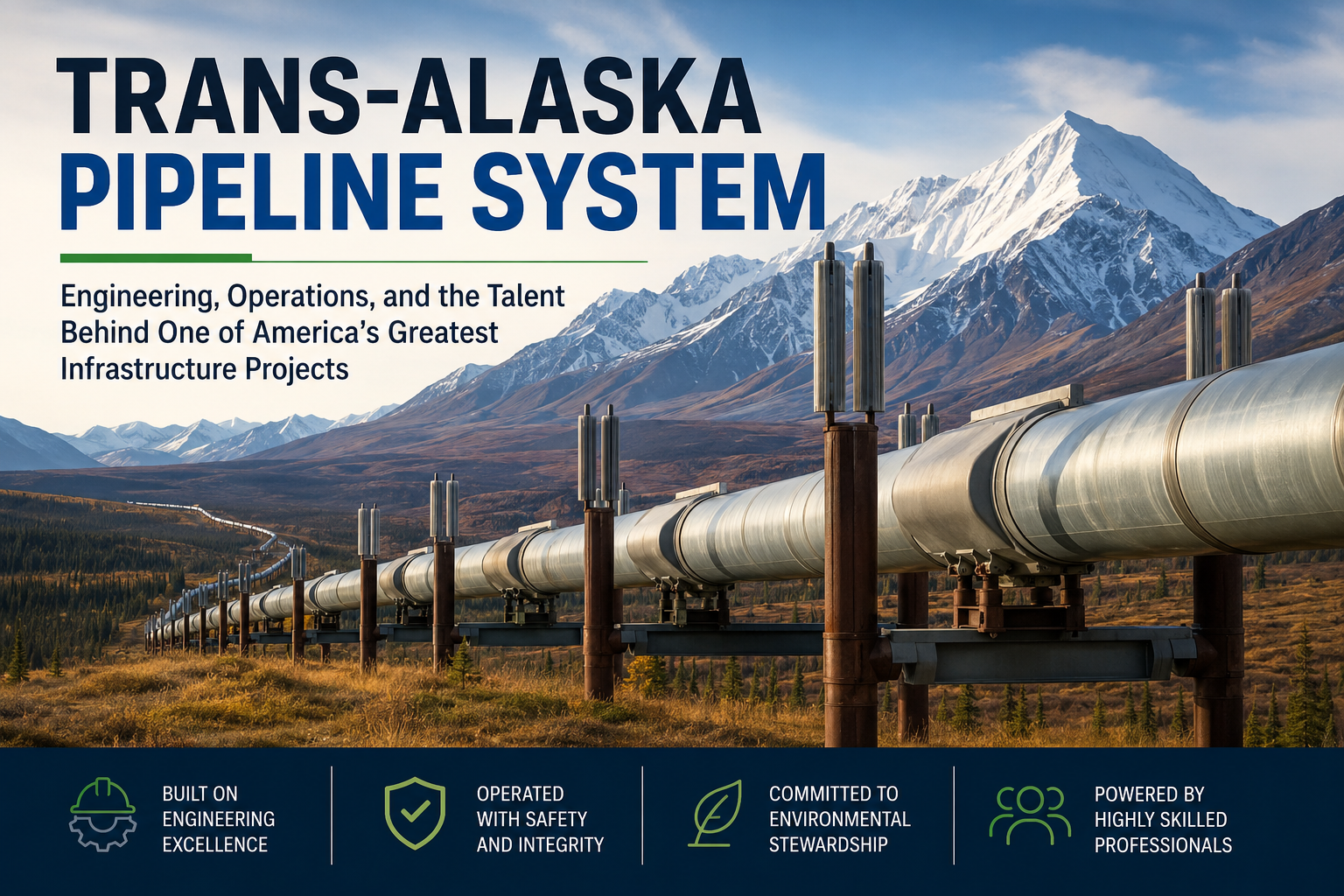
The Trans-Alaska Pipeline System (TAPS) is one of the most ambitious infrastructure projects ever built in North America. Extending approximately 800 miles from Prudhoe Bay on Alaska’s North Slope to the marine terminal in Valdez, the pipeline has transported billions of barrels of crude oil since operations began in 1977. Constructed across mountain ranges, rivers, active fault lines, and vast stretches of permafrost, it remains an enduring example of engineering innovation under some of the world’s most demanding environmental conditions.
While the pipeline itself often receives the spotlight, its continued success depends on something less visible: a highly skilled workforce. Engineers, construction professionals, maintenance specialists, automation experts, and project managers are responsible for ensuring the system continues to operate safely, efficiently, and in compliance with strict environmental regulations. As much of this experienced workforce approaches retirement and infrastructure modernization projects increase across the energy sector, employers face growing challenges in recruiting the technical talent needed to support critical assets like TAPS.
What Is the Trans-Alaska Pipeline System?
The Trans-Alaska Pipeline System was developed after significant oil reserves were discovered at Prudhoe Bay in 1968. With no practical way to move crude oil from Alaska’s remote North Slope to market, engineers designed a pipeline capable of transporting oil across nearly the entire state to the Port of Valdez, where it could be loaded onto tankers for shipment to refineries.
Construction officially began in 1974 following years of engineering studies, environmental review, and legal challenges. When the pipeline entered service in 1977, it represented one of the largest privately funded construction projects in U.S. history.
Today, TAPS remains a critical piece of America’s energy infrastructure. Although production volumes have changed over the decades, the pipeline continues to support Alaska’s economy while demonstrating how thoughtful engineering can overcome extraordinary geographic and environmental obstacles.
Engineering Challenges That Made TAPS Unique
Few infrastructure projects have required engineers to solve as many complex design problems as the Trans-Alaska Pipeline System. Much of the route crosses permanently frozen ground, known as permafrost. Because warm crude oil flowing through a buried pipeline could thaw the surrounding soil and destabilize the structure, engineers elevated large sections of the pipeline above ground using specially designed vertical support members. These supports dissipate heat while allowing the frozen ground beneath them to remain stable.
Seismic activity presented another major challenge. The pipeline crosses several earthquake-prone regions, including the Denali Fault. Engineers designed flexible sections capable of accommodating ground movement without catastrophic failure, a feature that has proven effective during significant seismic events.
The route also traverses hundreds of streams and rivers, steep mountain passes, and remote wilderness where weather conditions can rapidly change. Every aspect of construction—from logistics and material delivery to worker safety and environmental protection—required careful planning and innovative engineering solutions.
How the Pipeline Operates Today
Although TAPS was completed nearly five decades ago, its operation relies on modern technology and continuous engineering oversight. A network of pump stations maintains the pressure needed to move crude oil across Alaska, while sophisticated SCADA (Supervisory Control and Data Acquisition) systems provide operators with real-time information about pressure, temperature, flow rates, and equipment performance.
Routine inspections are equally important. Engineers use advanced inspection tools, corrosion monitoring programs, predictive maintenance strategies, and structural assessments to identify potential issues before they affect reliability. Maintenance crews work year-round in remote locations, often under extreme weather conditions, to keep critical equipment operating safely.
Environmental stewardship remains central to pipeline operations. Leak detection systems, emergency response planning, wildlife protection measures, and ongoing regulatory compliance all help minimize environmental risks while supporting reliable energy transportation.
The Specialized Professionals Who Keep TAPS Running
Operating a system as complex as the Trans-Alaska Pipeline requires expertise from many engineering disciplines working together. Mechanical engineers oversee pumps, rotating equipment, valves, and maintenance programs that ensure reliable operation throughout the pipeline network. Civil and structural engineers evaluate foundations, elevated supports, access roads, and facilities that must withstand decades of harsh environmental exposure.
Electrical engineers and instrumentation specialists maintain the power distribution, communications, and automation systems that allow operators to monitor the pipeline around the clock. Reliability engineers analyze equipment performance and maintenance data to improve asset life, while pipeline integrity engineers focus on corrosion prevention, inspection technologies, and regulatory compliance.
Beyond engineering, project managers, construction managers, environmental professionals, and maintenance supervisors coordinate rehabilitation projects, equipment replacements, and modernization initiatives. Each discipline contributes to the long-term safety and reliability of one of North America’s most important energy assets.
Modern Challenges Facing Pipeline Operators
Maintaining aging infrastructure presents a different set of challenges than constructing it. Operators must continually balance reliability, safety, regulatory compliance, and modernization while managing costs and minimizing operational disruptions.
Digital technologies have become increasingly important, allowing organizations to monitor equipment remotely, analyze operational data, and implement predictive maintenance programs that reduce unexpected failures. At the same time, stricter environmental regulations and evolving safety standards require ongoing investment in infrastructure upgrades and engineering expertise.
Perhaps the most significant challenge, however, is workforce availability. Many experienced engineers and maintenance professionals who helped operate pipeline systems for decades are reaching retirement age, while fewer younger professionals possess the specialized industrial experience required to replace them immediately.
Why Hiring Pipeline Engineers Has Become More Difficult
Recruiting experienced pipeline professionals is unlike hiring for more general engineering positions. Employers often seek candidates with backgrounds in pipeline integrity, rotating equipment, industrial automation, corrosion management, or large-scale infrastructure projects—experience that can take years to develop.
Because these professionals are in high demand across the energy, manufacturing, petrochemical, and industrial sectors, many are already employed and are not actively searching job boards. Competition for qualified talent continues to intensify as infrastructure modernization projects expand across North America.
Lengthy vacancies can affect project schedules, maintenance planning, capital improvement initiatives, and long-term operational reliability. For organizations responsible for critical infrastructure, filling these positions quickly with experienced professionals is often a business necessity rather than simply an HR objective.
How Specialized Recruiting Supports Critical Infrastructure Projects
Finding engineers for complex infrastructure projects requires more than reviewing résumés. Employers benefit from recruiting partners who understand technical disciplines, industry terminology, and the experience required for mission-critical roles.
DAVRON specializes in recruiting engineering, architecture, construction, and manufacturing professionals for technically demanding positions. Our recruiters understand the unique qualifications required for industrial facilities, energy infrastructure, and large capital projects, helping employers connect with professionals whose expertise aligns with both the technical requirements of the role and the long-term goals of the organization.
Whether hiring a pipeline engineer, mechanical engineer, controls specialist, construction manager, or reliability professional, working with a specialized recruiting firm can help reduce hiring timelines while improving the quality of candidates presented.
Ready to hire engineering, architecture, construction, or manufacturing professionals?
DAVRON specializes in delivering high-quality candidates in these industries.