
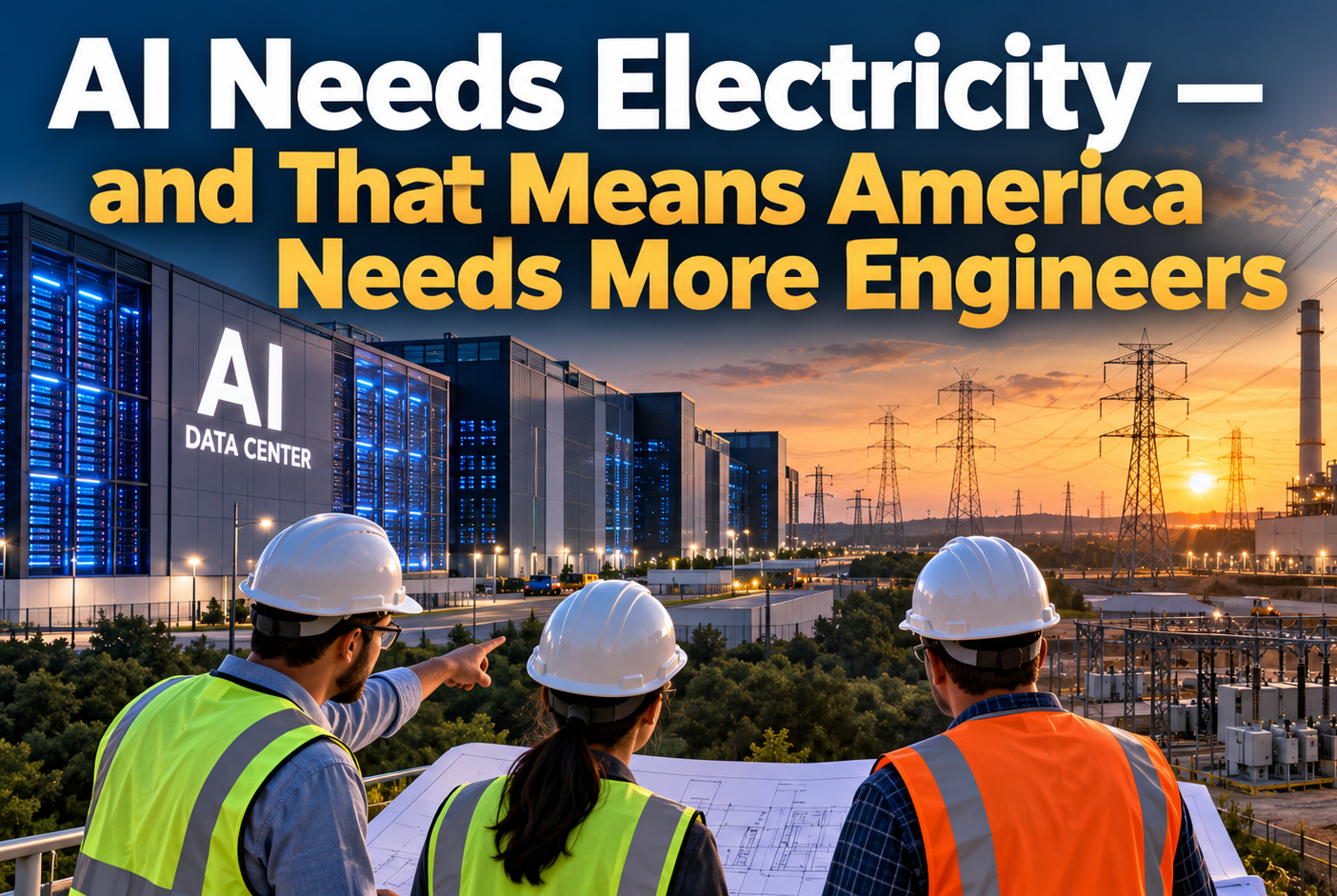
Artificial intelligence may run in the cloud, but the infrastructure behind it is decidedly physical.
AI data centers need enormous amounts of reliable electricity. Supplying that power can mean new generation, substations, transmission lines, distribution upgrades, transformers, switchgear, controls, cooling systems, and construction. And every one of those projects depends on something that cannot simply be downloaded or switched on:
Qualified engineers and technical professionals.
Recent research illustrates how quickly the challenge could grow. A September 2026 study published in Communications Sustainability estimates that electricity consumption from AI-focused data centers could increase from approximately 118 terawatt-hours (TWh) in 2024 to between 239 and 295 TWh by 2030—potentially approaching 1% of global electricity consumption.
The implications extend far beyond technology companies.
Utilities, engineering firms, EPC companies, electrical contractors, equipment manufacturers, power producers, data-center developers, and construction companies may all need specialized talent to turn additional electrical capacity from a plan on paper into functioning infrastructure.
For employers involved in that buildout, the question is increasingly not just where will the electricity come from?
It is also: Who will engineer and build everything required to deliver it?
AI Is Becoming an Electricity and Infrastructure Challenge
Training and operating increasingly sophisticated AI systems requires substantial computing capacity. That computing capacity is concentrated in data centers filled with servers and other equipment that require continuous power and cooling.
As data centers become larger and more power-intensive, providing electricity becomes an infrastructure problem.
A major facility may require work involving:
utility interconnections
transmission and distribution infrastructure
substations and transformers
switchgear and electrical distribution systems
backup power
energy storage
protection and control systems
cooling and mechanical systems
site and civil infrastructure
commissioning and testing
The September 2026 review Electricity demand and grid impacts of AI data centers: Challenges and prospects describes AI data centers as an emerging challenge for electricity systems, with implications for grid planning, operations, electricity markets, and infrastructure investment.
That matters to employers because infrastructure does not expand automatically when electricity demand increases.
It has to be planned, engineered, permitted, manufactured, installed, tested, commissioned, and maintained.
That requires people.
America's Grid Already Needs More Infrastructure
AI data centers are not the only source of growing electricity demand, and it would be misleading to treat AI as the sole reason the United States needs additional grid infrastructure.
But data-center growth is arriving alongside other significant sources of demand.
The U.S. Department of Energy’s 2026 National Transmission Needs Study identifies growing electricity demand from data centers, domestic manufacturing, and other large loads among the factors contributing to the need for additional transmission infrastructure.
Meanwhile, EPRI’s 2026 Powering Intelligence research examines scenarios in which total U.S. data-center electricity consumption could reach approximately 9% to 17% of U.S. electricity consumption by 2030, compared with roughly 4% to 5% today.
Those are projections rather than guarantees. Actual demand will depend on factors including AI adoption, computing efficiency, data-center construction, grid constraints, energy availability, and technology development.
But even the range of plausible outcomes creates a significant planning issue for organizations responsible for America’s electrical infrastructure.
Building additional capacity is partly a capital challenge.
It is also a talent challenge.
The AI Boom Could Become an Electrical Engineering Hiring Boom
The connection between artificial intelligence and electrical engineering is becoming increasingly direct.
Every large new electrical load has to be integrated into a power system safely and reliably. Expanding that system can require professionals across multiple electrical engineering specialties.
Power systems engineers may be needed to analyze system capacity, reliability, load growth, and the integration of new resources.
Transmission engineers help plan and design the infrastructure required to move large amounts of electricity across the grid.
Distribution engineers work closer to the point where electricity reaches customers and facilities, helping utilities accommodate new and changing loads.
Substation engineers design and upgrade the facilities that transform voltage and connect different portions of the electrical system.
Protection and controls engineers help ensure electrical systems can detect faults, isolate problems, and operate safely and reliably.
Relay engineers specialize in protection systems critical to substations and transmission and distribution networks.
Electrical project engineers and designers translate project requirements into practical electrical designs and specifications.
Controls engineers support the automation and monitoring systems increasingly important throughout power and industrial infrastructure.
The exact hiring requirements will differ from project to project. But the underlying relationship is straightforward:
When electrical infrastructure expands, engineering work expands with it.
And when many companies pursue projects simultaneously, employers can find themselves recruiting from the same specialized pools of technical talent.
Power Generation Needs Engineers, Too
There is another fundamental issue behind rapidly growing electricity demand: the electricity ultimately has to come from somewhere.
Meeting new loads can involve some combination of additional generation, energy storage, demand management, efficiency improvements, transmission expansion, and better utilization of existing resources.
Which technologies dominate will depend on geography, economics, regulation, project timelines, grid requirements, and other factors.
From a hiring perspective, however, developing or upgrading generation and energy infrastructure can require a broad range of technical professionals.
Electrical engineers may design power systems and interconnections.
Mechanical engineers may work on generating equipment, thermal systems, cooling, piping, and other mechanical infrastructure.
Civil and structural engineers may be required for sites, foundations, buildings, equipment supports, and associated infrastructure.
Controls and instrumentation engineers can support plant automation, monitoring, and operating systems.
Project engineers and project managers coordinate complex technical work across engineering, procurement, construction, scheduling, and commissioning.
Commissioning engineers help ensure that new equipment and systems actually perform as designed before entering full operation.
The infrastructure may vary.
The need for specialized technical expertise does not.
Then Someone Has to Build It
Engineering is only part of the equation.
A completed design does not produce another megawatt of usable capacity until someone builds and commissions the infrastructure.
That creates hiring implications across construction as well.
Data centers, substations, transmission projects, power-generation facilities, utility upgrades, manufacturing facilities, and related infrastructure can require:
construction project managers
superintendents
electrical project managers
MEP professionals
estimators
schedulers
field engineers
construction managers
commissioning professionals
These positions can become project-critical.
An organization might have financing secured, equipment ordered, customers waiting, and an aggressive construction schedule. But execution can still suffer if it cannot hire the professionals required to manage and deliver the work.
That is why technical recruiting should not be separated from infrastructure planning.
If a company knows a project will require difficult-to-find engineers, project managers, superintendents, estimators, or commissioning professionals, waiting until those positions become urgent vacancies can unnecessarily compress the recruiting timeline.
AI Infrastructure Creates a Talent Supply Chain
One of the most important hiring consequences of AI infrastructure is easy to overlook.
A new data center does not create hiring demand at only the data-center operator.
Its infrastructure requirements can ripple through an entire supply chain.
A utility may need engineers to evaluate a large new load and determine what upgrades are necessary.
An engineering consultant may need additional power, civil, structural, or mechanical engineers to design those improvements.
An EPC company may need project engineers and project managers to execute the work.
A transformer, switchgear, or electrical-equipment manufacturer may need engineering and manufacturing professionals as production requirements increase.
Electrical and construction contractors may need project managers, superintendents, estimators, field engineers, and other experienced personnel.
Generation developers may need additional engineering and project talent.
In other words, the physical infrastructure behind AI creates its own talent supply chain.
That creates an important planning question for employers:
Which positions could become bottlenecks for your projects if you cannot hire them quickly enough?
Identifying those positions early allows companies to build recruiting plans before a vacancy begins affecting project execution.
What Employers Can Do When They Need Engineers Now
Sometimes workforce planning happens months ahead of a project.
Sometimes an engineer resigns unexpectedly, a new project is awarded, workload jumps, a critical deadline moves forward, or a client suddenly needs additional capacity.
Then the hiring question becomes immediate.
Employers facing an urgent engineering or technical vacancy have several options.
Mobilize internal recruiting resources. Internal HR and talent-acquisition teams can immediately search existing applicant databases, contact previous candidates, advertise the position, and begin direct outreach.
Activate professional and employee networks. Experienced employees, managers, vendors, consultants, and industry contacts may know qualified professionals who are not actively applying for jobs.
Look at adjacent industries. Some technical positions have transferable skills. Employers that define the underlying technical requirements carefully may discover candidates in neighboring industries who can succeed without matching every line of the original job description.
Reconsider unnecessarily restrictive requirements. A job specification containing too many preferred qualifications can inadvertently eliminate strong candidates. Separate genuine requirements from qualifications that can be learned.
Consider contract or temporary technical talent where appropriate. For project-based requirements or immediate workload problems, an interim staffing solution may provide capacity while the organization continues searching for a permanent employee.
Engage a specialized technical recruiter. When the position is highly specialized, business-critical, geographically difficult, or simply taking too long to fill, an external recruiting partner can add another dedicated sourcing channel.
That last option can be particularly valuable when internal recruiters are already managing numerous positions.
Instead of asking the internal team to abandon its existing workload to concentrate on one difficult electrical engineer, project manager, superintendent, or manufacturing engineer search, an employer can add recruiting capacity specifically for the hard-to-fill position.
Where DAVRON Fits
DAVRON specializes in recruiting and staffing for engineering, architecture, construction, and manufacturing.
That specialization matters when an employer’s hiring problem is technical.
Recruiting an electrical engineer is different from recruiting for a general corporate position. A power systems engineer, controls engineer, construction project manager, superintendent, mechanical engineer, or manufacturing professional may require a search that accounts for specific technical experience, industry background, project exposure, geography, and employer requirements.
A specialized recruiting partner can focus its search on those requirements.
For employers supporting data centers, utilities, power generation, grid infrastructure, engineering projects, construction, and related manufacturing operations, that provides another way to reach qualified candidates without relying exclusively on job advertisements or an already-busy internal recruiting department.
The goal is not to replace every internal hiring process.
It is to provide additional specialized recruiting resources when a technical position is difficult to fill, time-sensitive, or important enough that leaving it open creates a business problem.
The AI Revolution Is Becoming a Physical Infrastructure Story
AI is often discussed as software.
But software runs on servers.
Servers operate inside data centers.
Data centers need electricity.
Supplying substantially more electricity can require generation, transmission, substations, distribution systems, transformers, controls, cooling, manufacturing, engineering, and construction.
And all of those systems require people.
That makes the expansion of AI infrastructure relevant not only to technology executives, but also to utility leaders, engineering managers, contractors, manufacturers, project executives, and hiring teams throughout America’s physical infrastructure economy.
The precise scale of AI’s future electricity demand remains uncertain. The engineering and infrastructure challenge, however, is already important enough that employers should be thinking beyond equipment and capital.
They should be thinking about talent.
Organizations expecting to participate in data-center, utility, generation, electrical-infrastructure, manufacturing, or construction growth should identify their project-critical positions early and determine how those people will be recruited.
Because having the demand, capital, equipment, and project opportunity is not enough.
Someone still has to engineer and build it.
Ready to hire engineering, architecture, construction, or manufacturing professionals?
DAVRON specializes in delivering high-quality candidates in these industries.