
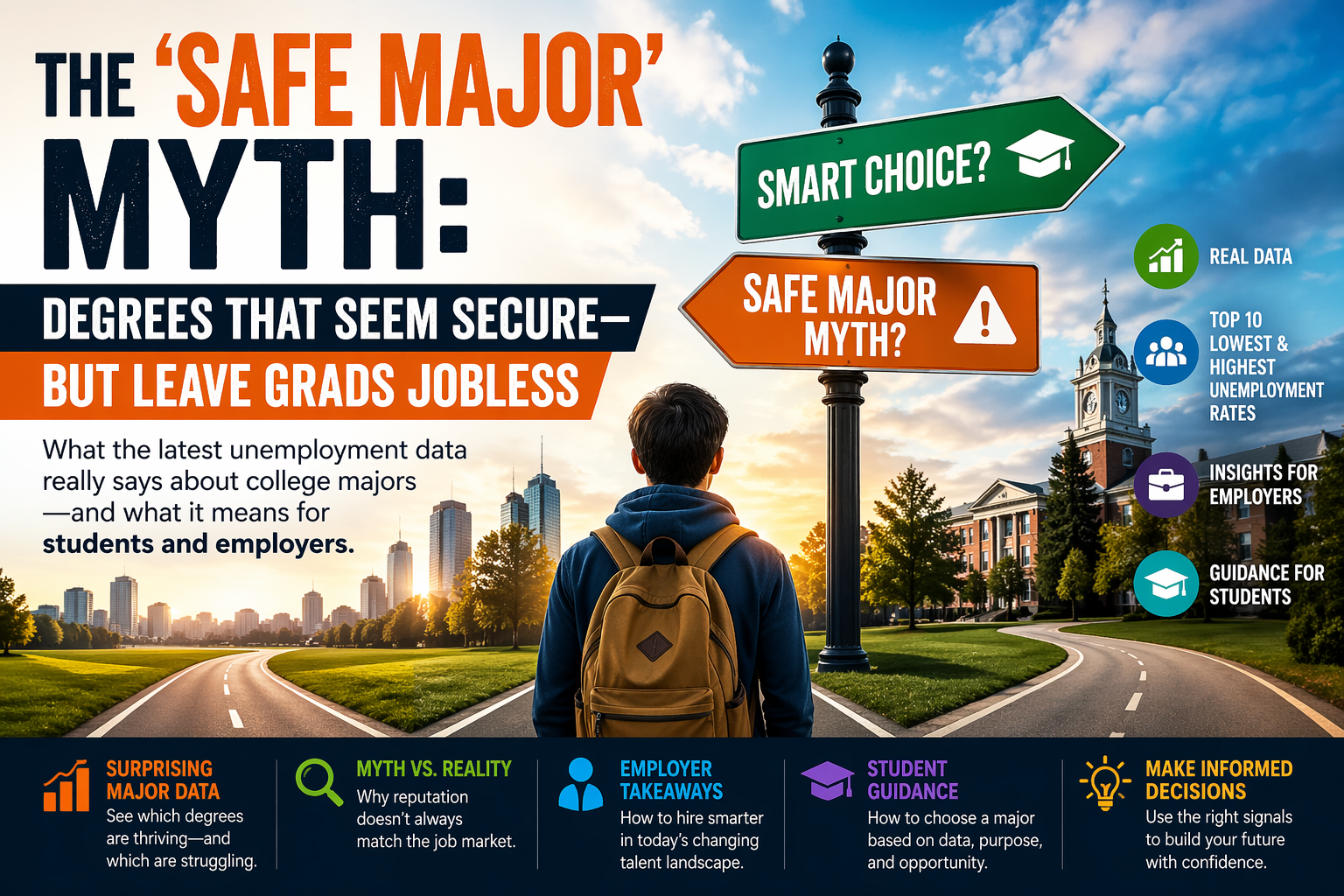
Some degrees get treated like insurance policies.
They are framed as practical, stable, employable, and less risky than other fields of study. Parents recommend them. Advisors repeat them. Students hear the same message often enough that it starts to sound like fact: choose the “safe” major, and the job market will take care of itself.
That assumption is weaker than many people realize.
Recent labor market data by college major shows that some degrees widely viewed as secure are producing surprisingly high unemployment rates among early-career graduates. At the same time, several less-hyped majors are posting much lower unemployment. The lesson is not that certain majors are worthless. It is that reputation and real job outcomes are not always aligned.
That matters on both sides of the market.
For employers, it is a reminder that degree title alone is a poor shortcut for predicting job readiness or hiring success. For students and early-career professionals, it is a warning not to let myths, social perceptions, or outdated assumptions make the decision for them.
What the “safe major” myth gets wrong
When people talk about a “safe major,” they usually mean one of a few things:
- it sounds practical
- it connects to a recognizable profession
- it has a reputation for stability
- it once had strong placement
- it is associated with strong earnings over time
The problem is that those ideas do not always move together.
A major can sound career-focused and still produce a difficult early-career job search. A major can lead to solid long-term earnings but uneven entry-level opportunities. A major can look less glamorous yet have much stronger employment outcomes right after graduation.
That is why “safe” is often more of a cultural label than a labor-market reality.
The 10 majors with the lowest unemployment rates
Looking at early-career graduates, these majors are among those with the lowest unemployment rates.
- Special Education — 0.739% unemployment | 99.261% employment
- Miscellaneous Education — 1.089% unemployment | 98.911% employment
- Elementary Education — 1.180% unemployment | 98.820% employment
- Agriculture — 1.395% unemployment | 98.605% employment
- Foreign Language — 1.579% unemployment | 98.421% employment
- Geography — 1.600% unemployment | 98.400% employment
- Engineering Technologies — 1.740% unemployment | 98.260% employment
- Social Services — 1.943% unemployment | 98.057% employment
- Secondary Education — 2.115% unemployment | 97.885% employment
- Nursing — 2.147% unemployment | 97.853% employment
A few things stand out immediately.
Education-related majors dominate much of the low-unemployment side. That does not mean every one of those fields offers the highest pay or the widest long-term options. It means the market is actively absorbing that talent.
Applied majors such as nursing and engineering technologies also remain strong. And importantly, several of the majors with the best employment outcomes are not the ones most commonly marketed as elite, future-proof, or especially prestigious.
That alone should make people more skeptical of the “safe major” narrative.
The 10 majors with the highest unemployment rates
Now look at the other side of the market.
- Anthropology — 7.922% unemployment | 92.078% employment
- Computer Engineering — 7.783% unemployment | 92.217% employment
- Fine Arts — 7.655% unemployment | 92.345% employment
- Computer Science — 6.992% unemployment | 93.008% employment
- Performing Arts — 6.950% unemployment | 93.050% employment
- Architecture — 6.844% unemployment | 93.156% employment
- Art History — 6.688% unemployment | 93.312% employment
- Physics — 6.631% unemployment | 93.369% employment
- Early Childhood Education — 6.593% unemployment | 93.407% employment
- Environmental Studies — 6.307% unemployment | 93.693% employment
This is where the myth breaks.
Computer science, computer engineering, and architecture are all majors many people still describe as safe, technical, or highly employable. Yet they show up among the highest unemployment rates for early-career graduates.
That does not mean those degrees are bad choices. It means their reputation can easily outlive the market conditions facing actual graduates.
A major can still be valuable while producing a rough early-career entry point. A field can still offer strong long-term upside while being crowded, cyclical, bottlenecked, or difficult at the entry level. Students and employers both get into trouble when they confuse long-term reputation with near-term job-market reality.
Why unemployment rate alone still does not tell the whole story
This is where many people overcorrect.
Seeing a higher unemployment rate for a major does not automatically mean students should avoid it. Seeing a lower unemployment rate does not automatically mean it is the smarter choice. Labor market outcomes are more complex than one ranking.
Some majors may have elevated unemployment but stronger long-term salary potential. Others may have low unemployment but high underemployment, meaning graduates are working, but not always in roles that fully use their degree. Some majors also depend heavily on internships, graduate school, licensing, portfolio quality, geography, or willingness to relocate.
That is why this kind of data is most useful when it challenges lazy assumptions, not when it becomes a new lazy assumption.
What this means for students and early-career professionals
This data should not push students to panic-pick a major based on unemployment rankings alone. It should push them to make more informed decisions.
A major with a higher unemployment rate is not automatically a bad choice. A major with a lower unemployment rate is not automatically a smart one. Labor market outcomes depend on more than the degree title. They depend on geography, internships, portfolio strength, technical skills, networking, timing, graduate school plans, and how closely the major connects to actual employer demand.
That is why students should be careful not to let the “safe major” myth make the decision for them.
A better question is not, “Which major sounds safest?” It is, “What path gives me the best combination of interest, ability, market demand, and practical career preparation?”
For some students, that may still be computer science, architecture, physics, or another major with uneven short-term employment outcomes. But if they pursue those paths, they should do it with open eyes. They may need to be more intentional about internships, software skills, certifications, project work, networking, or geographic flexibility.
On the other hand, students should also avoid assuming that a low-unemployment major guarantees strong long-term fit. Choosing a major purely because it looks stable on paper can lead to a different kind of problem: graduating into a field they do not want to stay in.
The smarter takeaway is this: do not choose a major based on reputation alone, whether that reputation is positive or negative. Use the data as one signal, not the whole decision.
What this means for employers hiring early-career talent
For employers, especially those hiring technical talent, the takeaway is not to ignore majors. It is to stop treating major name as a complete hiring signal.
A company hiring entry-level engineers, architects, drafters, estimators, analysts, manufacturing professionals, or other project-support talent should look beyond the degree label and ask better questions:
- Does this candidate have internship or co-op experience?
- Have they used the software, tools, or systems the job actually requires?
- Can they operate in a project-driven environment?
- Are they stronger in theory, applied execution, or communication?
- Is the talent market for this role crowded, delayed, or highly regional right now?
Those questions are usually more valuable than assuming a supposedly safe major will automatically produce job-ready candidates.
This is especially relevant in DAVRON’s core markets. In engineering, architecture, construction, and manufacturing, employers do not just need credentials. They need people who can contribute in real operating environments. A graduate may have the right degree on paper and still need deeper screening for software fluency, production knowledge, field coordination ability, code familiarity, design standards awareness, or project exposure.
That is where specialized recruiting becomes more valuable. The hiring challenge is rarely just finding someone with the correct degree title. It is finding someone whose background actually fits the role, the team, and the urgency of the business need.
The bigger risk is relying on outdated assumptions
The real problem with the “safe major” myth is not just that it can mislead students. It can also distort hiring decisions.
If employers rely too heavily on degree reputation, they may narrow their talent pool unnecessarily. If students rely too heavily on major branding, they may walk into a field without understanding the actual path into it.
In both cases, the mistake is the same: replacing market evidence with received wisdom.
A stronger approach is more practical.
Use degree as one input.
Use labor market data as context.
Use internships, skills, and applied experience as stronger indicators.
And when hiring for hard-to-fill technical roles, use a recruiting partner that understands the difference between a credential and a real fit.
Final thought
The “safe major” myth survives because it feels simple. But career decisions and hiring markets are not simple.
Some majors that sound highly employable are producing weaker early-career unemployment outcomes than many people expect. Others that get far less cultural attention are producing stronger results. For employers, that is a reminder to hire based on real-world fit, not academic branding. For students and early-career professionals, it is a reminder not to let myths, stereotypes, or outdated assumptions choose a degree for them.
The better approach is more practical: understand the market, understand your strengths, and make decisions based on both opportunity and fit.
Ready to stand out to recruiters and employers?
DAVRON helps engineering, architecture, construction, and manufacturing professionals improve
how they are seen, understood, and matched to the right opportunities.
Call us to connect directly with a live recruiting specialist:
Upload your resume to be considered for current and future opportunities:
Get help with your resume, LinkedIn profile and more:
EMPLOYERS
Ready to hire engineering, architecture, construction, or manufacturing professionals?
DAVRON specializes in delivering high-quality candidates in these industries.