
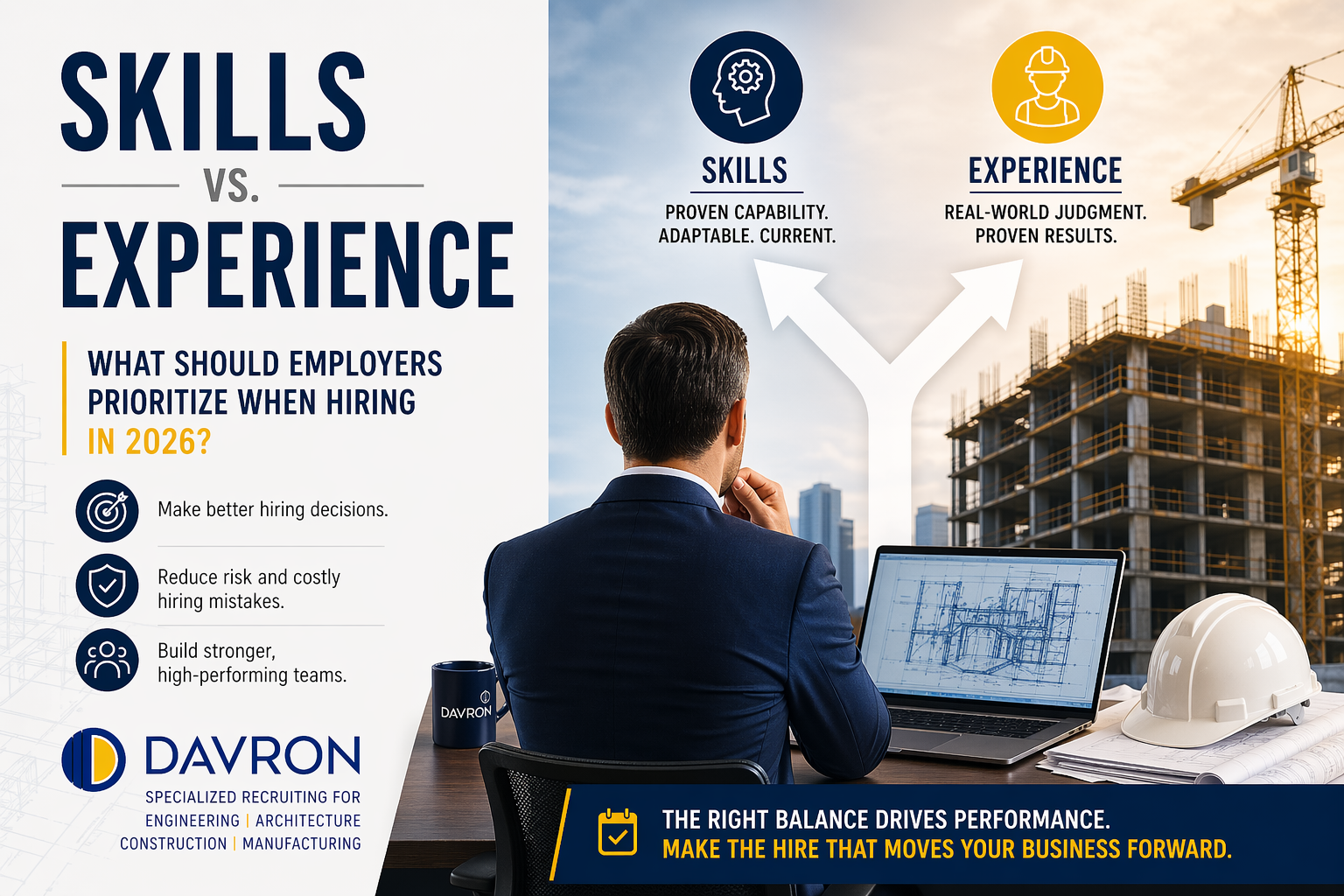
In 2026, employers cannot afford to treat hiring like a résumé-sorting exercise. When a key role stays open too long or gets filled by the wrong person, the cost shows up fast in missed deadlines, production slowdowns, project risk, team strain, and lost momentum. The real question is not whether skills or experience matters more in theory. It is which one better predicts performance in the role you need to fill now.
For most employers, the right answer is not to prioritize one at the total expense of the other. It is to prioritize job-relevant capability first, then weigh experience based on how much judgment, autonomy, speed, and risk the role carries. In some positions, proven hands-on skills should outweigh years on paper. In others, experience is what prevents costly mistakes.
The Direct Answer
Employers should usually prioritize the candidate’s ability to do the actual job. That means focusing on the skills, technical capability, and problem-solving required for the role. But experience should carry more weight when the position involves leadership, safety, compliance, client management, or high-cost decision-making.
A better hiring question is this:
What combination of skills and experience gives this person the highest likelihood of succeeding in this role, in this environment, with this level of urgency?
That approach leads to better hiring decisions than defaulting to “10+ years required” or assuming raw technical skill alone is enough.
When Skills Should Carry More Weight
There are many hiring situations where demonstrable skills matter more than years of experience.
1. The tools, systems, or processes are changing quickly
A candidate with fewer years of experience but stronger current capability may outperform someone with a longer résumé built around outdated tools or methods. This is especially relevant in technical hiring, where software platforms, design environments, manufacturing systems, and automation tools can shift faster than job descriptions do.
2. The role is execution-heavy
If the person needs to produce, design, model, troubleshoot, program, estimate, draft, or optimize, practical ability often matters more than tenure alone. A candidate who can do the work well today may be a better hire than one whose experience sounds impressive but does not translate into current performance.
3. The talent pool is tight
For hard-to-fill technical roles, waiting for the perfect candidate with every ideal background marker can create more damage than hiring someone with the right core skill set and a slightly less conventional path. Employers that stay too rigid often lose strong candidates while the work keeps piling up.
4. Transferable ability matters more than exact industry history
Sometimes a candidate from an adjacent sector can bring the exact technical skills the role requires, even without the expected industry label on the résumé. In engineering, architecture, construction, and manufacturing, this happens more often than many employers realize.
For example:
- A manufacturing engineer may transition effectively between product environments if the process-improvement and systems knowledge is strong.
- A CAD professional may be highly capable across multiple technical contexts if standards, speed, and detail accuracy are proven.
- A controls or automation candidate may bring valuable skills from a related production setting even without the exact title an employer initially wrote into the requisition.
5. The employer can support some ramp-up
If your team structure allows for a moderate learning curve, skills often deserve heavier weighting than experience. Not every hire needs to arrive with ten years of directly matching background if the core ability is there and the person can become productive quickly.
When Experience Should Carry More Weight
There are also roles where experience is not just a preference. It is a risk-control factor.
1. The role requires judgment built over time
Some decisions cannot be reduced to testable technical skill alone. They depend on repeated exposure to project variables, stakeholder pressure, tradeoffs, and consequences. That is where experience becomes highly valuable.
This is common in roles such as:
- project managers
- construction superintendents
- senior design leads
- operations leaders
- client-facing technical managers
2. The cost of error is high
If a mistake can trigger safety issues, compliance failures, rework, production loss, schedule damage, or customer problems, experience should usually weigh more heavily. In these cases, employers are not just buying execution. They are buying reduced risk.
3. The hire must contribute with minimal ramp-up
Some openings are too urgent or too critical for a long learning curve. If the business needs immediate independent performance, directly relevant experience becomes more important because it shortens the time to productivity.
4. The role includes leadership or coordination responsibility
Leading teams, managing subcontractors, handling clients, resolving conflicts, and making field or project decisions often demand more than technical ability. They require context, maturity, and real-world repetition. A candidate may be highly skilled and still not be ready for the full scope of leadership responsibility.
5. The environment is complex or highly regulated
In compliance-heavy, safety-sensitive, or process-dependent settings, experience may matter more because it helps people recognize issues earlier, avoid known failure points, and respond better under pressure.
Why Employers Get This Wrong
Many hiring mistakes happen because employers frame the choice too simply.
Overvaluing years of experience
A long résumé can create false confidence. Years in a role do not always equal current skill, adaptability, or execution quality. Employers sometimes hire for tenure and assume performance will follow.
Overvaluing technical skill in isolation
A candidate may test well or interview well on technical topics but still fall short in judgment, communication, accountability, or decision-making under pressure. Especially in project-critical roles, execution history matters.
Writing unrealistic job requirements
Some employers ask for deep experience, niche industry background, leadership ability, tool mastery, immediate availability, and budget flexibility all in one requisition. That often narrows the pool unnecessarily and slows hiring.
Screening out strong candidates too early
Rigid filters can eliminate candidates with the right skills simply because they do not match a traditional background pattern. In a tight labor market, that is often a costly mistake.
Confusing credentials with readiness
Degrees, titles, certifications, and years of service can all be useful signals, but they are not the same thing as job readiness. The real question is whether the person can succeed in your specific role.
A Better Framework for Evaluating Both
The strongest hiring decisions come from evaluating skills and experience together in a structured way.
Define what success looks like
Start with outcomes, not generic requirements. What must this person accomplish in the first six to twelve months? What problems are they expected to solve? What level of independence is required?
Separate non-negotiables from trainables
Not every desired qualification needs to be present on day one. Identify what cannot be compromised and what can be taught, supported, or learned on the job.
Assess skills directly
Use interviews, work examples, portfolio discussion, project walkthroughs, or targeted technical questions to validate real capability. Do not rely on title inflation or résumé language alone.
Validate context and judgment
Ask how the candidate handled delays, design changes, stakeholder conflict, process issues, production problems, or field constraints. Experience matters most when it reveals how someone thinks and responds in real situations.
Consider business risk
The more costly the wrong hire would be, the more carefully experience should be weighed. For lower-risk or more execution-based roles, strong skills may deserve greater priority.
Account for team structure
A candidate who is not a perfect standalone match may still be an excellent hire if your team can support onboarding, mentorship, or skill transfer. Hiring decisions should reflect the actual environment the person is entering.
How This Applies in Technical Hiring
In engineering, architecture, construction, and manufacturing, this is rarely a simple either-or decision.
A design engineer may need strong technical tools, design accuracy, and problem-solving ability more than a certain number of years on paper. A construction superintendent, by contrast, may require deeper real-world experience because field leadership, sequencing, accountability, and issue response can directly affect project outcome. A manufacturing engineer may need both practical process skill and enough background to improve throughput without disrupting operations. A CAD drafter may be judged more heavily on precision, speed, standards, and workflow fit than on tenure alone.
That is why technical hiring often breaks standard hiring logic. The right balance between skills and experience changes by role, urgency, team structure, and business consequence.
Why Specialized Recruiting Helps
This is exactly where specialized recruiting becomes valuable.
In technical hiring, the wrong decision often comes from evaluating candidates too superficially. A résumé may look strong but hide gaps in execution. Another candidate may appear less conventional while actually being a better fit for the work, timeline, and environment.
DAVRON helps employers make that distinction.
Because DAVRON focuses on engineering, architecture, construction, and manufacturing, the evaluation process goes beyond broad recruiting filters. Specialized recruiting helps employers look at what matters most for the role: technical capability, applicable experience, time-to-productivity, hiring urgency, and overall business risk.
That matters most when:
- the role is hard to fill
- the hiring team does not want to lose time screening mismatched applicants
- the position affects delivery, production, project schedules, or operational performance
- the employer needs a candidate who can do more than simply look qualified on paper
The Best Hiring Priority in 2026
In 2026, employers should not ask whether skills or experience matters more in general. That question is too broad to be useful.
A better question is:
Which combination of proven skills and relevant experience best predicts success for this specific role right now?
For some hires, skills should lead. For others, experience should. In many technical roles, the best decision comes from balancing both with a clear understanding of business impact, hiring urgency, and role complexity.
When that balance is hard to determine, a specialized recruiting partner can help employers hire faster and with greater confidence.
Ready to hire engineering, architecture, construction, or manufacturing professionals?
DAVRON specializes in delivering high-quality candidates in these industries.