
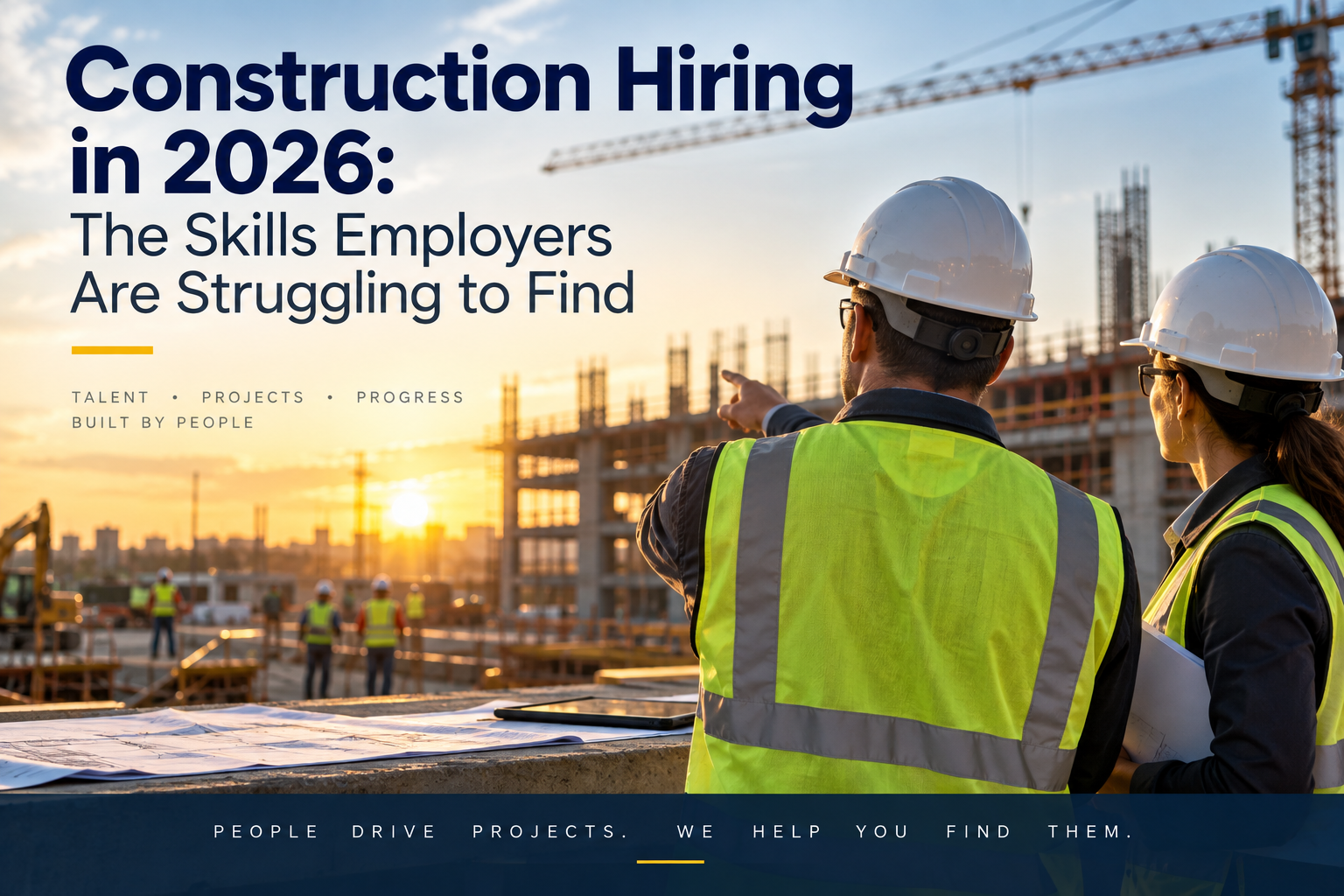
Construction employers facing a critical vacancy in 2026 have a problem that goes well beyond posting a job and waiting for applications.
When a superintendent, project manager, estimator, skilled craft professional, or other project-critical employee is missing, the effects can reach the field quickly. Existing employees absorb additional responsibilities. Decisions take longer. Schedules become harder to protect. Project leaders have less capacity to manage new work. In some cases, the company may have the opportunity to pursue projects but not the people needed to execute them confidently.
The latest workforce data shows just how persistent the problem has become.
In the Associated General Contractors of America (AGC) and NCCER’s 2026 workforce survey, 87% of respondents reported openings for hourly craft workers and 82% reported salaried openings. Among companies with openings, 88% said craft positions were as hard or harder to fill than a year earlier, while 87% said the same about salaried positions. Perhaps more importantly, half of respondents said available candidates lacked the skills, certificates, or licenses needed to work in the industry.
That distinction matters.
For many construction employers, the challenge isn’t simply finding applicants. It’s finding qualified candidates with the right combination of technical knowledge, project experience, leadership ability, and specialized skills.
And when that person is needed now, employers need more than another job posting. They need a hiring strategy capable of reaching qualified people quickly.
Construction Hiring Remains Difficult Even as Parts of the Market Cool
At first glance, the construction labor market in 2026 might appear contradictory.
Some construction markets have softened. Construction spending in July 2026 was 3.8% lower than a year earlier, and construction employment grew in only 48% of the 360 metro areas analyzed by AGC between July 2025 and July 2026.
Yet qualified construction professionals remain difficult to find.
Construction unemployment fell to 3.1% in August 2026—the lowest rate for any month in the 26-year history of the data cited by AGC. Construction employment also increased by 22,000 positions during the month.
The reason is partly that demand is highly uneven.
Data centers, power projects, advanced manufacturing, infrastructure, and other technically demanding projects can create intense demand for specific categories of workers even while other construction segments slow.
That means employers cannot assume that softer conditions across the broader construction industry will automatically make an experienced superintendent, project manager, estimator, engineer, or specialized craft professional easy to recruit.
What Construction Skills Are Employers Struggling to Find in 2026?
There isn’t one universal list that applies to every contractor.
A heavy civil contractor has different needs from a commercial general contractor. A data center project requires a different mix of expertise than a multifamily development. Geography, project size, delivery method, technology, licensing requirements, and the local labor market can all affect recruiting difficulty.
But several categories of capability deserve particular attention.
Field Leadership and Superintendent Experience
An experienced superintendent brings together far more than construction knowledge.
The role can require coordinating subcontractors, monitoring progress, solving field problems, enforcing safety requirements, maintaining quality, communicating with project stakeholders, and keeping work moving against the schedule.
That combination makes superintendent hiring particularly sensitive to experience.
A candidate may have worked in construction for years without having led projects comparable to the employer’s current work.
For employers, that means the search should go beyond:
“Has this person been a superintendent?”
The better questions include:
- What types and sizes of projects have they delivered?
- How much field leadership responsibility did they actually have?
- Which trades and subcontractors did they coordinate?
- How technically complex were their projects?
- How did they handle schedule pressure and field problems?
- Have they worked in the employer’s specific construction environment?
A strong title match does not necessarily equal a strong project match.
Project Management and Coordination
Construction project managers sit at the intersection of people, budgets, schedules, documentation, clients, subcontractors, and field execution.
That makes the strongest candidates difficult to replace with someone who only meets the basic qualifications on paper.
Employers may need professionals who understand RFIs, submittals, change management, procurement, cost control, scheduling, contracts, subcontractor coordination, client communication, and project-management technology.
The more complex the project becomes, the more important the combination of technical and management experience becomes.
For employers trying to hire quickly, this creates a common problem: a large applicant pool can still produce very few people who have actually managed comparable projects.
Estimating and Preconstruction Expertise
An estimator’s work affects decisions long before construction begins.
Employers may need professionals capable of interpreting plans and specifications, performing takeoffs, understanding material and labor costs, evaluating subcontractor pricing, identifying risk, supporting value engineering, and producing estimates that reflect current market conditions.
Sector knowledge can matter enormously.
Estimating a conventional commercial project is not necessarily the same as estimating a technically complex industrial, infrastructure, mission-critical, or specialty construction project.
When experienced estimators are difficult to find, the problem can affect more than the recruiting department. It can influence bidding capacity and how confidently a company pursues new work.
Skilled Craft and Trade Capabilities
The craft shortage remains one of the clearest construction workforce challenges.
The September AGC/NCCER survey found that 87% of responding firms had openings for hourly craft positions, and 88% of firms with those openings said they were as difficult or more difficult to fill than the previous year.
The exact shortage varies by market and project.
Complex projects can create demand for electricians, plumbers, pipefitters, operating engineers, ironworkers, concrete specialists, and other skilled trades. Data center construction is a particularly useful example because these projects require specialized electrical infrastructure, cooling systems, backup generation, fiber connectivity, security systems, and supporting utilities.
The issue is therefore not simply headcount.
Employers need workers with the skills necessary for the work being performed.
MEP and Technically Specialized Construction Knowledge
Mechanical, electrical, and plumbing expertise becomes especially valuable as building systems become more sophisticated.
A complex facility can require construction professionals who understand electrical distribution, HVAC and cooling, controls, commissioning, utility coordination, backup systems, and highly technical installation requirements.
This is one reason major data center and advanced manufacturing projects can create recruiting pressure far outside their immediate jobsites.
They compete for professionals with specialized experience that other contractors also need.
Scheduling, Cost Control, and Project Controls
As projects become larger and more complex, employers may need professionals who can translate massive amounts of project information into reliable decisions.
That includes capabilities involving:
- scheduling and schedule analysis
- forecasting
- cost control
- progress measurement
- change management
- reporting
- risk identification
- project controls software
These professionals can be particularly important on large industrial, infrastructure, power, and mission-critical projects where small deviations can have substantial downstream effects.
BIM, VDC, and Construction Technology
Construction technology is also changing what employers look for in candidates.
BIM and virtual design and construction can require professionals who understand not only software but also how design information translates into actual construction.
The same applies to estimating platforms, project-management systems, digital field tools, scheduling software, and increasingly AI-assisted workflows.
AGC’s January 2026 outlook found that 61% of surveyed contractors were using artificial intelligence or planned to increase their AI investment, up from 44% the previous year. Common applications included administrative functions, estimating, and preconstruction.
Technology does not eliminate the need for experienced construction professionals.
Instead, it can increase the value of people who understand both construction and technology.
Safety and Regulatory Knowledge
Safety knowledge is another capability that cannot be separated easily from experience.
Employers may need candidates familiar with the regulations, documentation, site conditions, owner requirements, and safety expectations associated with a specific type of construction.
For supervisory roles especially, technical competence without the ability to establish and maintain safe field practices can create unacceptable risk.
Leadership and Communication
Some of the hardest construction skills to evaluate are not software certifications or technical credentials.
They are the abilities to lead people, communicate under pressure, resolve problems, coordinate stakeholders, and make decisions when conditions change.
A technically strong candidate who cannot manage subcontractors or communicate effectively with owners and project teams may struggle in a leadership position.
This is why experienced construction professionals who combine technical depth with proven leadership can be so difficult to replace.
Experience May Be the Real Construction Hiring Bottleneck
One of the most important hiring lessons for employers in 2026 is that job title and project capability are not the same thing.
Consider two candidates who both carry the title “Project Manager.”
One may have spent eight years managing conventional commercial projects.
The other may have managed mission-critical facilities with sophisticated electrical and mechanical infrastructure, accelerated schedules, extensive commissioning requirements, and multiple technical stakeholders.
Both are project managers.
They are not necessarily interchangeable.
The same principle applies to superintendents, estimators, project engineers, schedulers, and other construction professionals.
Employers should define the experience that is genuinely necessary before launching the search:
Project type. What has the candidate actually built?
Project size. Have they operated at the scale required?
Technical complexity. How sophisticated were the systems and construction methods involved?
Responsibility. Did the candidate own decisions or support someone else making them?
Delivery environment. Does the candidate understand the company’s project delivery model?
Technology. Can the candidate operate effectively with the systems the employer uses?
Leadership. Can the person manage teams, subcontractors, clients, and difficult situations?
This is also why simply increasing the number of applicants may not solve a construction hiring problem.
The objective is not more résumés.
It is more qualified candidates.
Data Centers Are Intensifying Competition for Skilled Construction Talent
Few construction sectors illustrate the 2026 talent problem as clearly as data centers.
Twenty-eight percent of respondents to AGC and NCCER’s 2026 workforce survey said they had performed data center construction during the prior 12 months. Among those companies, 58% reported that data center projects had increased competition for skilled workers, while 49% reported increased wage pressure. Thirty-seven percent identified worker or subcontractor availability as their biggest challenge when pursuing or delivering data center projects.
That competition matters because data centers are technically demanding projects.
They require sophisticated electrical systems, cooling infrastructure, backup generation, fiber connectivity, security systems, and substantial supporting utilities.
And the market is expanding rapidly. AGC’s analysis of federal construction spending data reported that data center construction spending jumped 57.2% year over year as of July 2026.
Data centers are not the only source of pressure. AGC has also identified power and advanced manufacturing projects as areas generating significant demand for skilled construction workers.
For employers outside these sectors, the important lesson is that talent competition does not stop at industry boundaries.
An experienced electrical professional, project manager, superintendent, estimator, or engineer recruited onto a major mission-critical project is one fewer candidate available elsewhere.
What Happens When Construction Positions Stay Open?
The consequences of an unfilled construction role can move beyond HR quickly.
In AGC and NCCER’s September survey, 42% of respondents reported that shortages involving their own employees or subcontractors’ workers had delayed projects. Workforce shortages were the most commonly cited reason for project delays, while 74% of respondents had experienced at least one significant project delay during the previous year.
The exact impact of an individual vacancy will vary, but employers should consider several potential costs.
An open position can increase the workload on existing employees.
It can limit the number of projects senior employees can oversee effectively.
It can slow estimating, preconstruction, or project coordination.
It can force an employer to rely on less-experienced personnel.
And in a project-driven business, insufficient staffing can eventually affect the company’s capacity to pursue and deliver work.
That changes the hiring calculation.
The question is not only:
“What will it cost us to recruit this person?”
Employers should also ask:
“What does it cost us to leave this position open?”
How Can Construction Employers Hire Qualified People Faster?
When a construction position becomes urgent, doing more of the same recruiting activity is not always the best answer.
Employers have several options.
Start With the Existing Network
Employee referrals, former employees, industry contacts, subcontractor relationships, and previous qualified candidates can be valuable sources.
For urgent searches, this should happen immediately rather than after weeks of job advertising.
Revisit Previous Candidates
Someone who was not right for a position two years ago may be right for the role today.
Previous finalists and qualified applicants already familiar with the company can sometimes shorten the sourcing process considerably.
Make Sure Compensation Matches the Market
Construction wages continue to rise.
Average hourly earnings for production and nonsupervisory construction employees reached $39.36 in August 2026, up 5% from the previous year, compared with a 3.3% increase for comparable private-sector employees overall.
Employers struggling to attract candidates should determine whether compensation, incentives, travel expectations, relocation assistance, benefits, or other elements of the opportunity are reducing candidate interest.
Remove Requirements That Don’t Affect Performance
An overly restrictive job description can eliminate otherwise qualified people.
Separate genuine requirements from preferences.
If ten years of experience is listed but a highly capable candidate could perform the role with seven, the requirement may unnecessarily reduce the available talent pool.
The same scrutiny should apply to degrees, software experience, exact project types, and other qualifications.
That does not mean lowering standards.
It means making sure every requirement serves a business purpose.
Shorten the Interview Process
Speed matters when qualified candidates have multiple opportunities.
Determine who actually needs to participate in the hiring decision, establish interview availability early, and eliminate unnecessary delays between stages.
A strong candidate should not spend weeks waiting for the organization to decide what happens next.
Recruit Passive Candidates
This may be the biggest difference between filling an easy construction vacancy and solving a difficult one.
The person an employer wants may already have a job.
Experienced superintendents, project managers, estimators, engineers, and other technical professionals do not necessarily spend their time applying to online job postings.
Reaching them requires proactive recruiting.
Bring in Specialized Recruiting Support Earlier
An employer does not have to wait until a position has been open for months before engaging a recruiter.
If the role is project-critical, unusually specialized, geographically difficult, or repeatedly attracting the wrong candidates, waiting can simply extend the vacancy.
A specialized recruiter can add another sourcing channel while the employer continues using referrals, internal recruiting, advertising, and other methods.
When Does a Specialized Construction Recruiter Make Sense?
Not every construction vacancy requires outside recruiting assistance.
If an employer has a strong candidate pipeline, sufficient internal recruiting resources, and enough time to fill the position, an internal search may work well.
Specialized recruiting becomes more valuable when:
- the position is difficult to fill
- the employer needs someone quickly
- conventional job advertisements are producing applicants but not qualified candidates
- the required experience is highly specific
- the best prospects are likely already employed
- the company is entering a new market or geography
- an unfilled position is affecting project execution or business capacity
DAVRON specializes in recruiting for construction as well as engineering, architecture, and manufacturing.
That specialization matters because technical recruiting requires more than matching keywords on a résumé. Employers need candidates whose backgrounds align with the actual requirements of the position, project, and organization.
For a construction employer with an urgent vacancy, DAVRON can work alongside existing hiring efforts to identify and recruit qualified professionals—including candidates who may not be actively applying for jobs.
The objective is simple: get qualified people in front of the employer so the company can make a hiring decision and keep the business moving.
Construction Hiring in 2026: Frequently Asked Questions
What construction positions are hardest to hire in 2026?
There is no single list that applies to every employer or market. However, AGC and NCCER’s September 2026 workforce survey found widespread difficulty filling both hourly craft and salaried construction positions, with half of respondents reporting that available candidates lacked necessary skills, certificates, or licenses.
Employers can face particular difficulty when roles require specialized project experience, field leadership, technical expertise, or experience in rapidly growing sectors.
Why is construction talent still difficult to find if parts of the market are slowing?
Construction demand is uneven. While some segments and geographic markets have softened, data centers, power, advanced manufacturing, and certain infrastructure projects continue generating substantial demand for skilled people.
As a result, a broader slowdown does not necessarily create an abundant supply of candidates with the specific experience an employer needs.
What skills should employers prioritize when hiring construction professionals?
Priorities depend on the position, but employers should evaluate technical knowledge, relevant project experience, leadership, communication, safety awareness, problem-solving ability, and proficiency with the technology required for the role.
For experienced positions, employers should pay particular attention to what candidates have actually been responsible for—not just their job titles.
How can contractors hire qualified construction professionals faster?
Start multiple recruiting channels simultaneously rather than sequentially.
Use referrals and previous candidates, review compensation and unnecessary job requirements, shorten the interview process, proactively approach passive candidates, and consider specialized recruiting support when internal sourcing is not reaching enough qualified people.
Are construction technology skills becoming more important?
Yes. Construction firms continue investing in digital tools, and AGC’s 2026 outlook found growing adoption and planned investment in AI, particularly for administrative work, estimating, and preconstruction.
The strongest candidates in some roles may increasingly be those who combine practical construction expertise with the ability to work effectively using modern project, estimating, BIM/VDC, scheduling, and data tools.
When should a construction company use a specialized recruiter?
Consider specialized recruiting when the vacancy is urgent, highly technical, difficult to fill, or important enough that leaving it open is affecting the business.
It can also make sense when the best candidates are likely to be employed and therefore unlikely to respond to conventional job advertisements.
How can employers compete for construction candidates who are already employed?
A passive candidate needs a reason to consider changing jobs.
Employers should be prepared to communicate the opportunity clearly, move quickly, offer market-appropriate compensation, and explain why the role represents a meaningful professional move.
Proactive recruiting is also important because the employer must first reach these candidates before it can persuade them to consider the opportunity.
The Construction Talent Problem Is Ultimately a Business Problem
Construction hiring in 2026 is not simply about whether workers exist.
The harder question is whether an employer can find the right person, with the right experience, in the right market, at the time the business needs them.
The latest workforce data makes the stakes clear: employers continue reporting difficulty filling both craft and salaried positions, many available candidates lack necessary qualifications, and workforce shortages are contributing directly to project delays.
For employers, the response should be equally clear.
Define the experience that truly matters. Remove unnecessary barriers. Move quickly when qualified candidates appear. Recruit beyond active job seekers. And when a critical position remains difficult to fill, bring specialized recruiting resources into the search before the vacancy becomes an operational problem.
Ready to hire engineering, architecture, construction, or manufacturing professionals?
DAVRON specializes in delivering high-quality candidates in these industries.