
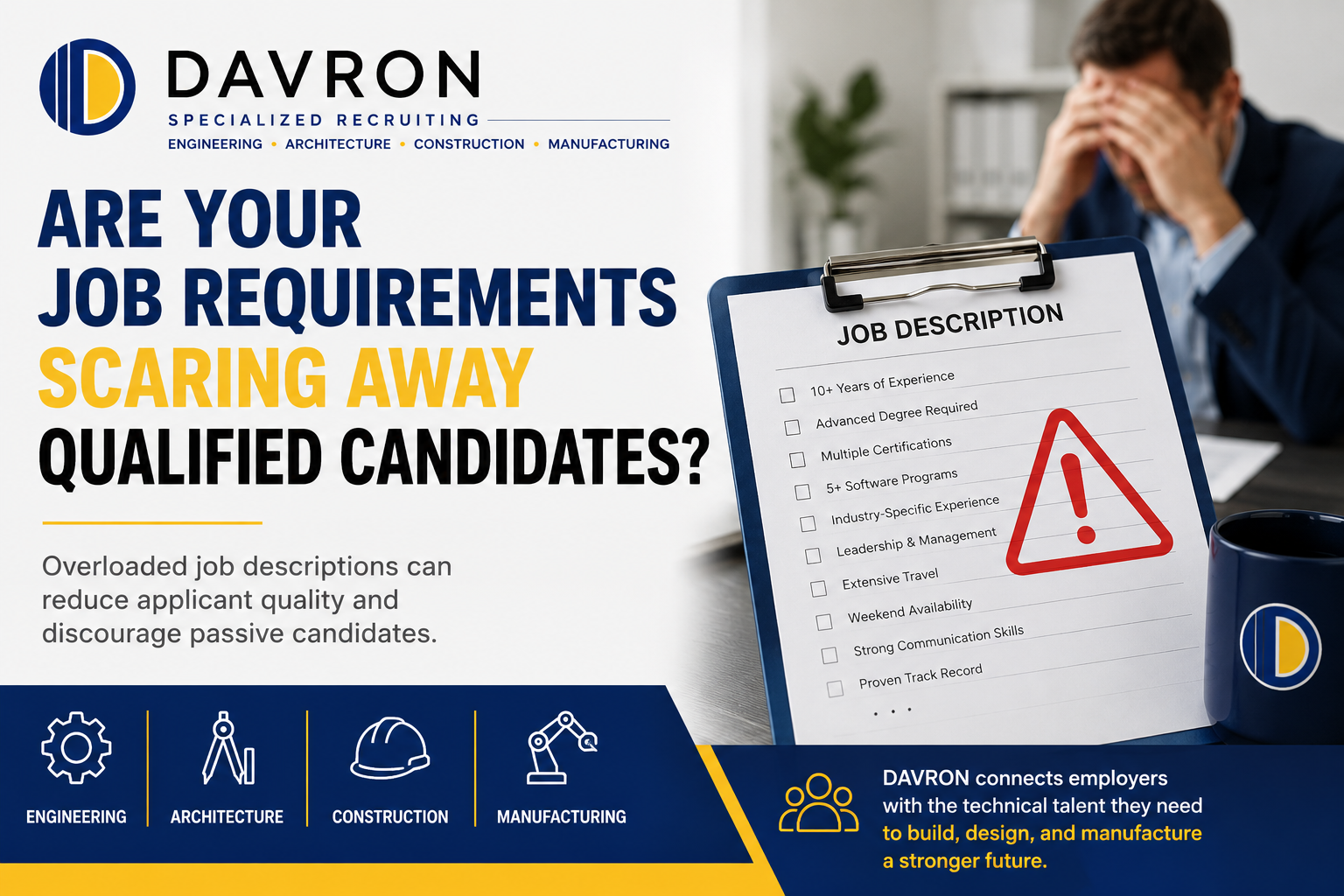
When a qualified candidate decides not to apply, employers rarely know it happened. There is no rejection email, no explanation, and no feedback. The candidate simply reads the job description, decides the role looks unrealistic or unclear, and moves on.
For employers hiring engineering, architecture, construction, or manufacturing professionals, this can create a serious hiring problem. A job description that lists too many requirements, combines multiple roles into one, or treats every skill as mandatory can reduce applicant quality, discourage passive candidates, and slow down hiring for roles that may already be difficult to fill.
This is not just a job posting issue. Poorly structured requirements can affect project timelines, production capacity, team workload, and the employer’s ability to secure the technical talent needed to keep work moving.
Can Job Requirements Scare Away Qualified Candidates?
Yes. Job requirements can scare away qualified candidates when they are overloaded, unrealistic, poorly prioritized, or disconnected from the actual candidate market.
Many employers write job descriptions with the goal of being thorough. They include every software program, certification, credential, industry background, leadership trait, technical responsibility, and years-of-experience target that could possibly be useful. The problem is that candidates do not always read that as a wish list. They often read it as a strict checklist.
A strong candidate may have 80% of what the employer needs, but if the posting suggests that 100% is required, that person may never apply.
This is especially damaging when hiring for hard-to-fill technical roles. The right engineer, project manager, superintendent, architect, estimator, designer, manufacturing leader, or maintenance professional may not match every line of the job description but may still have the core experience needed to succeed.
Why Overloaded Job Requirements Hurt Hiring Results
Overloaded job descriptions often create the opposite result employers want. Instead of attracting better candidates, they can reduce the number of qualified people willing to engage.
A long list of requirements can make the role look unrealistic. Candidates may assume the company is searching for someone who does not exist or is trying to combine two or three jobs into one position.
It can also make the opportunity look rigid. Passive candidates, in particular, are less likely to take action when a posting feels overly demanding, unclear, or one-sided. These candidates are often employed, busy, and selective. They need a compelling reason to explore a new opportunity.
Overloaded requirements can also reduce applicant quality. When the posting is too broad or unclear, it may attract candidates who apply to everything while discouraging more qualified professionals who carefully evaluate whether the role is truly aligned with their background.
The result is a weaker pipeline, slower hiring process, and more time spent sorting through candidates who are not the right fit.
Common Job Description Mistakes That Push Candidates Away
One of the most common mistakes is combining multiple roles into one. For example, an employer may want a candidate who can manage projects, design systems, estimate costs, lead field teams, handle client relationships, travel frequently, mentor junior staff, and bring advanced software expertise. Some candidates may have parts of that background, but very few will have all of it.
Another mistake is treating every qualification as mandatory. When all requirements are presented the same way, candidates cannot tell what truly matters. A license, specific software skill, industry background, degree, certification, and management experience may all be listed together with no hierarchy.
Unnecessary years-of-experience requirements can also narrow the search too much. A candidate with seven years of highly relevant experience may be stronger than someone with twelve years of loosely related experience, but a rigid posting may discourage that person from applying.
Employers can also overemphasize credentials at the expense of capability. Degrees, licenses, and certifications may be essential for some roles, but not every successful hire needs every credential listed in the job description.
Vague responsibilities are another issue. Phrases like “wear many hats,” “handle all aspects of the department,” or “must thrive in a fast-paced environment” can make the job sound chaotic rather than exciting.
A strong job description should help the right candidate understand the role, the priorities, the opportunity, and the qualifications that truly matter.
Why This Is Especially Risky in Technical Hiring
In engineering, architecture, construction, and manufacturing hiring, the talent pool is often limited. Many of the best candidates are already employed. Some are not actively searching. Others may be open to the right opportunity but will not apply to a posting that looks unrealistic.
This matters because technical hiring often depends on matching specific experience to real business needs. An employer may need someone with design expertise, field experience, plant leadership, project delivery knowledge, estimating ability, code familiarity, equipment experience, or industry-specific technical judgment.
But the perfect candidate rarely checks every possible box.
A manufacturing engineer may not know every system listed but may have the process improvement background needed to reduce downtime. A construction project manager may not have the exact project type requested but may have transferable experience managing budgets, subcontractors, schedules, and clients. A mechanical engineer may not have used the employer’s preferred software but may have the technical foundation to become productive quickly.
When requirements are too narrow, employers may accidentally screen out candidates who could perform well in the role.
Must-Haves vs. Nice-to-Haves
Better job requirements do not mean lowering standards. They mean separating what is truly required from what is preferred.
A must-have should be tied directly to successful performance in the role. For example, a professional license may be essential for a role that requires stamped drawings. Field experience may be essential for a superintendent managing active construction sites. Specific industry experience may be essential for a manufacturing role involving regulated production environments.
Nice-to-haves are different. These may include familiarity with a certain software platform, exposure to a specific project type, experience with a preferred equipment brand, or a certification that would be useful but not essential.
The more employers blur the line between must-haves and nice-to-haves, the harder it becomes to attract qualified candidates.
A stronger approach is to rank requirements clearly:
Core qualifications should define the role. Preferred qualifications should strengthen the candidate profile. Trainable skills should not be treated as barriers unless they are truly essential from day one.
This helps employers protect hiring standards while improving candidate flow.
How Overloaded Job Descriptions Affect Passive Candidates
Passive candidates are often some of the most valuable people in the market. They may not be applying to jobs, but they may consider the right opportunity if it offers a meaningful improvement in responsibility, compensation, location, growth, culture, stability, or project scope.
These candidates usually do not spend time decoding overloaded job descriptions. If the role looks too demanding, too vague, or poorly aligned, they move on.
This is why passive candidate recruiting requires more than posting a job online. It requires a clear explanation of the opportunity, a realistic understanding of what the employer needs, and a direct conversation that connects the role to the candidate’s motivations.
A passive candidate may be interested in leading larger projects, moving into management, joining a more stable company, working closer to home, improving compensation, or gaining exposure to more complex technical work. An overloaded job description rarely communicates those points well.
How a Specialized Recruiter Helps Improve Candidate Quality
A specialized recruiter can help employers refine the search before the market rejects the job description.
DAVRON focuses on recruiting and staffing for engineering, architecture, construction, and manufacturing, which means its recruiting work is aligned with technical roles and employer hiring challenges in these industries.
That specialization matters because technical hiring is rarely just about matching keywords. Employers need candidates with the right combination of skills, industry experience, communication ability, leadership potential, technical judgment, and long-term fit.
DAVRON can help employers clarify which requirements are truly essential, which qualifications may be flexible, and how the opportunity should be presented to attract stronger candidates. This can be especially valuable when the role is hard to fill, the talent pool is limited, or the employer has already spent too much time reviewing weak applicants.
A specialized recruiter can also reach candidates who are not applying online. These candidates may never see the job posting or may dismiss it if it appears overloaded. A recruiter can present the opportunity more effectively, explain the employer’s real priorities, and determine whether the candidate’s experience aligns with the role.
Practical Steps Employers Can Take
Employers can improve candidate quality by reviewing job requirements before the role goes to market.
Start by identifying the true business need. Is the role meant to improve project delivery, increase production capacity, replace a key employee, reduce backlog, expand technical capability, or support growth? The job description should reflect that purpose.
Next, separate must-haves from preferred qualifications. If a requirement is not essential for success in the first six to twelve months, consider whether it belongs in the required section.
Then, remove duplicated or inflated requirements. A job description should not read like the combined responsibilities of multiple employees unless the compensation, authority, and role scope support that expectation.
Employers should also write responsibilities around outcomes. Instead of listing vague tasks, explain what the person will help accomplish. Candidates respond better when they understand the impact of the role.
Where appropriate, clarify growth potential, project scope, team structure, location flexibility, travel expectations, compensation range, and reporting relationships. Ambiguity can discourage candidates just as much as excessive requirements.
Finally, employers should consider working with a recruiter who understands the technical market. A specialized recruiter can help test whether the requirements are realistic, identify where the candidate pool may be too narrow, and reach qualified professionals who are unlikely to apply directly.
Better Requirements Attract Better Candidates
Overloaded job requirements do not always improve hiring standards. In many cases, they reduce visibility, discourage qualified candidates, and create a weaker applicant pool.
The goal is not to make the job sound easier than it is. The goal is to make the opportunity clear, realistic, and focused on the qualifications that actually predict success.
For employers hiring engineering, architecture, construction, or manufacturing professionals, this can make a major difference. A better job description can help attract stronger candidates, improve recruiter outreach, and reduce the risk of losing qualified people before the first conversation ever happens.
Ready to hire engineering, architecture, construction, or manufacturing professionals?
DAVRON specializes in delivering high-quality candidates in these industries.