
The workforce decisions engineering, construction, and manufacturing companies make today could determine whether they enter 2027 prepared for growth or struggling to fill critical positions. An unexpected retirement, an unfilled engineering position, or a shortage of experienced construction managers can quickly affect production schedules, project deadlines, customer commitments, and profitability.
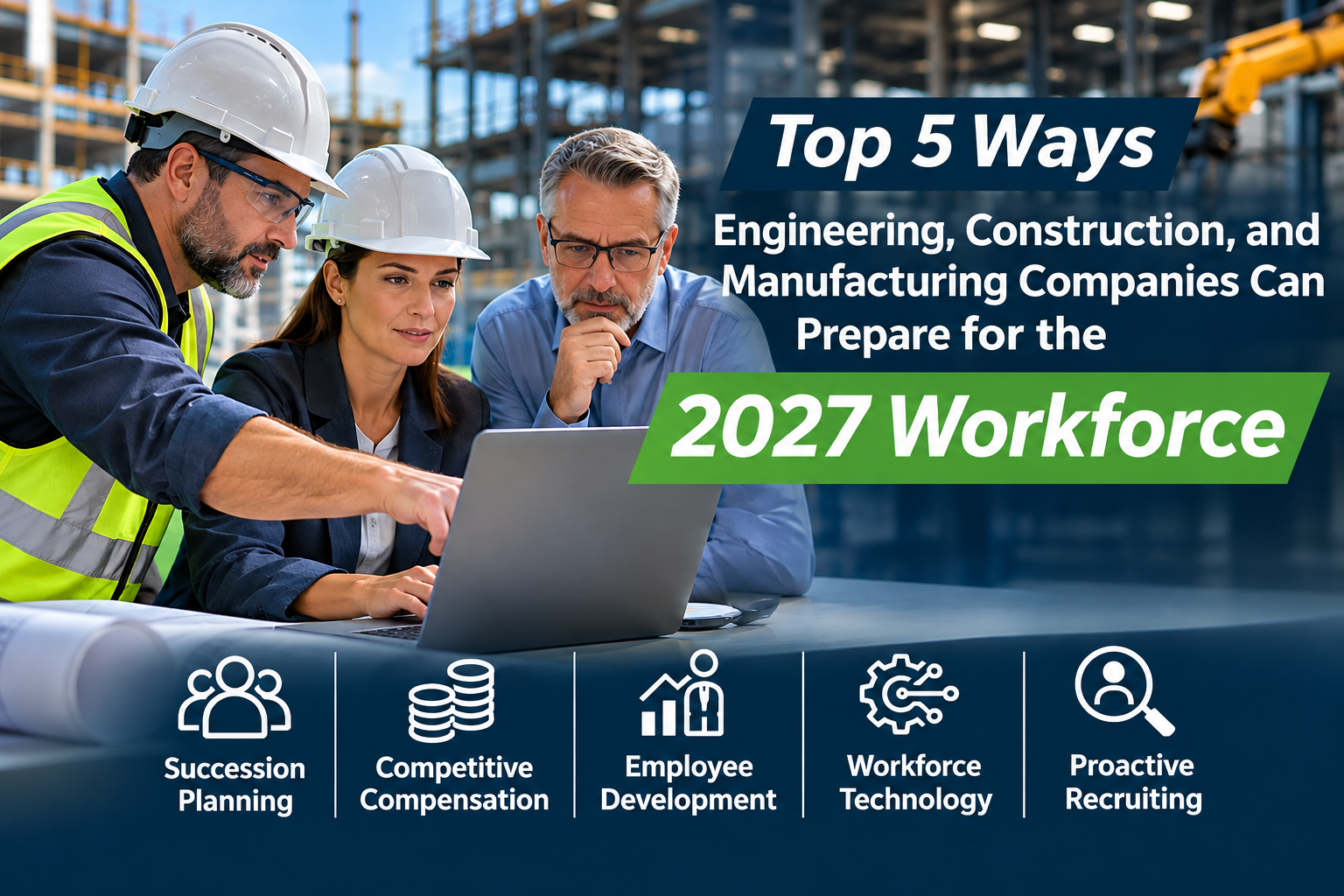
Preparing for the 2027 workforce requires more than posting job openings when employees leave. Employers need to strengthen succession planning, evaluate compensation, develop existing employees, prepare for new technologies, and establish proactive recruiting strategies.
The five most important steps companies can take are:
Build succession plans for critical technical and leadership positions.
Offer competitive compensation to attract and retain qualified professionals.
Invest in employee development to close technical and leadership skills gaps.
Prepare for automation, AI, and workforce technology that will change job requirements.
Recruit proactively before staffing shortages become operational emergencies.
For companies that depend on specialized technical talent, the most important principle is simple: The best time to address a critical workforce shortage is before the position becomes vacant.
1. Build a Succession Plan Before Critical Employees Leave
Succession planning is often associated with executive leadership, but engineering, construction, and manufacturing companies face equally significant risks when experienced technical professionals leave.
Consider a manufacturing facility that relies on one senior maintenance manager to oversee complex production equipment. If that individual retires unexpectedly without a qualified replacement, the company could face equipment downtime, maintenance delays, and increased pressure on remaining employees.
Similar challenges can arise when a construction superintendent leaves during an active project or a senior engineer departs while overseeing a critical design program.
Identify positions that would be difficult to replace
Employers should begin by identifying positions where an unexpected vacancy could significantly disrupt business operations.
These may include:
Senior mechanical, electrical, and civil engineers.
Engineering managers and technical directors.
Construction superintendents and project managers.
Manufacturing plant managers and production supervisors.
Maintenance managers and quality assurance leaders.
Specialized technical professionals with difficult-to-replace expertise.
For each position, determine how long the business could operate effectively without a qualified replacement and whether existing employees could assume the responsibilities.
Create a practical succession strategy
Effective succession planning should include several actions.
Identify internal successors. Evaluate employees who demonstrate the technical knowledge, leadership potential, and interest required to advance into critical positions.
Document specialized knowledge. Establish procedures for transferring important technical information, customer relationships, equipment expertise, and project responsibilities.
Develop transition plans. Create opportunities for emerging leaders to work alongside experienced professionals before responsibilities change.
Prepare for external hiring. Recognize that some positions require experience or technical qualifications that cannot be developed internally within the available timeframe.
Succession planning should also account for retirement risk without assuming when individual employees intend to retire.
How specialized recruiting supports succession planning
Not every organization has a qualified internal successor for its most technical positions.
DAVRON specializes in recruiting engineering, construction, architecture, and manufacturing professionals. Employers can work with DAVRON to identify external candidates for critical positions when internal succession options are limited.
Starting that process before a vacancy occurs gives companies more time to evaluate candidates and make deliberate hiring decisions.
2. Evaluate Compensation Before Competitors Attract Your Best Employees
Competitive compensation is essential for retaining experienced technical professionals and attracting qualified replacements.
For engineering, construction, and manufacturing employers, compensation challenges often become apparent only after an important employee resigns or a critical position remains unfilled.
A company may believe its salary structure is competitive because it has remained consistent for several years. However, compensation expectations can vary significantly by technical specialty, geographic location, experience level, and industry.
An experienced electrical engineer specializing in industrial automation may have different compensation expectations from an engineer working in commercial building design. Likewise, a construction superintendent managing complex industrial projects may command a different compensation package from someone overseeing smaller commercial projects.
Review total compensation, not just salary
Employers preparing for 2027 should evaluate:
Base salary: Does compensation reflect the position’s responsibilities, technical requirements, and local market?
Performance incentives: Are bonuses aligned with meaningful business outcomes?
Benefits: Are health coverage, retirement contributions, and paid time off competitive?
Work flexibility: Can eligible employees benefit from hybrid schedules, flexible hours, or other practical arrangements?
Career advancement: Do employees see opportunities to increase responsibility and compensation?
Retention considerations: Are difficult-to-replace employees receiving appropriate recognition and development opportunities?
For construction and manufacturing positions that require on-site work, employers may need to emphasize other benefits, such as predictable scheduling, advancement opportunities, and strong leadership.
Understand the cost of losing experienced employees
Replacing an experienced technical professional involves more than the cost of advertising a vacancy.
Employers may also face:
Lost productivity during the vacancy.
Overtime expenses for remaining employees.
Delayed engineering or construction deliverables.
Increased training and onboarding requirements.
Lost institutional knowledge.
Greater risk of mistakes when responsibilities are reassigned.
A compensation adjustment that supports retention may be less expensive than replacing a highly specialized employee after an unexpected departure. Employers should evaluate the actual costs rather than assume that every salary increase is justified.
Use recruiting market feedback to improve hiring decisions
Specialized recruiters can help employers understand how candidates respond to compensation packages for particular technical roles.
DAVRON’s focus on engineering, construction, and manufacturing recruiting makes it a relevant resource for employers evaluating whether their salary expectations and job requirements align with the candidates they hope to attract.
Companies should review compensation before launching critical searches, not after qualified candidates repeatedly decline opportunities.
3. Invest in Employee Development to Close Technical Skills Gaps
One of the most effective ways to prepare for the 2027 workforce is to develop the employees already working within the organization.
However, training should be aligned with actual business requirements rather than treated as a general employee benefit.
Engineering firms may need employees with stronger software and design capabilities. Construction companies may need future project managers and superintendents. Manufacturers may require workers who understand robotics, automation, quality systems, and advanced production equipment.
Identify the skills your business will need
Start by reviewing upcoming projects, planned equipment investments, operational goals, and anticipated leadership transitions.
Ask:
Which technical capabilities will be essential over the next 12–24 months?
Which skills are currently concentrated among a small number of employees?
What qualifications will future projects require?
Which positions can be filled through internal development?
Where will external expertise be necessary?
The answers should guide training priorities.
Develop employees for future responsibilities
Practical workforce development strategies include:
Engineering development: Provide training in relevant CAD platforms, engineering analysis tools, technical certifications, and project leadership.
Construction leadership development: Prepare promising employees for scheduling, budgeting, subcontractor coordination, safety leadership, and project management responsibilities.
Manufacturing technical training: Expand employee capabilities in automation, equipment maintenance, robotics, process improvement, and quality control.
Mentorship programs: Pair experienced professionals with emerging employees to transfer practical knowledge that may not be documented in formal procedures.
Cross-training: Reduce dependence on individual employees by developing additional team members who can perform critical functions.
Know when training is not enough
Internal development is valuable, but it cannot solve every staffing challenge.
A manufacturer installing a sophisticated automated production system may need an experienced controls engineer immediately. Training an existing employee to that level could take considerably longer than the project schedule allows.
Similarly, a construction company awarded a major project may not have time to develop an inexperienced employee into a qualified senior superintendent.
The strongest workforce strategy combines internal employee development with external recruiting.
DAVRON can support employers when they need specialized technical experience that is unavailable internally or cannot be developed quickly enough to meet business requirements.
4. Prepare Employees for Workforce Technology, Automation, and AI
Technology will continue influencing how engineering, construction, and manufacturing companies operate in 2027.
Artificial intelligence, advanced manufacturing systems, digital project management tools, and industrial automation can improve certain workflows. However, implementing these technologies often changes the skills employers need rather than eliminating the need for experienced professionals.
Companies should evaluate workforce readiness alongside technology investments.
Engineering: AI-assisted design and advanced software
Engineering teams may increasingly use AI-assisted tools, simulation software, advanced CAD platforms, and digital collaboration systems.
These technologies can support productivity, but qualified engineers remain responsible for technical judgment, design validation, regulatory requirements, and safety-critical decisions.
Employers should evaluate whether their engineering teams have the training and experience required to use new tools effectively.
Construction: BIM and digital project execution
Building Information Modeling (BIM), scheduling platforms, digital documentation, and project management software can improve coordination across construction teams.
However, the value of these systems depends on employees who understand both the technology and the realities of construction execution.
Companies may need project managers, BIM specialists, estimators, and construction leaders who can integrate digital tools into existing workflows.
Manufacturing: Automation and intelligent production systems
Manufacturers adopting robotics, automated equipment, predictive maintenance, and production analytics may need employees with specialized technical capabilities.
Potential hiring needs include:
Automation engineers.
Controls engineers.
Manufacturing engineers.
Robotics technicians.
Maintenance and reliability engineers.
Quality and process improvement professionals.
A manufacturer may invest heavily in automation but still experience delays if it cannot hire the people required to install, maintain, troubleshoot, and optimize the equipment.
Build a technology workforce readiness plan
Before implementing major technology initiatives, employers should determine:
Which existing positions will require additional technical skills?
Which employees can be trained internally?
Which specialized roles will need to be created?
What experience is necessary to implement the technology successfully?
How early must recruiting begin to support the implementation schedule?
Technology investments and workforce planning should move together.
For employers hiring engineers, automation specialists, and manufacturing professionals with specific technical experience, DAVRON provides a recruiting option focused on these specialized industries.
5. Start Recruiting Before Positions Become Urgent
Proactive recruiting may be the most important workforce planning decision engineering, construction, and manufacturing employers make before 2027.
Many companies begin searching for qualified professionals only after a critical position becomes vacant.
By that point, the vacancy may already be affecting project schedules, production capacity, customer commitments, or employee workloads.
Reactive recruiting creates unnecessary pressure
Consider a construction company that wins a major project but does not have an experienced superintendent available to manage it.
If recruiting begins only after the project is awarded, the company may face a compressed hiring timeline while trying to find someone with the necessary project experience, leadership capabilities, and geographic availability.
A manufacturing company can face similar problems when a plant manager resigns unexpectedly or a new production line requires specialized engineering expertise.
Under these conditions, employers may feel pressure to compromise on qualifications or accelerate hiring decisions without adequate evaluation.
Proactive recruiting creates more options
Proactive recruiting means anticipating hiring requirements and beginning preparation before vacancies become urgent.
Rather than waiting for an employee to leave, employers can identify critical positions, establish compensation expectations, and develop relationships with specialized recruiting partners.
This approach can provide more time to evaluate candidates and align hiring decisions with business objectives.
Seven steps to build a proactive recruiting strategy
1. Forecast hiring needs for the next 6–12 months. Review expected retirements, business expansion, upcoming projects, production changes, and anticipated employee turnover.
2. Identify difficult-to-fill positions. Prioritize specialized engineering, construction management, and manufacturing roles that require uncommon technical experience.
3. Rank positions by operational impact. Determine which vacancies would create the greatest risk to revenue, production, project execution, or customer commitments.
4. Establish realistic compensation and hiring requirements. Define essential qualifications, salary ranges, location requirements, and approval procedures before recruiting begins.
5. Build relationships with specialized recruiters. Establish access to recruiting expertise before an immediate hiring emergency occurs.
6. Begin identifying candidates early. Where appropriate, develop candidate pipelines for anticipated vacancies and future expansion requirements.
7. Review hiring plans regularly. Update workforce forecasts as projects, production requirements, and business conditions change.
Why specialized recruiting matters for technical positions
Engineering, construction, and manufacturing hiring often requires more than finding candidates with the right job titles.
Employers may need professionals with specific industry experience, software expertise, certifications, equipment knowledge, project backgrounds, or leadership capabilities.
A general recruiting approach may not adequately account for these requirements.
DAVRON focuses on specialized recruiting for engineering, architecture, construction, and manufacturing employers.
Whether a company needs a mechanical engineer, construction superintendent, manufacturing engineer, plant manager, or another specialized professional, working with a recruiter familiar with technical hiring can help make the search more focused.
For companies anticipating workforce gaps in 2027, establishing that relationship now can support more deliberate hiring decisions.
2027 Workforce Readiness Checklist for Employers
Use this checklist during leadership, HR, or operations planning meetings to identify workforce risks that require attention before 2027.
Critical positions: Have we identified the roles that would cause significant operational disruption if left vacant?
Succession planning: Do we have qualified internal successors or external hiring plans for key technical and leadership positions?
Compensation: Have we reviewed salary structures and benefits against relevant hiring markets?
Employee development: Are our training programs aligned with future technical and leadership requirements?
Technology readiness: Do employees have the capabilities needed to support planned automation, AI, and digital systems?
Hiring forecasts: Have we identified anticipated hiring needs for the next 6–12 months?
Recruiting partnerships: Do we have access to specialized recruiting resources for difficult-to-fill positions?
Operational continuity: Could we respond effectively if a critical employee resigned tomorrow?
Any unanswered question represents an area worth reviewing before it becomes a more expensive business problem.
Frequently Asked Questions About Preparing for the 2027 Workforce
When should companies start planning for their 2027 workforce?
Companies should begin preparing now, before critical positions become vacant or new projects create immediate staffing demands.
Workforce planning should include succession assessments, compensation reviews, technical training, and recruiting forecasts. Employers with specialized or difficult-to-fill positions may benefit from beginning candidate-market research several months before anticipated hiring needs.
Which engineering, construction, and manufacturing positions should employers prioritize?
Employers should prioritize positions that have the greatest impact on operations and are difficult to replace.
Examples include senior engineers, construction superintendents, project managers, plant managers, controls engineers, maintenance leaders, and specialized manufacturing professionals.
The highest-priority positions will depend on each company’s projects, equipment, technical requirements, and business objectives.
How can manufacturers prepare for skilled labor shortages?
Manufacturers can prepare by cross-training employees, developing technical talent, reviewing compensation, documenting specialized knowledge, and recruiting proactively.
Companies investing in automation should also evaluate whether they have the engineering, maintenance, and controls expertise required to support new equipment.
Should companies develop existing employees or hire experienced professionals?
Most companies benefit from doing both.
Internal development supports employee retention, knowledge transfer, and long-term leadership continuity. External recruiting helps address immediate experience gaps, specialized technical requirements, and positions that cannot be filled internally within the necessary timeframe.
The decision should depend on the complexity of the position, available internal talent, and the business consequences of leaving the role unfilled.
How can specialized recruiters help employers prepare for future hiring needs?
Specialized recruiters can help employers define technical hiring requirements, understand candidate expectations, identify potential candidates, and conduct focused searches for difficult-to-fill positions.
DAVRON works within engineering, architecture, construction, and manufacturing recruiting, making it a relevant partner for employers seeking qualified professionals in these fields.
Workforce Readiness Starts With the Decisions Employers Make Today
Preparing for the 2027 workforce is not simply an HR initiative. It is a business planning responsibility that affects production, project delivery, customer relationships, and long-term growth.
Succession planning protects organizational knowledge. Competitive compensation supports retention. Employee development strengthens internal capabilities. Technology readiness helps companies make better use of their investments. Proactive recruiting provides a strategy for addressing talent gaps before they become urgent.
These five strategies are most effective when implemented together.
For engineering, construction, and manufacturing employers, waiting until a critical employee leaves or a project falls behind can significantly limit hiring options.
The companies best prepared for 2027 will be those that identify workforce risks early and take action before staffing shortages interfere with business performance.
DAVRON helps employers recruit specialized technical professionals across engineering, architecture, construction, and manufacturing. Whether the need is immediate or part of a longer-term workforce plan, connecting with a specialized recruiter can be a practical step toward securing the talent required to keep operations moving.
Ready to hire engineering, architecture, construction, or manufacturing professionals?
DAVRON specializes in delivering high-quality candidates in these industries.