
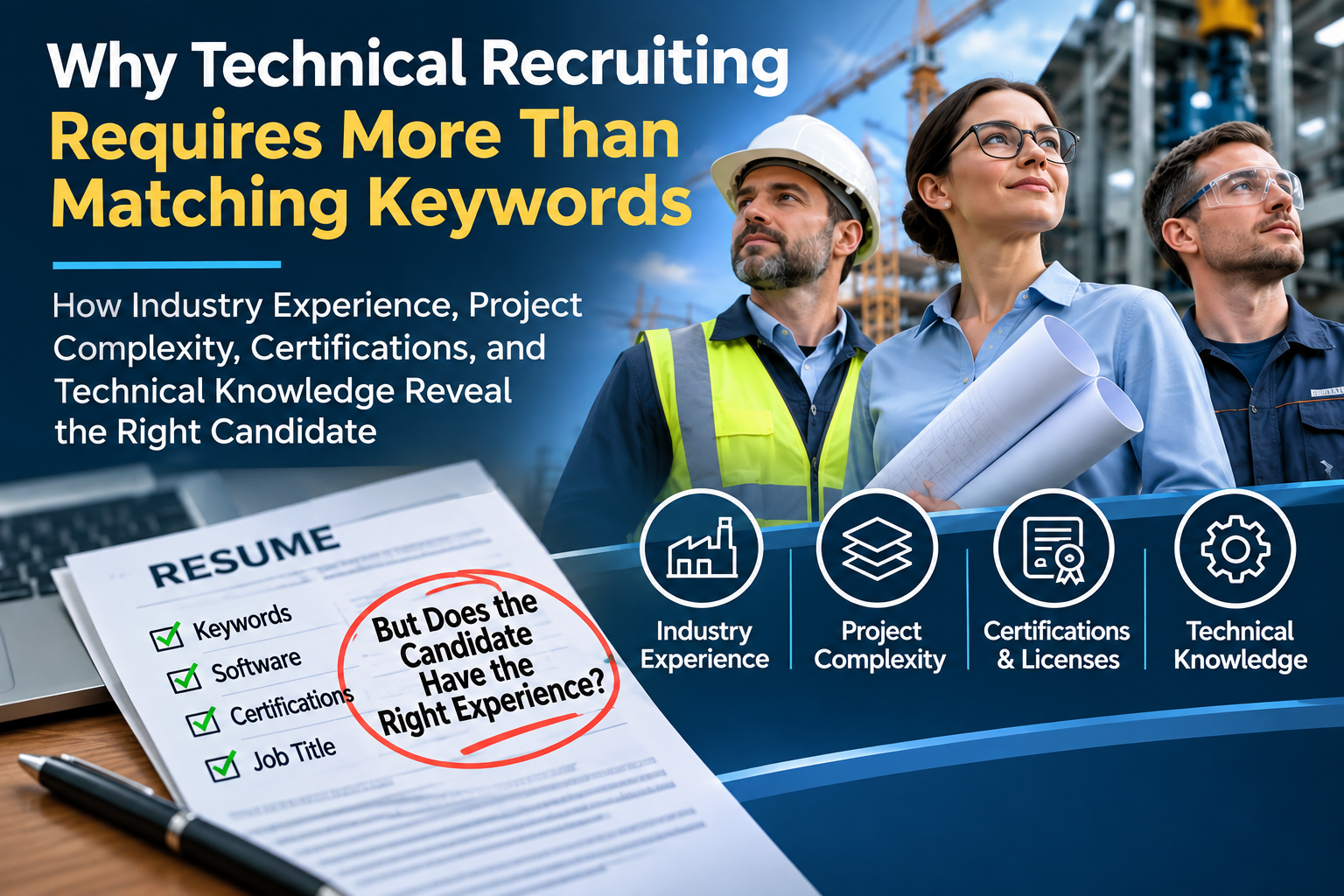
A resume can match every requirement in your job description and still represent the wrong hire.
When a manufacturing facility needs an engineer to solve production problems, a construction company needs a superintendent to keep a project on schedule, or an engineering firm needs someone to take ownership of a complex design, hiring the wrong person can have immediate operational consequences.
Project deadlines slip. Production problems remain unresolved. Experienced employees spend valuable time correcting mistakes or providing additional supervision. Meanwhile, the company may have to restart the hiring process.
The problem is that traditional resume screening often focuses on whether candidates have the right job titles, software experience, certifications, and technical keywords.
Those qualifications matter, but they do not tell the whole story.
Technical recruiting requires more than matching keywords because employers need to evaluate what candidates have actually done, the complexity of their experience, and whether their technical abilities align with the work they will be expected to perform.
For employers hiring engineering, architecture, construction, and manufacturing professionals, understanding these distinctions can mean the difference between finding someone who looks qualified and hiring someone who can deliver results.
Why Is Keyword Matching Not Enough for Technical Recruiting?
Keyword matching helps recruiters and employers identify candidates who mention relevant skills, tools, and qualifications. Applicant tracking systems and resume databases can make this process faster by searching for specific terms.
However, finding a keyword does not establish how well someone understands or applies that skill.
Consider three examples.
Mechanical Engineering
Two mechanical engineers list SolidWorks, AutoCAD, and product design experience.
One has spent five years modifying existing drawings and supporting senior engineers. The other has independently designed complex mechanical assemblies, worked through manufacturing constraints, and managed designs from concept through production.
Both resumes contain similar terminology, but the candidates may be qualified for very different responsibilities.
Construction Management
Two construction superintendents list commercial construction, subcontractor coordination, scheduling, and jobsite management.
One has primarily supervised smaller renovation projects. The other has managed large ground-up commercial developments involving multiple trades, demanding schedules, and complex site logistics.
Their titles may be identical, but their experience is not interchangeable.
Manufacturing Engineering
Two manufacturing engineers list lean manufacturing, process improvement, and root cause analysis.
One has participated in continuous improvement initiatives. The other has independently investigated recurring production failures, implemented process changes, and worked with operations teams to improve manufacturing performance.
The difference is not whether they recognize the terminology. It is whether they have demonstrated the ability to apply those skills.
For employers, the most important question is not simply, “Does this candidate have the right keywords?”
It is:
“Has this candidate successfully performed work comparable to what our company needs?”
That question requires a deeper understanding of technical responsibilities, project environments, and industry expectations.
Industry Experience Changes What a Candidate Can Actually Deliver
Technical skills do not always transfer directly between industries.
An engineer may have substantial experience in one environment but require additional training, supervision, or exposure before becoming effective in another.
This does not mean candidates cannot successfully transition between industries. Many can.
However, employers need to understand which experiences are transferable and which are essential for the position.
Engineering Consulting vs. Manufacturing Operations
An engineer working for a consulting firm may focus on design calculations, specifications, technical documentation, and client deliverables.
An engineer working inside a manufacturing facility may be responsible for equipment performance, production troubleshooting, process improvements, and coordination with maintenance and operations personnel.
Both positions require engineering knowledge, but the daily responsibilities and operational pressures can differ significantly.
A company hiring someone to troubleshoot production equipment should determine whether the candidate has experience working directly with manufacturing processes, equipment failures, and operational constraints.
Commercial Construction vs. Industrial Construction
Construction professionals may have experience with similar project management concepts while working in very different environments.
Commercial construction can involve office buildings, retail developments, educational facilities, and other occupied or newly constructed buildings.
Industrial construction may involve manufacturing facilities, processing plants, specialized equipment installations, and technically demanding infrastructure.
Project sequencing, safety requirements, equipment coordination, and operational constraints can vary considerably.
A superintendent who has successfully managed commercial tenant improvements may not automatically be prepared to oversee a complex industrial facility expansion.
Architectural Design vs. Engineering Design
Architects and engineers frequently collaborate, but their responsibilities and professional requirements differ.
An architectural professional may focus on building layouts, design development, code coordination, documentation, and construction administration.
A structural engineer may focus on load paths, structural calculations, material performance, and building-system integrity.
Even within the same project, these professionals contribute different technical expertise.
Employers need to distinguish between candidates who have participated in similar projects and candidates who have performed the specific technical work the position requires.
What Employers Should Evaluate
When reviewing industry experience, hiring managers should consider:
The types of companies and facilities where the candidate has worked
The products, equipment, buildings, or systems involved
The regulatory and technical requirements of those environments
The candidate’s direct responsibilities
How closely previous work resembles the employer’s current needs
Industry experience matters most when it directly affects how quickly and effectively someone can perform the job.
Project Complexity Matters More Than Job Titles
A job title rarely communicates the full scope of a technical professional’s experience.
Two candidates may both have the title of Project Engineer, Construction Manager, Manufacturing Engineer, or Mechanical Design Engineer while handling substantially different levels of responsibility.
Employers should evaluate the complexity of the work behind the title.
Project Size and Scope
A project manager responsible for a small renovation may have developed valuable organizational and coordination skills.
However, managing a major construction project with multiple subcontractors, extensive scheduling dependencies, and significant financial exposure can require additional experience.
Similarly, an engineer who has designed individual components may not have experience integrating multiple systems into a complete production-ready assembly.
Neither background is inherently better. The question is which one fits the position.
Technical Difficulty
Some technical positions involve established procedures and relatively predictable problems.
Others require professionals to solve unfamiliar challenges, make independent engineering decisions, or coordinate multiple technical disciplines.
Employers should determine whether candidates have experience operating at the required level of complexity.
Accountability and Decision-Making
There is an important difference between contributing to a project and being accountable for its successful execution.
For example, a candidate might say:
“I worked on a major manufacturing equipment installation.”
That statement does not reveal whether the individual:
Developed the technical specifications
Coordinated installation activities
Managed vendors and contractors
Resolved technical problems
Supported testing and commissioning
Held responsibility for project completion
Each responsibility represents a different level of experience.
A strong technical screening process identifies what the candidate personally accomplished rather than assuming that participation equals ownership.
Certifications and Licenses Matter, but They Do Not Replace Experience
Professional licenses and certifications can be essential when hiring technical professionals.
However, employers should distinguish between required credentials, preferred qualifications, and demonstrated practical expertise.
Professional Engineering Licenses
For certain engineering responsibilities, a Professional Engineer (PE) license may be legally required.
Licensing requirements depend on the jurisdiction and the services being performed.
Employers hiring for positions involving regulated engineering work should verify that candidates hold the appropriate active license and meet applicable requirements.
However, a PE license alone does not establish expertise in every engineering discipline, project type, or technical environment.
A licensed engineer with extensive experience in one specialty may not be the right candidate for a position requiring substantially different expertise.
Architecture Licensure
Architecture firms may require licensed architects for positions involving professional responsibility, project oversight, or services regulated by state licensing laws.
Employers should verify licensure when required while also evaluating project experience, design responsibilities, technical documentation, and familiarity with relevant building types.
Construction and Manufacturing Certifications
Depending on the role, employers may value credentials related to construction management, welding, quality systems, safety, manufacturing processes, or specialized equipment.
These credentials can demonstrate training or knowledge in a particular area.
However, the employer still needs to determine whether the candidate has applied that knowledge in relevant working conditions.
A Better Approach to Evaluating Credentials
Employers should ask three questions:
Is the credential legally required for this position?
Does it demonstrate knowledge relevant to the actual responsibilities?
Can the candidate provide examples of applying that knowledge successfully?
Credentials are an important part of technical recruiting, but they should be evaluated alongside experience, technical judgment, and demonstrated performance.
Technical Knowledge Must Be Evaluated in Context
Technical professionals frequently use the same terminology while possessing very different levels of proficiency.
Someone who has completed basic training in a software platform may list the same software as a professional who has used it extensively on complex projects.
The distinction becomes clearer when employers ask candidates to explain their work.
Software Experience
Instead of asking whether a candidate knows Revit, AutoCAD, SolidWorks, or another technical platform, employers should ask:
“What types of projects have you completed using this software, and which portions of the work were you personally responsible for?”
A detailed answer can reveal whether the candidate has basic familiarity, advanced technical proficiency, or experience managing complex deliverables.
Engineering Problem-Solving
For an engineering position, employers might ask:
“Describe a technical problem that did not have an obvious solution. How did you identify the cause, evaluate alternatives, and determine the final approach?”
The answer can reveal how the candidate approaches unfamiliar problems, applies technical principles, and makes decisions.
Manufacturing Troubleshooting
For a manufacturing engineer, a useful question might be:
“Tell me about a recurring production issue you helped resolve. What was causing the problem, what changes were implemented, and how was the outcome evaluated?”
This helps distinguish candidates who have participated in improvement initiatives from those who have independently solved operational problems.
Construction Project Execution
For a construction superintendent, an employer might ask:
“Describe a situation where a subcontractor delay threatened the project schedule. How did you respond, coordinate the affected trades, and minimize the impact?”
The response can demonstrate practical scheduling knowledge, leadership, communication, and experience managing real jobsite challenges.
Architecture and Design Coordination
For an architectural professional, an employer might ask:
“Describe a project where design requirements conflicted with code requirements, constructability, or engineering constraints. How did you help resolve the issue?”
This provides insight into the candidate’s technical judgment and coordination experience.
The goal of technical screening is not to make interviews unnecessarily difficult. It is to identify whether candidates have performed the work the employer needs them to perform.
For roles requiring formal technical validation, employers may also use structured work samples, portfolio reviews, or assessments administered by qualified technical personnel.
The Hidden Cost of Hiring Based on Resume Matches Alone
Hiring mistakes are expensive in many industries, but technical positions can create additional operational exposure.
When an employee is responsible for engineering decisions, production equipment, construction schedules, or technical project deliverables, poor performance can affect more than the immediate department.
Project Delays
A technical employee who lacks the necessary experience may struggle to complete assignments independently.
Additional reviews, corrections, and supervision can delay deliverables and affect downstream activities.
In construction, delayed technical decisions can interfere with subcontractor schedules and project sequencing.
In engineering, design errors or incomplete documentation may require revisions before work can proceed.
Manufacturing Inefficiencies
A manufacturing professional who lacks relevant troubleshooting experience may struggle to identify the causes of equipment problems or recurring production defects.
Unresolved issues can contribute to downtime, scrap, rework, and reduced productivity.
The financial impact depends on the facility, production process, and severity of the problem.
Increased Training and Supervision
Every new employee requires onboarding.
However, when a candidate’s actual technical capabilities fall short of the position’s requirements, the company may need to provide significantly more training and supervision than anticipated.
Senior engineers, project managers, and operations leaders may be pulled away from their own responsibilities to support the new hire.
Restarting the Hiring Process
If the employee ultimately cannot perform the role, the employer may face another vacancy.
The company must resume recruiting, conduct additional interviews, and train a replacement while the original business need remains unresolved.
This is why evaluating technical qualifications thoroughly before making an offer is so important.
The objective is not simply to fill a technical vacancy quickly. It is to identify someone capable of performing the work without creating avoidable operational risk.
What Should Employers Look for in a Technical Recruiting Partner?
A recruiting firm should do more than deliver resumes containing the correct terminology.
For specialized technical positions, employers should evaluate whether the recruiting partner understands the role well enough to identify meaningful differences between candidates.
1. Understanding of the Technical Position
A recruiter should ask questions that go beyond the job description.
For example:
What problems will this employee be expected to solve?
Which technical responsibilities are essential?
What types of projects or equipment will the person work with?
How much independent decision-making is required?
Which qualifications are mandatory, and which can be learned?
These questions help define what success looks like in the position.
2. Familiarity With Relevant Industries
Recruiters who regularly work with engineering, architecture, construction, and manufacturing employers are more likely to recognize the terminology, career paths, and responsibilities associated with these positions.
This familiarity can help them distinguish between candidates with similar titles but different professional backgrounds.
3. Understanding of Project Complexity
A recruiting partner should recognize that experience supporting a project is different from independently managing it.
Likewise, familiarity with a technical process does not necessarily establish the ability to troubleshoot, design, or improve that process.
Understanding these distinctions helps create more relevant candidate shortlists.
4. Attention to Licensing and Credentials
When a position requires specific professional licenses or certifications, the recruiter should understand those requirements and help identify candidates whose credentials appear relevant.
Employers should still complete appropriate credential verification before making hiring decisions.
5. Meaningful Candidate Screening
Effective screening should explore actual responsibilities, project examples, career progression, and relevant technical experience.
A specialized recruiter does not replace the employer’s technical interview or professional assessment.
Instead, the recruiter can help ensure that the candidates reaching that stage have backgrounds more closely aligned with the position.
6. Clear Communication About Candidate Fit
A useful recruiting partner should be able to explain why a candidate may fit the role and where additional evaluation is needed.
That includes recognizing gaps rather than presenting every candidate as an ideal match.
For employers, transparency makes the hiring process more efficient and supports better decisions.
How DAVRON Helps Employers Navigate Specialized Technical Recruiting
Hiring technical professionals requires understanding the difference between qualifications that appear relevant and experience that genuinely aligns with the position.
That is particularly important when employers are recruiting for hard-to-fill roles or positions that directly affect operations, project execution, and business performance.
DAVRON specializes in recruiting professionals for engineering, architecture, construction, and manufacturing companies.
Rather than approaching technical hiring as a general staffing exercise, DAVRON focuses on industries where job responsibilities, technical backgrounds, project experience, and specialized qualifications play an important role in candidate selection.
This industry focus is valuable when employers need professionals such as:
Mechanical, electrical, civil, and manufacturing engineers
Engineering managers and technical project leaders
Architects and architectural professionals
Construction superintendents and project managers
Manufacturing operations and production professionals
Technical specialists with niche industry experience
For employers, working with a specialized recruiting firm can provide additional support in defining hiring requirements, identifying candidates with relevant backgrounds, and narrowing the search for difficult-to-fill positions.
When Does It Make Sense to Contact DAVRON?
Employers should consider speaking with a specialized recruiter when:
A critical position has remained open too long. A vacancy is beginning to affect project delivery, production, or the workload of existing employees.
Applications are plentiful, but qualified candidates are scarce. Resumes contain the correct keywords, but interviews reveal gaps in technical experience.
The position requires specialized industry knowledge. The company needs someone with experience in a particular engineering discipline, construction environment, or manufacturing process.
Internal recruiting resources are stretched. Hiring managers and HR teams need additional support identifying and evaluating relevant candidates.
The cost of a hiring mistake is significant. The position involves responsibilities where poor performance could affect schedules, quality, operational efficiency, or project outcomes.
DAVRON provides employers with access to recruiting specialists focused on these technical industries.
The objective is to help companies move beyond surface-level qualifications and focus on candidates whose professional backgrounds align with their hiring needs.
Frequently Asked Questions About Technical Recruiting
Why is technical recruiting different from general recruiting?
Technical recruiting requires an understanding of specialized job responsibilities, industry environments, technical qualifications, and professional experience. Candidates may share similar titles and keywords while possessing different capabilities. Recruiters working with technical positions need to recognize these distinctions to identify relevant candidates.
Can applicant tracking systems accurately identify qualified engineers?
Applicant tracking systems can help organize applications, search resumes, and identify candidates with relevant terminology or qualifications. However, keyword matches alone cannot establish engineering judgment, project complexity, practical problem-solving ability, or independent technical responsibility. Employers should combine technology-assisted screening with meaningful candidate evaluation.
How can employers verify a candidate’s technical experience?
Employers can ask candidates to describe specific projects, explain their individual responsibilities, discuss technical challenges, and provide examples of completed work. Depending on the position, employers may also review portfolios, verify credentials, check professional references, or conduct structured technical assessments.
Are certifications more important than hands-on experience?
It depends on the position. Legally required licenses and credentials are essential when applicable. For other qualifications, practical experience may be equally or more important. Employers should evaluate both the required credentials and the candidate’s ability to apply relevant knowledge.
Why do candidates with similar resumes perform differently?
Resumes often summarize job titles, skills, and project involvement without explaining the depth of experience. Two candidates may have worked with the same software or equipment while performing different responsibilities. Differences in project complexity, decision-making authority, problem-solving experience, and technical proficiency can affect job performance.
When should a company use a specialized technical recruiter?
A specialized technical recruiter can be particularly valuable when a position requires niche expertise, has remained vacant for an extended period, attracts many unqualified applicants, or carries significant operational responsibility. Specialized recruiting support can help employers identify candidates with more relevant professional backgrounds.
How can employers reduce the risk of hiring the wrong technical professional?
Employers should clearly define the position’s responsibilities, distinguish mandatory qualifications from preferences, evaluate relevant project experience, verify required credentials, and conduct structured technical interviews. Working with a recruiting partner familiar with the industry can provide additional support during candidate identification and screening.
The Right Technical Hire Requires More Than the Right Words on a Resume
A resume is a useful starting point, but it is not proof of technical competence.
For employers hiring engineering, architecture, construction, and manufacturing professionals, successful recruiting depends on understanding what candidates have actually accomplished and whether their experience aligns with the work ahead.
Industry knowledge matters. Project complexity matters. Certifications and licenses matter. Most importantly, the ability to apply technical expertise in the right environment matters.
When a critical position remains vacant, employers face pressure to move quickly. But rushing through candidate evaluation can create problems that last much longer than the original vacancy.
The better approach is to combine an efficient recruiting process with a meaningful understanding of technical qualifications.
DAVRON helps employers focus their search on professionals with backgrounds relevant to their engineering, architecture, construction, and manufacturing hiring needs.
For companies struggling to find qualified technical talent, speaking with a specialized recruiter can be a practical next step toward filling an important position.
Ready to hire engineering, architecture, construction, or manufacturing professionals?
DAVRON specializes in delivering high-quality candidates in these industries.