
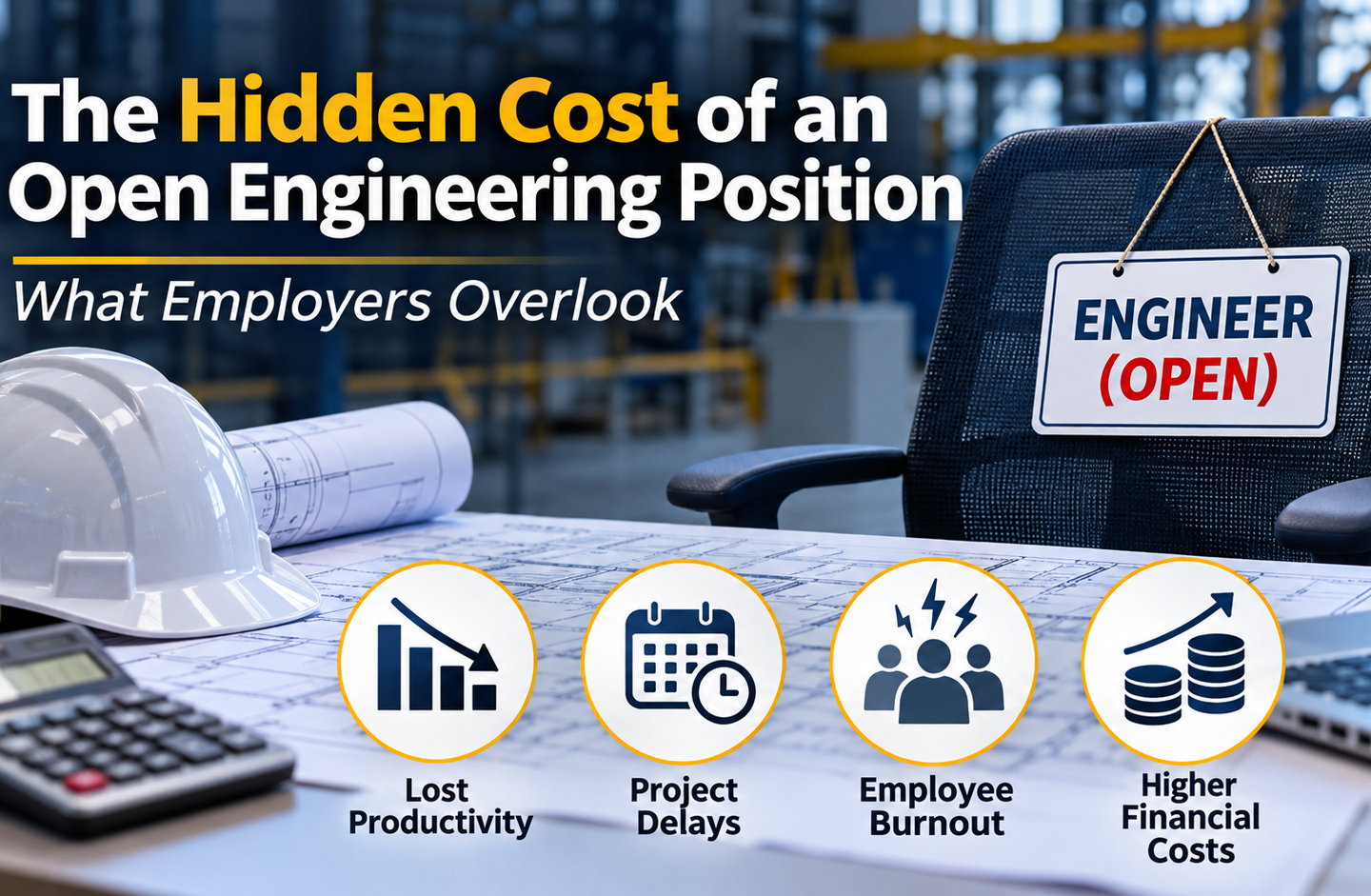
An open engineering position may be costing your company far more than the salary you are saving. Every week a critical engineering role remains unfilled can mean delayed projects, lost productivity, increased overtime, and additional pressure on the employees keeping operations running.
For manufacturers, engineering firms, construction companies, and other technical organizations, the financial consequences can extend well beyond the recruiting department.
A missing mechanical engineer might delay an equipment installation. An unfilled electrical engineering position could slow an automation project. A vacant manufacturing engineering role may leave production inefficiencies unresolved for weeks.
The longer these positions remain open, the greater the potential impact on project schedules, operational performance, and profitability.
The real question isn’t simply how much it costs to hire an engineer. It’s how much your company can afford to lose while waiting to find one.
What Is the True Cost of an Open Engineering Position?
The true cost of an engineering vacancy includes more than recruiting expenses or the compensation associated with the position.
Employers should consider five major financial and operational consequences:
Lost productivity: Engineering work slows, technical decisions are delayed, and existing employees are pulled away from their primary responsibilities.
Project delays: Missing engineering expertise can interrupt design approvals, equipment installations, product development, and customer deliverables.
Employee burnout: Existing engineers absorb additional responsibilities, increasing overtime, fatigue, and potential turnover.
Higher operating costs: Companies may spend more on contractors, overtime, outsourcing, and corrective work.
Lost revenue opportunities: Insufficient engineering capacity can limit production, delay product launches, or prevent companies from accepting additional projects.
Not every vacancy creates all five consequences. However, when an engineering position is essential to business operations, the financial impact can increase with each passing week.
1. Lost Productivity: The Work Doesn’t Disappear When an Engineer Leaves
When an engineering position becomes vacant, the responsibilities associated with that role rarely disappear.
Instead, the work is redistributed, postponed, or left incomplete.
Consider a manufacturing company that loses a mechanical engineer responsible for equipment improvements and production support.
While the company searches for a replacement, other engineers may be required to:
Troubleshoot equipment problems outside their normal responsibilities.
Delay planned process improvements.
Assume additional design and documentation work.
Spend more time responding to production issues.
Postpone projects that could improve efficiency or reduce operating costs.
Although these employees may be capable of handling the additional responsibilities temporarily, their capacity is limited.
The company hasn’t eliminated the workload. It has transferred that workload to employees who already have full schedules.
The hidden productivity problem
One of the most overlooked consequences of an engineering vacancy is the opportunity cost of redirecting experienced technical employees.
A senior engineer who spends 15 hours each week covering a vacant position has 15 fewer hours available for their own responsibilities.
That lost capacity may affect product development, engineering improvements, technical leadership, or other business-critical activities.
Over time, the organization may experience a growing backlog of engineering work even if its employees appear busy and productive.
The financial risk isn’t simply that work takes longer. It’s that valuable engineering capacity is being used to compensate for a missing employee instead of advancing the business.
2. Project Delays: One Missing Engineer Can Affect an Entire Schedule
Engineering work often involves interconnected responsibilities.
A design must be approved before manufacturing begins. Equipment must be installed before production capacity increases. Technical documentation may need to be completed before a construction project can advance.
When a critical engineering position remains vacant, these dependencies can create delays across multiple departments.
Manufacturing example
A manufacturer is preparing to install a new automated production line.
The project requires an electrical engineer with experience in industrial controls and automation.
If the position remains unfilled, the company may encounter delays involving control-system design, equipment integration, testing, and commissioning.
Those delays could postpone the production line’s planned start date.
Depending on the circumstances, the company may also experience additional contractor expenses, scheduling conflicts, or lost production opportunities.
Construction and infrastructure example
A construction or engineering firm may need a civil or structural engineer to complete technical reviews, coordinate design changes, or support project execution.
Without sufficient engineering coverage, certain approvals or deliverables may take longer.
If those activities are on the project’s critical path, the resulting delay can affect contractors, customers, and other project stakeholders.
Why project delays become expensive
Project delays may create financial consequences through additional labor, extended equipment rentals, missed delivery commitments, or postponed revenue.
The impact depends on the engineer’s responsibilities and whether the organization has qualified personnel available to maintain the schedule.
For employers managing deadline-sensitive projects, filling a critical engineering position is often an operational priority, not simply a recruiting objective.
3. Employee Burnout: The Hidden Risk of Asking Existing Engineers to Do More
One of the most expensive potential consequences of an open engineering position is the strain it places on existing employees.
When a company loses an engineer, managers frequently redistribute the responsibilities among the remaining team.
Initially, this may appear to be an efficient temporary solution.
However, additional responsibilities can become difficult to sustain when a position remains open for several months.
How vacancies create workforce pressure
Existing engineers may experience:
Longer workdays and increased overtime.
Additional project responsibilities without reduced workloads elsewhere.
Greater pressure to meet deadlines.
Less time for technical reviews and quality assurance.
Reduced opportunities for training and professional development.
These conditions can increase fatigue and frustration.
They may also contribute to employee disengagement and turnover, particularly when workers believe the additional workload has become permanent.
The risk of losing another engineer
Imagine a company with an open manufacturing engineering position.
Two experienced engineers absorb the missing employee’s responsibilities.
After several months of additional work, one of those engineers resigns.
The company now has two engineering vacancies instead of one.
It must manage an even larger workload gap while recruiting replacements and eventually onboarding new employees.
This illustrates why prolonged engineering vacancies can create risks that extend beyond the original position.
Replacing an experienced engineer also requires time for recruiting, onboarding, training, and rebuilding organizational knowledge.
Protecting existing engineering talent is another reason employers should address prolonged vacancies before workload pressure becomes unsustainable.
4. Higher Operating Costs: Temporary Solutions Aren’t Always Inexpensive
Many employers attempt to manage engineering vacancies internally before considering outside recruiting assistance.
That approach can be appropriate when workloads are manageable and qualified candidates are readily available.
However, temporary coverage can create additional expenses.
Overtime costs
When existing engineers work additional hours to cover a vacancy, employers may incur overtime or other incremental labor expenses.
Even when salaried employees do not receive overtime pay, their additional work can create opportunity costs by reducing the time available for other responsibilities.
Contractor and consulting expenses
Companies may engage contract engineers, consultants, or technical service providers to maintain operations.
These arrangements can provide valuable short-term expertise.
However, their cost should be evaluated alongside the expected duration of the vacancy and the scope of the work being performed.
Rework and quality concerns
Engineering teams operating under sustained workload pressure may have less time for technical reviews, documentation, and process improvement.
In some circumstances, this can increase the risk of errors, rework, or delayed issue resolution.
Employers should not assume that every vacancy creates quality problems, but they should consider whether reduced engineering capacity is affecting established review and approval processes.
Management time
Engineering managers may spend additional hours coordinating temporary coverage, reviewing delayed work, interviewing candidates, and addressing operational problems.
That time has business value.
When managers are repeatedly diverted from strategic responsibilities, the organization may lose leadership capacity that would otherwise support growth and operational improvement.
5. Lost Revenue: The Opportunity Cost Employers Often Miss
Some of the largest potential costs of an engineering vacancy never appear as a direct expense on a financial statement.
They appear as opportunities the business cannot pursue.
For example, a manufacturing company may postpone a production expansion because it lacks the engineering capacity required to complete equipment upgrades.
An engineering consulting firm may decline additional project work because its technical team is already operating at capacity.
A product manufacturer may delay launching a new product because essential design or testing responsibilities remain uncovered.
These situations can affect future revenue and profitability.
However, employers should distinguish between revenue that is merely delayed and revenue or contribution margin that is permanently lost.
A delayed project does not necessarily mean all associated revenue disappears.
The appropriate financial analysis depends on whether the company can recover the work later, whether customers impose penalties, and whether the delay prevents other profitable activities.
The most useful vacancy-cost calculation focuses on the financial contribution actually lost or deferred because the engineering position remains unfilled.
How Much Does an Open Engineering Position Cost Per Day?
There is no universal daily cost for an unfilled engineering position.
The impact depends on the position’s responsibilities, the organization’s workload, the availability of temporary coverage, and the financial consequences of delayed work.
However, employers can estimate the cost using a practical calculation.
Engineering vacancy cost formula
Estimated Vacancy Cost = Lost Contribution + Additional Labor Costs + Project Delay Costs + Other Incremental Costs − Avoided Compensation Costs
Lost contribution should represent the value of work the company cannot recover, rather than simply the vacant employee’s salary or the total revenue associated with a project.
Employers should also avoid counting the same loss more than once.
Example: The cost of a 60-day engineering vacancy
Consider a hypothetical manufacturing company with an open manufacturing engineering position.
The company expects to need 60 days to fill the role.
During that period, it estimates the following financial impact:
| Cost category | Estimated 60-day impact |
|---|---|
| Lost contribution from reduced production efficiency | $18,000 |
| Additional labor and overtime expenses | $9,000 |
| Incremental project delay costs | $12,000 |
| Temporary engineering contractor expenses | $15,000 |
| Total incremental costs and losses | $54,000 |
| Avoided salary and benefit expenses | −$22,000 |
| Estimated net vacancy cost | $32,000 |
These numbers are hypothetical and are intended to illustrate the calculation, not represent industry averages.
The example assumes the cost categories are separate, attributable to the vacancy, and not already included in one another.
<text></text>
Estimated net cost per calendar day: $533
Over 60 days, this employer could experience approximately $32,000 in net financial impact associated with the vacancy.
That estimate does not assign a dollar value to potential employee burnout, future turnover, or longer-term customer relationship risks.
The actual cost could be higher or lower depending on the circumstances.
The important lesson is that employers should measure the financial consequences of an engineering vacancy rather than assume that an unfilled position is saving money.
Which Engineering Positions Create the Greatest Vacancy Risk?
Not all engineering vacancies have the same business impact.
Positions involving specialized technical knowledge, project-critical responsibilities, or limited internal coverage may create particularly significant operational risks.
Mechanical engineers
Mechanical engineers may support equipment design, product development, machinery improvements, and manufacturing operations.
Vacancies can delay design work, equipment modifications, testing, or production-related problem solving.
Electrical engineers
Electrical engineers may be responsible for power distribution, industrial controls, automation, or electrical system design.
An unfilled position can affect commissioning schedules, system upgrades, equipment integration, and technical approvals.
Manufacturing engineers
Manufacturing engineers often support production processes, equipment efficiency, quality improvements, and operational problem solving.
Vacancies may leave production bottlenecks unresolved and delay improvements that could reduce operating costs.
Civil and structural engineers
Civil and structural engineers may be essential to design development, technical reviews, infrastructure projects, and construction coordination.
Insufficient staffing can affect project deliverables and approval timelines.
Engineering managers
Engineering managers provide technical leadership, project oversight, resource coordination, and decision-making.
A vacancy at this level may affect multiple engineering teams or projects simultaneously.
For employers, the most important question is not simply which engineering title is hardest to fill.
It is which unfilled position creates the greatest financial and operational exposure for the business.
When Does an Engineering Vacancy Become More Expensive Than Recruiting Assistance?
Employers often hesitate to engage an outside recruiting firm because of the associated fee.
That is a legitimate business consideration.
However, the recruiting fee should be evaluated against the expected cost of continuing the search without additional assistance.
Suppose an employer estimates that an open engineering position is creating $500 per calendar day in net vacancy costs.
If a specialized recruiting partner helps the employer fill the position 30 days sooner than its expected internal timeline, the potential avoided vacancy cost would be:
$500 × 30 days = $15,000
This is a hypothetical comparison, not a claim that a recruiting firm will necessarily shorten a search by 30 days.
The employer would still need to compare any recruiting fee against the realistic financial benefit of a faster, successful hire.
It should also account for candidate quality, retention expectations, internal recruiting resources, and the risk of making a poor hiring decision.
When internal recruiting makes sense
An internal search may be effective when the employer has a strong candidate pipeline, sufficient recruiting capacity, and a realistic timeline that does not threaten business operations.
When specialized recruiting deserves consideration
A specialized recruiting partner may be particularly valuable when:
The position requires uncommon technical expertise.
Existing recruiting efforts are producing few qualified candidates.
The vacancy is affecting production or project deadlines.
Engineering managers are spending excessive time sourcing candidates.
The organization needs access to professionals beyond its existing applicant pool.
The decision should be based on the business impact of the vacancy, not simply the desire to avoid an external recruiting expense.
How Can Employers Reduce the Cost of an Open Engineering Position?
Employers can take several steps to limit the financial impact of an engineering vacancy without sacrificing hiring quality.
Define the essential technical requirements
Separate qualifications that are genuinely necessary from preferences that can be developed through training.
An overly restrictive job description may exclude qualified candidates with transferable engineering experience.
Establish a realistic compensation range
Compensation should reflect the technical requirements, responsibilities, geographic market, and experience level associated with the position.
An unrealistic compensation range can prolong the search and limit candidate interest.
Streamline the interview process
Engineering hiring often requires technical evaluation and input from multiple stakeholders.
Employers should preserve meaningful assessments while eliminating unnecessary interview stages and scheduling delays.
Consider qualified candidates from adjacent industries
Some engineering skills transfer across manufacturing sectors, equipment types, and technical environments.
Evaluating relevant transferable experience may expand the candidate pool without compromising essential qualifications.
Develop a temporary coverage plan
When appropriate, contract engineering support or carefully managed internal workload redistribution may help maintain operations while a permanent search continues.
Temporary solutions should have defined responsibilities, realistic workloads, and clear expectations.
Engage specialized recruiting support when needed
If a critical position remains unfilled despite internal efforts, employers should evaluate whether a recruiting firm focused on technical hiring can provide additional candidate access and search capacity.
The goal is not simply to hire faster.
It is to reduce the cost of the vacancy while still selecting an engineer who can perform successfully in the position.
How DAVRON Helps Employers Address Hard-to-Fill Engineering Vacancies
When an engineering vacancy begins affecting project delivery, manufacturing operations, or employee workloads, employers need a recruiting approach aligned with the technical requirements of the position.
DAVRON specializes in recruiting and staffing for engineering, architecture, construction, and manufacturing.
Rather than approaching technical hiring as a general staffing assignment, DAVRON focuses on positions within industries where specialized qualifications and practical experience matter.
Specialized understanding of technical roles
Engineering positions frequently require combinations of technical knowledge, industry experience, software proficiency, equipment familiarity, and project responsibilities.
DAVRON’s specialized industry focus helps align recruiting efforts with the qualifications employers actually need.
Recruiting support for difficult-to-fill positions
Employers searching for mechanical engineers, electrical engineers, manufacturing engineers, civil engineers, and other technical professionals may benefit from recruiting support focused on these disciplines.
A specialized recruiting partner can help identify relevant candidates and support the evaluation process.
Reduced pressure on internal hiring teams
Engineering managers and internal HR teams often have competing responsibilities.
Working with a recruiting specialist can provide additional search capacity while allowing internal decision-makers to focus on evaluating qualified candidates and maintaining business operations.
Direct access to a recruiting specialist
Employers can speak with a live DAVRON recruiting specialist to discuss hiring requirements, technical qualifications, and recruiting priorities.
That conversation can help determine an appropriate recruiting approach based on the position’s complexity and the employer’s business needs.
For organizations facing an expensive or prolonged engineering vacancy, engaging a specialized recruiting firm is an option worth evaluating before additional delays accumulate.
Frequently Asked Questions About Engineering Vacancy Costs
How much does an unfilled engineering position cost a company?
The cost varies according to the position’s responsibilities and operational importance. Employers should calculate lost financial contribution, additional labor expenses, project delays, temporary staffing costs, and avoided compensation. A business-critical vacancy may create substantial financial losses even when the company is temporarily saving salary expenses.
Why can an engineering vacancy cost more than the employee’s salary?
An engineering position can support work that generates revenue, improves production efficiency, prevents operational problems, or keeps projects on schedule. When that position is vacant, the organization may lose more value through delayed work and additional expenses than it saves in compensation.
How do engineering vacancies affect project deadlines?
Engineering vacancies can slow design reviews, technical approvals, equipment installations, process improvements, and project coordination. If the missing engineer is responsible for activities on a project’s critical path, the vacancy may delay other teams and project milestones.
Can leaving engineering positions open increase employee turnover?
Yes. When existing engineers repeatedly absorb additional responsibilities, they may experience higher workloads, fatigue, and frustration. Prolonged pressure can contribute to disengagement and turnover risk, although the impact depends on management practices, staffing levels, and working conditions.
When should a company use an engineering recruiting firm?
Employers should consider specialized recruiting assistance when a technical position is difficult to fill, internal candidate sourcing is producing limited results, or the vacancy is creating significant business costs. A recruiting firm focused on engineering can provide additional search resources and industry-specific recruiting expertise.
How can employers reduce engineering vacancy costs without rushing the hiring decision?
Employers can define essential qualifications, establish realistic compensation, streamline interview scheduling, consider transferable technical experience, and use temporary engineering support when appropriate. Specialized recruiting assistance may also help improve the search process while maintaining hiring standards.
The Cost of Waiting Is a Hiring Decision
Leaving an engineering position open is not always avoidable.
Finding the right technical professional can take time, particularly when a role requires specialized expertise or experience with specific equipment, systems, or projects.
However, employers should not assume that waiting carries little financial consequence.
An open engineering position can affect productivity, project execution, employee workloads, operating expenses, and revenue opportunities.
The longer a business-critical vacancy continues, the more important it becomes to understand the financial impact and evaluate alternative recruiting strategies.
For employers managing urgent engineering hiring needs, the decision is not simply whether to spend money on recruiting.
It is whether the current hiring approach is minimizing the total cost of filling the position.
If an open engineering position is already affecting your operations, waiting another month may be a more expensive decision than taking action now.
DAVRON helps employers address specialized technical hiring needs across engineering, architecture, construction, and manufacturing.
Ready to hire engineering, architecture, construction, or manufacturing professionals?
DAVRON specializes in delivering high-quality candidates in these industries.
Call us to connect directly with a live recruiting specialist:
Provide your hiring needs here:
Send your requirements to:

Steve Gilbert
Recruiting Executive