
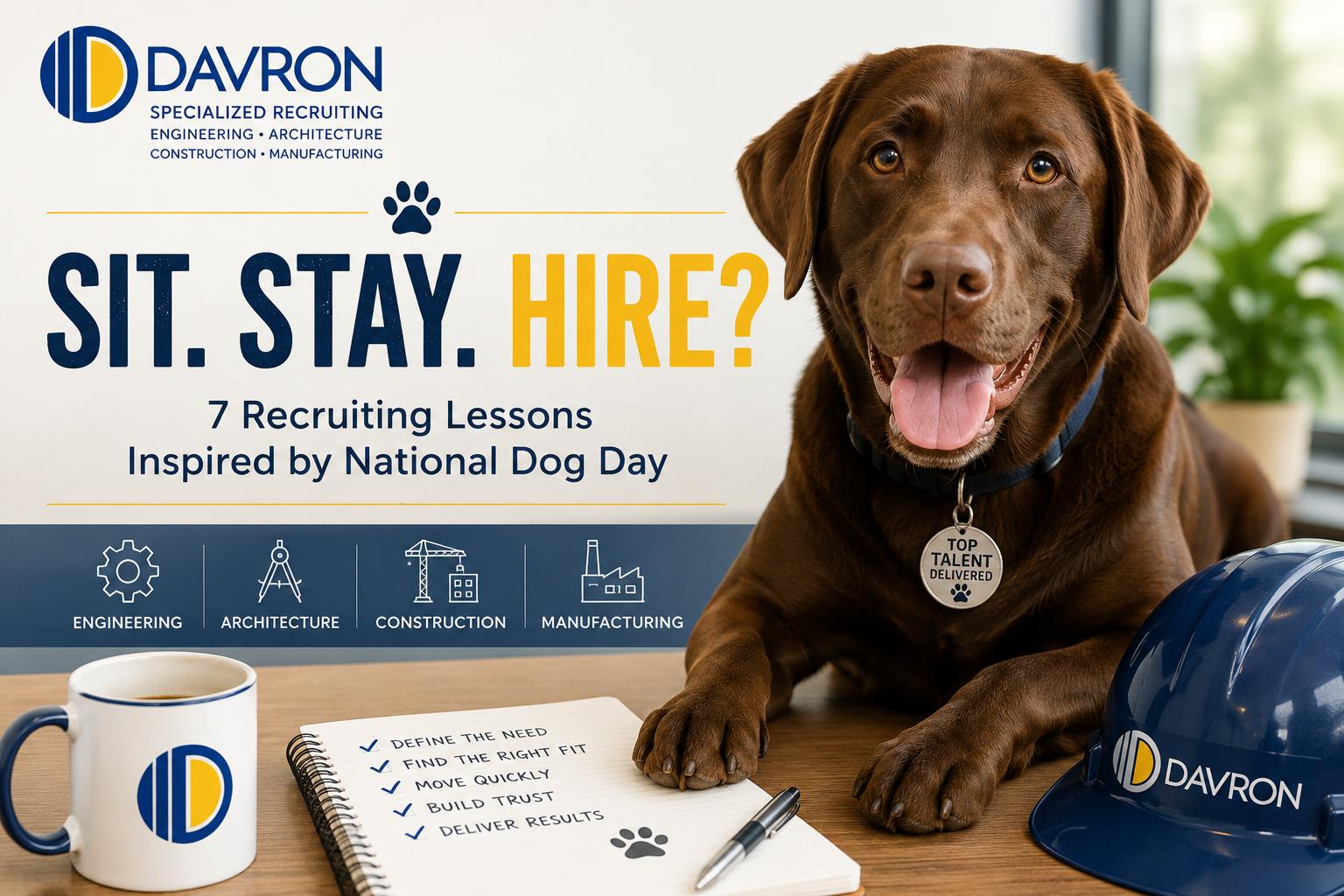
National Dog Day is a good excuse to celebrate loyal companions, but it also offers a surprisingly useful way to think about recruiting.
Finding the right dog starts with understanding what will actually fit your household, lifestyle, and expectations. Hiring isn’t so different. Employers need to know what they really need, recognize a good match when they see one, establish trust, and be prepared to act.
The stakes, of course, are considerably different.
When a mechanical engineer, construction superintendent, architect, manufacturing engineer, or other critical professional is missing from a team, the vacancy can affect project schedules, production, workloads, customer commitments, and business performance. Employers may need someone quickly—but rushing into the wrong hire can create an entirely new set of problems.
So, in honor of National Dog Day, here are seven recruiting lessons employers can put to work immediately.
1. Know What You're Looking For Before You Start the Search
Someone looking for a dog probably wouldn’t begin with, “I’ll take any dog.”
They would think about their living situation, activity level, family, available space, and what characteristics would make for a good long-term match.
Employers should bring the same clarity to recruiting.
Before posting a position or contacting candidates, determine what the business actually needs. Separate the qualifications required to perform the job from the preferences that simply make a job description look more complete.
Ask:
- What does this person need to accomplish in the first six to twelve months?
- Which technical skills are truly essential?
- What experience is necessary on day one?
- Which requirements can be learned after hiring?
- What kind of projects, products, clients, or environments will this person encounter?
- Why would a qualified professional want this opportunity?
This becomes particularly important in technical recruiting.
A company searching for a mechanical engineer, for example, may need much more than someone with “five years of mechanical engineering experience.” The real requirement could involve a specific type of equipment, industry, design environment, software, client interaction, or project responsibility.
The clearer the target, the more focused the search can become.
2. Don't Judge the Entire Candidate by the Résumé
A photo and a short description won’t tell you everything about a dog’s personality.
A résumé won’t tell you everything about a candidate, either.
Résumés are valuable screening tools, but employers can miss potentially strong candidates when they rely too heavily on exact job titles, keywords, or rigid career patterns.
Instead, look for evidence.
What has the candidate actually accomplished? What kinds of problems have they solved? How closely does their experience resemble the work your company needs completed? Have they progressed in responsibility? Can they explain their work clearly?
This matters in specialized technical hiring because two candidates with similar titles can have dramatically different experience.
Likewise, a candidate whose résumé isn’t an exact keyword match may have highly transferable experience that becomes obvious during a knowledgeable screening conversation.
Use the résumé to begin the evaluation—not necessarily to end it.
3. The Right Fit Matters More Than the Longest List of Qualifications
More qualifications do not automatically equal a better hire.
The strongest candidate is the person whose capabilities align with what the employer actually needs.
Imagine two candidates for the same technical position. One has an impressive list of credentials but limited experience with the employer’s type of projects. The other may have fewer credentials on paper but has repeatedly performed work that closely resembles what the new position requires.
Which candidate is stronger?
That depends on the job.
Employers should evaluate relevant project experience, technical environment, responsibilities, leadership expectations, communication demands, team structure, and business needs—not simply count years of experience or résumé keywords.
This is another reason defining the position before beginning the search matters so much. You cannot accurately evaluate “fit” if nobody agrees on what a good fit looks like.
4. Good Candidates Won't Wait Forever
This is where “stay” becomes questionable recruiting advice.
When a qualified candidate is interested in your position, unnecessary delays can become expensive.
Strong professionals may be speaking with several employers simultaneously. A company that takes days to schedule each interview, waits another week to collect feedback, and then sends an offer through multiple layers of approval can lose a candidate it was fully prepared to hire.
Speed does not mean abandoning due diligence.
It means removing delays that add no value.
Employers can accelerate hiring by establishing decision-makers before interviews begin, consolidating interview stages where practical, providing prompt feedback, eliminating unnecessary approval bottlenecks, communicating clearly with candidates, and preparing compensation parameters in advance.
Most importantly, know what happens when the right candidate appears.
If every stakeholder agrees that a candidate meets the requirements, what is preventing the company from moving forward?
For a business-critical vacancy, that question matters. Every additional week can mean more work redistributed across an already busy team, slower project execution, delayed production, or managers spending valuable time compensating for missing expertise.
When you find a genuinely strong match, be prepared to move.
5. Trust Has to Be Earned
Good recruiting is a two-way evaluation.
Employers are deciding whether they want the candidate, but the candidate is also deciding whether to trust the employer with the next stage of their career.
That makes candidate experience more than a courtesy.
Be transparent about the responsibilities of the position. Explain expectations clearly. Communicate what the interview process involves. Follow up when you say you will. If the timeline changes, tell the candidate.
And avoid overselling the opportunity.
Qualified professionals usually appreciate a realistic picture of a position more than a polished pitch that leaves out its challenges.
Trust established during recruiting can make it easier for candidates to evaluate an offer confidently—and can help both sides determine whether the opportunity truly makes sense.
6. Training Matters, but So Does Starting With the Right Match
Employers sometimes create an impossible candidate profile by treating every desirable qualification as mandatory.
Other times, they make the opposite mistake and underestimate how much specialized experience the position requires.
The better approach is to separate must-have qualifications from can-learn qualifications.
A capable engineer may be able to learn a new software package. A strong project manager may adapt to a different internal reporting system. An experienced manufacturing professional may be able to learn a company’s particular processes.
But certain project-critical responsibilities may require experience from day one.
The question is not whether training is good or bad. It is where the employer can realistically train without putting projects, quality, safety, production, clients, or schedules at unnecessary risk.
Being flexible about trainable skills can expand the candidate pool considerably. Being disciplined about genuinely essential skills helps protect the quality of the hire.
7. Sometimes You Need Help Finding the Right One
Employers have several ways to recruit.
They can advertise the position, ask employees for referrals, search professional networks, contact previous candidates, recruit directly, or use an outside recruiting partner.
For many positions, those approaches can work well.
But the equation changes when a position is specialized, difficult to fill, confidential, or urgently affecting the business.
An employer may post a job and discover that the applicants don’t have the necessary technical background. Internal recruiters may already be managing numerous openings. Hiring managers may know exactly who they need but have little time to spend sourcing and screening candidates.
That’s where specialized recruiting can become another valuable search channel.
DAVRON focuses specifically on recruiting and staffing for engineering, architecture, construction, and manufacturing employers.
That specialization matters when an employer needs to find professionals for technical and hard-to-fill positions. Rather than approaching the assignment as a general staffing search, a specialized recruiter can focus the process around the role, relevant industry experience, employer requirements, and the realities of the candidate market.
And when the vacancy is urgent, employers do not necessarily need to choose between their existing recruiting efforts and outside help.
They can continue accepting applications and referrals while a specialized recruiting partner works another channel simultaneously.
If an open engineering, architecture, construction, or manufacturing position is beginning to affect project delivery, production, operations, or workload, bringing DAVRON into the search gives the employer another way to pursue qualified candidates without simply waiting for the right applicant to appear.
The Best Recruiting Lesson? Know When You've Found the Right Match.
National Dog Day may provide the theme, but the underlying hiring lessons are serious.
Know what you need before beginning the search. Look beyond surface-level qualifications. Distinguish essential skills from trainable ones. Treat candidates with transparency and respect. And when a qualified candidate appears, don’t let an unnecessarily slow process cost you the hire.
Most importantly, recognize when the search itself needs additional resources.
For employers hiring technical professionals, especially for difficult or business-critical positions, specialized recruiting can provide another path to the people they need.
Sometimes the smartest recruiting command isn’t “sit” or “stay.”
It’s go.