
An engineering position that stays vacant for weeks or months can become much more than a recruiting problem.
Projects can slow down. Existing engineers may absorb additional work. Production or design capacity can suffer. Client commitments can become harder to meet. And when the position is critical to operations, the cost of waiting for the right candidate can continue to grow.
If your normal hiring process is not producing qualified engineers quickly enough, you have several options: increase internal sourcing, activate employee referrals, reconsider compensation, broaden geographic requirements, reach out to passive candidates, or add a specialized engineering recruitment agency to your search.
You do not necessarily have to choose between internal recruiting and an outside recruiter. When a position is difficult or urgent, a specialized agency can give your existing hiring team another channel for finding qualified candidates.
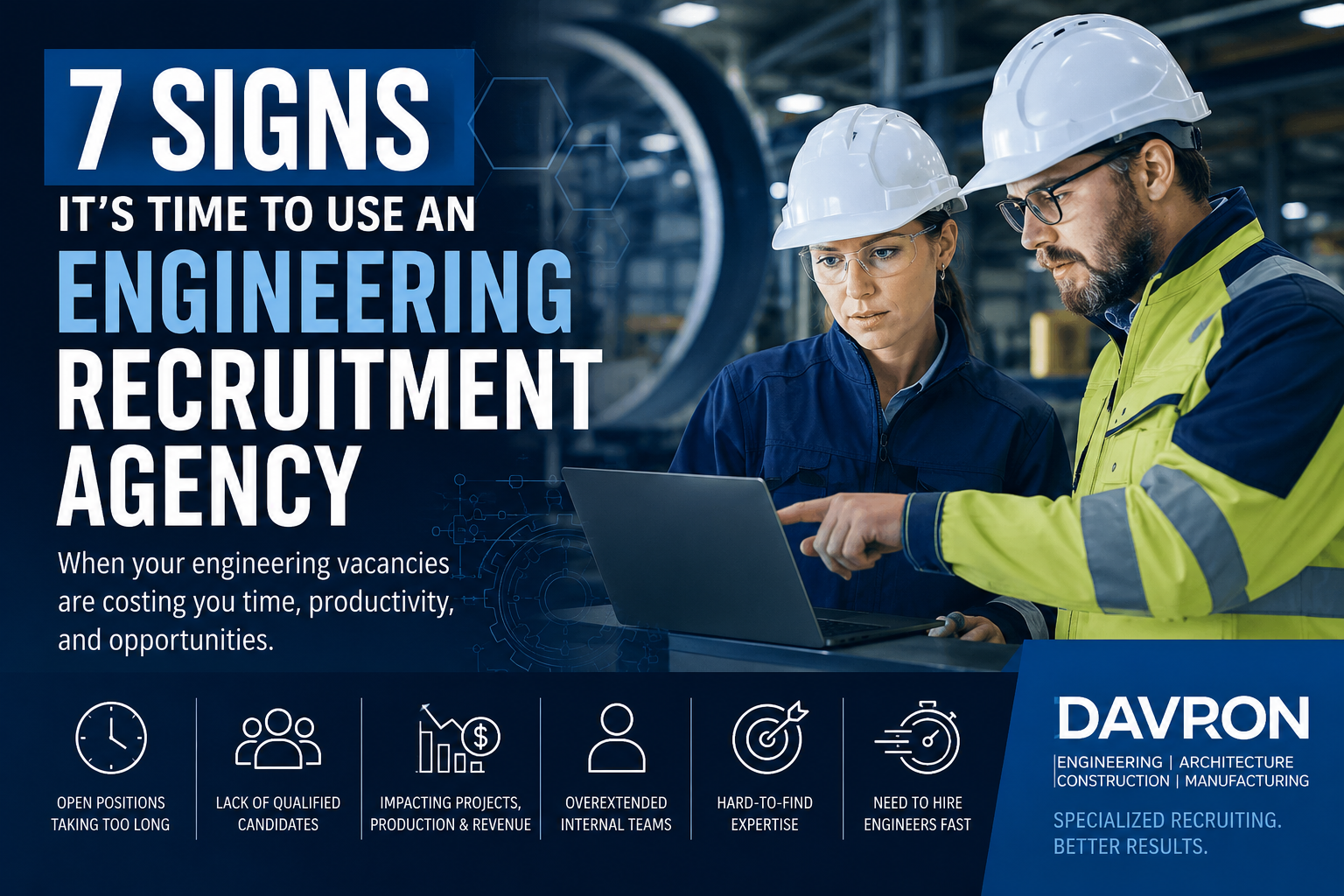
Here are seven signs that it may be time to make that move.
1. The Engineering Position Has Been Open Too Long
A difficult engineering search does not automatically require a recruitment agency. But when weeks of job postings, sourcing, referrals, and interviews fail to produce the right hire, repeating the same process may not change the outcome.
The more important question is what the vacancy is doing to the business.
Is engineering work accumulating? Are other employees taking on responsibilities outside their normal workload? Are projects waiting for technical expertise or approvals? Are managers spending significant time recruiting instead of managing their teams?
At some point, time-to-fill stops being an HR metric and becomes an operational concern.
If your team has already exhausted the obvious candidate sources, a specialized engineering recruiter can expand the search rather than simply reposting the position and waiting for different applicants.
2. You’re Getting Applicants, but Not Qualified Engineers
A large applicant pool can create the impression that recruiting is working—even when very few applicants actually meet the requirements.
Engineering positions often depend on specific combinations of experience.
An employer may need a mechanical engineer with experience in a particular manufacturing environment, an electrical engineer familiar with specific systems, or a civil engineer with the right project background and technical capabilities.
The narrower that combination becomes, the less useful raw application volume can be.
Your hiring team may end up spending hours reviewing resumes from candidates who lack essential qualifications.
This is where specialized recruiting can make a practical difference.
Instead of concentrating primarily on generating applications, a recruiter can build the search around the actual requirements of the position, proactively identify potential candidates, and conduct initial screening before candidates reach the employer.
The objective is not simply more resumes. It is a stronger pipeline of candidates relevant to the position.
3. Your Best Candidates Aren’t Actively Applying
Job postings primarily reach people who are actively looking—or at least actively browsing opportunities.
But some of the engineers your company would most like to hire may already be employed.
They may be performing well, reasonably satisfied with their current positions, and not spending their evenings searching job boards. That does not necessarily mean they would reject a compelling career opportunity.
It means someone may need to reach them.
This is one of the important distinctions between posting a vacancy and actively recruiting for one.
A specialized engineering recruiter can conduct targeted outreach to professionals whose experience appears aligned with the employer’s requirements, including candidates who may never have discovered or applied to the job independently.
For hard-to-fill engineering roles, expanding the search beyond active applicants can significantly change the available candidate pool.
4. The Vacancy Is Starting to Affect Projects, Production, or Revenue
This is one of the clearest signals that the hiring strategy needs to change.
Consider what is happening while the position remains unfilled.
A missing engineer may mean:
- Projects have fewer technical resources available.
- Existing employees are working additional hours.
- Engineering managers are covering responsibilities themselves.
- Design or production work is moving more slowly.
- Important deliverables are being pushed back.
- The company has less capacity to accept or execute additional work.
- Other employees are becoming frustrated by the additional workload.
The exact consequences depend on the role and the organization. But employers should evaluate vacancy costs just as seriously as recruiting costs.
Suppose an employer hesitates to use a recruitment agency because of the fee. That cost should not be evaluated in isolation.
The better comparison is:
What does recruiting assistance cost versus what could another month or two without this engineer cost the business?
For a noncritical position with a strong internal candidate pipeline, waiting may be reasonable.
For a project-critical engineering position that is already affecting execution, accelerating the search may be considerably more valuable.
5. Your Internal HR or Recruiting Team Is Stretched Thin
Using an engineering recruitment agency does not mean your internal recruiting team has failed.
Often, the opposite is true: the internal team simply has too much to cover.
An HR department may simultaneously be responsible for recruiting across operations, accounting, sales, administration, production, management, and technical departments. A recruiter supporting dozens of different positions cannot always devote substantial sourcing time to one unusually difficult engineering search.
Technical recruiting can require considerable effort.
There is the initial search, candidate identification, outreach, follow-up, qualification, scheduling, candidate communication, and continued sourcing when the first group does not produce a hire.
A specialized recruiter can provide additional recruiting capacity while the internal team continues handling its other responsibilities.
That makes the agency an extension of the existing hiring process rather than a replacement for HR.
For employers that have a capable internal team but one particularly difficult vacancy, this hybrid approach can be especially practical.
6. You Need Specialized or Hard-to-Find Engineering Experience
Not every engineering search has the same degree of difficulty.
The challenge increases when an employer needs a narrow combination of technical expertise, industry experience, software proficiency, certifications, project background, leadership capabilities, or geographic availability.
That can apply across positions such as:
- Mechanical engineers
- Civil engineers
- Electrical engineers
- Structural engineers
- Manufacturing engineers
- Controls engineers
- Project engineers
- Other specialized technical professionals
The more requirements that must overlap in a single candidate, the smaller the realistic candidate pool may become.
This is where recruiter specialization matters.
A broad staffing company may recruit across dozens of unrelated industries and occupations. A specialized technical recruiter operates with a narrower focus and can build its recruiting process around the types of positions technical employers actually need to fill.
DAVRON specializes in recruiting and staffing for engineering, architecture, construction, and manufacturing. That focus is particularly relevant when an employer is looking for technical talent rather than general staffing support.
7. You Need to Hire an Engineer Quickly
Urgency creates a difficult balancing act.
You need someone quickly, but you cannot afford to make a poor hire simply because the position is open.
Reducing hiring standards is rarely the best answer. Instead, employers should look for ways to remove unnecessary delays and increase recruiting reach.
If you need an engineer as soon as possible, consider several actions at the same time:
Identify true must-have qualifications. Separate requirements that are genuinely essential from preferences that can unnecessarily eliminate otherwise strong candidates.
Accelerate interview scheduling. If a qualified candidate must wait a week or more between every stage, the hiring process itself can become an obstacle.
Review compensation and the overall opportunity. If qualified candidates repeatedly decline or withdraw, determine whether the offer is aligned with the experience you are requesting.
Expand the geographic search when practical. Depending on the role and employer, relocation or broader geographic targeting may increase the candidate pool.
Activate referrals and professional networks. Employees and industry contacts can provide another source of qualified prospects.
Add a specialized engineering recruiter. You can continue your internal search while an outside recruiter simultaneously works to identify and engage additional candidates.
For urgent technical hiring, parallel recruiting efforts can be more useful than waiting for one sourcing method to succeed before trying another.
DAVRON can support employers that need additional recruiting reach for engineering and other technical positions while their internal hiring efforts continue.
How an Engineering Recruitment Agency Changes the Search
Hiring an agency should do more than add another copy of your job advertisement to the internet.
The value of specialized recruiting is in changing how candidates are identified, approached, evaluated, and moved through the hiring process.
Depending on the search, an engineering recruitment agency can help with:
Targeted candidate sourcing: Searching specifically for professionals whose backgrounds align with the employer’s requirements.
Passive candidate outreach: Contacting potential candidates who may not be actively applying for jobs.
Initial qualification: Reviewing experience against the requirements of the position before presenting a candidate to the employer.
Reducing irrelevant resume volume: Giving the hiring team a more focused candidate pipeline rather than simply increasing applications.
Candidate communication: Maintaining contact with candidates and helping keep the recruiting process moving.
Interview coordination and follow-up: Reducing unnecessary delays between candidate interest, employer interviews, feedback, and hiring decisions.
The employer still controls the hiring decision. The recruiter provides additional sourcing capacity, candidate access, and recruiting support.
Should You Use an Engineering Recruitment Agency or Keep Hiring Internally?
The right answer depends on the position and your current recruiting capabilities.
Internal recruiting may be sufficient when you have a healthy pipeline of qualified candidates, enough recruiting resources to actively source the position, reasonable time to make the hire, and a history of successfully filling similar roles.
Outside recruiting becomes more compelling when the situation changes.
If the position has remained vacant despite sustained effort, the candidate requirements are unusually narrow, qualified applicants are scarce, your internal team has limited sourcing capacity, or the vacancy is beginning to affect business performance, it may be time to expand the search.
And it does not need to be an either/or decision.
Your HR team can continue recruiting while an engineering recruitment agency works alongside it. This approach gives the employer another path to candidates without abandoning the recruiting resources already in place.
Why Specialization Matters When Choosing an Engineering Recruiter
If you decide to use an agency, do not evaluate recruiters solely by company size or the number of industries listed on their website.
Start with relevance.
Ask whether the recruiting firm regularly works with the kinds of technical positions your organization needs to fill. Consider whether the recruiter understands the requirements well enough to conduct a focused search and communicate effectively with potential candidates.
Employers should also evaluate:
- The firm’s industry focus
- Experience recruiting technical professionals
- How candidates are sourced and screened
- Recruiter responsiveness
- Communication throughout the search
- Understanding of the employer’s actual hiring requirements
- The overall recruiting process
DAVRON is specifically focused on engineering, architecture, construction, and manufacturing recruiting and staffing. Rather than functioning as a generalist staffing provider for every occupation, DAVRON’s niche is aligned with employers seeking specialized technical professionals.
That specialization can be particularly valuable when the role is difficult to fill, the requirements are narrow, or the employer cannot afford to rely exclusively on incoming applications.
Frequently Asked Questions
When should I hire an engineering recruitment agency?
Consider using an engineering recruitment agency when a critical position has remained open too long, you are struggling to attract qualified applicants, the candidates you need are difficult to find, internal recruiting resources are limited, or the vacancy is beginning to affect projects, productivity, or operations.
Can I use a recruitment agency while my internal HR team is still searching?
Yes. Employers do not necessarily need to replace internal recruiting with an agency. A specialized recruiter can supplement the internal search by providing additional sourcing, outreach, screening, and candidate access.
Can engineering recruiters find passive candidates?
Targeted outreach to professionals who are not actively applying is an important part of specialized recruiting. This can expand the search beyond candidates who happen to see and respond to a job advertisement.
Is an engineering recruitment agency worth the fee?
That depends on the position, recruiting difficulty, and business impact of leaving the job vacant. Employers should compare the recruiting cost with the potential cost of an extended vacancy, including lost capacity, project delays, additional workload, management time, and other operational consequences.
How can I speed up hiring for a critical engineering position?
Start by defining true must-have qualifications, shortening unnecessary delays between interviews, reviewing compensation, expanding sourcing channels, considering a broader geographic search where appropriate, and proactively contacting candidates. If the internal pipeline remains weak, adding a specialized engineering recruiter can provide another sourcing channel immediately.
What should I look for in an engineering recruiting firm?
Look for relevant technical recruiting experience, specialization aligned with your hiring needs, a clear sourcing and screening process, responsiveness, and an ability to understand the actual requirements of the position. For specialized engineering searches, relevant niche expertise may be more useful than choosing a broad generalist agency solely because of its size.
When the Warning Signs Are Already There, Change the Search
Employers do not need to wait until an engineering vacancy becomes a crisis before expanding their recruiting strategy.
If the position has been open too long, applications are not producing qualified candidates, the people you want are not actively applying, or the vacancy is affecting business performance, those are signals that continuing the same search may simply produce more of the same results.
The objective is not to outsource hiring for the sake of outsourcing it.
It is to give the business a better path to the qualified technical professional it needs.
For employers struggling with difficult or urgent engineering, architecture, construction, or manufacturing positions, DAVRON provides specialized recruiting support focused on those industries.