
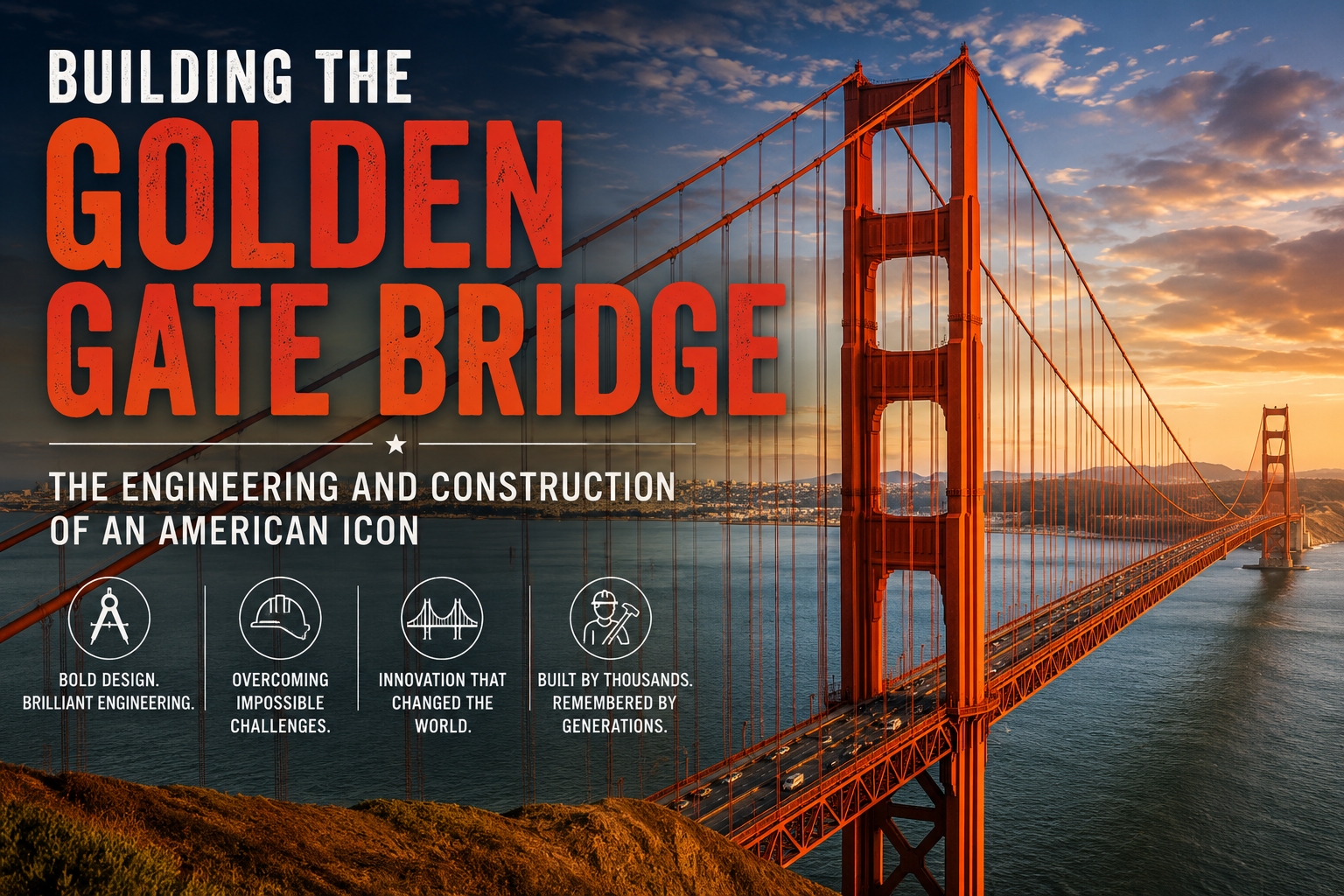
The Golden Gate Bridge is more than one of America’s most recognizable landmarks—it is one of the greatest engineering accomplishments in modern history. Completed in 1937 after just over four years of construction, the bridge overcame enormous technical, environmental, and financial challenges to span one of the world’s most dangerous waterways.
At the time of its completion, it was the longest suspension bridge in the world, stretching across the Golden Gate Strait between San Francisco and Marin County. Nearly 90 years later, it remains an enduring symbol of engineering innovation, architectural beauty, and human determination.
Why the Bridge Was Needed
Before the bridge existed, the only practical way to travel between San Francisco and Marin County was by ferry. While ferries transported thousands of passengers daily, increasing population growth and automobile ownership created mounting transportation challenges.
Business leaders envisioned a permanent crossing that would:
- Improve regional commerce
- Shorten travel times
- Support military transportation
- Connect Northern California communities
- Encourage economic development
Many experts believed such a bridge was impossible due to the harsh conditions of the Golden Gate Strait.
Why the Golden Gate Was Considered Impossible
Several natural obstacles made the location one of the most difficult bridge sites ever attempted.
Strong Ocean Currents
The Golden Gate is the narrow opening connecting San Francisco Bay with the Pacific Ocean. Massive tidal exchanges generate currents exceeding seven miles per hour.
These currents complicated underwater construction and made working from barges extremely dangerous.
Deep Water
The bridge’s south tower required construction in approximately 110 feet of water while exposed to powerful waves and changing tides.
Heavy Fog
Dense fog frequently reduced visibility to only a few hundred feet, complicating navigation and construction.
Powerful Winds
Wind speeds often exceeded 60 miles per hour.
Designers needed a structure flexible enough to withstand constant movement without sacrificing strength.
Earthquake Risk
California’s seismic activity required engineers to consider earthquake forces decades before modern seismic engineering standards existed.
Planning the Bridge
The bridge was the vision of engineer Joseph B. Strauss, who spent years promoting the project despite widespread skepticism.
While Strauss became the public face of the project, several other brilliant engineers played equally important roles.
Leon Moisseiff
Developed many of the suspension bridge concepts that made the final design possible.
Charles Alton Ellis
Performed thousands of pages of structural calculations that ensured the bridge’s safety.
Although Ellis was dismissed before completion due to disagreements with Strauss, historians now recognize his work as fundamental to the bridge’s success.
Irving Morrow
Designed many of the bridge’s architectural features, including:
- Art Deco detailing
- Lighting systems
- Tower appearance
- The famous International Orange paint color
Financing During the Great Depression
The estimated project cost approached $35 million, an enormous sum during the Great Depression.
Local counties approved bonds to finance construction.
Initially, investors refused to purchase the bonds because of economic uncertainty.
Bank of America founder Amadeo Giannini stepped forward and purchased the bonds, allowing construction to proceed.
Groundbreaking began on January 5, 1933.
Why Engineers Chose a Suspension Bridge
Several bridge types were considered.
A suspension bridge offered significant advantages:
- Long uninterrupted span
- Minimal obstruction to ship traffic
- Ability to flex in strong winds
- Reduced number of foundations
- Elegant appearance
The final design featured a main span measuring 4,200 feet (1,280 meters)—the longest in the world at the time.
Building the Foundations
The bridge’s massive towers required enormous foundations anchored directly into bedrock.
South Tower
Workers built a giant fender around the construction site to protect against waves and ship impacts.
Divers and construction crews worked under dangerous conditions to excavate the foundation.
North Tower
Construction proved somewhat easier because bedrock was closer to the surface.
Once complete, each tower foundation supported hundreds of thousands of tons of structural steel.
Constructing the Towers
Each steel tower rose 746 feet (227 meters) above the water.
Millions of rivets connected thousands of fabricated steel sections.
Construction crews climbed progressively higher while battling:
- Wind
- Rain
- Fog
- Cold temperatures
Despite the challenging conditions, tower construction progressed remarkably quickly.
Spinning the Main Cables
The bridge’s two main suspension cables remain among its most impressive engineering features.
Each cable measures approximately 36 inches (0.92 meters) in diameter.
Instead of installing completed cables, engineers spun them in place using thousands of individual steel wires.
Cable Facts
- Two main cables
- Approximately 80,000 miles of wire
- Over 27,000 individual wires in each cable
- Wire wrapped tightly to create immense strength
If laid end to end, the cable wire could circle the Earth more than three times.
Hanging the Roadway
Once the main cables were complete, vertical suspenders were attached.
Steel roadway sections were lifted into position using cranes and temporary supports.
As each section was installed, engineers carefully balanced the weight across the bridge.
The completed roadway stretches approximately 1.7 miles (2.7 kilometers) between anchorages.
Revolutionary Construction Safety
Perhaps the project’s greatest innovation wasn’t structural—it was worker safety.
Prior to the Golden Gate Bridge, falls from great heights almost always proved fatal.
Strauss insisted on installing a giant safety net beneath the bridge.
The net saved 19 workers, who became known as the:
“Halfway to Hell Club.”
Although 11 workers ultimately lost their lives during construction—many in a tragic scaffolding collapse near the project’s end—the fatality rate was dramatically lower than similar projects of the era.
The bridge helped establish new expectations for construction safety worldwide.
Engineering Statistics
| Feature |
|---|
| Construction Start |
| Opening Date |
| Total Length |
| Main Span |
| Tower Height |
| Clearance Above Water |
| Cable Diameter |
| Steel Used |
| Concrete Used |
| Original Cost |
| Measurement |
|---|
| January 5, 1933 |
| May 27, 1937 |
| 8,981 feet (2,737 m) |
| 4,200 feet (1,280 m) |
| 746 feet (227 m) |
| 220 feet (67 m) |
| 36.5 inches |
| Approximately 83,000 tons |
| Over 389,000 cubic yards |
| Approximately $35 million |
Why the Bridge Is Orange
One of the bridge’s defining characteristics is its distinctive International Orange color.
Originally, the steel arrived coated with a reddish-orange primer.
Architect Irving Morrow believed the color offered several advantages:
- Highly visible in fog
- Complemented the surrounding landscape
- Enhanced architectural elegance
- Distinguished the bridge from ordinary industrial structures
Despite proposals to paint it black or gray, International Orange became one of the bridge’s most recognizable features.
Maintaining an Engineering Masterpiece
The Golden Gate Bridge requires continuous maintenance to withstand the harsh marine environment.
Maintenance includes:
- Steel inspections
- Corrosion prevention
- Cable monitoring
- Roadway resurfacing
- Expansion joint replacement
- Structural strengthening
Contrary to popular myth, the bridge is not painted continuously from one end to the other. Instead, maintenance crews repaint sections as needed to control corrosion.
Seismic Upgrades
Following advances in earthquake engineering, major seismic retrofit projects began in the late 20th century.
Upgrades have included:
- Tower reinforcement
- Foundation improvements
- Flexible bearings
- Strengthened connections
- Enhanced energy dissipation systems
These improvements help the bridge withstand significantly stronger earthquakes than originally anticipated.
The Bridge's Lasting Legacy
When it opened in 1937, the Golden Gate Bridge represented the pinnacle of suspension bridge engineering.
Its influence can still be seen in modern long-span bridges worldwide.
Beyond engineering, it has become:
- A National Historic Civil Engineering Landmark
- A symbol of San Francisco
- An icon of American innovation
- One of the world’s most photographed structures
- A testament to the power of collaboration between engineers, architects, and construction workers
Nearly a century after its completion, millions of vehicles cross the bridge each month, while visitors from around the globe continue to marvel at its beauty and engineering excellence.
Frequently Asked Questions
How long did it take to build the Golden Gate Bridge?
Construction began in January 1933 and was completed in April 1937, taking just over four years.
Why was the Golden Gate Bridge painted orange?
The International Orange color improves visibility in fog while complementing the surrounding landscape and architecture.
How were the bridge’s cables made?
Engineers spun thousands of individual steel wires across the towers and bundled them into two massive suspension cables on site.
How many workers built the bridge?
Thousands of laborers, engineers, ironworkers, riveters, electricians, and support personnel contributed throughout construction.
Was the bridge the longest in the world?
Yes. Upon its completion in 1937, the Golden Gate Bridge held the world record for the longest suspension bridge main span.
Why is the bridge still considered an engineering marvel?
Its combination of structural innovation, elegant design, advanced safety measures, and remarkable durability continues to influence bridge engineering around the world.
Ready to hire engineering, architecture, construction, or manufacturing professionals?
DAVRON specializes in delivering high-quality candidates in these industries.