
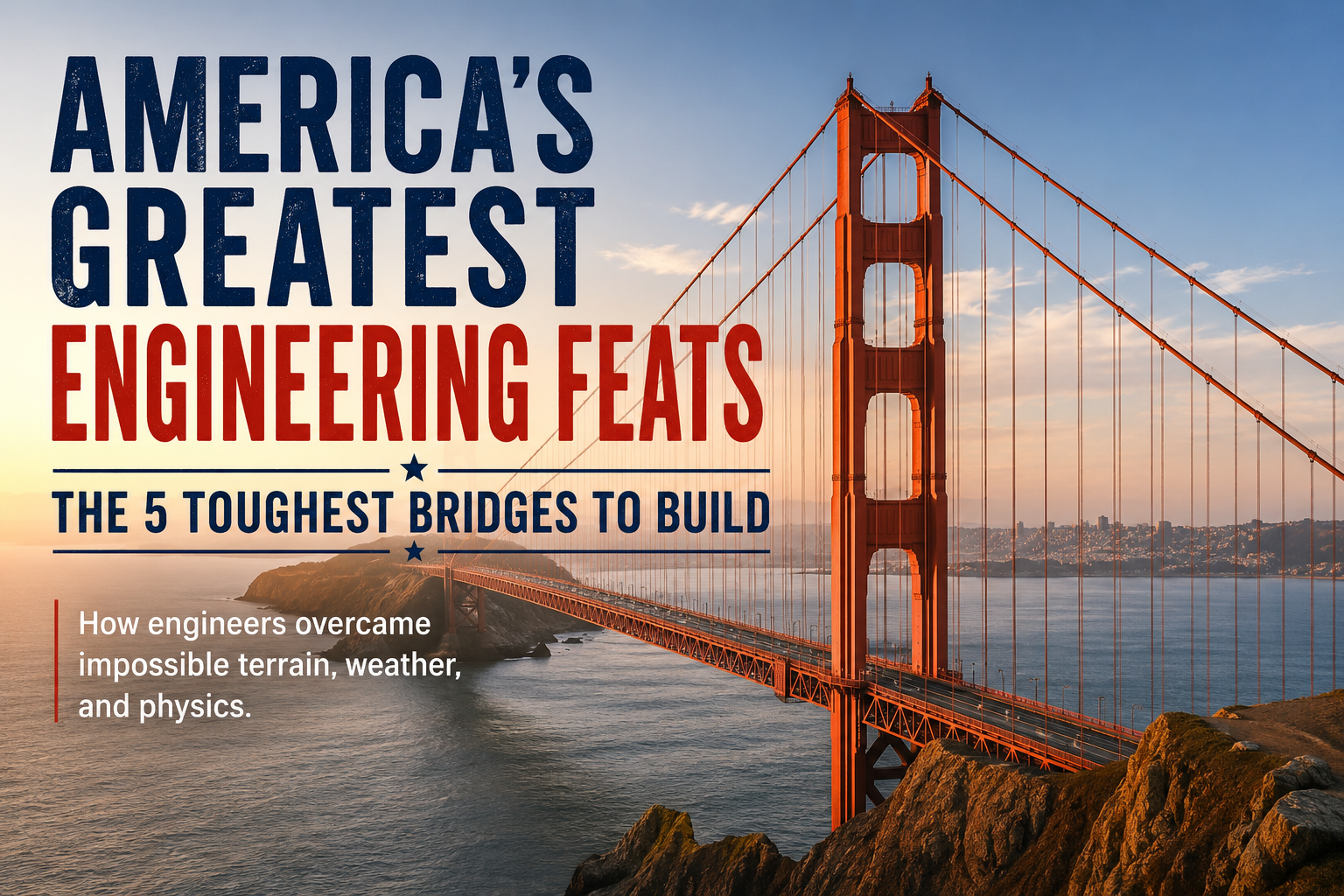
America’s most iconic bridges are more than impressive landmarks—they’re proof that engineers can solve problems that once seemed impossible. From spanning mile-wide straits battered by hurricane-force winds to anchoring foundations in deep, fast-moving rivers, these structures pushed the limits of design, materials, and construction technology.
Each project demanded more than bold ideas. Engineers had to account for geology, weather, aerodynamics, and enormous structural forces while ensuring that millions of people could safely cross for decades to come. The result is a collection of engineering marvels that continue to inspire today’s infrastructure projects and the professionals who build them.
Here are five of America’s toughest bridges to construct—and the remarkable engineering behind each one.
1. Golden Gate Bridge – California
When construction began in 1933, many believed building a bridge across the Golden Gate Strait was impossible.
The site presented nearly every challenge an engineer could imagine. Strong Pacific currents rushed through the narrow opening, dense fog reduced visibility, and winds frequently exceeded 60 miles per hour. The strait itself reaches depths of more than 300 feet, making foundation work exceptionally difficult.
Engineers overcame these obstacles by designing one of the world’s longest suspension bridges at the time. Massive underwater concrete anchorages secured the bridge’s enormous steel cables, while towers rising 746 feet above the water were carefully engineered to withstand both wind and seismic activity.
Construction crews also pioneered new safety practices. Chief engineer Joseph Strauss required the installation of a large safety net beneath the bridge, saving the lives of 19 workers—a revolutionary idea during an era when construction fatalities were often accepted as unavoidable.
Nearly a century later, the Golden Gate Bridge remains one of the world’s most recognizable engineering achievements and a symbol of American innovation.
2. Mackinac Bridge – Michigan
Connecting Michigan’s Upper and Lower Peninsulas required engineers to span one of North America’s most unpredictable waterways.
The Straits of Mackinac combine two Great Lakes, creating powerful currents, thick winter ice, and severe wind conditions. Before the bridge, transportation relied heavily on ferries that frequently shut down during storms and icy weather.
Completed in 1957, the Mackinac Bridge stretches nearly five miles, making it one of the longest suspension bridges in the Western Hemisphere.
One of the greatest engineering challenges involved designing foundations capable of resisting massive ice loads. Engineers constructed enormous concrete caissons that were sunk deep into the lakebed and shaped to break apart moving ice sheets rather than allowing pressure to build against the bridge piers.
The bridge’s flexible design also allows it to move with changing temperatures and strong winds. Drivers can occasionally feel the bridge sway slightly—a feature intentionally built into the structure to safely dissipate wind forces.
More than six decades later, “Mighty Mac” continues to withstand some of the harshest environmental conditions faced by any major American bridge.
3. Royal Gorge Bridge – Colorado
Unlike the others on this list, the Royal Gorge Bridge wasn’t designed primarily for vehicle traffic—it was built to cross one of America’s deepest canyons.
Completed in 1929, the bridge spans the Arkansas River nearly 1,000 feet above the canyon floor. At the time, it was the highest bridge in the world.
The greatest obstacle wasn’t the span itself but the extreme elevation. Every piece of steel, cable, and timber had to be transported to the canyon’s edge and carefully assembled while workers operated hundreds of feet above the river below.
Because there was no practical way to construct traditional falsework from the canyon floor, engineers relied on suspension bridge techniques that allowed the deck to be built from above.
The bridge’s lightweight design reduced structural loads while still providing enough strength to support pedestrian traffic and withstand Colorado’s powerful winds.
Today, the Royal Gorge Bridge remains one of the most breathtaking examples of engineering adapted to difficult terrain.
4. Chesapeake Bay Bridge-Tunnel – Virginia
Few transportation projects have required engineers to solve as many different problems as the Chesapeake Bay Bridge-Tunnel.
Rather than building a traditional bridge across one of America’s busiest shipping channels, engineers created a 17.6-mile system consisting of bridges, artificial islands, tunnels, and causeways.
The greatest challenge was allowing large naval vessels and commercial ships to pass while still providing uninterrupted highway traffic.
The solution was groundbreaking. Engineers built four artificial islands in the bay and connected them with two underwater tunnels beneath major shipping lanes. This hybrid design eliminated the need for extremely tall bridge spans while protecting the roadway from collisions with large vessels.
Construction also required working in open water exposed to hurricanes, heavy seas, and constantly changing tides. Specialized marine equipment, underwater excavation techniques, and prefabricated tunnel sections helped make the ambitious project possible.
The Chesapeake Bay Bridge-Tunnel remains one of the most unique transportation systems ever constructed and is considered a masterpiece of marine engineering.
5. New River Gorge Bridge – West Virginia
When completed in 1977, the New River Gorge Bridge became the world’s longest single-span steel arch bridge.
Crossing the rugged Appalachian landscape posed enormous logistical challenges. The gorge is more than 800 feet deep, making conventional bridge construction methods impractical.
Instead of building upward from the river below, engineers assembled the massive steel arch outward from each side of the canyon. Precision measurements ensured both halves met perfectly in the middle—an extraordinary accomplishment considering temperature changes, wind movement, and the sheer size of the structure.
The completed bridge reduced a 40-minute drive through winding mountain roads to less than one minute, dramatically improving transportation across southern West Virginia.
Today, the bridge is celebrated not only for its engineering excellence but also for its annual Bridge Day event, when thousands gather to admire—and even BASE jump from—the iconic structure.
What Made These Bridges So Difficult?
Although each project faced unique conditions, several engineering challenges appeared repeatedly:
- Extreme weather, including high winds, ice, hurricanes, and dense fog.
- Difficult geology requiring innovative foundation systems.
- Long spans that pushed the limits of structural engineering.
- Complex construction logistics in remote or hazardous environments.
- The need to balance strength, flexibility, and long-term durability.
Advances in structural analysis, high-strength steel, reinforced concrete, cable technology, and computer modeling have made today’s bridge projects safer and more efficient. Yet many of the engineering principles first demonstrated on these landmark structures continue to guide modern infrastructure design.
Engineering Excellence Still Shapes America's Future
America’s greatest bridges remind us that extraordinary infrastructure depends on extraordinary engineers. Whether spanning deep canyons, crossing turbulent waterways, or withstanding earthquakes and hurricanes, these projects succeeded because skilled professionals combined innovation with rigorous engineering principles.
Today’s infrastructure challenges are no less demanding. Aging transportation networks, expanding cities, resilient construction requirements, and major public works projects all require experienced civil, structural, geotechnical, transportation, and construction engineers capable of solving complex problems.
For organizations planning critical infrastructure or engineering projects, having the right talent can be just as important as having the right design.
Ready to hire engineering, architecture, construction, or manufacturing professionals?
DAVRON specializes in delivering high-quality candidates in these industries.