
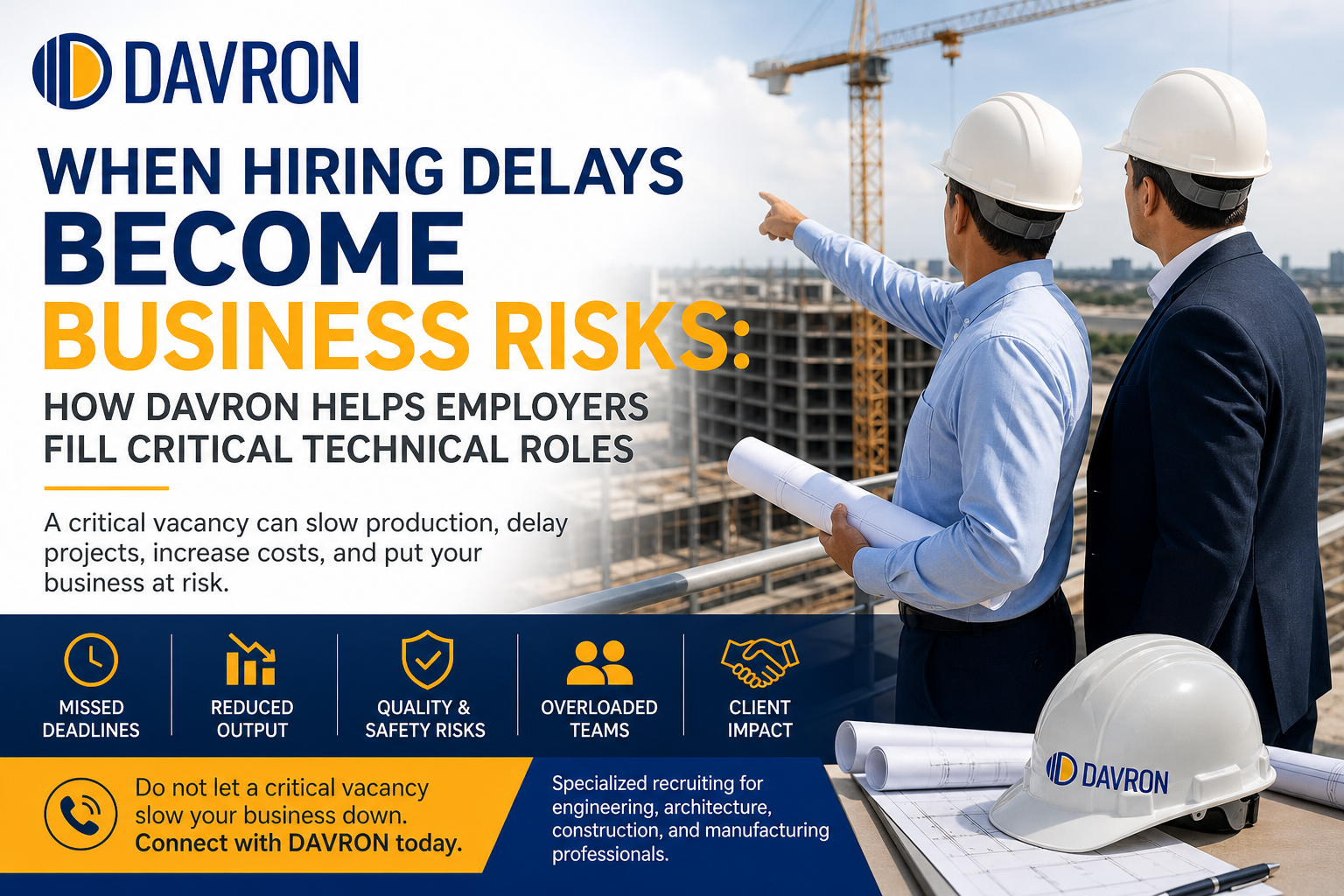
Some vacancies do more than leave a position open. When a critical engineering, architecture, construction, or manufacturing role remains unfilled, the impact can spread quickly across production, project timelines, quality control, safety, client satisfaction, and team performance.
A delayed hire may start as a staffing problem, but it can become an operational problem. Design schedules slow down. Project managers absorb responsibilities that pull them away from execution. Production teams work around missing leadership or technical expertise. Clients wait longer for answers. Existing employees become stretched, frustrated, or burned out.
For employers in technical industries, the cost of waiting can be significant. When the open role is tied directly to project delivery, production output, compliance, estimating, engineering decisions, field execution, or quality assurance, hiring delays can affect the business far beyond the recruiting department.
DAVRON supports employers in these situations by providing specialized recruiting and staffing services for engineering, architecture, construction, and manufacturing roles. For companies that cannot afford slow, unfocused, or misaligned hiring, DAVRON helps bring recruiting focus, industry knowledge, and access to qualified candidates.
When Does a Hiring Delay Become a Business Risk?
Not every vacancy creates immediate business disruption. Some roles can remain open temporarily while the company evaluates its options. But when a position is tied to technical execution, project progress, client delivery, or operational performance, delays can create measurable risk.
A hiring delay may be turning into a business risk when:
The open role is slowing project milestones or production schedules.
Managers are spending too much time covering technical responsibilities instead of leading the business.
Existing employees are overloaded and beginning to make mistakes, miss details, or lose momentum.
Clients are experiencing delayed responses, missed deadlines, or reduced confidence.
Quality issues, rework, or safety concerns are increasing because the right technical oversight is missing.
Revenue-generating work is delayed because the company does not have the people needed to execute.
The team is relying on temporary workarounds that are not sustainable.
In these cases, the vacancy is no longer just an HR issue. It is affecting output, efficiency, risk management, and business performance.
Why Technical Hiring Delays Are Especially Costly
Hiring delays are particularly difficult in engineering, architecture, construction, and manufacturing because many roles require specific technical knowledge, industry experience, certifications, software proficiency, project background, or field expertise.
A vacant engineering role can slow design reviews, calculations, product development, testing, quality improvements, or technical decision-making.
A vacant architecture role can delay drawings, coordination, client deliverables, permitting support, or project documentation.
A vacant construction role can affect scheduling, estimating, field supervision, subcontractor coordination, safety, and project execution.
A vacant manufacturing role can disrupt production, maintenance, quality control, process improvement, and plant efficiency.
These are not roles where employers can always rely on a large pool of immediately available candidates. Many qualified professionals are already employed, selective about opportunities, or difficult to reach through job postings alone. That makes a focused recruiting strategy especially important when the business needs someone quickly.
Roles Where Hiring Delays Can Create Immediate Pressure
Certain positions carry higher operational risk when left open for too long. These roles often sit close to project execution, technical decision-making, production performance, or client delivery.
Examples include:
Engineering managers, mechanical engineers, electrical engineers, civil engineers, structural engineers, manufacturing engineers, quality engineers, and process engineers.
Architects, project architects, architectural designers, CAD technicians, BIM specialists, and design professionals.
Construction project managers, superintendents, estimators, schedulers, safety managers, and field leaders.
Manufacturing supervisors, plant managers, maintenance managers, quality managers, production leaders, and operations professionals.
When these positions are vacant, companies may still be able to operate, but often with more pressure, slower execution, and greater risk. The longer the role remains open, the more likely the company is to experience missed deadlines, overextended teams, or reduced performance.
Why Slow or Misaligned Hiring Makes the Problem Worse
When employers feel pressure to fill a role, it can be tempting to either wait for the right applicant to appear or rush into a decision. Both approaches can create problems.
Waiting too long can allow business disruption to grow. Relying only on job postings may not reach qualified candidates who are already employed or not actively searching. Internal recruiting teams may be stretched across many roles and may not have the technical market focus needed for a specialized search.
At the same time, rushing into the wrong hire can create even greater risk. A poor-fit candidate can cause quality problems, project delays, cultural strain, rework, turnover, and additional hiring costs. Speed matters, but speed without alignment can create a different kind of business risk.
Employers need a hiring process that moves quickly without losing focus on qualifications, fit, technical ability, and long-term value.
How DAVRON Supports Employers Facing Critical Hiring Delays
DAVRON specializes in recruiting and staffing for engineering, architecture, construction, and manufacturing. That specialization matters when employers need candidates who understand technical environments, project demands, production requirements, and industry-specific expectations.
Rather than approaching technical hiring as a generic staffing need, DAVRON focuses on the industries where these roles are most critical. This allows DAVRON to better understand employer requirements, role complexity, candidate expectations, and the consequences of a delayed or misaligned hire.
DAVRON helps employers by:
Identifying qualified candidates for hard-to-fill technical roles.
Supporting searches in engineering, architecture, construction, and manufacturing.
Helping employers move beyond passive job postings.
Providing recruiting focus when internal teams are overloaded.
Connecting employers with live recruiting support.
Helping companies respond quickly when a vacancy is affecting business performance.
For employers dealing with a project-critical or operations-critical vacancy, this specialized focus can make the recruiting process more targeted, efficient, and aligned with the business need.
Practical Steps Employers Can Take When a Vacancy Becomes Urgent
When a critical role is slowing the business down, employers should act quickly but carefully. The goal is not simply to hire fast. The goal is to hire the right person before the delay creates greater operational damage.
A practical response may include:
Clarifying which responsibilities are truly essential for the role.
Separating must-have qualifications from preferred qualifications.
Making sure compensation, location expectations, and work arrangements are aligned with the market.
Reducing unnecessary interview delays.
Preparing decision-makers to move quickly when a strong candidate is identified.
Considering direct hire, contract, or staffing support depending on the business need.
Engaging a specialized recruiter when internal resources are not producing qualified candidates quickly enough.
These steps help employers avoid two common mistakes: waiting too long for a perfect applicant or hiring too quickly without enough confidence in fit.
Do Not Let a Critical Vacancy Slow Your Business Down
A vacant technical role can affect more than headcount. It can slow production, delay designs, weaken project execution, increase pressure on existing teams, and affect client commitments.
When hiring delays begin to create business risk, employers need a focused recruiting strategy and access to candidates who match the technical demands of the role. DAVRON helps employers in engineering, architecture, construction, and manufacturing fill important positions with greater focus and confidence.
Do not let a critical vacancy slow your business down. Connect with DAVRON today.
Ready to hire engineering, architecture, construction, or manufacturing professionals?
DAVRON specializes in delivering high-quality candidates in these industries.