
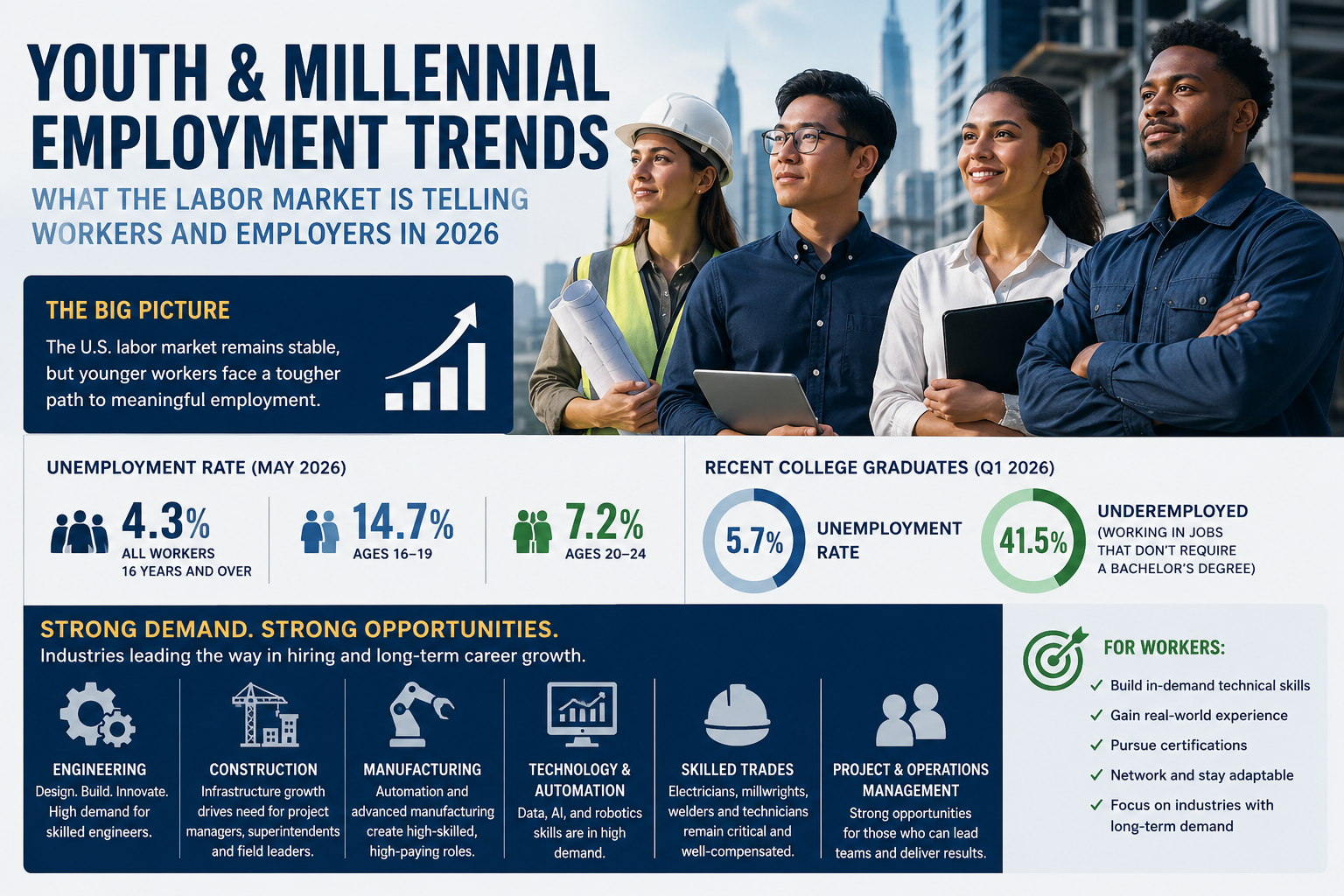
The U.S. labor market remains resilient in 2026, but younger workers are experiencing a noticeably different reality than older professionals. While the national unemployment rate has hovered around 4.3%, unemployment among younger Americans is substantially higher, and many recent college graduates are finding it harder to secure positions that align with their education. At the same time, employers in engineering, construction, manufacturing, and other technical industries continue to report difficulty filling skilled positions.
For employers, these seemingly contradictory trends reveal an important truth: there is no shortage of people looking for work, but there is a shortage of candidates with the right skills, experience, and technical capabilities. Understanding these labor market dynamics is critical for workforce planning, recruiting, and long-term talent development.
Understanding the Age Groups
Several organizations measure employment differently, making it helpful to distinguish between generations and statistical age groups.
Bureau of Labor Statistics (BLS) Youth Categories
- Ages 16–19
- Ages 20–24
- Ages 25 and older
Recent College Graduates
Organizations such as the Federal Reserve Bank of New York generally focus on workers approximately 22–27 years old.
Millennials
As of 2026, millennials are roughly 30 to 45 years old, meaning many are now mid-career professionals rather than entry-level employees. They increasingly occupy leadership, engineering, management, and technical specialist positions.
Employment Trends by Age
Ages 16–19: Entry-Level Jobs Continue to Be Competitive
Teenagers continue to have the highest unemployment rates in the country. Many work in:
- Retail
- Restaurants
- Hospitality
- Recreation
- Seasonal employment
These industries traditionally serve as entry points into the workforce but remain highly sensitive to economic fluctuations and employer scheduling needs.
BLS data indicates unemployment among teenagers remains well above the national average, reflecting both seasonal hiring patterns and the limited experience of younger applicants.
Ages 20–24: A Challenging Transition Into Careers
Workers in their early twenties often face one of the most difficult transitions in the labor market.
Many are:
- Completing college
- Leaving vocational training
- Beginning apprenticeships
- Searching for their first professional position
Although employers continue hiring, many organizations have become more selective with entry-level positions, often preferring candidates who already possess internships, certifications, or hands-on experience.
This has contributed to unemployment rates for workers aged 20–24 that remain significantly above the national average.
Recent College Graduates: A Growing Underemployment Problem
One of the most notable labor market stories of 2026 has been the rise in underemployment among recent graduates.
Underemployment occurs when individuals hold jobs that do not require the education they earned.
Examples include:
- Engineers working in customer service
- Business graduates working retail
- Marketing graduates working hourly administrative positions
- Liberal arts graduates accepting jobs unrelated to their field
According to the Federal Reserve Bank of New York, recent college graduates have experienced elevated unemployment and underemployment compared with historical norms. Approximately 41.5% of recent graduates work in positions that typically do not require a bachelor’s degree.
This does not necessarily indicate that degrees have lost value. Instead, employers increasingly expect graduates to bring practical experience alongside formal education.
Millennials: Moving Into Leadership
Unlike Generation Z workers, millennials are no longer primarily entering the workforce.
Instead, many millennials are:
- Project managers
- Engineering managers
- Manufacturing supervisors
- Construction managers
- Architects
- Technical specialists
- Operations leaders
Millennials now represent much of America’s experienced workforce and increasingly fill leadership positions across technical industries.
As older Baby Boomers retire, millennials continue moving into decision-making roles while simultaneously helping train younger employees entering skilled professions.
Men and Women in Today's Labor Market
Overall labor force participation has continued to improve for both men and women, but employment patterns differ across industries.
Male Employment Trends
Men remain heavily represented in:
- Construction
- Manufacturing
- Skilled trades
- Transportation
- Engineering
- Utilities
- Industrial maintenance
Demand remains particularly strong for workers possessing technical certifications or trade experience.
Female Employment Trends
Women continue to see strong employment growth in:
- Healthcare
- Education
- Finance
- Human Resources
- Project Management
- Professional Services
- Architecture
- Engineering (growing participation)
Women have steadily increased representation in STEM occupations over the past decade, particularly in engineering, architecture, and technical project management, although some engineering specialties remain male-dominated.
Degree Outcomes: Which Fields Continue to Perform Well?
Not all degrees produce the same employment outcomes.
Fields with consistently strong employment prospects include:
- Mechanical Engineering
- Civil Engineering
- Electrical Engineering
- Chemical Engineering
- Industrial Engineering
- Computer Engineering
- Construction Management
- Architecture
- Nursing
- Accounting
- Supply Chain Management
Graduates in these disciplines generally experience lower unemployment and stronger long-term earnings due to sustained employer demand.
Degrees Facing Greater Challenges
Some graduates experience more difficulty finding degree-specific employment, particularly when programs offer fewer direct pathways into specialized careers.
These often include broader majors where career outcomes depend heavily on internships, networking, certifications, or graduate education.
Success remains possible, but graduates typically benefit from developing additional technical or professional skills that employers value.
Technical Industries Continue to Stand Out
One of the strongest employment stories in America continues to be the shortage of skilled technical professionals.
Industries experiencing sustained hiring demand include:
Engineering
Demand remains strong for:
- Mechanical Engineers
- Civil Engineers
- Structural Engineers
- Electrical Engineers
- Controls Engineers
- Manufacturing Engineers
- Process Engineers
Construction
Companies continue hiring:
- Project Managers
- Superintendents
- Estimators
- Field Engineers
- Construction Inspectors
Large infrastructure investments and commercial development continue driving demand.
Manufacturing
Manufacturers continue investing in:
- Automation
- Robotics
- Process Improvement
- Lean Manufacturing
- Quality Engineering
- Maintenance Leadership
Finding experienced professionals in these specialties remains a challenge across many regions.
High-Paying Career Paths
| Career | Typical Salary Potential* |
|---|---|
| Petroleum Engineer | $140,000+ |
| Software Engineer | $120,000+ |
| Electrical Engineer | $110,000+ |
| Mechanical Engineer | $100,000+ |
| Civil Engineer | $95,000+ |
| Construction Manager | $110,000+ |
| Manufacturing Engineering Manager | $140,000+ |
| Industrial Engineer | $100,000+ |
| Automation Engineer | $120,000+ |
| Project Manager (Technical) | $120,000+ |
How Young Workers Can Improve Their Chances of Landing High-Paying Jobs
The strongest candidates today typically combine education with practical experience.
Gain Real-World Experience Early
Internships, co-op programs, apprenticeships, and part-time technical work often distinguish candidates from peers with similar academic credentials.
Build Technical Skills
Employers increasingly value proficiency in industry-standard tools and software, such as:
- AutoCAD
- SolidWorks
- Revit
- PLC programming
- Python
- SQL
- ERP systems
- Project management platforms
Earn Relevant Certifications
Industry-recognized certifications can demonstrate practical competence and commitment to professional growth.
Develop Communication Skills
Technical expertise is essential, but employers also prioritize candidates who can collaborate, present ideas clearly, and work effectively across teams.
Stay Flexible
Being open to relocation, shift work, or emerging industries can expand opportunities and accelerate career growth.
Network with Specialized Recruiters
Recruiters who focus on technical fields often have access to opportunities that are not publicly advertised and can help candidates align their skills with employers’ needs.
What This Means for Employers
The youth labor market presents a paradox. While many young workers are seeking opportunities, employers continue to struggle filling specialized technical positions.
Rather than assuming talent is readily available, employers should:
- streamline hiring processes to reduce delays
- clearly define required skills and career paths
- invest in internships and early-career development programs
- offer competitive compensation and advancement opportunities
- partner with specialized recruiters when hiring for hard-to-fill technical roles
For organizations in engineering, architecture, construction, and manufacturing, the competition is not simply for workers—it is for qualified professionals who can contribute immediately and grow with the business.
Ready to hire engineering, architecture, construction, or manufacturing professionals?
DAVRON specializes in delivering high-quality candidates in these industries.