
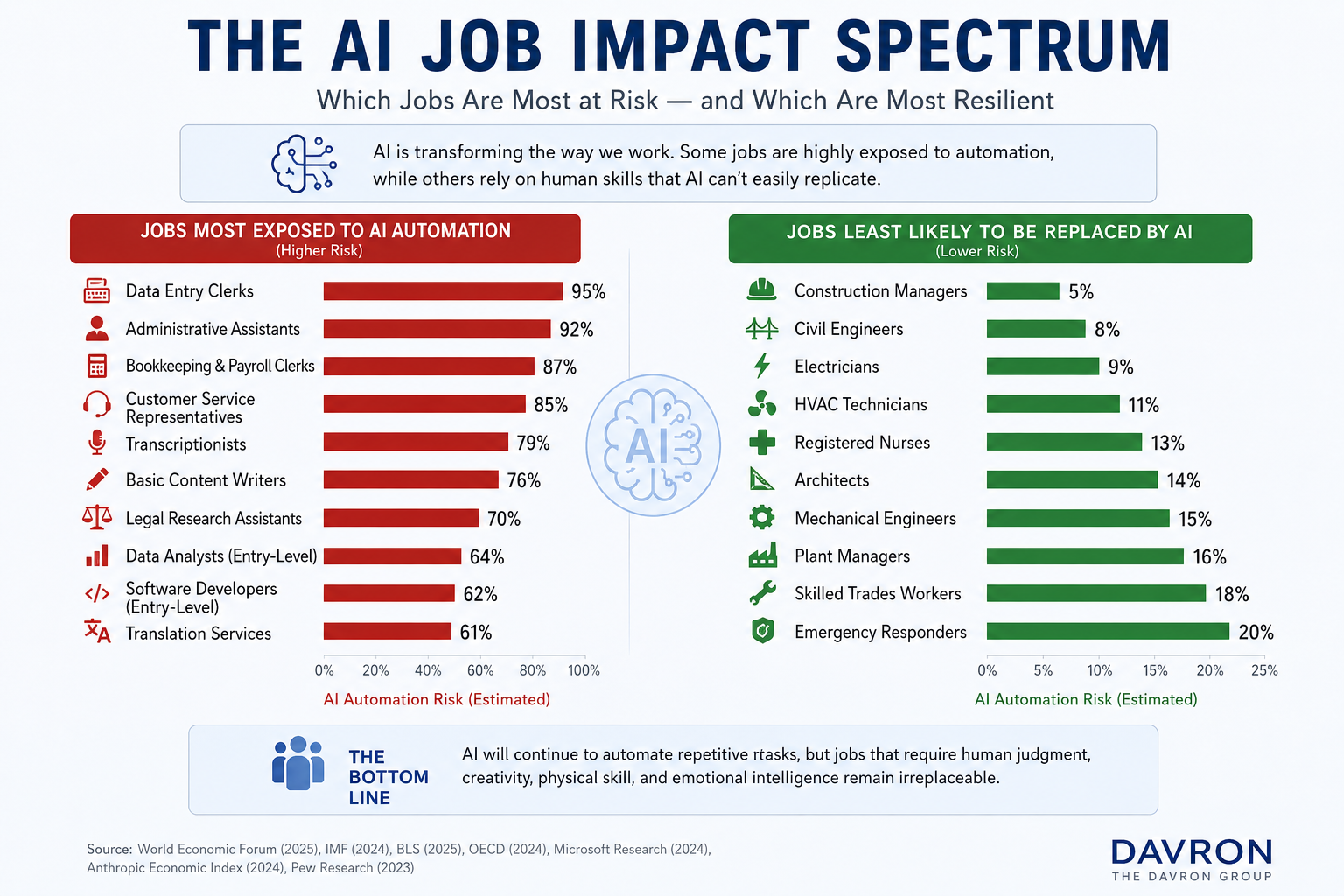
Artificial intelligence has become one of the most talked-about technologies in modern history. Depending on who you ask, AI is either the greatest productivity tool since the internet or an existential threat to millions of jobs. Headlines frequently claim that AI will eliminate hundreds of millions of jobs, while others argue it will create entirely new industries and usher in an era of unprecedented prosperity.
So which is it?
The truth is far more nuanced—and far more interesting.
After reviewing the latest research from the U.S. Bureau of Labor Statistics (BLS), International Monetary Fund (IMF), Organisation for Economic Co-operation and Development (OECD), World Economic Forum (WEF), leading universities, and AI companies themselves, one conclusion becomes clear:
There is currently little hard evidence that AI has caused widespread unemployment. There is overwhelming evidence that AI is changing how people work.
That distinction matters.
For most workers today, AI is not replacing entire occupations—it is replacing specific tasks. An accountant may spend less time reconciling spreadsheets. A software engineer may generate boilerplate code with an AI assistant. A marketing specialist may draft content in minutes instead of hours. A physician may use AI to summarize patient records before an appointment. In these cases, the worker still exists—the workflow simply becomes more efficient.
This task-level transformation is precisely how the U.S. Bureau of Labor Statistics now evaluates AI’s impact. Rather than assuming occupations disappear, BLS analyzes how AI affects the individual tasks within occupations, recognizing that many jobs combine technical expertise, human judgment, communication, creativity, and physical activity—capabilities that AI cannot yet fully replicate.
The Biggest Misunderstanding About AI
One of the largest misconceptions surrounding artificial intelligence is that “AI exposure” means “job loss.”
It does not.
When researchers estimate that AI could affect 40%, 60%, or even more of jobs, they are referring to jobs that contain tasks AI may influence—not jobs that will disappear.
For example, the International Monetary Fund estimates that approximately 40% of jobs globally and about 60% of jobs in advanced economies are exposed to AI in some capacity. However, the IMF emphasizes that exposure includes both positive and negative outcomes. Many workers may become more productive and valuable rather than obsolete.
Similarly, the World Economic Forum projects that generative AI could reshape a substantial share of working hours over the next five years, but it argues the greatest opportunity lies in augmenting workers and increasing productivity, not simply replacing them.
What We Actually Know Today
Several facts are already well supported.
AI excels at routine cognitive work.
Tasks involving predictable writing, summarization, transcription, data classification, customer support, coding assistance, document review, and information retrieval have seen dramatic improvements.
AI struggles with complex real-world execution.
Construction management, field engineering, manufacturing operations, skilled trades, executive leadership, emergency medicine, hands-on maintenance, negotiation, and jobs requiring interpersonal trust remain difficult to automate because they combine physical, social, and contextual intelligence.
The labor market has not experienced an AI-driven collapse.
Despite explosive growth in generative AI since late 2022, the U.S. economy has continued to add jobs overall. The Bureau of Labor Statistics has not identified broad-based AI-driven unemployment across the labor market. Instead, it notes that AI’s effects are expected to vary substantially by occupation and remain uncertain over the coming decade.
Why Predictions Vary So Much
One reason AI forecasts seem contradictory is that experts are often answering different questions.
Some studies ask:
“Which jobs contain tasks AI could perform?”
Others ask:
“Which jobs will actually disappear?”
Those are fundamentally different questions.
Goldman Sachs’ widely cited estimate that generative AI could expose the equivalent of hundreds of millions of full-time jobs globally refers to potential task automation, not guaranteed layoffs. Likewise, IMF estimates describe exposure to AI rather than certain displacement.
History suggests that technological revolutions rarely produce one-for-one substitution. Instead, they tend to:
- Eliminate some tasks.
- Transform many jobs.
- Increase productivity.
- Create entirely new occupations.
- Shift labor demand toward emerging skills.
This pattern occurred during the Industrial Revolution, the mechanization of agriculture, electrification, the rise of computers, and the internet era. AI appears poised to follow a similar—though potentially faster—trajectory.
The Real Question Isn't "Will AI Replace Jobs?"
A more useful question is:
Which parts of each job can AI perform better than humans, and which parts still require people?
Increasingly, economists view occupations as collections of tasks rather than indivisible jobs. AI may automate routine documentation, analysis, or drafting while leaving judgment, collaboration, creativity, leadership, and accountability in human hands. This task-based perspective helps explain why many occupations evolve instead of disappearing outright.
What This Article Will Explore
The rest of this guide separates measurable evidence from speculation.
We’ll examine:
- What the Bureau of Labor Statistics actually says about AI.
- Which occupations are already seeing measurable change.
- Which jobs remain relatively insulated.
- Why engineering, manufacturing, architecture, and construction continue to depend heavily on human expertise despite rapid AI adoption.
- What economists, AI researchers, and technology leaders predict over the next decade.
- Whether mass unemployment is likely—or whether AI will ultimately create more opportunities than it eliminates.
- What governments, businesses, educators, and workers can do to prepare for an AI-driven economy.
The Bottom Line
Artificial intelligence is unquestionably transforming work. It is automating routine tasks, accelerating knowledge work, and changing the skills employers value. Yet the evidence to date does not support the idea that AI has already caused widespread, economy-wide job replacement.
What the Hard Data Says: BLS, IMF, OECD, and the World Economic Forum
One of the biggest challenges in discussing artificial intelligence and employment is separating measured evidence from future projections.
Every week, headlines proclaim that AI will either eliminate millions of jobs or create an economic renaissance. Yet many of those stories blur an important distinction:
- What has already happened
- What researchers believe could happen
- What business leaders think might happen
- What governments are preparing for
The reality is that hard data is still catching up to technological change. AI, particularly generative AI, only entered mainstream business use after the public release of ChatGPT in late 2022. That’s a remarkably short period in labor market terms. The Industrial Revolution unfolded over decades. The personal computer took nearly 20 years to become standard office equipment. Even the internet required more than a decade before fundamentally reshaping employment.
AI is moving faster—but economists still need time to measure its effects.
Fortunately, several of the world’s leading institutions have begun publishing rigorous research. Their findings paint a much more balanced picture than many headlines suggest.
The Bureau of Labor Statistics: AI Is Affecting Jobs, But the Magnitude Is Still Uncertain
The U.S. Bureau of Labor Statistics (BLS) is widely regarded as the nation’s most authoritative source for employment data. If AI were already causing a broad employment collapse, the BLS would likely be among the first agencies to detect it.
Instead, the agency’s message is considerably more measured.
In 2025, the BLS published one of its first comprehensive explanations of how it incorporates AI into employment projections. Rather than attempting to predict sweeping job losses, the agency evaluates AI the same way it evaluates other technologies: by examining how specific technologies change the tasks performed within occupations.
This task-based approach recognizes that occupations are rarely defined by a single activity. A civil engineer, for example, does far more than produce calculations. They communicate with clients, coordinate with architects, interpret regulations, visit job sites, make engineering judgments, and oversee projects. AI may assist with portions of that work, but it cannot replace the entire role.
The BLS therefore avoids simplistic conclusions such as “AI replaces engineers” or “AI replaces lawyers.” Instead, it evaluates where AI can automate portions of an occupation while leaving the broader role intact.
What Occupations Does BLS Expect AI to Affect?
The Bureau identifies occupations that contain tasks especially susceptible to current generative AI capabilities, including roles in:
- Computer and software development
- Legal services
- Financial analysis
- Business operations
- Architecture and engineering
Importantly, inclusion on this list does not mean these occupations are expected to disappear. In fact, many continue to have positive employment projections through 2033. Software developers, civil engineers, electrical engineers, aerospace engineers, and database architects are all examples of occupations that may be significantly influenced by AI while still being projected to grow.
This is one of the article’s most important takeaways:
An occupation can be highly exposed to AI while simultaneously experiencing strong employment growth.
Why BLS Avoids Dramatic Predictions
The Bureau also explains why forecasting AI’s long-term impact is inherently difficult.
Unlike previous technologies with decades of historical data, generative AI is evolving rapidly. Businesses are still determining how to integrate it into workflows, regulations are still developing, and many organizations are experimenting rather than fully deploying AI. Because of these uncertainties, the BLS intentionally avoids embedding speculative large-scale displacement into its official employment projections.
That restraint is significant. It reflects a broader consensus among labor economists that today’s evidence does not yet support precise forecasts of widespread AI-driven unemployment.
The International Monetary Fund: AI Will Affect Many Jobs—Not Necessarily Eliminate Them
The International Monetary Fund (IMF) takes a global perspective, analyzing how AI could reshape labor markets across advanced, emerging, and developing economies.
Its headline findings are often cited in media coverage:
- Approximately 40% of jobs worldwide are exposed to AI.
- In advanced economies, that figure rises to roughly 60% because knowledge-based work is more common.
At first glance, those numbers sound alarming. However, they are frequently misunderstood.
The IMF is measuring exposure, not guaranteed displacement.
An occupation is considered exposed when AI can perform some of its tasks or materially change how the work is done. Exposure may result in:
- Higher productivity.
- Better decision-making.
- Increased wages for some workers.
- Changes in job responsibilities.
- Reduced demand for certain tasks.
- In some cases, job displacement.
The report stresses that AI’s overall effect depends on how businesses deploy the technology and how quickly workers acquire complementary skills. Productivity gains could raise incomes and create new opportunities even as some routine work declines.
The IMF also warns that AI could widen inequality if its benefits accrue mainly to highly skilled workers or owners of AI-driven capital. That makes investments in education, digital infrastructure, and workforce training especially important.
OECD: Focus on Skills, Not Panic
The Organisation for Economic Co-operation and Development (OECD), representing many of the world’s most advanced economies, has adopted a pragmatic approach.
Rather than asking, “Which jobs disappear?” the OECD asks:
How is AI changing the work people actually perform?
Its recent research emphasizes several recurring themes:
- AI is transforming workplace practices.
- New skills are becoming essential.
- Continuous learning will matter more than ever.
- Workers need support adapting to AI-enabled workplaces.
- Governments and employers should invest in reskilling rather than assuming permanent displacement.
The OECD also notes that AI can improve workplace safety, accessibility, and inclusion when implemented thoughtfully. For example, AI-assisted tools may help workers with disabilities perform tasks more effectively or reduce repetitive administrative burdens that consume valuable time.
In other words, the OECD sees AI not only as a source of disruption but also as a tool that can improve job quality if accompanied by the right policies and training.
The World Economic Forum: Massive Change, But Not a Net Loss of Work
Among the most widely cited reports on the future of employment is the World Economic Forum’s Future of Jobs Report 2025, based on surveys of more than 1,000 global employers representing over 14 million workers across 55 economies.
Its findings are striking.
By 2030, employers expect AI, robotics, and related technologies to significantly reshape work. Yet they also anticipate substantial job creation alongside displacement.
The WEF estimates that over the 2025–2030 period:
- Around 170 million new jobs could be created.
- Approximately 92 million existing jobs could be displaced.
- The result would be a net gain of about 78 million jobs globally, assuming these expectations materialize.
That does not mean every worker benefits equally.
Instead, the report envisions significant labor-market churn. Some occupations will shrink, others will expand rapidly, and many workers will need to acquire new skills to remain competitive.
The WEF also identifies AI and information processing as the fastest-growing skill category for the remainder of the decade, alongside cybersecurity and broader technological literacy.
Why the Data Sometimes Appears Contradictory
Readers often wonder why one report predicts millions of displaced jobs while another projects net employment growth.
The answer lies in what each organization is measuring.
Organization | Primary Focus |
BLS | Occupational employment projections and task-level impacts |
IMF | Global exposure to AI and macroeconomic effects |
OECD | Skills, workplace transformation, and policy responses |
World Economic Forum | Employer expectations and workforce planning through 2030 |
These are complementary perspectives rather than conflicting ones.
For example:
- A job can be highly exposed to AI (IMF).
- Continue growing in employment (BLS).
- Require significant reskilling (OECD).
- Look very different by 2030 (WEF).
All four statements can be true simultaneously.
What We Can Say With Confidence Today
Across these leading institutions, several conclusions consistently emerge:
- There is no compelling evidence of economy-wide AI-driven mass unemployment today. The labor market remains dynamic, with employment continuing to evolve rather than collapse.
- AI is changing tasks much faster than it is eliminating occupations. Task automation and job redesign are the dominant trends observed so far.
- Knowledge work is generally more exposed than physical work. Roles centered on information processing, writing, coding assistance, and document analysis face greater AI exposure than occupations requiring hands-on execution, interpersonal leadership, or physical dexterity.
- Future outcomes depend heavily on adoption, policy, education, and worker adaptation. None of the major institutions claims AI’s trajectory is predetermined. The balance between productivity gains and displacement will be shaped by business decisions and public policy over the coming decade.
The Bottom Line
The data does not support either extreme narrative.
AI is neither a harmless novelty nor an unstoppable job-destroying force—at least not based on the evidence available today.
Instead, the world’s leading economic institutions agree on three central ideas:
- AI will transform a very large share of existing jobs.
- Most transformation will occur at the task level before entire occupations disappear.
- The ultimate employment impact will depend on how quickly workers, employers, educators, and governments adapt.
- Which Jobs AI Is Replacing—and Which It Isn’t
The most honest answer is this:
AI is replacing tasks faster than it is replacing entire jobs.
That may sound like a technical distinction, but it is the key to understanding the labor market right now. Most occupations are bundles of different responsibilities. Some are highly automatable. Others still require judgment, physical presence, emotional intelligence, accountability, field experience, leadership, or trust.
A customer service representative may use AI to generate responses. A lawyer may use AI to summarize case law. A software developer may use AI to draft code. An engineer may use AI to accelerate calculations or documentation. But in most cases, the job itself does not vanish immediately. Instead, the worker’s workflow changes.
That is why the Bureau of Labor Statistics evaluates AI through a task-based lens rather than assuming full occupational replacement. BLS specifically notes that generative AI is expected to affect occupations whose core tasks can be replicated by current AI systems, while also emphasizing that many affected occupations still have uncertain or positive employment trajectories.
The clearest pattern: AI affects routine cognitive work first
The jobs most exposed to AI tend to share several characteristics:
They involve large amounts of text, data, documentation, pattern recognition, coding, classification, summarization, or routine communication. These are precisely the areas where generative AI performs well.
That does not mean every worker in these jobs will be replaced. It does mean employers may need fewer people to complete the same volume of repetitive work, or they may expect workers to produce more with AI tools.
Jobs and tasks AI is already replacing or reducing
The strongest evidence of AI substitution appears in specific task categories rather than broad economy-wide layoffs.
- Data entry and routine clerical work
Data entry is one of the clearest examples of work vulnerable to AI. The task is repetitive, rule-based, and often involves moving information from one system or document into another. AI tools can now extract, classify, summarize, and transfer information from forms, emails, PDFs, invoices, spreadsheets, and databases.
That puts pressure on roles built primarily around repetitive information handling.
The risk is not just that AI can perform the task. It is that a single employee using AI may be able to complete work that previously required several clerical workers.
- Basic customer service and scripted support
Customer service is another area where AI is already reducing the need for some human labor, especially in high-volume, low-complexity support environments.
Chatbots and AI voice agents can answer routine questions, reset passwords, process returns, summarize support tickets, and route customers to the right department. Human representatives remain necessary for complex, emotional, high-value, or escalated issues, but the first layer of support is increasingly automated.
Anthropic’s early-warning work has identified customer service representatives as among the occupations with high AI exposure, although current unemployment data has not yet shown a major spike directly tied to AI.
- Transcription, translation, and basic language processin
AI has become very strong at transcription, translation, summarization, and language conversion. That creates pressure on occupations where the core product is straightforward language transformation.
Interpreters and translators are frequently identified in research as highly exposed to AI. The vulnerability is greatest for routine translation, basic transcription, captioning, and standardized written content. However, human expertise remains important for legal, medical, diplomatic, literary, technical, and culturally sensitive translation.
In other words, AI is likely to replace the lower-complexity end of language work first, while increasing the value of specialists who can verify accuracy, handle nuance, and manage high-stakes communication.
- Basic content production
AI has already changed entry-level writing, marketing, and content production. It can draft blog posts, social media captions, emails, product descriptions, ad variations, summaries, outlines, and scripts.
This has reduced demand for some low-cost, high-volume writing work. It has not eliminated the need for strong writers, editors, strategists, subject-matter experts, or brand leaders.
The pattern is familiar: AI commoditizes basic output but increases the value of judgment.
A writer who simply produces generic text is more exposed. A writer who understands audience, positioning, research, subject-matter accuracy, conversion strategy, and brand voice is harder to replace.
- Routine legal research and document review
Legal work is highly exposed because it involves large volumes of text, contracts, filings, precedents, summaries, and structured reasoning. AI can help review contracts, summarize case law, identify clauses, draft routine documents, and organize discovery materials.
But legal responsibility still rests with licensed professionals. AI can assist, but it cannot independently represent a client, make strategic legal judgments, negotiate complex disputes, or assume malpractice risk.
That means legal support roles and routine research functions may be affected more immediately than senior attorneys doing complex advisory work.
- Entry-level coding and routine software tasks
Software development is one of the most discussed AI-exposed fields. AI coding assistants can generate boilerplate code, debug errors, write tests, explain code, document functions, and accelerate routine development.
Microsoft’s research using anonymized Bing Copilot conversations found high AI applicability in knowledge-work categories such as computer and mathematical occupations, office and administrative support, and information-heavy sales roles. Microsoft later emphasized that “applicability” does not mean job elimination, but it does show where AI tools are already useful in real work.
The most vulnerable software work is routine, narrow, or entry-level. The more resilient work involves architecture, systems design, security, complex debugging, product judgment, customer needs, and accountability for business outcomes.
Jobs AI is transforming but not replacing
Some occupations are highly exposed to AI but still likely to remain in demand because the human role is broader than the automatable tasks.
Engineers
Engineering is a strong example.
AI can assist with calculations, documentation, simulation, code, design iteration, research, proposal writing, and technical communication. But engineering work also requires professional judgment, field conditions, safety considerations, regulatory compliance, client coordination, liability, constructability, and multidisciplinary decision-making.
BLS specifically includes architecture and engineering among occupational groups potentially susceptible to AI-related impacts, but that does not mean engineers are expected to disappear. Many engineering occupations remain tied to infrastructure, energy, manufacturing, construction, transportation, defense, utilities, and physical systems that require human oversight.
For employers, this means AI may raise expectations for engineering productivity, but it does not eliminate the need to recruit qualified engineers. In many cases, companies will need engineers who can combine technical expertise with AI-enabled workflows.
Architects and designers
AI can generate concepts, renderings, layouts, material ideas, and early design options. It can help speed up visualization and documentation. But architecture is not just image generation. It involves code compliance, client needs, site constraints, permitting, coordination with engineers, constructability, budgets, public approvals, and professional liability.
AI may change the design process, but it does not replace the full responsibility of licensed architects and experienced designers.
Construction managers and superintendents
Construction is much less exposed to full AI replacement because the work happens in the physical world. Superintendents, project managers, estimators, schedulers, and field leaders make constant decisions based on site conditions, subcontractor coordination, safety, weather, sequencing, material availability, and client expectations.
AI can help with scheduling, estimating, document control, risk analysis, and project reporting. But it cannot walk the jobsite, resolve a subcontractor conflict, inspect workmanship, manage safety culture, or make fast field decisions under real-world constraints.
This is why construction-related leadership roles remain far more resistant to full automation than routine office work.
Manufacturing professionals
Manufacturing has used automation for decades, but AI is now improving quality control, predictive maintenance, production planning, robotics, supply-chain analysis, and process optimization.
Still, manufacturing engineers, maintenance managers, plant managers, quality engineers, CNC programmers, and operations leaders are not easily replaced because they work across machines, people, materials, production goals, safety, and business constraints.
AI may reduce repetitive inspection or reporting tasks, but it often increases the need for people who understand both production systems and technology.
Healthcare professionals
AI is already helping with medical documentation, imaging analysis, triage support, diagnostics, coding, and administrative work. But doctors, nurses, therapists, technicians, and healthcare support workers continue to rely on trust, bedside judgment, empathy, physical examination, procedural skill, ethical reasoning, and accountability.
Microsoft’s research found AI least applicable in healthcare support and physical-labor-heavy occupations compared with language-heavy knowledge work.
AI will likely make many healthcare workers more efficient. It is much less likely to remove the need for human care.
Jobs least likely to be replaced by AI soon
The least exposed roles generally involve one or more of these characteristics:
- Hands-on physical work
- Unstructured environments
- Human trust
- Real-time judgment
- Leadership
- Skilled trades
- Complex interpersonal communication
- Safety accountability
- Field execution
Examples include:
- Electricians
- Plumbers
- HVAC technicians
- Welders
- Machinists
- Construction superintendents
- Field service technicians
- Nurses and healthcare aides
- Physical therapists
- Plant maintenance professionals
- Heavy equipment operators
- Firefighters and emergency responders
- Skilled manufacturing technicians
Pew Research found that U.S. workers are not evenly exposed to AI. In 2022, 19% of American workers were in jobs with the highest AI exposure, while 23% were in the least exposed jobs. The least exposed jobs tend to involve activities farther from current AI capabilities.
The most exposed jobs are not always the most endangered
This point is crucial.
A job can be highly exposed to AI and still grow.
Software developers are highly exposed, yet demand for skilled software talent may continue because AI increases the amount of software companies want to build. Engineers are exposed, but infrastructure, manufacturing, construction, energy, and technical project needs continue. Financial analysts are exposed, but businesses still need people who can interpret numbers, advise leadership, and make decisions under uncertainty.
High exposure means AI can affect the job. It does not automatically mean the job disappears.
Microsoft made this same clarification after its occupational AI research was widely interpreted as a “jobs at risk” list. The company explicitly stated that the study measured where AI was applicable to work activities and did not conclude that jobs would be eliminated.
Where AI replacement is most likely first
The most immediate displacement risk appears in jobs where:
- The work is mostly digital.
- The tasks are repetitive.
- The output is easy to verify.
- The work does not require licensing or physical presence.
- Customers accept automated service.
- One AI-assisted worker can manage much higher volume.
That points to greater near-term pressure on:
- Data entry clerks
- Basic administrative assistants
- Tier-one customer support agents
- Simple content writers
- Transcriptionists
- Routine translators
- Basic bookkeeping clerks
- Low-complexity paralegal support
- Entry-level coding roles
- Research assistants doing repetitive summaries
Even here, the impact will vary by industry, company size, regulation, customer expectations, and whether AI tools are accurate enough for the work.
Where AI is least likely to replace humans soon
AI is least likely to replace roles where mistakes are costly, environments are unpredictable, and accountability matters.
That includes:
- Engineering roles tied to safety and physical systems
- Architecture roles tied to permitting and code compliance
- Construction leadership roles tied to field execution
- Manufacturing roles tied to plant performance
- Healthcare roles tied to direct patient care
- Skilled trades
- Executive leadership
- Sales roles requiring trust and negotiation
- Technical recruiting and hiring decision support
These jobs may still change. Workers may use AI tools daily. But replacement is much harder because the job is not just information processing.
What this means for employers
Employers should avoid two mistakes.
The first mistake is assuming AI will quickly replace large portions of the workforce and solve hiring challenges on its own. That is especially unrealistic in engineering, construction, architecture, and manufacturing, where talent shortages often involve specialized knowledge, field experience, licensing, leadership, and technical judgment.
The second mistake is ignoring AI entirely. AI is already changing expectations for productivity, documentation, analysis, communication, and decision-making. Employers that hire professionals who can use AI effectively may gain a meaningful advantage.
The practical hiring question is no longer:
“Can AI replace this person?”
The better question is:
“What parts of this role can AI improve, and what human skills become more valuable as a result?”
For many technical employers, the answer is clear. AI may reduce repetitive tasks, but it increases the value of professionals who can interpret, apply, verify, manage, and lead.
The bottom line
AI is already replacing some tasks and reducing demand for certain routine roles. The clearest pressure is on repetitive digital work: data entry, basic customer support, routine writing, transcription, simple translation, document review, and entry-level coding tasks.
But AI is not broadly replacing entire occupations at scale—at least not yet. The strongest evidence shows task transformation, not economy-wide job collapse. Current research from BLS, Pew, Microsoft, and Anthropic all points to the same conclusion: AI exposure is real, but exposure is not destiny.
For employers, the winners will not be companies that simply try to replace people with AI. The winners will be companies that understand which work can be automated, which work must remain human, and how to hire people who can operate effectively in an AI-enabled workplace.
AI as a Job Creator and Productivity Tool
One of the biggest misconceptions about artificial intelligence is that its primary purpose is to replace workers.
While job displacement receives most of the media attention, the evidence suggests something different is happening across much of the economy. Today, AI is proving to be a far more powerful productivity tool than a job elimination tool. It is helping employees complete work faster, improving decision-making, reducing repetitive tasks, and allowing businesses to expand output without necessarily expanding headcount.
This pattern isn’t unique to AI. Nearly every major technological revolution—from the steam engine to electricity to the personal computer—initially sparked fears of mass unemployment. Instead, those technologies generally increased productivity, raised living standards, and created entirely new industries, even as they rendered some jobs obsolete.
Whether AI ultimately follows the same path remains an open question. But the data available today suggests that, for most organizations, AI is functioning as an amplifier of human capability rather than a wholesale replacement for human labor.
Productivity Has Always Been the Engine of Economic Growth
Economists often distinguish between two kinds of innovation:
- Labor-replacing innovation, which reduces the need for workers.
- Labor-augmenting innovation, which makes workers more productive.
Artificial intelligence can do both.
The debate is really about which effect becomes dominant.
History offers some perspective.
The ATM did not eliminate bank tellers. Instead, it reduced the cost of operating bank branches, allowing banks to open more locations and shifting tellers toward customer service and relationship management.
Spreadsheets did not eliminate accountants. They dramatically increased the amount of financial analysis accountants could perform.
Computer-aided design (CAD) changed engineering forever, but it did not eliminate engineers. Instead, engineers could produce better designs, iterate more quickly, and tackle increasingly complex projects.
AI appears to be following a similar pattern.
Rather than replacing entire professions overnight, it is removing repetitive work and allowing professionals to focus on higher-value activities.
AI Is Already Making Workers More Productive
Some of the strongest evidence comes from randomized workplace studies rather than economic forecasts.
Customer Service
One of the most cited studies comes from researchers at Stanford University and MIT, who examined more than 5,000 customer support agents using generative AI.
The results were striking.
Workers using AI increased productivity by approximately 14% overall, while newer and less experienced employees improved by as much as 35%. AI helped representatives respond faster, solve more customer problems, and learn from high-performing colleagues through AI-generated suggestions.
Perhaps most interestingly, the greatest productivity gains came from lower-skilled workers rather than top performers. AI effectively narrowed the experience gap.
Instead of replacing employees, AI helped average workers perform more like experts.
Software Development
Software engineering has become one of the earliest large-scale tests of AI-assisted knowledge work.
GitHub’s research on Copilot found that developers using AI completed coding tasks significantly faster than those working without AI. In controlled experiments, developers using Copilot finished tasks about 55% faster on average.
The productivity improvements extended beyond speed.
Developers also reported:
- Spending less time searching documentation.
- Less repetitive coding.
- More time solving difficult engineering problems.
- Greater job satisfaction.
- Reduced mental fatigue.
Again, the technology was augmenting skilled professionals rather than replacing them.
Consulting
Professional services have also begun measuring AI’s impact.
In one large field experiment conducted by Harvard Business School, Boston Consulting Group consultants using GPT-4 completed substantially more tasks, finished work faster, and produced higher-quality results than consultants working without AI on suitable assignments. The researchers described AI as creating a “cyborg” model in which human expertise and AI complement one another.
Importantly, the benefits were strongest when consultants used AI for tasks it performed well, such as drafting, brainstorming, summarization, and structured analysis.
When AI was used outside its strengths, performance sometimes declined.
This reinforces an important lesson:
Knowing when not to rely on AI is becoming just as valuable as knowing how to use it.
AI Is Creating Entirely New Occupations
Every major technological revolution creates jobs that previously did not exist.
The internet produced:
- Social media managers
- Cloud architects
- App developers
- Cybersecurity analysts
- Search engine specialists
- Data scientists
Artificial intelligence is already creating new categories of work.
Examples include:
- AI engineers
- Prompt engineers
- AI product managers
- Machine learning operations (MLOps) engineers
- AI ethics specialists
- AI safety researchers
- AI governance professionals
- AI compliance officers
- Synthetic data engineers
- Human-AI interaction designers
- AI trainers
- AI auditors
Many of these roles barely existed five years ago.
Demand has accelerated rapidly as organizations move from experimentation to enterprise deployment.
According to LinkedIn’s workforce data, AI-related hiring has grown substantially faster than overall hiring in many advanced economies, particularly for technical, governance, and implementation roles.
AI Is Expanding Existing Jobs
Another overlooked effect of AI is that it enables workers to take on more ambitious projects.
Consider an engineering firm.
Previously, engineers might spend hours:
- Formatting reports.
- Writing documentation.
- Searching specifications.
- Organizing project files.
- Reviewing standards.
- Producing repetitive calculations.
AI increasingly automates much of this work.
That leaves engineers with more time for:
- Design optimization.
- Client meetings.
- Technical innovation.
- Problem solving.
- Project management.
- Quality assurance.
The engineer hasn’t disappeared.
The engineer simply spends less time on low-value administrative work.
The same pattern appears across architecture, accounting, marketing, finance, legal services, healthcare, and manufacturing.
Small Businesses May Benefit Even More
Historically, sophisticated technology favored large corporations because only they could afford specialized software, analysts, consultants, or research teams.
Generative AI changes that equation.
Today, a ten-person engineering consulting firm can use AI for:
- Proposal writing.
- Marketing.
- Financial analysis.
- Document review.
- Scheduling.
- Customer support.
- Knowledge management.
- Research.
- Coding assistance.
Capabilities that once required entire departments are increasingly available through relatively inexpensive AI tools.
Economists sometimes describe this as the “democratization of expertise.”
AI allows small organizations to compete with much larger firms by increasing the productivity of existing employees.
Why Economists Care About Productivity
Productivity may sound like an abstract economic concept, but it is one of the strongest drivers of long-term prosperity.
When workers produce more value per hour:
- Businesses become more profitable.
- Wages often rise over time.
- Prices may fall.
- Living standards improve.
- New industries emerge.
This is why economists are paying close attention to AI.
The International Monetary Fund argues that if AI primarily augments workers rather than replacing them, productivity gains could significantly increase global economic output. However, the IMF also cautions that the benefits may not be shared equally without investments in education and policies that support workers through the transition.
Similarly, Goldman Sachs has estimated that widespread adoption of generative AI could eventually increase global GDP by roughly 7% over a decade through productivity gains and new economic activity, while emphasizing that adoption will likely occur gradually rather than overnight.
Productivity Does Not Automatically Mean Job Loss
One of the biggest fears surrounding AI is that if one worker becomes twice as productive, companies will need only half as many employees.
Sometimes that happens.
More often, history shows something more complex.
When productivity rises, organizations frequently choose to:
- Serve more customers.
- Launch new products.
- Expand geographically.
- Increase research and development.
- Reduce costs while growing revenue.
- Improve customer service.
- Pursue opportunities that were previously uneconomical.
In these situations, productivity growth can support employment rather than reduce it.
Economists call this the “productivity paradox of employment.”
Higher productivity can increase demand enough to create additional work.
Whether AI ultimately follows this pattern remains one of the most important economic questions of the coming decade.
AI Is Changing the Skills Employers Want
Perhaps the most immediate labor-market impact isn’t job loss.
It’s changing hiring expectations.
Employers increasingly value candidates who can:
- Use AI responsibly.
- Verify AI-generated information.
- Write effective prompts.
- Interpret AI outputs.
- Recognize AI errors.
- Combine technical expertise with AI tools.
- Exercise independent judgment.
In other words, AI literacy is becoming a professional skill much like spreadsheet proficiency became essential in the 1990s.
The World Economic Forum identifies AI, big data, and technological literacy among the fastest-growing skill categories employers expect to seek through 2030.
For employers, this shifts the hiring question from:
“Can this candidate use AI?”
to:
“Can this candidate use AI to produce better outcomes than someone who cannot?”
That distinction is likely to define workforce competitiveness over the next decade.
The Bottom Line
Despite fears of widespread automation, the strongest evidence today suggests AI is functioning primarily as a force multiplier for human workers.
Across customer service, software development, consulting, engineering, finance, healthcare, and manufacturing, AI is helping professionals complete work faster, automate repetitive tasks, and devote more time to higher-value activities.
At the same time, AI is creating entirely new occupations in engineering, governance, compliance, product development, and machine learning, while increasing demand for workers who can combine domain expertise with AI proficiency.
The lesson from history is not that technology never eliminates jobs—it clearly does. The more consistent pattern is that transformative technologies reshape work, increase productivity, and create new opportunities that were previously unimaginable.
So far, artificial intelligence appears to be following that same trajectory. The greatest opportunity may not lie in replacing people with AI, but in empowering people to accomplish far more with it than ever before.
What AI Experts Predict: From Optimism to Existential Concern
Artificial intelligence may be the only technology in modern history where the people building it are also among those issuing the strongest warnings about its potential impact.
Some experts believe AI will unlock one of the greatest periods of economic growth ever experienced. Others believe it could fundamentally disrupt labor markets, eliminate millions of white-collar jobs, and force governments to rethink the relationship between work and income.
The truth is that there is no consensus—even among the world’s leading AI researchers.
What is remarkable, however, is that despite their differing outlooks, many experts agree on several important points:
- AI capabilities are advancing faster than most previous technologies.
- Most occupations will change in some way.
- Productivity will likely increase dramatically.
- Workers who adapt to AI will generally outperform those who ignore it.
- Governments, educators, and businesses should prepare for significant labor-market disruption, even if the ultimate scale remains uncertain.
Here’s what some of the world’s leading voices are saying.
Sam Altman (OpenAI): AI Will Change Nearly Every Job
OpenAI CEO Sam Altman has consistently argued that AI will transform virtually every profession rather than simply replace entire occupations.
He has compared artificial intelligence to previous general-purpose technologies like electricity and the internet—technologies that reshaped nearly every industry while ultimately creating enormous economic growth.
Altman believes AI will increasingly function as an intelligent collaborator capable of handling many routine cognitive tasks. Rather than replacing most professionals outright, he expects AI to become an indispensable tool for engineers, scientists, lawyers, physicians, teachers, writers, and business leaders.
At the same time, Altman has acknowledged that some occupations will disappear and that society must prepare for difficult transitions. He has repeatedly said that governments should begin exploring new social and economic policies long before AI reaches its full capabilities.
One notable example is his long-standing interest in universal basic income (UBI). Even before ChatGPT, Altman helped fund one of the largest UBI experiments in the United States through OpenResearch to better understand how guaranteed income might affect people’s well-being and economic choices.
Altman’s broader message is optimistic:
AI will likely make humanity significantly wealthier—but society must ensure those benefits are broadly shared.
Dario Amodei (Anthropic): Prepare for Significant White-Collar Disruption
Among major AI CEOs, Anthropic’s Dario Amodei has issued some of the starkest warnings about employment.
In 2025, Amodei suggested that advanced AI could eliminate a substantial share of entry-level white-collar work within the next several years if businesses rapidly adopt increasingly capable AI systems. He warned that unemployment could rise sharply if governments and employers fail to prepare workers for the transition.
His concern focuses particularly on occupations involving:
- Administrative work
- Customer service
- Finance
- Research
- Programming
- Legal support
- Office-based knowledge work
Amodei argues that AI is improving faster than many policymakers appreciate and believes labor-market disruption could occur more quickly than previous technological revolutions.
Importantly, Anthropic’s own economic research also finds that AI is currently used more often for augmentation than complete automation, suggesting today’s labor market has not yet experienced the dramatic displacement some fear. That tension—between current evidence and future concern—is central to Amodei’s outlook.
Jensen Huang (NVIDIA): AI Won’t Take Your Job—Someone Using AI Might
NVIDIA CEO Jensen Huang has become one of the most influential voices on artificial intelligence because NVIDIA’s chips power much of today’s AI infrastructure.
Huang has repeatedly argued that AI itself is unlikely to replace most workers directly.
Instead, he says:
“You are not going to lose your job to AI. You’re going to lose your job to someone who uses AI.”
That quote has become one of the defining observations about the modern labor market.
His central argument is straightforward.
Workers who learn AI become dramatically more productive.
Workers who refuse to learn AI risk becoming less competitive.
Huang compares AI to calculators, spreadsheets, search engines, and programming languages—tools that increased productivity without eliminating the need for skilled professionals.
He believes nearly every profession will eventually incorporate AI as a standard part of daily work.
Demis Hassabis (Google DeepMind): Scientific Acceleration
DeepMind CEO and Nobel laureate Demis Hassabis focuses less on job replacement and more on scientific advancement.
He believes AI could dramatically accelerate discoveries in:
- Medicine
- Drug development
- Climate science
- Materials engineering
- Biology
- Mathematics
Under his vision, AI functions as a research partner capable of helping scientists solve problems that previously required decades of work.
Rather than emphasizing labor displacement, Hassabis often discusses how AI could expand human capability by allowing experts to solve larger, more complex challenges.
DeepMind’s work on AlphaFold—which accurately predicted the structures of nearly all known proteins—is frequently cited as an example of AI creating entirely new scientific possibilities rather than replacing scientists.
Satya Nadella (Microsoft): Every Knowledge Worker Will Have an AI Assistant
Microsoft CEO Satya Nadella describes AI as becoming a universal workplace assistant.
Microsoft’s long-term vision centers on AI copilots integrated into nearly every business application.
Rather than replacing workers, these systems help employees:
- Write documents.
- Analyze spreadsheets.
- Prepare presentations.
- Summarize meetings.
- Generate code.
- Search enterprise knowledge.
- Automate repetitive workflows.
Nadella frequently compares AI to the arrival of personal computers.
Computers didn’t eliminate office workers.
They fundamentally changed how office work was performed.
He believes AI represents the next major productivity platform.
Andrew Ng: Don’t Panic—Learn AI
Stanford professor Andrew Ng has consistently encouraged a measured approach.
Ng argues that AI is extremely powerful but often overhyped in both directions.
He believes businesses should focus on identifying specific, valuable applications rather than expecting AI to replace entire organizations.
His advice to workers is refreshingly practical:
Learn AI.
Use it.
Understand its strengths.
Understand its weaknesses.
Develop expertise alongside it.
Ng has repeatedly argued that people who learn to work with AI will generally be far more valuable than people who attempt to compete against it.
Erik Brynjolfsson: AI Could Become the Biggest Productivity Revolution in Decades
Stanford economist Erik Brynjolfsson has spent decades studying technology and productivity.
He believes AI has the potential to become one of history’s largest productivity accelerators.
However, he also emphasizes an important distinction:
Technology creates value only when organizations redesign workflows around it.
Simply purchasing AI software rarely transforms productivity.
Businesses must rethink processes, management practices, training, and organizational design.
Brynjolfsson often argues that the greatest economic gains from AI may take years to fully materialize because organizations need time to adapt.
David Autor (MIT): Jobs Evolve More Often Than They Disappear
MIT economist David Autor has become one of the world’s leading researchers on automation and labor markets.
Unlike some commentators who predict widespread technological unemployment, Autor argues that history consistently shows a more complicated pattern.
Technology removes certain tasks.
Workers shift toward new tasks.
Entire occupations evolve.
New occupations emerge.
Autor emphasizes that labor markets are remarkably adaptive.
He also warns against assuming every task AI can technically perform will actually be automated in practice. Businesses must consider quality, liability, customer expectations, regulation, costs, and organizational change.
His research suggests AI is more likely to reshape work than eliminate it wholesale.
Geoffrey Hinton: The Godfather of AI Warns of Long-Term Risks
Geoffrey Hinton, often called one of the “Godfathers of AI,” has expressed some of the strongest concerns about advanced AI.
After leaving Google in 2023, Hinton warned that AI could eventually outperform humans across many cognitive tasks.
He has expressed concern not only about misinformation and safety, but also about future labor markets.
Hinton believes society should begin planning for scenarios in which AI eventually performs a substantial fraction of today’s intellectual work.
Unlike some technology leaders, he does not assume market forces alone will smoothly absorb displaced workers.
What the Experts Agree On
Although these experts differ substantially in their predictions, several areas of agreement stand out.
- AI will affect nearly every profession.
No major expert believes AI’s impact will be limited to technology companies.
Every industry—from healthcare to manufacturing to engineering—is expected to experience significant changes.
- Knowledge work faces the greatest disruption first.
Administrative work, coding assistance, writing, finance, legal research, customer support, and office work appear more immediately exposed than occupations centered on physical labor.
- AI literacy will become a core professional skill.
Nearly every expert encourages workers to learn AI rather than avoid it.
Using AI effectively may become as fundamental as using spreadsheets or email.
- Productivity gains are likely.
Even experts concerned about job displacement generally agree that AI will dramatically increase productivity.
The remaining question is:
Who benefits from those productivity gains?
- Society should prepare for multiple outcomes.
No responsible researcher claims to know exactly how AI will affect employment over the next twenty years.
The technology is advancing too rapidly.
Adoption varies widely across industries.
Government policy remains uncertain.
Economic incentives continue evolving.
Preparation therefore becomes more important than prediction.
Why the Predictions Differ So Much
If all these experts understand AI deeply, why do they disagree?
Because forecasting labor markets is extraordinarily difficult.
No one knows:
- How quickly businesses will adopt AI.
- Which regulations governments will introduce.
- How consumers will respond.
- Whether AI progress will continue accelerating.
- Which entirely new industries AI will create.
- How education systems will adapt.
- How quickly workers will develop new skills.
Even relatively small differences in these assumptions can produce dramatically different forecasts.
The Bottom Line
Perhaps the most surprising conclusion is that the experts building AI are not unanimous about its future.
Some, like Sam Altman, Satya Nadella, Andrew Ng, and Demis Hassabis, focus on AI’s extraordinary potential to expand human capability and drive scientific and economic progress, while acknowledging the need for careful transition planning.
Others, including Dario Amodei and Geoffrey Hinton, warn that the pace of AI development could outstrip society’s ability to adapt, particularly for white-collar workers performing routine cognitive tasks.
Economists such as David Autor and Erik Brynjolfsson occupy a middle ground. They argue that history suggests technological revolutions usually transform jobs more than they eliminate them, but they also caution that AI’s speed and breadth may make this transition unlike any before.
Taken together, the consensus is not that mass unemployment is inevitable, nor that AI poses little risk. Rather, it is that AI represents one of the most significant labor-market experiments in modern history, and the choices made by businesses, governments, educators, and workers over the next decade will play a major role in determining whether AI becomes primarily a force for widespread prosperity, widespread disruption, or some combination of both.
Universal Basic Income and Other Policy Responses
If there is one question that consistently follows every discussion about AI and employment, it is this:
What happens if AI really does replace millions of jobs?
It’s a question that extends far beyond economics. It touches politics, education, social welfare, taxation, and even the purpose of work itself.
While there is currently no evidence that AI has caused mass unemployment, policymakers around the world are increasingly preparing for the possibility that advanced AI could fundamentally reshape labor markets over the coming decades.
As a result, governments, economists, technology companies, and think tanks are debating solutions that would have seemed politically impossible just a decade ago.
Some proposals focus on helping workers transition to new careers.
Others propose redesigning the entire social safety net.
None has emerged as the definitive answer.
First, Is Universal Basic Income Even Necessary?
Before discussing Universal Basic Income (UBI), it’s important to recognize that many economists believe we may never need it.
Historically, technological revolutions have certainly eliminated jobs—but they have also created entirely new industries.
Agriculture once employed roughly 40% of Americans. Today it employs fewer than 2%, yet unemployment has not remained permanently high because manufacturing, healthcare, finance, education, technology, logistics, and countless other industries emerged.
The same occurred when:
- Automobiles replaced horse transportation.
- ATMs changed banking.
- Computers transformed offices.
- The internet reshaped retail.
- Industrial robots entered manufacturing.
In every case, labor markets eventually adjusted.
Many economists—including MIT’s David Autor—believe AI may follow this historical pattern by transforming work rather than permanently eliminating the need for workers.
However, many also acknowledge one major difference:
AI is progressing much faster than previous technologies.
That raises concerns about whether workers can retrain quickly enough.
What Is Universal Basic Income?
Universal Basic Income is one of the most widely discussed responses to large-scale automation.
The concept is simple.
Every adult receives a guaranteed cash payment from the government, regardless of employment status.
Unlike traditional welfare programs:
- There are no work requirements.
- Income is generally unconditional.
- Everyone receives the same basic payment.
The goal is to ensure that every citizen has enough income to meet basic living expenses even during periods of technological disruption.
Supporters argue that UBI could:
- Prevent poverty during labor-market transitions.
- Reduce financial anxiety.
- Encourage entrepreneurship.
- Allow workers to retrain.
- Simplify complex welfare systems.
- Give people greater freedom to pursue education or caregiving.
Critics argue that it could:
- Cost trillions of dollars annually.
- Reduce incentives to work.
- Increase government spending dramatically.
- Require substantially higher taxes.
- Contribute to inflation if poorly designed.
The debate remains one of the most controversial questions in economics.
Why AI Has Renewed Interest in UBI
Universal Basic Income has existed as an economic idea for decades.
Artificial intelligence has simply given it new urgency.
Several AI leaders—including OpenAI CEO Sam Altman—have publicly discussed UBI as one possible long-term response if AI eventually generates enormous wealth while reducing demand for human labor.
Altman has gone beyond theory.
Through OpenResearch, he helped fund one of the largest guaranteed-income studies ever conducted in the United States. Rather than testing AI directly, the study examined how unconditional cash payments affected recipients’ financial stability, employment, health, and well-being. The goal was to generate evidence that could inform future policy discussions.
It’s important to note that supporting research into UBI is not the same as advocating for immediate implementation.
Many technology leaders view it as one of several policy options worth understanding before automation accelerates further.
Reskilling: The Most Widely Supported Solution
While Universal Basic Income attracts headlines, the most broadly supported response among economists is far less dramatic:
Help workers learn new skills.
Organizations such as the OECD, World Economic Forum, and International Monetary Fund consistently emphasize lifelong learning, workforce development, and continuous education as the best defenses against technological disruption.
The reasoning is straightforward.
If AI automates routine work, workers must shift toward tasks requiring:
- Judgment
- Creativity
- Leadership
- Technical expertise
- Human interaction
- Complex problem-solving
- AI oversight
Throughout history, economies have adapted by changing the kinds of work people perform rather than permanently reducing the need for labor.
That transition depends heavily on education.
The World Economic Forum estimates that a large share of today’s workforce will require reskilling or upskilling by the end of the decade due to AI and other technological changes.
Wage Insurance
Some economists favor a less radical approach known as wage insurance.
Instead of providing unconditional income, governments temporarily compensate workers who lose jobs and must accept lower-paying positions.
For example:
A worker earning $90,000 annually whose job disappears due to automation might take a new position paying $70,000.
Rather than replacing the entire salary, wage insurance could temporarily reimburse part of the difference while the worker gains new skills or experience.
Supporters argue this approach:
- Encourages continued employment.
- Reduces financial hardship.
- Helps workers transition more smoothly.
- Costs less than permanent UBI.
Expanded Unemployment and Transition Benefits
Another proposal is strengthening existing unemployment systems rather than replacing them.
Potential reforms include:
- Longer unemployment benefits during major technological disruptions.
- Government-funded retraining.
- Tuition assistance.
- Career counseling.
- Apprenticeships.
- Relocation assistance.
- Employer partnerships.
Rather than assuming permanent unemployment, these policies aim to accelerate workers’ return to productive employment.
Shorter Workweeks
Some economists believe productivity gains from AI could eventually allow society to work fewer hours without reducing living standards.
If AI dramatically increases output, businesses may eventually choose to distribute productivity gains through:
- Four-day workweeks.
- Shorter daily schedules.
- Additional vacation time.
- Flexible work arrangements.
This idea has historical precedent.
Average working hours declined substantially throughout the twentieth century as productivity increased.
Whether AI will produce another reduction remains uncertain, but the topic is receiving growing attention.
Taxing AI or Robots
Another controversial proposal involves taxing automation.
Some policymakers—including Bill Gates in earlier discussions about automation—have suggested taxing robots or AI systems that replace human workers.
The logic is straightforward.
If automation reduces payroll tax revenue while increasing corporate profits, governments may need new revenue sources to fund education, healthcare, and workforce transitions.
Critics counter that taxing innovation could slow productivity growth and reduce economic competitiveness.
No major economy has implemented a comprehensive AI tax, but the concept continues to appear in policy discussions.
AI Dividends: Sharing the Wealth
A newer idea is sometimes called the AI dividend.
Instead of simply taxing AI, governments could establish public investment funds or sovereign wealth mechanisms that allow citizens to benefit from AI-driven economic growth.
The concept resembles Alaska’s Permanent Fund, which distributes annual dividends from oil revenues to state residents.
Applied to AI, the idea would be:
If AI dramatically increases national wealth, a portion of those gains could be distributed to citizens.
Supporters argue this approach allows society to share the benefits of automation without discouraging innovation.
Could We Simply Create New Jobs Instead?
Some economists argue that the entire debate over income replacement may be premature.
History suggests technological revolutions consistently create occupations that nobody previously imagined.
Before the internet, there were no:
- App developers
- Cloud architects
- Cybersecurity analysts
- Social media managers
- UX designers
- Data scientists
Similarly, AI is already creating demand for:
- AI engineers
- AI auditors
- AI governance specialists
- Machine learning engineers
- Prompt specialists
- AI safety researchers
- Human-AI interaction designers
The challenge is that new jobs often require different skills than the jobs they replace.
That mismatch—not permanent unemployment—may become the central policy challenge.
The Psychological Side of Work
One aspect often overlooked in discussions about automation is that work provides more than income.
Employment also offers:
- Purpose
- Identity
- Social interaction
- Professional development
- Community
- Daily structure
Even if governments could fully replace lost wages through Universal Basic Income, many researchers question whether income alone addresses the broader role work plays in people’s lives.
This is one reason many economists prioritize keeping people connected to meaningful employment whenever possible.
What Do Most Economists Think?
Although opinions differ, a broad consensus is emerging.
Most economists do not currently advocate implementing Universal Basic Income immediately because there is little evidence that AI has yet produced sustained, economy-wide unemployment.
Instead, they generally support:
- Expanding education.
- Improving workforce training.
- Encouraging lifelong learning.
- Helping workers transition between occupations.
- Modernizing unemployment systems.
- Monitoring AI adoption closely.
- Remaining flexible as evidence evolves.
If AI eventually proves far more disruptive than current data suggests, broader policies—including guaranteed income—may receive greater consideration.
But today’s evidence does not yet justify assuming such measures are inevitable.
What This Means for Employers
For employers, the policy debate carries an important lesson.
Regardless of whether governments pursue UBI, wage insurance, retraining, or other reforms, businesses will remain at the center of workforce adaptation.
Organizations that invest in employee development, AI literacy, and continuous learning are likely to be better positioned than those relying solely on automation to reduce costs.
The most successful companies may not be those that replace the most workers with AI, but those that help their employees become significantly more productive through AI.
For employers in engineering, architecture, construction, and manufacturing, this distinction is especially important. These industries continue to face skilled labor shortages, aging workforces, and growing technical complexity. AI can help experienced professionals work more efficiently, but it cannot quickly replace decades of field knowledge, engineering judgment, licensing, safety expertise, or project leadership.
The Bottom Line
Universal Basic Income has become one of the defining policy debates of the AI era, but it remains just one of many possible responses to technological disruption.
Today, the strongest evidence does not indicate that AI has created the kind of mass unemployment that would require such sweeping intervention. Instead, most leading economists and international organizations favor a more measured approach: invest in education, expand reskilling opportunities, modernize worker protections, and monitor how AI adoption evolves before making irreversible policy changes.
History suggests that societies adapt to transformative technologies—not without disruption, but often with greater prosperity over time. Whether artificial intelligence follows that same pattern will depend not only on the technology itself, but also on the choices made by businesses, workers, educators, and policymakers in the years ahead.
What This Means for Employers and Workers
Artificial intelligence is no longer a future technology. It is already changing how companies hire, how employees work, and how organizations compete.
For employers and workers alike, the most important question is no longer:
“Will AI affect my job?”
Instead, the better question is:
“How should I adapt to take advantage of AI while minimizing its risks?”
The answer is different for employers than it is for employees, but one principle applies to both:
The organizations and individuals that learn to work alongside AI will almost certainly outperform those that ignore it.
The evidence reviewed throughout this article points to a future where AI becomes a standard business tool—much like email, spreadsheets, CAD software, cloud computing, or the internet itself.
The challenge is not simply adopting AI.
The challenge is adopting it wisely.
What Employers Should Do
Many organizations initially viewed AI as a way to reduce labor costs.
Increasingly, forward-thinking companies are taking a different approach.
Instead of asking:
“How many people can AI replace?”
they are asking:
“How can AI help our people perform at a higher level?”
That subtle shift may determine which companies become leaders over the next decade.
Invest in Productivity Before Workforce Reduction
History shows that companies rarely achieve lasting competitive advantages simply by cutting staff.
Instead, organizations that successfully adopt transformative technologies typically:
- Improve productivity.
- Increase innovation.
- Expand capacity.
- Improve customer service.
- Accelerate product development.
- Reduce repetitive administrative work.
Rather than replacing experienced employees, AI often allows organizations to produce more with the same workforce.
That is particularly valuable in industries already facing labor shortages.
Engineering, construction, manufacturing, healthcare, and skilled trades continue struggling to recruit qualified professionals.
Replacing those workers with AI is not a realistic strategy.
Making those workers more productive is.
Hire for AI Literacy
Technical expertise alone is no longer enough.
Increasingly, employers should look for candidates who can:
- Use AI responsibly.
- Verify AI-generated information.
- Understand AI’s limitations.
- Identify hallucinations and errors.
- Improve workflows using AI.
- Combine domain expertise with AI tools.
AI literacy is quickly becoming another professional competency alongside communication, critical thinking, and digital skills.
It doesn’t mean every employee must become a machine learning expert.
It means employees should understand how AI fits into their work.
Don’t Eliminate Human Judgment
One of the biggest mistakes companies can make is assuming AI can replace expertise.
AI can summarize information.
It can identify patterns.
It can generate recommendations.
But it cannot accept responsibility.
It cannot assume legal liability.
It cannot build client relationships.
It cannot negotiate complex human situations.
It cannot lead organizations.
Human judgment remains one of the most valuable competitive advantages businesses possess.
The companies that succeed will combine AI’s speed with human expertise.
Invest in Employee Training
Many organizations are spending millions on AI software while investing very little in helping employees use it effectively.
That is backwards.
Technology alone rarely creates competitive advantage.
People do.
Organizations should provide training on:
- Prompt engineering.
- AI verification.
- Data privacy.
- Ethical AI use.
- Industry-specific AI applications.
- Workflow redesign.
Employees who understand AI will often discover productivity improvements that management never anticipated.
Continue Hiring Specialized Talent
One of the biggest misconceptions is that AI will dramatically reduce hiring needs across technical industries.
The evidence suggests otherwise.
Engineering firms still need licensed engineers.
Manufacturers still need plant managers.
Construction companies still need superintendents.
Architecture firms still need experienced architects.
Utilities still need electrical engineers.
Infrastructure projects still require civil engineers.
Defense contractors still need systems engineers.
AI can help these professionals work faster.
It does not eliminate the need for their knowledge, experience, certifications, leadership, or accountability.
For employers struggling to hire specialized professionals, AI should be viewed as a productivity multiplier—not a substitute for qualified talent.
What Workers Should Do
Employees often ask the same question:
“Will AI replace me?”
A better question is:
“How can I become more valuable because of AI?”
That shift in mindset changes everything.
Learn AI Before You Need It
Workers who wait until AI becomes mandatory may find themselves behind.
Instead, professionals should begin experimenting now.
Learn how AI can:
- Draft documents.
- Analyze information.
- Generate ideas.
- Summarize meetings.
- Write code.
- Automate repetitive work.
- Organize knowledge.
- Improve research.
The goal isn’t to let AI do your job.
The goal is to remove low-value work so you can spend more time on high-value work.
Double Down on Human Skills
Ironically, AI makes human abilities more valuable.
Skills likely to become increasingly important include:
- Leadership
- Critical thinking
- Creativity
- Emotional intelligence
- Negotiation
- Collaboration
- Client relationships
- Strategic decision-making
- Ethical judgment
- Problem solving
These are precisely the areas where humans continue to outperform AI.
Technical expertise still matters.
But combining technical expertise with strong interpersonal skills may become even more valuable.
Become the AI Expert in Your Organization
Every company needs people who understand both the business and AI.
Those employees often become:
- Internal trainers.
- Process improvement leaders.
- AI implementation managers.
- Department experts.
- Innovation champions.
Workers who help organizations adopt AI successfully may create career opportunities that didn’t previously exist.
Expect Continuous Learning
Perhaps the biggest career lesson of the AI era is that education will no longer end after college.
The pace of technological change means continuous learning is becoming a permanent requirement.
Workers should expect to update their skills throughout their careers.
This isn’t unique to AI.
Cybersecurity.
Cloud computing.
Automation.
Data analytics.
Digital marketing.
Software development.
All have followed similar patterns.
AI simply accelerates the need.
What This Means for Engineering, Architecture, Construction, and Manufacturing
For DAVRON’s core industries, the outlook is encouraging.
These sectors continue experiencing:
- Skilled labor shortages.
- Aging workforces.
- Increasing project complexity.
- Infrastructure investment.
- Manufacturing reshoring.
- Energy expansion.
- Data center construction.
- Semiconductor manufacturing.
- Defense modernization.
These trends are increasing—not decreasing—the need for experienced technical professionals.
Artificial intelligence will undoubtedly change how engineers design systems, how architects develop plans, how manufacturers optimize production, and how construction managers oversee projects.
But none of these industries is becoming less dependent on human expertise.
If anything, AI raises expectations.
Tomorrow’s engineers won’t simply calculate faster.
They’ll solve bigger problems.
Construction managers won’t spend less time managing projects.
They’ll manage larger and more complex ones.
Manufacturing engineers won’t disappear.
They’ll oversee increasingly intelligent factories.
The result is not less work.
It is different work.
The Competitive Advantage Belongs to Adaptable Organizations
Throughout history, the organizations that benefited most from technological revolutions were rarely those with the newest technology.
They were the ones that learned how to integrate technology into better business processes.
Artificial intelligence appears no different.
Companies that combine:
- Skilled employees
- Continuous learning
- AI-enabled productivity
- Strong leadership
- Effective hiring
will likely outperform organizations relying on technology alone.
Likewise, workers who combine deep expertise with AI proficiency will likely enjoy greater career opportunities than those who resist change.
The Biggest Mistake Both Employers and Workers Can Make
There are two extremes in today’s AI conversation.
The first is panic.
Assuming AI will replace nearly everyone.
The second is complacency.
Assuming AI changes nothing.
Neither position aligns with the evidence.
The data reviewed throughout this article suggests AI is already reshaping work—but primarily by changing how work gets done rather than eliminating the need for people altogether.
The biggest risk may not be AI itself.
It may be failing to adapt while competitors do.
Looking Ahead
The next decade will almost certainly bring changes we cannot fully predict.
Some occupations will shrink.
Others will grow.
Entirely new careers will emerge.
Businesses will redesign workflows.
Education will evolve.
Public policy will adapt.
What remains remarkably consistent throughout history is that economies reward people who learn new skills and organizations that embrace innovation without losing sight of the human expertise that drives real value.
Artificial intelligence is unlikely to be the last transformative technology of our lifetimes.
But it may become one of the most important.
For employers, the opportunity lies in building AI-enabled organizations without losing the knowledge, creativity, and judgment that only people can provide.
For workers, the opportunity is equally clear:
Don’t compete against AI. Learn to become the person who knows how to use it better than anyone else.
That may prove to be one of the most valuable career investments of the next decade.
Frequently Asked Questions (FAQs)
Will AI replace most jobs?
Based on current evidence, no.
Despite widespread adoption of generative AI since late 2022, there is little evidence that AI has caused widespread, economy-wide unemployment. Instead, AI is primarily changing how work is performed by automating specific tasks rather than eliminating entire occupations.
Most economists expect AI to transform millions of jobs over the next decade, but whether that results in net job losses or net job gains depends on technological progress, business adoption, education, and public policy. Organizations such as the Bureau of Labor Statistics (BLS), International Monetary Fund (IMF), OECD, and World Economic Forum all emphasize that the future remains uncertain and that today’s evidence points more toward job transformation than wholesale replacement.
Which jobs are most at risk from AI?
Jobs involving repetitive digital tasks are currently the most exposed.
Examples include:
- Data entry clerks
- Basic administrative support
- Entry-level customer service
- Transcriptionists
- Routine translators
- Simple bookkeeping
- Basic content creation
- Routine legal research
- Entry-level coding tasks
These occupations involve structured information that modern AI systems can increasingly process efficiently.
However, even within these professions, AI is often changing responsibilities rather than eliminating positions entirely.
Which jobs are safest from AI?
No job is completely immune to AI, but occupations requiring a combination of physical skills, human judgment, leadership, creativity, and interpersonal interaction remain among the least susceptible.
These include:
- Engineers
- Construction superintendents
- Architects
- Skilled trades
- Electricians
- Welders
- HVAC technicians
- Nurses
- Physicians
- Physical therapists
- Manufacturing managers
- Plant managers
- Executive leadership
- Sales professionals
- Emergency responders
These professions rely on real-world decision-making, accountability, communication, and physical execution—areas where AI still has significant limitations.
Will AI replace engineers?
Current evidence suggests AI will change engineering far more than replace engineers.
Engineering involves far more than calculations.
Engineers must:
- Exercise professional judgment.
- Design safe systems.
- Understand regulations.
- Coordinate with clients.
- Solve unexpected problems.
- Work across multiple disciplines.
- Accept professional responsibility.
AI is already helping engineers generate documentation, automate calculations, accelerate simulations, and improve design workflows.
Rather than replacing engineers, AI is becoming another engineering tool—much like CAD software, finite element analysis, or computer simulation transformed previous generations of engineering.
Will AI replace software developers?
Probably not—but it will change software development dramatically.
Modern AI coding assistants can already:
- Generate boilerplate code.
- Suggest improvements.
- Explain unfamiliar code.
- Write documentation.
- Identify bugs.
- Create unit tests.
This allows developers to spend less time writing repetitive code and more time designing systems, solving business problems, improving architecture, and collaborating with stakeholders.
The role of software developer is evolving—not disappearing.
Could AI eventually create mass unemployment?
It is possible—but far from certain.
Some AI leaders, including Anthropic CEO Dario Amodei and AI pioneer Geoffrey Hinton, have warned that rapid advances in AI could eventually eliminate large numbers of white-collar jobs if society fails to adapt.
Other economists, including MIT’s David Autor and Stanford’s Erik Brynjolfsson, argue that history suggests technology usually transforms work while creating new industries and occupations.
At present, no one knows which outcome will prove correct.
Most experts agree that preparing workers through education and reskilling is the safest course regardless of how quickly AI develops.
Will AI create new jobs?
History suggests it will.
Previous technological revolutions created occupations that were impossible to imagine beforehand.
The internet created:
- App developers
- Cybersecurity analysts
- Social media managers
- Cloud architects
- UX designers
Artificial intelligence is already creating demand for:
- AI engineers
- AI product managers
- AI safety researchers
- AI governance specialists
- Prompt engineers
- Machine learning engineers
- AI auditors
- Human-AI interaction designers
As adoption grows, many additional occupations are likely to emerge.
Should students choose different careers because of AI?
Students should be cautious about making career decisions based solely on headlines.
Instead of asking:
“Which jobs won’t be affected by AI?”
a better question is:
“Which careers combine technical expertise with human judgment, creativity, communication, and adaptability?”
The most resilient professionals are likely to be those who:
- Continuously learn.
- Embrace new technology.
- Develop strong interpersonal skills.
- Build deep subject-matter expertise.
- Learn to use AI effectively rather than compete against it.
Is AI something we should fear?
Fear is probably the wrong response.
Ignoring AI would also be a mistake.
Artificial intelligence is one of the most significant technological developments of the past century.
Like electricity, computers, and the internet, it will almost certainly reshape nearly every industry.
That transformation will create winners and losers.
Some jobs will disappear.
Others will evolve.
Entirely new professions will emerge.
The greatest risk may not be AI itself.
It may be failing to prepare for how rapidly it is changing the nature of work.
Conclusion: The Future of Work Will Be Human—and AI
Artificial intelligence has become one of the defining technologies of the 21st century, but much of the public conversation has been driven by speculation rather than evidence.
The research tells a more balanced story.
The Bureau of Labor Statistics is not reporting widespread AI-driven unemployment.
The International Monetary Fund sees broad exposure to AI but emphasizes that exposure does not equal job loss.
The OECD focuses on skills, adaptation, and lifelong learning.
The World Economic Forum projects significant disruption but also expects millions of new jobs to emerge alongside those displaced.
Leading economists generally agree that AI is transforming tasks more quickly than it is eliminating occupations.
At the same time, many AI leaders warn that this technological revolution could unfold faster than previous ones, giving workers, employers, and governments less time to adapt.
The future is therefore neither predetermined nor simple.
Artificial intelligence will almost certainly eliminate some jobs.
It will almost certainly create others.
It will certainly redefine how millions of people work.
For employers, the challenge is not deciding whether AI matters—it already does. The real challenge is learning how to integrate AI into business operations while continuing to invest in the skilled professionals whose judgment, creativity, leadership, and expertise remain indispensable.
For workers, the message is equally clear.
Learning AI is becoming as fundamental as learning to use a computer was in the 1990s. Those who combine deep expertise with AI literacy will likely be among the most valuable professionals of the coming decade.
History reminds us that transformative technologies rarely produce simple outcomes. They disrupt existing industries, create entirely new ones, and reward societies that invest in innovation, education, and adaptability.
Artificial intelligence appears poised to follow that same pattern.
Whether it ultimately becomes remembered as history’s greatest job destroyer or one of its greatest productivity tools will depend less on the technology itself and more on how we choose to use it.
Ready to hire engineering, architecture, construction, or manufacturing professionals?
DAVRON specializes in delivering high-quality candidates in these industries.
Call us to connect directly with a live recruiting specialist:
Provide your hiring needs here:
Send your requirements to:
World Economic Forum — Future of Jobs Report 2025
https://www.weforum.org/publications/the-future-of-jobs-report-2025/
IMF — AI Exposure by Country and Occupation
BLS AI Employment Research
https://www.bls.gov/opub/mlr/2025/article/incorporating-ai-impacts-in-bls-employment-projections.htm
Anthropic Economic Index
https://www.anthropic.com/economic-index
Pew Research Center
Microsoft Research
GitHub Copilot Productivity Research
https://github.blog/news-insights/research/
Stanford + MIT Customer Support Study
https://www.nber.org/papers/w31161
Goldman Sachs
https://www.goldmansachs.com/insights/articles/generative-ai-could-raise-global-gdp-by-7-percent
OECD
LinkedIn Economic Graph
https://economicgraph.linkedin.com/
NVIDIA GTC Presentations