
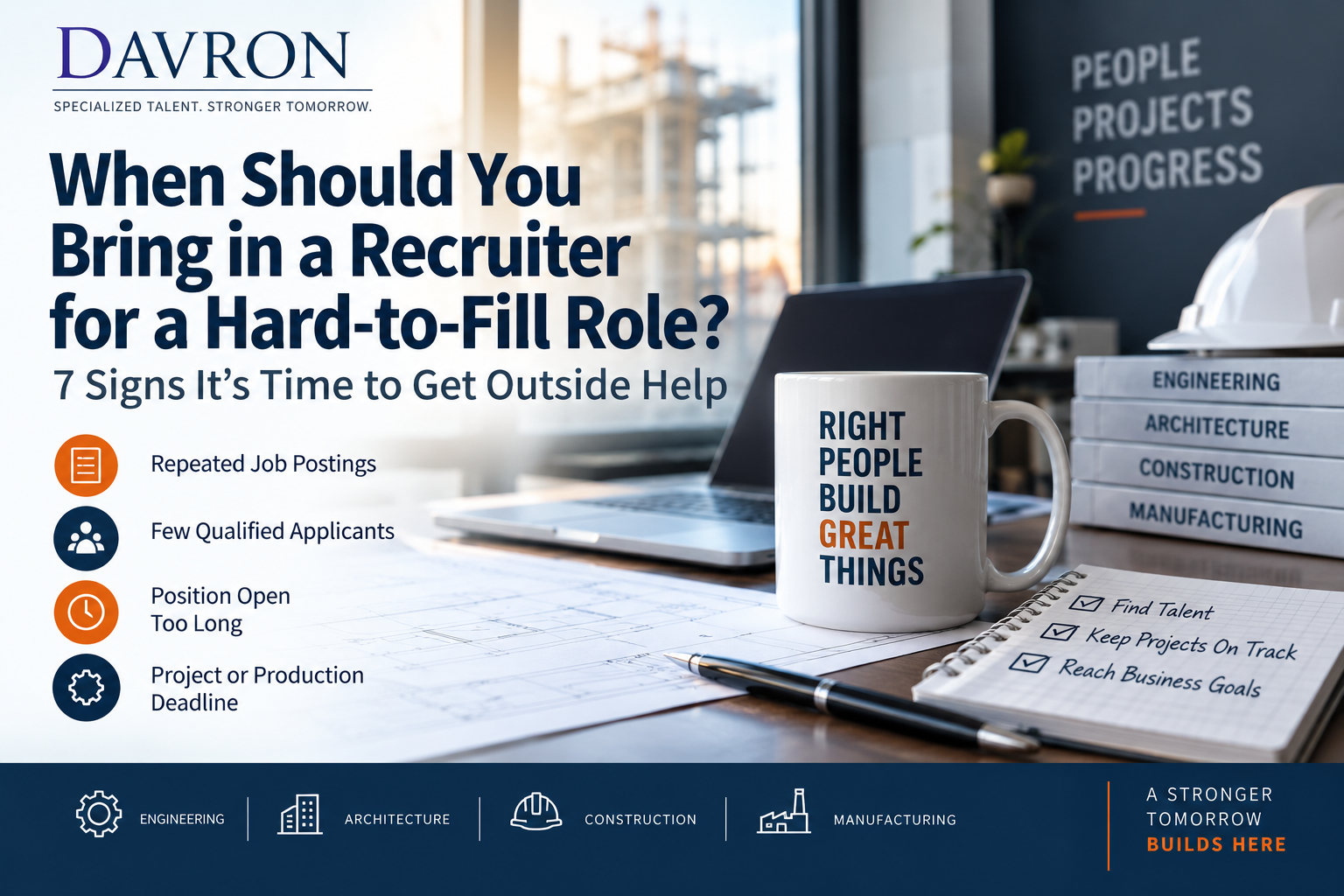
When a critical position stays open, it can quickly become more than a recruiting problem.
Projects can fall behind. Production goals can become harder to meet. Existing employees may absorb additional work. Managers can spend hours reviewing resumes and interviewing candidates instead of focusing on their teams. In project-driven businesses, an unfilled position can even limit the amount of work the company can take on.
So when should you bring in a recruiter?
Consider bringing in a specialized recruiter when your normal hiring process repeatedly fails to produce enough qualified candidates, the vacancy begins affecting business performance, or you have a deadline that makes waiting for the right applicant increasingly risky.
You do not necessarily need to abandon internal recruiting. A specialized recruiter can expand the search, reach candidates your existing process is not reaching, and give your team additional recruiting capacity when a difficult position demands more attention.
Here are seven signs that it may be time to get outside help.
1. You Have Reposted the Position Multiple Times
Reposting a job once does not necessarily mean the search is failing. But if you have posted essentially the same position multiple times and continue to see the same results, another repost may not solve the problem.
Warning signs include:
- Large numbers of applicants but few qualified candidates
- The same types of unqualified applicants appearing each time
- Weeks passing without serious interviews
- Rewriting the job description without improving the candidate pool
- Hiring managers repeatedly reviewing resumes that do not meet the requirements
At this point, the problem may not be the job posting itself. It may be the sourcing strategy.
Job boards primarily help employers reach people who are actively looking and willing to apply. That can leave out experienced professionals who are currently employed and not searching job boards but may be willing to consider the right opportunity.
A specialized recruiter can expand the search beyond incoming applications through targeted sourcing and direct candidate outreach.
If another repost is likely to produce the same applicant pool, it may be time to change how you are searching.
2. You Are Getting Applicants, but Very Few Are Actually Qualified
Applicant volume and candidate quality are not the same thing.
A position can receive dozens or even hundreds of applications while producing only a handful of candidates who actually meet the employer’s requirements.
That problem can be especially frustrating with technical positions.
An engineering firm might need a professional with a particular combination of design experience, software knowledge, industry background, and project exposure. A construction company may need a superintendent who has managed projects of a particular type and scale. A manufacturer may require someone with experience involving specific processes, equipment, or production environments.
Broad recruiting channels do not always distinguish between these requirements effectively.
The result is more work for the employer.
Managers and HR teams spend time reviewing resumes, conducting initial interviews, and discussing candidates who ultimately cannot perform the job.
A specialized recruiter should help narrow that funnel.
Rather than measuring success by how many resumes are generated, the search can focus on identifying candidates whose experience more closely matches what the employer actually needs.
3. The Position Has Been Open Longer Than Expected
There is no universal number of days after which every employer should call a recruiter.
A better question is whether the search is making meaningful progress.
If a position has been open substantially longer than expected, ask:
- Are qualified candidates consistently entering the pipeline?
- Are interviews producing legitimate finalists?
- Are strong candidates withdrawing before the process is complete?
- Are compensation or job requirements limiting the candidate pool?
- Is the vacancy beginning to affect the department?
- Is there a clear reason to believe another few weeks of the same recruiting approach will produce a different result?
The last question is particularly important.
If the search has stalled, simply allowing more time to pass does not necessarily increase the likelihood of success.
Employers should diagnose why the search is struggling.
Perhaps the candidate pool is smaller than expected. The compensation may not align with the experience being requested. The position may require a rare combination of skills. The geographic market could be limiting the search. Or the candidates the company wants may simply not be applying.
A specialized recruiter can provide another source of market feedback while expanding the search.
4. A Project, Production Goal, or Business Deadline Is Approaching
Some vacancies become more urgent because the business cannot wait indefinitely.
Imagine an engineering project approaching a critical design phase without enough technical staff.
A construction company may have an upcoming project that requires an experienced superintendent or project manager.
A manufacturer may need an engineer or technical leader to support production goals, equipment improvements, quality initiatives, or an expansion.
An architecture firm may have won new work but lack enough experienced professionals to execute it without overloading the existing team.
In these situations, the cost of waiting is not measured only in recruiting time.
The vacancy can affect execution.
That is when employers should consider expanding their recruiting strategy instead of continuing to wait for applicants.
A specialized recruiter can conduct a more proactive search while the company’s internal hiring efforts continue.
The closer the business gets to a project-critical deadline, the less attractive a passive “post and wait” strategy becomes.
5. Your Internal Recruiting or HR Team Is Stretched Too Thin
Bringing in a recruiter does not necessarily mean your internal recruiting team has failed.
Sometimes the issue is simply capacity.
An HR department may be responsible for dozens of open positions while simultaneously handling onboarding, employee relations, benefits, compliance, retention, and other responsibilities.
A particularly difficult technical search can require more sourcing and outreach than the internal team has time to provide.
Signs that bandwidth has become a problem include:
- Recruiters managing many openings simultaneously
- Hiring managers sourcing candidates themselves
- Candidate outreach happening inconsistently
- Follow-ups taking longer than expected
- Difficult searches repeatedly being pushed behind easier vacancies
- Managers spending too much time recruiting instead of managing
An external recruiter can function as additional recruiting capacity for the positions that require more focused attention.
For employers in engineering, architecture, construction, and manufacturing, specialization can also matter. A recruiter who regularly works with technical professionals may be better positioned to understand the terminology, experience, and career paths associated with a difficult search.
The goal is not to replace the internal team. It is to give that team another resource when a particular vacancy requires more attention than it can reasonably provide.
6. The Candidates You Need Are Not Actively Applying
One of the biggest limitations of relying entirely on job postings is straightforward:
The person you want may never see the posting.
Experienced professionals are often already employed. They may not be visiting job boards or submitting applications, even if they would consider a compelling opportunity.
That does not mean passive candidates are inherently better than active job seekers. It means an employer that relies exclusively on applications is searching only part of the potential talent market.
Recruiters can expand that reach through:
- Direct candidate sourcing
- Targeted outreach
- Industry relationships
- Candidate conversations
- Referral networks
- Consistent follow-up
This can be especially useful for niche technical positions where the total number of professionals with the required background is already limited.
Instead of waiting for the right candidate to discover the job, the search becomes proactive.
7. The Cost of Leaving the Position Vacant Is Becoming Greater Than the Cost of Recruiting Help
Recruiting fees are visible.
The cost of a vacancy can be harder to see.
That does not make it less important.
Depending on the position, leaving a critical role vacant can contribute to:
- Project delays
- Reduced production capacity
- Overtime
- Increased workload for existing employees
- Manager distraction
- Employee burnout
- Missed client deadlines
- Lost billable work
- Difficulty accepting new projects
- Customer delivery problems
Not every vacancy creates all of these consequences. But employers should identify which ones apply to the position they are trying to fill.
Then compare the cost of continuing the vacancy with the cost of expanding the recruiting effort.
For a business-critical position, the question should not simply be:
“What will a recruiter cost us?”
It should also be:
“What is this vacancy costing us while we continue searching?”
That comparison can make the decision much clearer.
Should You Call a Recruiter Now?
You may not need to wait until the hiring situation becomes a crisis.
Consider bringing in recruiting help when several of these statements describe your search:
- The position has already been reposted.
- Qualified applications remain scarce.
- The search is taking significantly longer than expected.
- Your hiring manager is spending excessive time sourcing candidates.
- Your internal recruiting team lacks bandwidth or niche expertise.
- The professionals you want are difficult to reach through normal job postings.
- A project, production target, client commitment, or deadline depends on filling the role.
- The business impact of the vacancy is increasing each week.
You do not necessarily need several warning signs if one is serious enough.
If a project-critical position must be filled quickly, an approaching deadline alone may be enough reason to expand the search.
What Should a Specialized Recruiter Do Differently?
Hiring a recruiter should involve more than sending your job description to another company and waiting for resumes.
A specialized recruiter should help improve the search itself.
That starts with understanding the position.
Which qualifications are truly required? Which are preferred? What experience would allow someone to succeed? What type of candidate would realistically consider the opportunity?
From there, the recruiting process should include targeted sourcing and direct outreach to professionals whose backgrounds align with those requirements.
A strong recruiting process should also include candidate screening before resumes reach the employer, consistent communication throughout the hiring process, and feedback when the market indicates something may need to change.
For example, if qualified candidates repeatedly decline because of compensation, location, responsibilities, or another requirement, that information can help the employer decide whether to adjust the position or continue targeting the existing profile.
For technical hiring, industry specialization can make this process more focused because the recruiter needs to understand the roles being discussed—not simply match keywords on resumes.
When DAVRON Can Help With a Hard-to-Fill Role
DAVRON specializes in recruiting professionals across engineering, architecture, construction, and manufacturing.
That specialization is particularly relevant when an employer is dealing with a technical, niche, project-critical, or otherwise difficult-to-fill position.
Instead of relying only on incoming applications, DAVRON can support employers with a focused recruiting process designed around the position’s actual requirements and the candidate market.
For employers whose internal teams have already spent weeks searching, the objective is not to repeat what has already been tried. It is to broaden the search, directly pursue relevant professionals, screen candidates, and help move qualified people into the hiring process.
And you do not have to wait until the vacancy becomes a crisis.
Tell us about the position you’re struggling to fill.
A conversation with a recruiting specialist can help you determine whether expanding the search makes sense before another week—or another project deadline—passes.
Ready to hire engineering, architecture, construction, or manufacturing professionals?
DAVRON specializes in delivering high-quality candidates in these industries.