
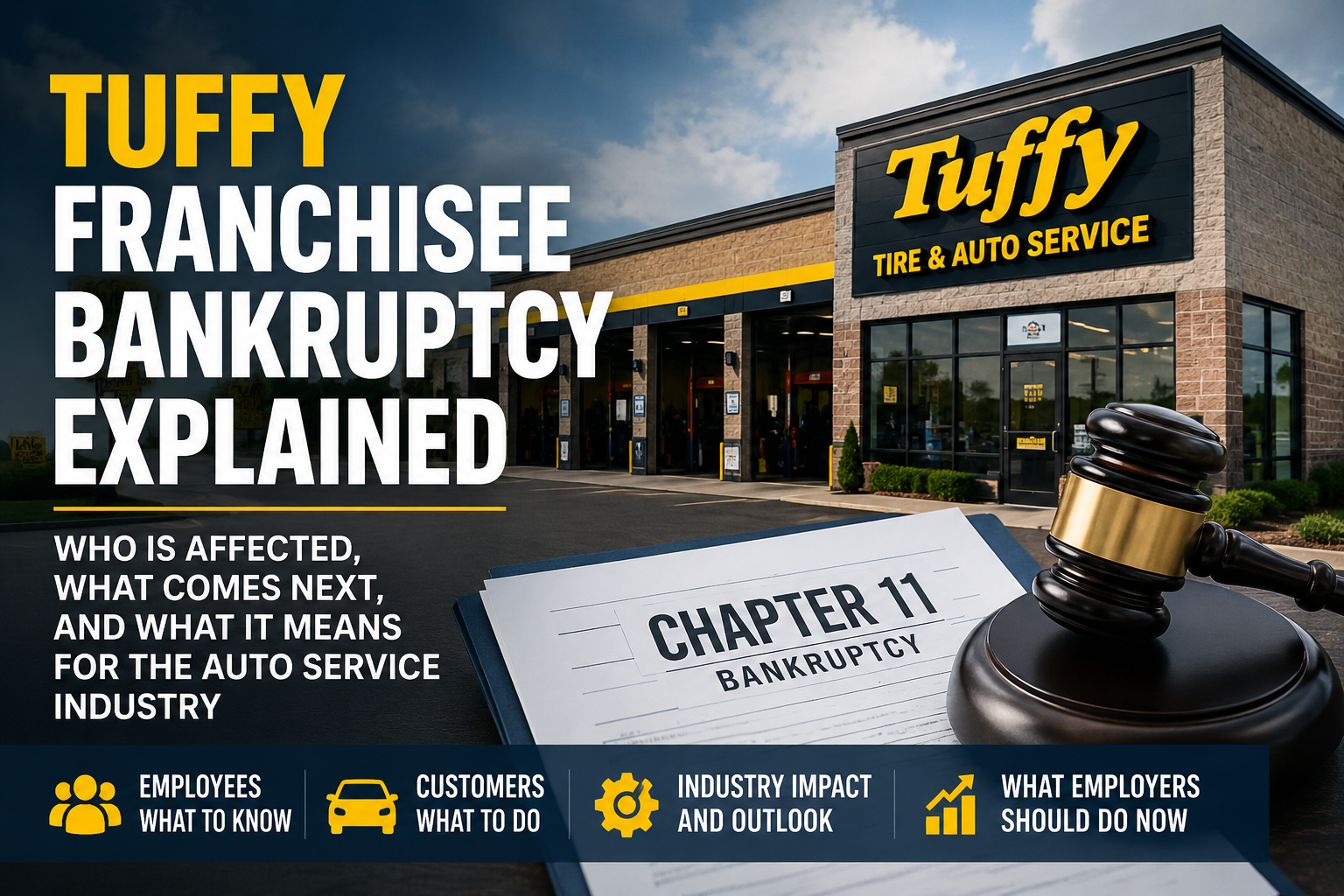
A bankruptcy filing connected to Tuffy Tire & Auto Service has generated headlines and understandable concern among customers, employees, suppliers, and competitors. However, one important distinction should be made immediately: the available information indicates that Automotive Solutions Inc., the operator of two Tuffy Tire & Auto Service franchise locations in Fort Wayne, Indiana, filed for Chapter 11 Subchapter V bankruptcy protection on July 7, 2026. This is not the same as the entire Tuffy Tire & Auto Service franchise system declaring bankruptcy.
That distinction matters because franchise businesses operate differently than corporate-owned chains. Individual franchise owners are independent businesses with their own finances, debts, leases, employees, and legal obligations. When one franchisee encounters financial difficulties, it does not automatically mean the franchisor—or hundreds of other franchise locations—is experiencing the same problems.
Even so, the filing offers an important window into the challenges facing today’s automotive repair industry. Rising operating costs, technician shortages, inflation, increasing vehicle complexity, and changing consumer spending habits continue to place pressure on many independent repair shops and franchise operators. Whether this case ultimately results in a successful restructuring or a sale of the business, it highlights broader issues that automotive employers, suppliers, and technical professionals should understand.
The History of Tuffy Tire & Auto Service
Tuffy Tire & Auto Service traces its roots back to 1970 when the company opened as a specialty muffler shop in Toledo, Ohio. As consumer demand evolved beyond exhaust repair, the business gradually expanded into brake service, suspension work, oil changes, tire replacement, preventive maintenance, diagnostics, and complete automotive repair.
Over several decades, Tuffy grew through franchising, allowing independent entrepreneurs to operate local repair facilities under the Tuffy brand. Like many automotive service franchises, individual stores are independently owned while operating under common branding, marketing, operational standards, and franchise agreements.
In 2021, Tuffy became part of Mavis Tire Express Services, one of the largest tire and automotive service companies in North America. The acquisition added another recognized automotive repair brand to Mavis’ expanding portfolio while allowing existing franchise operations to continue serving their local communities.
Today, the Tuffy name remains associated with independently owned franchise locations rather than a network of entirely corporate-operated stores. That ownership structure is an important reason why one franchisee’s financial distress should not automatically be interpreted as financial trouble across the entire organization.
What Happened in Fort Wayne?
According to bankruptcy filings and publicly available reports, Automotive Solutions Inc., which operates two Tuffy Tire & Auto Service locations in Fort Wayne, Indiana, filed for Chapter 11 protection under Subchapter V of the U.S. Bankruptcy Code on July 7, 2026.
Subchapter V was created specifically to help qualifying small businesses reorganize more efficiently than under a traditional Chapter 11 proceeding. Rather than forcing an immediate liquidation, the process is designed to give businesses an opportunity to restructure debt, negotiate with creditors, and continue operating while developing a financial recovery plan.
At this stage, the filing does not necessarily indicate that the stores will permanently close or that employees will immediately lose their jobs. Many Chapter 11 debtors continue normal business operations while the court oversees the restructuring process. Future court filings will provide greater clarity regarding the company’s long-term plans, creditor negotiations, and operational outlook.
Why Did the Franchisee File for Bankruptcy?
As of this writing, court documents have not publicly established a single definitive reason for the filing. Like many Chapter 11 cases, multiple financial pressures may have contributed to the decision.
Across the automotive repair industry, business owners continue to face rising labor costs, increasing commercial lease expenses, higher insurance premiums, elevated borrowing costs, inflation affecting parts and inventory, and persistent shortages of experienced automotive technicians. Many repair businesses are also investing heavily in diagnostic equipment, software subscriptions, and technician training as modern vehicles become increasingly dependent on advanced electronics, hybrid systems, and complex onboard technologies.
Consumer behavior has also shifted in recent years. While Americans continue driving older vehicles that require maintenance, economic uncertainty often causes drivers to postpone discretionary repairs until problems become unavoidable. That delay can create inconsistent revenue streams for repair facilities already operating with narrow margins.
Whether these broader industry conditions directly contributed to Automotive Solutions Inc.’s bankruptcy remains subject to the facts ultimately presented in court. Until additional documentation becomes available, it would be inappropriate to attribute the filing to any single operational or financial issue.
Who Is Affected?
Although public reports have not identified the exact number of employees working at the two Fort Wayne locations, the bankruptcy naturally creates uncertainty for multiple groups connected to the business.
Employees may wonder about future payroll, benefits, scheduling, and long-term employment stability. Customers may have questions regarding ongoing repairs, warranty work, prepaid services, or vehicles currently at the affected locations. Vendors and suppliers will closely monitor payment schedules and the treatment of outstanding invoices through the bankruptcy process. Commercial landlords, lenders, and other creditors also become participants in the restructuring proceedings.
It is important to recognize that being affected does not necessarily mean experiencing financial loss. In many Chapter 11 reorganizations, businesses continue operating while employees remain at work, customers continue receiving service, and vendors maintain business relationships under court supervision.
What Should Employees Do?
For employees, uncertainty often creates more anxiety than the bankruptcy itself. The most productive approach is to stay informed through official company communications rather than relying on rumors or social media speculation.
Employees should maintain copies of payroll records, employment agreements, benefit information, retirement account documentation, and work schedules. If circumstances change, those records may become valuable when addressing wage claims, unemployment benefits, or retirement issues.
Workers should also understand that a Chapter 11 filing does not automatically terminate employment. Many reorganizing companies continue paying employees and operating normally throughout the restructuring process.
If layoffs eventually occur, experienced automotive technicians, service advisors, maintenance professionals, and shop managers may find opportunities elsewhere. Demand for skilled technical talent remains strong across much of the automotive repair industry, fleet maintenance, manufacturing, and industrial operations.
What Should Customers Do?
Customers with vehicles currently being repaired should first contact the affected location directly to determine whether normal operations are continuing. Those with deposits, warranties, or pending repairs should retain copies of estimates, invoices, payment receipts, warranty documentation, and service records.
In many Chapter 11 cases, customer work continues without interruption. If complications arise, customers may need to communicate with the bankruptcy administrator, the franchise operator, or consumer protection agencies depending on the specific circumstances.
Importantly, customers should not assume that every Tuffy warranty nationwide has become invalid simply because one franchise operator filed for bankruptcy. Warranty obligations may depend on the terms of the warranty, the franchisor’s policies, and the legal status of the individual franchise location.
Are Other Automotive Repair Chains Also at Risk?
The bankruptcy of one franchise operator does not establish that competitors such as Tire Kingdom, Tires Plus, Firestone Complete Auto Care, Midas, Meineke, Pep Boys, or other automotive repair companies face similar financial circumstances.
However, many businesses throughout the automotive service industry confront comparable operational challenges.
Finding qualified technicians has become increasingly difficult as experienced workers retire faster than new technicians enter the workforce. Shops continue investing in expensive diagnostic equipment to service hybrid and electric vehicles while also managing higher wages, insurance costs, inventory expenses, and facility overhead.
Corporate-owned chains often possess greater financial resources than individual franchisees, allowing them to absorb temporary economic pressures more effectively. Independently owned repair facilities and franchise operators may have less financial flexibility if revenue declines or unexpected expenses arise.
Ultimately, each company’s financial health depends on its own debt structure, cash flow, operational efficiency, management decisions, geographic market conditions, and access to capital. It would be inaccurate to suggest that competitors are likely to experience bankruptcy simply because one franchise operator has sought court protection.
Broader Ramifications for the Automotive Industry
Although this bankruptcy involves only two franchise locations, it reflects larger trends affecting automotive service nationwide.
The shortage of experienced technicians continues to influence repair capacity across the industry. As vehicles become more technologically advanced, employers increasingly compete for professionals with diagnostic expertise, electrical knowledge, hybrid and electric vehicle experience, and advanced repair certifications.
Consolidation also continues reshaping the automotive service landscape. Large ownership groups have acquired numerous regional chains and independent operators, creating businesses with broader geographic reach and greater purchasing power. While consolidation can improve efficiency, it also increases competitive pressure on smaller independent operators and franchisees.
Financial restructurings can also create unexpected workforce shifts. Employees leaving one organization frequently become attractive candidates for competing repair facilities, manufacturers, fleet operators, equipment companies, and industrial employers seeking experienced technical professionals.
What Automotive Employers Should Learn
For employers, this case serves as a reminder that workforce planning should begin long before an operational disruption occurs.
Whether the challenge involves bankruptcy, rapid expansion, unexpected turnover, or increased customer demand, organizations that already have recruiting relationships and succession plans in place are generally better positioned to respond quickly.
Companies should also recognize that financial distress at one employer often releases highly qualified talent into the market. Those opportunities can disappear quickly as competing businesses recruit experienced technicians, supervisors, operations leaders, and technical professionals.
Organizations that move decisively are frequently able to strengthen their workforce while competitors remain focused on reacting to events rather than planning ahead.
How DAVRON Helps Employers Navigate Workforce Challenges
While DAVRON does not recruit for general automotive repair positions, the same economic forces affecting automotive service businesses often influence manufacturing, engineering, industrial operations, and technical hiring.
Companies expanding production, upgrading facilities, improving maintenance operations, or responding to changing market conditions frequently need experienced mechanical engineers, manufacturing engineers, quality engineers, electrical engineers, maintenance leaders, plant managers, operations professionals, and other difficult-to-find technical talent.
DAVRON specializes exclusively in engineering, architecture, construction, and manufacturing recruiting. By focusing on these highly specialized industries, DAVRON helps employers identify qualified professionals for critical positions that directly affect productivity, project timelines, operational efficiency, and long-term business performance.
Common Questions Answered
Did Tuffy Tire & Auto Service declare bankruptcy?
Based on currently available information, no. The bankruptcy filing involves Automotive Solutions Inc., an independent franchise operator of two Tuffy locations in Fort Wayne, Indiana, rather than the entire Tuffy franchise system.
Will all Tuffy locations close?
There is no evidence indicating that the national Tuffy franchise network is closing. Individual franchise ownership means one operator’s financial challenges do not automatically affect every location.
Does Chapter 11 mean the business is shutting down?
Not necessarily. Chapter 11 is designed to allow businesses to continue operating while reorganizing debt and negotiating with creditors under court supervision.
Should customers be concerned about warranties?
Customers should review the specific terms of their warranties and contact their local Tuffy location for guidance. A franchisee bankruptcy does not automatically invalidate every warranty associated with the brand.
Does this indicate broader problems in the automotive repair industry?
The filing highlights real challenges facing many repair businesses, including technician shortages, inflation, rising operating costs, and increasing vehicle complexity. However, one franchisee’s bankruptcy should not be interpreted as evidence of widespread financial instability across the industry.