
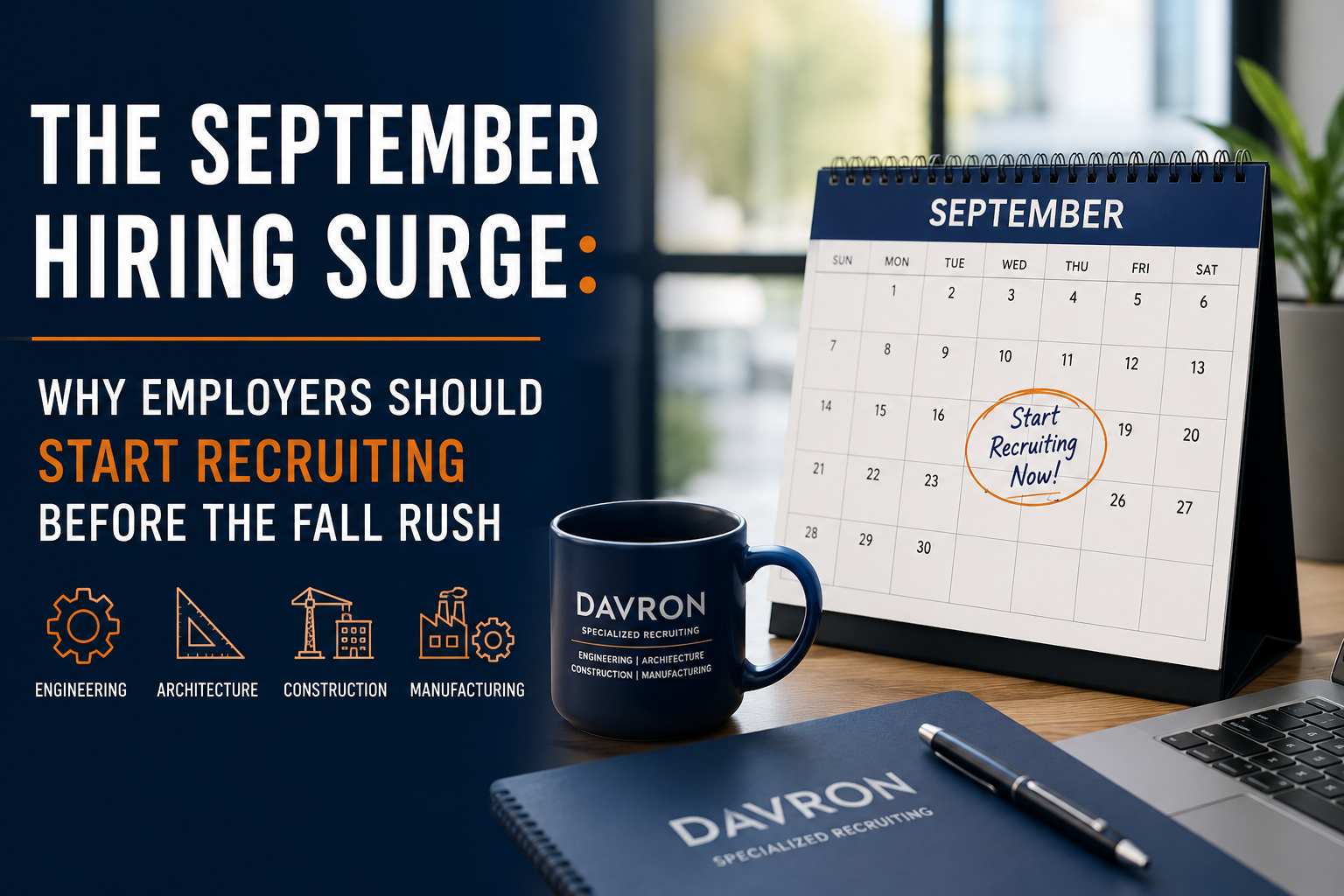
If you know you will need an engineer, architect, construction professional, or manufacturing specialist this fall, waiting until the need becomes urgent can put your business behind before the search even begins.
A position that needs to be filled in October does not have an October start date from a recruiting perspective. Employers still need time to source candidates, screen qualifications, coordinate interviews, make decisions, negotiate an offer, accommodate a candidate’s notice period, and complete onboarding.
That makes the weeks leading into September an important recruiting window.
An unfilled technical position can affect much more than HR. It can leave projects understaffed, increase workloads for existing employees, constrain production, delay deliverables, and put additional pressure on Q4 objectives.
If you already know you will need specialized talent this fall, the best time to start recruiting may be before everyone else feels the same urgency.
Why Does Hiring Activity Pick Up in September?
September often represents a shift from summer planning to fall execution.
Teams return from vacations. Projects that were delayed or deferred move forward. Managers have greater visibility into year-end workloads. Staffing gaps that were manageable during the summer can become more difficult to absorb as companies focus on Q4 priorities.
Not every organization follows the same seasonal hiring cycle, but the underlying business pressures are familiar.
A construction company may realize an upcoming project requires another superintendent or project manager. An engineering firm may need additional technical capacity to meet project deadlines. A manufacturer may discover that an open engineering or leadership position is creating a production bottleneck.
By the time the hiring need becomes obvious, the recruiting process may already be behind schedule.
That is why employers should consider the date they need someone working and productive, not simply the date they plan to post the job.
Why Can Waiting Until Q4 Make a Difficult Search Harder?
Specialized technical positions are not always filled by posting a job advertisement and waiting for qualified applicants.
The right candidate may already be employed. The required combination of technical expertise, industry experience, location, compensation expectations, leadership ability, and project background may significantly narrow the available talent pool.
Waiting does not necessarily make those requirements easier to satisfy.
Instead, it reduces your margin for error.
When a company begins recruiting early, hiring managers have more time to define the position, evaluate candidates carefully, adjust the search when necessary, and make a strong offer.
When a company waits until the vacancy begins affecting operations, the conversation changes.
Now the team needs someone immediately.
Managers may feel pressure to accelerate interviews. Existing employees may be carrying additional responsibilities. Project deadlines may be getting closer. Production requirements may be increasing. The cost of leaving the position open may become more significant with each passing week.
That is exactly when a difficult recruiting problem can turn into a business problem.
Need Someone ASAP? Here Are Your Main Options
If a position is already open—or you know it soon will be—there are several ways to accelerate the search.
Activate Your Internal Recruiting Team Immediately
If your company has internal recruiters with experience sourcing candidates for the specific position, begin the search as soon as the need is confirmed.
Do not wait until the ideal start date approaches.
Give the recruiting team a clear understanding of the required qualifications, preferred experience, compensation range, location requirements, and which qualifications are truly non-negotiable.
Ask for Employee Referrals
Employees and industry contacts may know professionals who fit the position.
Referrals can be particularly useful in specialized industries where professionals develop strong networks over the course of their careers.
The limitation is predictability. Your network may produce an excellent candidate—or no viable candidates at all.
Use referrals as one recruiting channel rather than assuming they will solve an urgent search.
Reach Beyond Active Job Applicants
Some of the professionals who best fit your position may not be actively applying to jobs.
This matters when recruiting for specialized engineering, architecture, construction, and manufacturing positions.
An employer relying entirely on incoming applications is primarily evaluating people who have decided to enter the job market. A broader recruiting strategy can also identify qualified professionals who may be willing to consider the right opportunity even though they are not actively searching job boards.
Remove Unnecessary Delays From the Interview Process
Finding a qualified candidate quickly accomplishes little if the hiring process then stalls.
Before recruiting intensifies, determine:
- Who needs to interview the candidate?
- Who has final hiring authority?
- What approvals are required?
- How quickly can interviews be scheduled?
- Is the compensation range already approved?
- Who can make an offer?
- Which requirements are essential, and which are preferences?
When a strong candidate becomes available, employers should be prepared to make a decision without unnecessary administrative delays.
Engage a Specialized Recruiter
When the position is highly technical, difficult to fill, confidential, project-critical, or already urgent, a specialized recruiter can expand the employer’s recruiting effort.
This is where specialization matters.
DAVRON focuses specifically on recruiting and staffing for engineering, architecture, construction, and manufacturing employers.
Rather than approaching the search as a general staffing assignment, DAVRON’s recruiting focus is aligned with technical positions and the hiring challenges employers encounter in these industries.
For a company facing an urgent vacancy, that specialized focus can provide an additional recruiting resource without requiring the employer to abandon its existing internal recruiting, referral, or sourcing efforts.
Which Positions Should Employers Start Recruiting for Before Fall?
Additional lead time becomes particularly valuable when the position requires specialized technical experience or plays a critical role in project execution, production, or operations.
Examples can include:
- Mechanical engineers
- Civil engineers
- Electrical engineers
- Manufacturing engineers
- Project engineers
- Architects
- Designers and drafters
- Construction project managers
- Construction superintendents
- Estimators
- Manufacturing leaders
- Technical managers and executives
The harder the combination of requirements is to find, the less sense it makes to deliberately shorten the recruiting window.
A senior engineer with specific industry experience may require a very different search from an entry-level generalist. A construction superintendent needed in a specific geographic market creates different constraints from a position that can be performed remotely. A manufacturing leader may need technical knowledge, management experience, and familiarity with a particular production environment.
The more specialized, senior, location-sensitive, or project-critical the position, the more valuable recruiting lead time becomes.
How Far in Advance Should You Start Recruiting?
There is no single recruiting timeline that applies to every technical position.
Instead, work backward from when you need the employee to be productive.
The recruiting process may include:
Sourcing → Screening → Interviews → Internal Approvals → Offer → Negotiation → Notice Period → Onboarding
Every additional step requires time.
For example, identifying the right candidate does not mean that person can start Monday. An employed professional may need to provide notice to a current employer. Interview schedules can take time to coordinate. Senior positions may require multiple decision-makers. Offers may require internal approval or negotiation.
That leads to a simple rule:
Do not start recruiting based on when you want to make an offer. Start based on when the business needs the person contributing.
If that date falls during Q4, the recruiting process may need to begin well before Q4 arrives.
8 Signs You Should Start the Search Today
Employers do not need to wait for a vacancy to become a crisis before taking action.
Consider starting the recruiting process now if:
- The position is already open. Every additional week extends the vacancy.
- A key employee has given notice. Recruiting during the transition may help reduce the time the position remains uncovered.
- An upcoming fall project depends on the hire. Recruiting should be incorporated into the project timeline rather than treated as a separate HR deadline.
- Existing employees are absorbing the vacant position’s responsibilities. Temporary coverage can become an ongoing workload problem.
- Your internal search has not produced qualified candidates. Repeating the same sourcing strategy may not change the outcome.
- The required skill set is highly specialized. A narrower talent pool can require more proactive recruiting.
- The vacancy could affect production, schedules, customers, or revenue. The business cost of waiting may matter more than the convenience of delaying the search.
- Management already expects to approve the position for Q4. If the need is predictable, employers can begin preparing the recruiting strategy before the pressure peaks.
If several of these conditions describe your situation, waiting for the fall hiring rush offers little practical advantage.
Starting Early Does Not Mean Hiring Hastily
One reason employers postpone recruiting is the belief that starting now means they must hire immediately.
It does not.
Starting early gives you information.
You can determine whether your requirements match the available candidate pool. You can discover whether compensation is aligned with candidate expectations. You can identify geographic limitations. You can see which qualifications are making the search particularly difficult.
Most importantly, you gain time to make a deliberate decision.
Starting a difficult search after the position becomes urgent can create pressure to compromise.
Starting before that pressure arrives gives the employer more flexibility.
Earlier recruiting can mean more time to be selective—not less.
How Can Employers Get Ahead of the September Hiring Rush?
The first step is to identify positions that are likely to become hiring priorities before the end of the year.
Talk with department leaders now.
Which teams are already stretched?
Which projects are coming?
Where are there known vacancies?
Which employees are covering responsibilities outside their normal roles?
Where could a missing engineer, project manager, superintendent, architect, manufacturing specialist, or technical leader affect execution?
Then decide how each search will be handled.
Some positions may be appropriate for internal recruiting. Others may benefit from referrals or direct sourcing. Difficult or urgent technical searches may justify bringing in specialized recruiting support immediately.
The important point is to make that decision before the vacancy dictates the timeline for you.
How DAVRON Helps Employers Get Ahead of Fall Hiring
DAVRON specializes in recruiting professionals for engineering, architecture, construction, and manufacturing employers.
That specialization is particularly relevant when companies are searching for technical professionals who may be difficult to identify through general recruiting channels.
Employers can use DAVRON to support searches for engineers, architects, construction professionals, manufacturing specialists, technical managers, and other specialized positions.
DAVRON’s approach combines niche recruiting focus, a process-driven search, responsiveness, and direct access to recruiting specialists.
For employers heading into September with open positions—or looking ahead at staffing requirements for Q4—the objective is straightforward:
Start the search while you still have time to make a strong hiring decision, rather than waiting until the business forces you to make a fast one.
If you already know a specialized position needs to be filled this fall, there is little advantage in waiting for the fall hiring rush to begin.
Ready to hire engineering, architecture, construction, or manufacturing professionals?
DAVRON specializes in delivering high-quality candidates in these industries.