
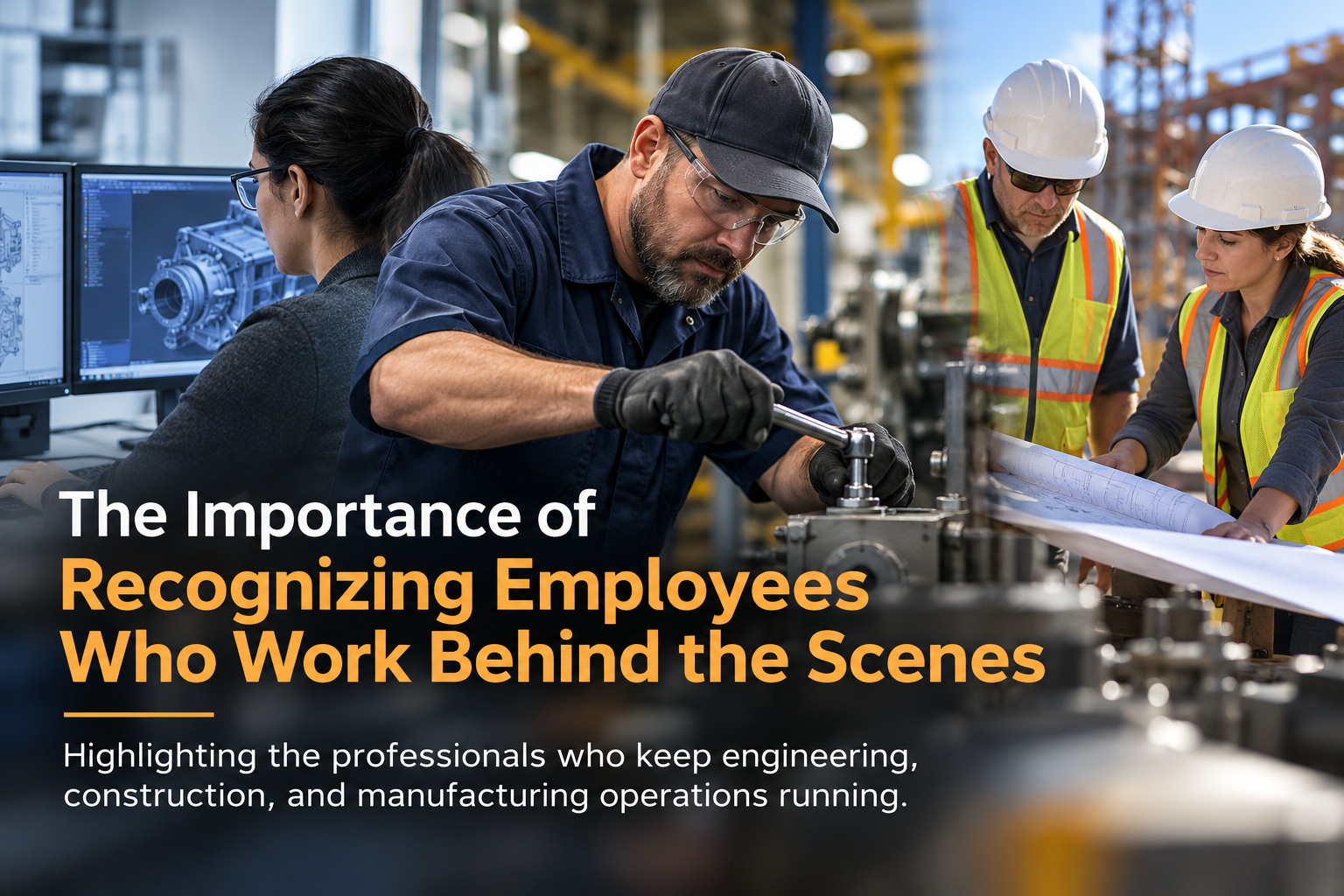
The employees who keep your operations running are not always the ones receiving the most recognition. But when one of them leaves, their absence can quickly become a serious business problem.
A manufacturing facility may depend on a maintenance technician who knows exactly how to prevent a critical machine from breaking down. A construction company may rely on a project coordinator who keeps subcontractors, documentation, and schedules organized. An engineering firm may have a CAD designer whose attention to detail prevents costly design errors.
These professionals rarely receive the spotlight. Their contributions are often most noticeable when something goes wrong.
For employers in engineering, construction, and manufacturing, recognizing behind-the-scenes employees is more than an employee appreciation initiative. It is an important part of retaining skilled professionals, protecting operational continuity, and preventing avoidable disruptions.
When these employees feel overlooked, companies risk losing specialized knowledge and dependable talent that may be difficult to replace.
Understanding their value—and making sure they know it—should be a priority for every organization that depends on technical expertise.
Who Are the Behind-the-Scenes Professionals Keeping Operations Running?
Every successful engineering project, construction site, and manufacturing operation depends on professionals whose work supports the larger team.
Some hold highly technical positions. Others manage documentation, scheduling, quality, maintenance, or coordination. Their responsibilities may not always be visible to customers or executives, but their work directly influences business performance.
Engineering: The Professionals Behind Accurate Designs and Successful Projects
Engineering organizations depend on more than the engineers leading major projects.
CAD designers and drafters translate engineering concepts into detailed technical drawings. Engineering technicians support testing, troubleshooting, and equipment evaluation. Document control specialists maintain accurate records and help teams work from current specifications.
Design coordinators help manage revisions, communication, and deliverables across multiple disciplines.
Without these professionals, engineering teams may experience:
Delayed drawing packages and project deliverables
Documentation errors and unnecessary rework
Communication gaps between engineering disciplines
Increased workloads for senior engineers
Difficulty maintaining consistent project quality
A skilled CAD designer who catches a dimensional inconsistency before drawings are released may prevent expensive problems later in the project.
That contribution deserves recognition, even when the problem was prevented so effectively that nobody else noticed it.
Construction: The People Keeping Projects Organized and Moving Forward
Construction projects involve complex schedules, multiple contractors, changing requirements, and substantial financial commitments.
While superintendents and project managers often receive recognition for completed projects, many other professionals contribute to keeping those projects on track.
Project coordinators organize communication and documentation. Estimators help establish accurate budgets and evaluate project costs. Scheduling professionals monitor activities and identify potential conflicts.
Safety coordinators support safe working practices, while construction administrators help manage the documentation required throughout a project’s lifecycle.
When these positions are understaffed or overlooked, the consequences may include scheduling confusion, delayed approvals, inaccurate documentation, and increased pressure on project leadership.
A construction project does not stay organized by accident. It stays organized because experienced professionals consistently manage the details.
Manufacturing: The Employees Preventing Downtime and Protecting Production
Manufacturing provides some of the clearest examples of why behind-the-scenes employees matter.
A maintenance technician who identifies a worn component before it fails can help prevent an unplanned shutdown.
A quality control inspector who identifies a recurring defect may prevent an entire production run from requiring rework.
A CNC programmer who improves a machining process can contribute to greater consistency and efficiency.
Production planners, manufacturing technicians, and materials coordinators also play important roles in keeping production schedules achievable.
These employees help protect:
Equipment reliability
Production output
Product quality
Inventory availability
On-time delivery
Workplace safety
Their contributions are sometimes invisible precisely because they are doing their jobs well.
When equipment runs reliably, materials arrive when needed, and production targets are met, it is easy to overlook the people making those outcomes possible.
Why Is Recognizing Behind-the-Scenes Employees Important?
Recognizing behind-the-scenes employees helps reinforce their value to the organization, supports employee engagement, and can contribute to stronger retention and operational stability.
Recognition also communicates which behaviors and contributions an employer considers important.
For technical organizations, that matters because many essential responsibilities involve preventing problems rather than producing highly visible accomplishments.
1. Recognition Supports Employee Retention
Experienced technical employees often develop knowledge that cannot be quickly transferred to a replacement.
A maintenance technician may understand the history of specific equipment, including recurring failures and effective troubleshooting methods.
An engineering technician may know the testing procedures, documentation requirements, and practical challenges associated with a company’s products.
A construction coordinator may understand the communication preferences and processes of numerous subcontractors and project stakeholders.
When employees consistently feel that their contributions are ignored, they may become less engaged or more willing to consider opportunities elsewhere.
Recognition alone cannot guarantee retention. Compensation, leadership, workload, career development, and working conditions also matter.
However, regularly acknowledging meaningful contributions can help employees understand that their expertise is respected.
2. Recognition Reinforces Operational Excellence
Organizations often celebrate major milestones such as completing a project, achieving a production target, or securing a new contract.
Those accomplishments deserve attention.
But employers should also recognize the work that makes those achievements possible.
Consider a quality inspector who identifies a problem before defective products reach a customer.
Or a scheduling coordinator who notices a conflict that could delay a construction milestone.
These employees may prevent problems that never appear in a performance report.
Recognizing this type of work reinforces the importance of accuracy, preparation, reliability, and proactive problem-solving.
3. Recognition Strengthens Team Collaboration
Engineering, construction, and manufacturing operations require employees with different responsibilities to work together.
When recognition consistently goes only to managers or highly visible contributors, other employees may feel disconnected from the organization’s success.
Acknowledging the contributions of technical support staff, maintenance personnel, and operational coordinators helps reinforce the idea that successful outcomes depend on the entire team.
It also encourages employees to appreciate the responsibilities and expertise of their colleagues.
4. Recognition Helps Preserve Institutional Knowledge
Some of an organization’s most valuable knowledge exists in the experience of its employees.
Written procedures and technical documentation are essential, but they do not always capture every practical lesson learned over years of operation.
Experienced employees may know why a particular process was established, how equipment behaves under unusual conditions, or which project details frequently cause delays.
Recognizing these employees creates opportunities to acknowledge their expertise and encourage knowledge sharing.
Employers should also document critical processes and cross-train employees so operational knowledge does not depend entirely on one person.
The Hidden Cost of Overlooking Essential Employees
Losing an experienced employee can create consequences that extend far beyond the cost of recruiting a replacement.
The true operational impact depends on the employee’s responsibilities, the availability of internal coverage, and the difficulty of finding someone with comparable skills.
Manufacturing Example: Losing an Experienced Maintenance Technician
Imagine a manufacturing facility where one experienced maintenance technician has extensive knowledge of several critical production machines.
After years of consistently solving problems with little acknowledgment or opportunity for advancement, the technician accepts another position.
The company now faces several challenges.
Remaining technicians must absorb additional responsibilities. Troubleshooting may take longer. Less-experienced employees may require training, and equipment issues that were previously resolved quickly may cause extended interruptions.
The employer must also recruit someone with the appropriate mechanical, electrical, and equipment-specific knowledge.
The vacancy affects more than headcount. It creates a potential risk to production reliability.
Construction Example: Losing a Dependable Project Coordinator
A construction company loses a project coordinator who manages documentation, tracks approvals, and maintains communication between project stakeholders.
Although the position is not part of senior management, the employee has been essential to keeping multiple projects organized.
After the departure, project managers must spend additional time handling administrative and coordination responsibilities.
Documentation may take longer to process, communication becomes more complicated, and project leaders have less time available for higher-level responsibilities.
The company may discover that the coordinator’s value was significantly greater than the visibility of the position suggested.
Engineering Example: Losing a Skilled CAD Designer
An engineering firm depends on an experienced CAD designer who understands its drafting standards, software workflows, and recurring project requirements.
When that employee leaves, the firm must redistribute drawing responsibilities while searching for a replacement.
Even a technically qualified new hire may require time to learn the organization’s standards and project-specific processes.
That transition can increase pressure on engineers and affect project delivery schedules.
The lesson for employers is straightforward: An employee’s operational importance is not always reflected in their title, salary, or visibility within the organization.
How Can Employers Better Recognize Behind-the-Scenes Employees?
Effective employee recognition does not require elaborate programs or expensive celebrations.
It requires consistency, specificity, and an understanding of how different employees contribute to business performance.
Recognize the Work That Prevents Problems
Many organizations naturally celebrate completed projects and achieved targets.
Employers should also acknowledge the work that prevents negative outcomes.
For example, a plant manager might recognize a maintenance technician for identifying an equipment issue before it caused a shutdown.
An engineering manager might acknowledge a designer who identified a drawing conflict before fabrication.
A construction executive might recognize a coordinator who helped resolve a scheduling issue before it affected project progress.
Specific recognition demonstrates that leadership understands the work being performed.
Connect Individual Contributions to Business Results
Employees should understand how their responsibilities support larger organizational goals.
Instead of simply telling a quality inspector that they are doing a good job, a manager might explain how their careful inspections help reduce rework and protect customer relationships.
A production planner could be recognized for coordinating materials and capacity to support delivery commitments.
Connecting everyday responsibilities to meaningful business outcomes helps employees see the importance of their work.
Provide Opportunities for Professional Development
Recognition should extend beyond verbal appreciation.
Employers can demonstrate that they value technical professionals by investing in their development.
Depending on the position, opportunities might include additional technical training, professional certifications, equipment-specific education, leadership development, or advancement into more specialized responsibilities.
Not every valuable employee wants to become a manager.
Organizations should also consider career paths that allow experienced technical professionals to advance while continuing to apply their expertise.
Include Technical Employees in Operational Decisions
Employees closest to daily operations often understand recurring problems and opportunities for improvement.
Maintenance technicians may identify equipment reliability concerns.
CAD designers may recognize inefficiencies in drafting workflows.
Project coordinators may identify documentation processes that create unnecessary delays.
Inviting these employees to contribute ideas demonstrates respect for their experience.
It can also help leadership make better-informed operational decisions.
Make Recognition Consistent Across Departments
Recognition programs should not focus exclusively on departments with the most visible accomplishments.
Engineering support, maintenance, quality assurance, scheduling, document control, and production coordination should all have opportunities to receive meaningful acknowledgment.
Managers should also consider how individual employees prefer to be recognized.
Some appreciate public acknowledgment, while others prefer direct feedback or professional development opportunities.
Back Recognition With Meaningful Employment Practices
Employee appreciation is less effective when it is disconnected from working conditions.
A technician who regularly works excessive overtime may not view an occasional award as meaningful if staffing shortages remain unresolved.
A skilled designer may appreciate recognition but still leave if compensation or advancement opportunities are consistently inadequate.
Employers should support recognition with fair compensation, reasonable workloads, responsive management, and opportunities for growth.
The strongest recognition programs demonstrate that employees are valued through both words and decisions.
Why Retaining Behind-the-Scenes Technical Talent Can Be Challenging
Technical employers sometimes underestimate how difficult certain positions may be to replace.
A job title may sound straightforward, but the actual position could require a highly specific combination of experience.
A maintenance technician may need familiarity with particular industrial equipment, automation systems, and troubleshooting procedures.
A CAD designer may need experience with specialized software, industry standards, and specific engineering disciplines.
A construction scheduler may need knowledge of project sequencing, scheduling software, and the practical challenges associated with complex construction projects.
These requirements can narrow the pool of suitable candidates.
Employers should therefore evaluate retention priorities based on operational importance, not simply organizational seniority.
An experienced technical employee may be business-critical even without supervisory responsibilities.
One useful approach is to identify positions where a vacancy would create immediate disruption, require extensive cross-training, or significantly increase the workload of other employees.
These positions deserve particular attention in workforce planning and retention discussions.
When Recognition Isn't Enough: Addressing Critical Staffing Gaps
Even employers with strong workplace cultures and effective recognition programs experience employee turnover.
Experienced employees retire, relocate, pursue new opportunities, or move into different responsibilities.
Companies also grow, add production capacity, expand engineering departments, and take on construction projects that require additional personnel.
When a critical technical position becomes vacant, employers must act strategically.
Waiting too long to address the gap may increase pressure on existing employees and create operational challenges.
First, Determine the Business Impact of the Vacancy
Not every open position carries the same level of urgency.
Employers should consider whether the vacancy affects production capacity, equipment reliability, project schedules, quality control, or customer commitments.
A missing employee in a business-critical position may require a faster response than a role where responsibilities can be temporarily redistributed without significant disruption.
Second, Evaluate Temporary Internal Coverage
Cross-training and internal reassignment may help maintain operations while recruiting takes place.
However, employers should evaluate whether existing employees can realistically absorb the additional work.
Extended overtime and ongoing workload increases can create additional retention challenges.
A temporary solution should not become an indefinite expectation without considering its effects on the team.
Third, Define the Technical Requirements Clearly
Recruiting becomes more effective when employers distinguish between essential qualifications and preferences.
For example, a manufacturing employer hiring a maintenance technician should identify the specific equipment, systems, and troubleshooting capabilities required.
An engineering firm hiring a CAD designer should define the software proficiency, design discipline, and relevant industry experience needed.
Clear requirements help employers evaluate candidates based on the work they must actually perform.
Fourth, Consider Specialized Recruiting Support
Some technical vacancies are difficult to fill through standard job advertisements alone.
The challenge may involve a narrow skill set, specific industry experience, geographic limitations, or the need to reach qualified professionals who are not actively searching for employment.
A specialized recruiting partner can help employers focus their search on candidates whose backgrounds align with the position.
This can be particularly valuable when a vacancy affects production, project delivery, or other business-critical activities.
How DAVRON Helps Employers Recruit Essential Technical Professionals
Recognizing and retaining valuable employees should be a priority. But when an essential position becomes vacant, employers also need an effective plan for finding the right replacement.
DAVRON is a specialized recruiting and staffing firm focused on engineering, architecture, construction, and manufacturing.
That specialization is particularly relevant when employers need professionals whose qualifications extend beyond general administrative or operational experience.
Technical recruiting often requires an understanding of specific equipment, engineering software, industry practices, project responsibilities, and specialized skills.
A job title alone rarely tells the complete story.
For example, two maintenance technicians may have very different experience depending on the equipment and manufacturing environments in which they have worked.
Two CAD designers may use different software platforms or specialize in entirely different engineering disciplines.
Construction coordinators may also have different backgrounds depending on project size, delivery methods, and the types of contractors they support.
DAVRON’s focused recruiting approach is designed to help employers identify qualified candidates for specialized positions across these industries.
Whether a company needs a CAD designer, maintenance technician, manufacturing engineer, construction project coordinator, or another technical professional, working with a specialized recruiter can provide additional support when internal hiring resources are stretched.
DAVRON also understands that essential employees are not limited to executive and management positions.
The professionals supporting daily operations can be just as important to meeting production targets, maintaining project schedules, and protecting business performance.
For employers facing a critical staffing gap, speaking with a DAVRON recruiting specialist can help clarify hiring requirements and determine an appropriate recruiting approach.
Frequently Asked Questions
Why is recognizing behind-the-scenes employees important?
Recognizing behind-the-scenes employees reinforces the value of work that supports daily operations, prevents problems, and helps organizations meet business objectives. Meaningful recognition can contribute to employee engagement and retention while encouraging reliability, collaboration, and consistent performance.
Which employees are commonly overlooked in engineering, construction, and manufacturing?
Common examples include CAD designers, engineering technicians, maintenance technicians, quality control inspectors, production planners, project coordinators, construction administrators, document control specialists, and scheduling professionals. These employees often perform essential technical and operational responsibilities without receiving the same visibility as managers or senior leadership.
How does employee recognition support retention?
Recognition helps employees understand that their contributions are noticed and appreciated. When combined with competitive compensation, career development, manageable workloads, and effective leadership, it can support a workplace environment where skilled professionals are more motivated to remain.
What happens when a company loses an experienced maintenance technician, CAD designer, or project coordinator?
The company may lose valuable technical knowledge, process familiarity, and operational experience. Depending on the position, the departure can contribute to equipment downtime, delayed engineering deliverables, scheduling disruptions, increased workloads, and additional recruiting and training costs.
How can manufacturing and construction companies recognize employees who rarely receive public credit?
Employers can acknowledge specific contributions during team meetings, recognize employees who prevent operational problems, provide professional development opportunities, invite technical employees into improvement discussions, and connect their work to measurable business outcomes. Recognition should be consistent and supported by meaningful employment practices.
When should employers consider using a specialized recruiter to replace critical technical employees?
Employers should consider specialized recruiting support when a vacancy requires hard-to-find technical qualifications, creates operational urgency, or exceeds the capacity of internal recruiting resources. A recruiter focused on engineering, construction, or manufacturing can help identify candidates whose experience aligns with the position’s technical and industry-specific requirements.
Recognize the People Who Keep Everything Moving
The success of an engineering firm, construction company, or manufacturing operation depends on more than its most visible employees.
It depends on the maintenance technician who prevents equipment failures.
The CAD designer who produces accurate technical drawings.
The quality inspector who catches defects before products reach customers.
The project coordinator who keeps documentation, schedules, and communication organized.
The production planner who helps ensure materials and resources are available when needed.
These professionals contribute to the reliability, efficiency, and consistency that businesses depend on every day.
Recognizing their work is not simply a gesture of appreciation. It is a practical way to reinforce the value of essential employees and support long-term workforce stability.
Employers should make recognition part of their everyday management practices rather than waiting until a critical employee announces their departure.
And when an important technical position does become vacant, having a focused recruiting strategy can help prevent an already challenging staffing situation from becoming a larger operational problem.
The employees working behind the scenes may not always receive the spotlight, but their contributions deserve to be seen, valued, and protected.
Ready to hire engineering, architecture, construction, or manufacturing professionals?
DAVRON specializes in delivering high-quality candidates in these industries.