
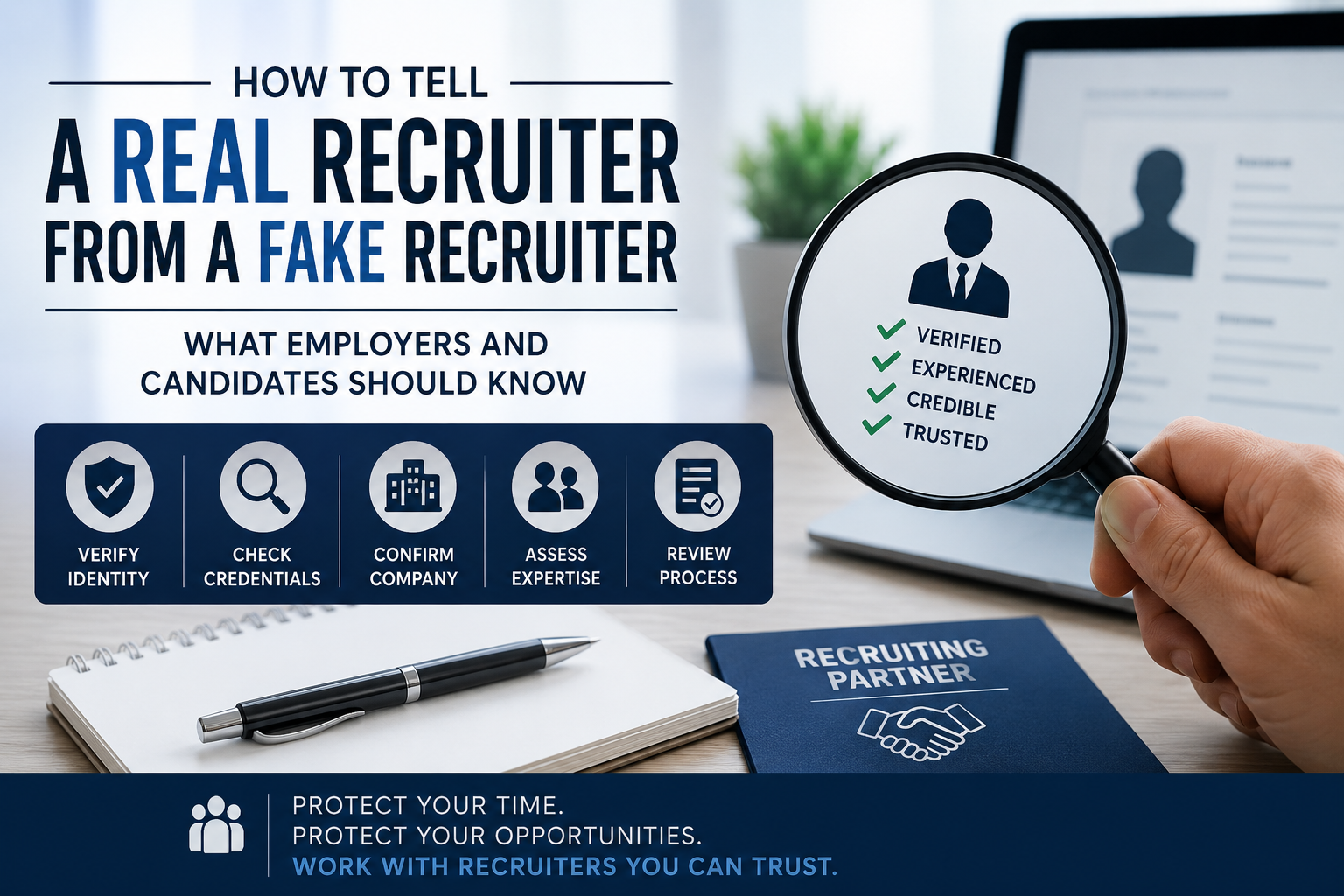
Recruiters regularly reach out to employers and candidates they have never spoken with before. That alone is not a red flag. In fact, proactive outreach is a normal part of professional recruiting.
But recruiter impersonation, misleading outreach, and questionable recruiting practices make it important to know who you are dealing with before you share sensitive information, sign an agreement, send money, or make an important hiring or career decision.
The key is verification.
A legitimate recruiter should be connected to a real recruiting business that you can independently verify. Their identity, contact information, company affiliation, and recruiting process should make sense when examined together.
And there is another important distinction:
A recruiter can be real without being the right recruiter for you.
Employers should verify both legitimacy and recruiting expertise. Candidates should verify both legitimacy and whether the recruiter appears to represent a credible opportunity.
How Can You Tell If a Recruiter Is Real?
Start by verifying the recruiting company independently.
Do not rely exclusively on a website, phone number, email address, or link supplied in the recruiter’s original message. Search for the company yourself and compare what you find with the information the recruiter provided.
Look for multiple consistent trust signals:
- Does the recruiting company have an established business presence?
- Does the recruiter’s email domain match the company’s legitimate website?
- Can you verify that the recruiter is associated with that company?
- Does the company’s publicly available contact information match what you have been given?
- Can you reach the company through an independently located phone number or contact method?
- Does the firm’s stated recruiting specialization make sense for the position being discussed?
- Is the recruiter able to explain the recruiting process clearly?
- Are the recruiter’s requests reasonable for the stage of the hiring process?
One unusual detail does not necessarily prove that someone is a fake recruiter. Instead, look for inconsistencies that cannot be reasonably explained or independently verified.
When in doubt, contact the recruiting company directly using contact information you find independently.
How Employers Can Verify a Recruiter
When an employer needs to fill a critical position, speed matters. An open engineering, construction, architecture, or manufacturing position can affect project schedules, production, delivery commitments, workloads, and business performance.
That urgency can also make it tempting to move quickly when a recruiter suddenly claims to have the perfect candidate.
Before relying on an unfamiliar recruiter, verify who you are dealing with.
Check the recruiting company
Search for the recruiting firm independently. Review its website, business presence, areas of specialization, and contact information.
If a recruiter claims to specialize in engineering but the firm’s public presence shows no meaningful connection to technical recruiting, ask questions.
Verify the recruiter’s company email
Look carefully at the domain after the @ symbol.
An impersonator may use an address that resembles a legitimate company’s domain but contains a small difference. A free email address is not automatic proof of fraud—independent recruiters may legitimately use one—but it can justify additional verification when someone claims to represent an established firm.
Contact the firm independently
If you are uncertain, find the recruiting company’s official contact information yourself and call.
Ask whether the individual contacting you actually works with the company.
This simple step can resolve many questions quickly.
Ask about the recruiting process
A legitimate recruiter should be able to explain how the relationship works.
Employers should understand important issues such as:
- how candidates will be presented
- what information the recruiter needs from the employer
- how communication will be handled
- what fees apply
- when fees become due
- what contractual terms govern the search
Do not enter a recruiting relationship when you do not understand the terms.
Evaluate the recruiter’s knowledge
Verification establishes that someone is real. It does not establish that they are qualified to handle your search.
If you need a mechanical engineer, superintendent, architect, manufacturing engineer, or another specialized professional, ask questions about the recruiter’s experience with that type of position.
A recruiter who does not understand the role may simply be a poor fit rather than fraudulent—but that distinction still matters when you need someone quickly.
How Candidates Can Verify a Recruiter
Candidates should know one thing immediately:
Receiving an unexpected message from a recruiter does not mean it is a scam.
Professional recruiters routinely identify and contact qualified people who never applied for a particular job. Finding potential candidates and starting those conversations is a fundamental part of recruiting.
Instead of judging the recruiter solely by whether you expected the message, verify the person and company behind it.
Research the recruiting company yourself
Search for the company independently and determine whether it has a legitimate business presence.
Compare its official website and contact information with what appears in the recruiter’s message.
Look closely at the email address
If someone claims to work for a specific recruiting firm, compare their email domain with the firm’s official domain.
Be especially cautious of domains that are almost—but not exactly—the same.
Verify the recruiter through the company
If anything feels inconsistent, contact the recruiting company through its publicly available contact information.
You can simply ask whether the person who contacted you is one of its recruiters.
Consider what the recruiter is asking for
The information requested should make sense for the stage of the recruiting process.
A recruiter may reasonably need information about your:
- professional experience
- technical skills
- education
- certifications
- location
- availability
- compensation expectations
- career interests
Requests involving money, financial account information, or highly sensitive personal information deserve significantly more scrutiny.
If you do not understand why information is being requested, ask before providing it.
Recruiter Scam Red Flags Candidates Should Know
Certain behaviors should prompt additional verification.
Watch for:
- A company identity you cannot verify. You cannot find a credible business corresponding to the recruiter’s claims.
- A suspicious email domain. The address imitates a legitimate company’s domain but is slightly different.
- Requests for money. Be particularly cautious when someone claiming to recruit you for employment unexpectedly asks you to pay them.
- Requests for sensitive financial information unusually early. The request does not make sense for the stage of the hiring process.
- Unrealistic promises. The recruiter guarantees employment, unusually high compensation, or an outcome they should not reasonably be able to guarantee.
- Pressure to act before verification. You are discouraged from asking questions or independently confirming the recruiter’s identity.
- Inconsistent information. Names, companies, email addresses, phone numbers, job details, or other information repeatedly fail to line up.
- Suspicious links or attachments. You are pushed to open files or visit questionable websites before you can verify who sent them.
No single signal needs to be treated as definitive proof. Look at the overall pattern and verify independently when something does not add up.
Recruiter Red Flags Employers Should Know
Employers face a somewhat different set of concerns.
An unfamiliar recruiter may be completely legitimate while still being a poor choice for a difficult search.
Questions deserve attention when a recruiter:
- cannot clearly identify the company they represent
- provides inconsistent contact or company information
- cannot explain their recruiting process
- provides unclear or confusing fee terms
- sends candidates without establishing expectations around representation and fees
- makes claims that cannot be verified
- appears to have little understanding of the position
- pressures the employer to proceed before terms are understood
- avoids normal business communication channels without a reasonable explanation
Again, separate fraud indicators from quality indicators.
A recruiter who does not understand your technical position may not be fake. They may simply lack the specialization required to recruit effectively for it.
For an employer with a critical vacancy, that can still be costly in terms of lost time.
Real Recruiter vs. Good Recruiter: They Are Not the Same Question
Once you establish that a recruiter is legitimate, ask the next question:
Is this the right recruiter for what I need?
For employers, that means evaluating factors such as:
Industry specialization. Does the recruiter regularly work with positions like yours?
Understanding of the role. Can the recruiter discuss the position intelligently enough to identify relevant candidates?
Recruiting process. Is there a clear process for understanding the requirement, identifying candidates, presenting them, and communicating throughout the search?
Responsiveness. Can you reach the recruiter when something changes or you need an answer?
Transparency. Do you understand the relationship, expectations, and fees?
Technical hiring experience. If the position is difficult to fill, does the recruiter understand the market they are searching?
Candidates can make similar evaluations.
A legitimate recruiter should communicate professionally, understand your background, explain the opportunity as clearly as circumstances permit, and establish reasonable expectations about what happens next.
What Does a Credible Specialized Recruiting Firm Look Like?
Specialization becomes particularly important when hiring technical professionals.
Finding someone who happens to have the correct job title is not necessarily the same as finding someone whose skills, experience, location, compensation requirements, and professional background align with the employer’s actual needs.
That is why employers hiring in fields such as engineering, architecture, construction, and manufacturing may benefit from working with recruiters who concentrate on those markets.
A specialized recruiting partner should be able to understand the hiring requirement, communicate intelligently about technical positions, establish a clear search process, and remain accessible as the search progresses.
Candidates can benefit from specialization as well. A recruiter familiar with their profession is better positioned to understand their experience, qualifications, and the types of opportunities that may be relevant.
Need Someone Immediately? Verify Quickly, Then Choose the Right Hiring Path
An urgent vacancy creates a practical problem: you need to perform appropriate due diligence without allowing verification to stall the search.
If a critical engineer leaves, a construction project needs a superintendent, or a manufacturing operation needs technical talent, employers have several options.
You may already have a trusted recruiting partner who can begin searching immediately. Your internal recruiting team may have an established pipeline. Employee referrals and professional networks can also produce strong candidates.
When those channels are not producing the talent you need—or when you do not have time to build a specialized candidate pipeline from scratch—another option is contacting a recruiting firm that already focuses on your market.
DAVRON specializes in recruiting for engineering, architecture, construction, and manufacturing positions. Rather than approaching technical hiring as one category among dozens of unrelated industries, DAVRON’s focus is built around these professional and technical markets.
For a hard-to-fill or urgent position, that specialization can give employers a more relevant starting point for the search.
What Should You Do If Someone Claims to Be From DAVRON?
If you receive an email, call, text, or other communication from someone claiming to represent DAVRON and you are uncertain whether it is legitimate, verify it.
Do not rely solely on the contact information contained in the message you are questioning. Locate DAVRON’s official contact information independently and contact the company directly.
This applies whether you are an employer being approached about recruiting services or a candidate being contacted about an opportunity.
DAVRON is a specialized recruiting and staffing firm focused on engineering, architecture, construction, and manufacturing. Employers and candidates should expect communications claiming to come from DAVRON to be consistent with a professional recruiting process in these markets.
Verification is not an inconvenience. It is reasonable due diligence.
Quick Recruiter Verification Checklist
Quick Recruiter Verification Checklist
Before trusting an unfamiliar recruiter, ask:
If I am an employer, are the recruiting terms and fees clear?
Are there inconsistencies I should verify before proceeding?
Am I being asked for money or sensitive information in circumstances that do not make sense?
Can I independently verify that the recruiting company exists?
Can I verify that this recruiter is actually associated with the company?
Does the recruiter’s email domain match the company’s legitimate domain?
Can I reach the recruiting company through contact information I found independently?
Is the recruiter’s communication consistent and professional?
Does the recruiter demonstrate reasonable knowledge of the job and industry?
Do the requests being made make sense at this stage of the process?
A real recruiter should withstand reasonable verification.
A good recruiter should go further: they should demonstrate the knowledge, specialization, communication, and recruiting process necessary to help an employer make a strong hire or help a candidate evaluate a legitimate opportunity.