
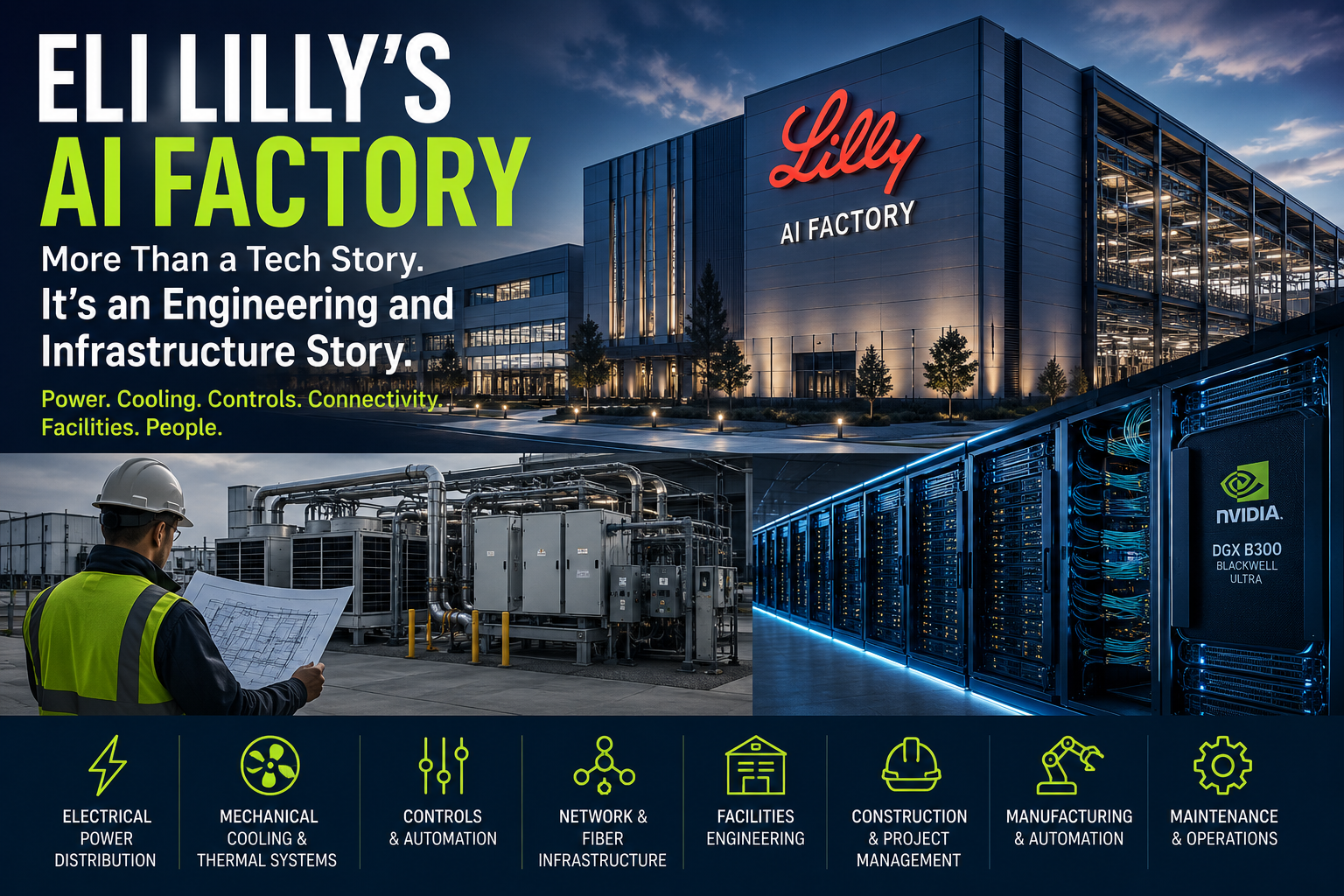
Eli Lilly’s new AI factory may sound like a story about artificial intelligence, GPUs, and drug discovery. But there is another side of the story that matters to engineering and manufacturing leaders:
AI at this scale has a physical footprint.
More computing requires power. High-density hardware produces heat that must be removed. Thousands of connections require network and fiber infrastructure. Complex equipment has to be installed, monitored, controlled, maintained, and kept operating reliably.
That means the growth of AI infrastructure is not only creating demand for software and data expertise. It is creating engineering, facilities, construction, manufacturing, automation, and operations challenges as well.
Lilly’s project makes that physical reality unusually visible.
The company announced its AI factory in October 2025 and brought the system, called LillyPod, online in February 2026. According to NVIDIA, the system contains 1,016 NVIDIA Blackwell Ultra GPUs, nearly 5,000 connections, more than 1,000 pounds of fiber cabling, and liquid cooling. Lilly says the infrastructure will support applications ranging from drug discovery to manufacturing, medical imaging, digital twins, robotics, and scientific AI.
For employers, that raises a bigger question:
What jobs and engineering skills are needed to build an AI factory?
An AI factory requires much more than AI researchers and software engineers. At a physical-infrastructure level, projects of this kind can require expertise in electrical systems, mechanical systems and cooling, controls and automation, networking, facilities, construction, commissioning, reliability, manufacturing, and ongoing operations.
Not every AI facility will require the same team, and Lilly has not publicly stated that it is hiring every role discussed below. But the infrastructure requirements demonstrate something important about the AI economy: the more computing becomes embedded in physical industries, the more important the engineering behind that computing becomes.
What Is an AI Factory?
An AI factory is specialized computing infrastructure designed to support the AI lifecycle at large scale.
When Lilly first announced its project, the company described the AI factory as infrastructure capable of handling the AI lifecycle from data ingestion and model training through fine-tuning and high-volume inference. Lilly partnered with NVIDIA on a DGX SuperPOD based on DGX B300 systems and a unified high-speed networking fabric.
The purpose goes well beyond running a chatbot.
Lilly plans to use the computing capacity to train biomedical models and analyze large volumes of experimental data in an effort to identify and optimize potential medicines. The company has also identified applications involving medical imaging, scientific AI agents, manufacturing, digital twins, and robotics.
That makes the term factory particularly appropriate.
AI requires inputs, infrastructure, processes, equipment, and people capable of keeping the system operating. And once AI begins interacting with manufacturing plants, robotics, laboratories, and other physical environments, the boundary between information technology and traditional engineering becomes even less distinct.
Why Is Eli Lilly Building Its Own AI Infrastructure?
Lilly wants greater computational capacity to accelerate how it discovers, develops, and manufactures medicines.
The company’s AI factory can train large biomedical foundation and frontier models for tasks such as identifying, optimizing, and validating molecules. Lilly has also said the infrastructure will support applications beyond discovery, including medical imaging and manufacturing.
Manufacturing is particularly significant from an engineering perspective.
Lilly and NVIDIA have described plans to use digital twins to model and stress-test manufacturing operations before making changes in the physical world. The companies are also exploring robotics and physical AI to increase manufacturing capacity and strengthen supply-chain reliability.
This is not merely theoretical. Lilly says it is already using AI-powered digital twins in its broader manufacturing operations to simulate configurations before physically implementing them. The company says these tools have helped increase production volume and accelerate the replication of manufacturing capabilities across facilities.
The result is an important shift for employers to understand: AI is moving out of purely digital environments and deeper into physical operations.
What Does an AI Factory Require Beyond GPUs?
GPUs get much of the attention because they provide the computational horsepower. But installing GPUs is not the same thing as creating functioning AI infrastructure.
The physical system around the computing equipment has to support it.
Electrical infrastructure and power distribution
High-performance computing depends on reliable electrical infrastructure.
At larger scales, organizations have to consider how power reaches computing equipment, how loads are distributed, how electrical systems are protected, and how infrastructure is designed around reliability and uptime.
Lilly has said it aims for LillyPod to operate on 100% renewable electricity by 2030.
That power requirement makes electrical infrastructure an inseparable part of the AI conversation.
Mechanical systems and advanced cooling
Computing equipment converts electrical energy into heat, and increasingly dense computing systems make thermal management a major engineering challenge.
LillyPod uses liquid cooling, according to NVIDIA.
At the infrastructure level, cooling can involve mechanical systems, pumps, piping, heat exchange, controls, redundancy, monitoring, and careful coordination with electrical and computing equipment.
The more powerful the computing environment becomes, the less reasonable it is to treat cooling as an afterthought.
Network and fiber infrastructure
An AI factory is also a communications system.
Lilly’s system uses a unified high-speed network, and NVIDIA reports that LillyPod has nearly 5,000 connections incorporating more than 1,000 pounds of fiber cabling.
Moving enormous amounts of data quickly between GPUs, storage, and other systems requires network architecture and physical connectivity capable of supporting that traffic.
Controls and monitoring
Large technical facilities have to be observable and controllable.
NVIDIA says its Mission Control software allows Lilly to orchestrate workloads, monitor system performance, and automate AI operations.
Beyond the computing layer, sophisticated facilities can also depend on controls and monitoring for electrical systems, cooling, environmental conditions, equipment performance, alarms, and facility operations.
Facilities, construction, and commissioning
All of this equipment has to exist somewhere.
Physical infrastructure has to be designed, installed, integrated, tested, commissioned, and maintained. Different projects may involve facility engineers, construction managers, project managers, commissioning professionals, contractors, equipment specialists, and technical operations personnel.
That is why an AI factory cannot be viewed exclusively as an IT project.
It is also an infrastructure project.
What Engineers Are Needed to Build and Operate an AI Factory?
The precise staffing model depends on the project, facility, ownership structure, contractors, and technology involved. However, large-scale AI infrastructure can create demand for several engineering disciplines.
Electrical Engineers
Electrical engineers can be critical to the power infrastructure supporting high-performance computing.
Relevant work can include:
- power distribution
- electrical equipment specification
- system protection
- redundancy and reliability
- backup-power integration
- equipment coordination
- monitoring
- capacity planning
As computing density rises, the relationship between computing strategy and electrical engineering becomes increasingly important.
Mechanical Engineers
Mechanical engineers address another fundamental constraint: heat.
Depending on the facility, mechanical engineering responsibilities can include:
- liquid cooling
- HVAC systems
- piping
- pumps
- heat exchangers
- heat rejection
- equipment selection
- thermal management
- energy efficiency
LillyPod’s use of liquid cooling is a concrete example of how advanced computing becomes a mechanical-engineering problem as well as a computational one.
Controls and Automation Engineers
Controls engineers help connect equipment, sensors, monitoring, and automated decision-making.
That expertise becomes especially relevant as AI moves into manufacturing.
Lilly has specifically identified digital twins and robotics as manufacturing applications for its AI capabilities. Its other announced U.S. manufacturing investments also incorporate technologies such as automated systems, digitally integrated monitoring, machine learning, and AI.
Those environments create a natural intersection between software intelligence and industrial automation.
Data-Center and Facilities Engineers
AI hardware cannot deliver value if the supporting facility cannot operate reliably.
Facilities professionals can be responsible for coordinating power, cooling, environmental conditions, infrastructure capacity, preventive maintenance, uptime, safety, and other systems required to keep technical environments functioning.
These roles become particularly important when equipment downtime carries significant operational or financial consequences.
Network and Fiber Infrastructure Professionals
The thousands of physical connections inside LillyPod illustrate another easily overlooked requirement.
AI computing depends on data moving quickly and reliably among processors, storage, and other infrastructure.
That creates a need for expertise in high-speed networking, fiber infrastructure, network architecture, installation, testing, and troubleshooting.
Manufacturing Engineers
The engineering implications extend beyond the data center.
Lilly and NVIDIA are exploring AI-enabled manufacturing, digital twins, robotics, and physical AI. Digital twins can allow engineers and operations teams to test manufacturing changes virtually before implementing them on an actual production line.
That makes manufacturing engineers particularly important because someone still has to understand the real process the digital system is attempting to model and improve.
Construction Professionals and Project Managers
Complex technical facilities require coordination across disciplines.
Construction managers, project managers, superintendents, schedulers, estimators, and other project professionals may be involved depending on the scale and scope of an AI infrastructure build.
Their challenge is not simply completing a building. They may have to coordinate specialized equipment, contractors, utilities, mechanical and electrical systems, schedules, testing, commissioning, and strict operational requirements.
Maintenance, Reliability, and Operations Professionals
An AI facility does not stop needing talent once construction ends.
Equipment has to be inspected and maintained. Failures have to be diagnosed. Cooling and electrical systems must remain reliable. Operating conditions need monitoring.
As organizations become more dependent on computational infrastructure, reliability becomes a business issue—not merely a maintenance issue.
Will AI Increase Demand for Electrical, Mechanical, Controls, and Manufacturing Engineers?
AI could automate portions of many jobs, including engineering work. But that does not mean the physical expansion of AI eliminates the need for engineers.
In many cases, it creates new problems for them to solve.
More AI infrastructure can mean more:
- electrical capacity
- cooling infrastructure
- high-speed connectivity
- controls and monitoring
- specialized facilities
- automation
- robotics
- manufacturing integration
- reliability requirements
- technical maintenance
The effect is particularly visible when AI moves into manufacturing and other physical environments.
A digital twin still represents a physical system. A robot still interacts with machinery and production processes. An AI-enabled manufacturing line still depends on controls, sensors, mechanical equipment, electrical infrastructure, maintenance, and people who understand how the process actually works.
Lilly’s own plans demonstrate this convergence. Its AI strategy spans computational drug discovery while also extending into robotics, digital twins, manufacturing, and physical AI.
The future of AI is therefore not purely a software story.
It is also an engineering story.
Why AI Infrastructure Can Become a Recruiting Challenge
This is where the technology trend becomes an immediate employer issue.
The talent required for sophisticated infrastructure is often specialized.
An employer may not simply need an electrical engineer. It may need an electrical engineer who understands mission-critical power systems.
It may not simply need a mechanical engineer. It may need someone experienced with high-density cooling or complex industrial facilities.
A controls position might require a specific combination of automation platforms, manufacturing experience, robotics, instrumentation, or process knowledge.
Construction leadership may need experience delivering technically demanding facilities while coordinating multiple engineering disciplines.
And manufacturing positions may increasingly require candidates who can operate at the intersection of traditional production systems, automation, data, and AI-enabled technologies.
Those combinations can substantially narrow the candidate pool.
When the position is tied to a major capital project, facility launch, production expansion, commissioning milestone, or reliability problem, leaving the position vacant can become more than a recruiting inconvenience.
It can become an execution problem.
Projects can lose momentum. Existing technical teams absorb additional workload. Commissioning or implementation can become harder to coordinate. Production and operational goals may be affected.
That makes specialized recruiting increasingly relevant as companies invest in more technically complex infrastructure.
What Should Employers Do When They Need Specialized Engineering Talent Quickly?
Employers facing an urgent technical vacancy have several ways to expand the available talent pool.
Look beyond exact industry matches. A candidate from a neighboring industry may have highly transferable experience in power systems, thermal management, controls, automation, mission-critical facilities, or advanced manufacturing.
Expand the geographic search. Highly specialized engineers may simply not exist in sufficient numbers within a narrow commuting radius. Relocation or broader regional recruiting can open substantially more possibilities.
Separate true requirements from preferences. Long lists of mandatory technologies, credentials, and industry experience can unintentionally eliminate candidates capable of doing the job. Determine which qualifications are genuinely necessary on day one.
Build pipelines before the need becomes critical. Organizations planning capital investments or facility expansions should identify difficult positions early rather than waiting until a missing hire threatens the schedule.
Use specialized recruiting when internal reach is not enough. When a role is highly technical, business-critical, or urgent, a recruiting partner that already works within technical markets can help employers reach candidates who may not be actively responding to job advertisements.
DAVRON specializes in recruiting engineering, architecture, construction, and manufacturing professionals. For employers building advanced facilities, expanding manufacturing operations, implementing automation, or searching for hard-to-find technical expertise, that specialization matters.
The objective is not simply generating more résumés.
It is identifying qualified candidates whose experience actually aligns with the technical and operational problem the employer needs to solve.
What Does Lilly’s AI Factory Mean for the Future of Engineering Jobs?
LillyPod offers a useful preview of a much larger infrastructure trend.
Its 1,016 GPUs are impressive. But the physical details surrounding those GPUs may be even more instructive for engineering employers: liquid cooling, thousands of connections, extensive fiber infrastructure, high-speed networking, power requirements, monitoring, and an operational environment that has to function reliably.
Then consider what happens when the intelligence generated by that infrastructure moves into the physical world.
Lilly is pursuing digital twins, robotics, manufacturing optimization, real-time monitoring, and other applications that connect computation to actual facilities and production systems.
Each connection between AI and the physical world creates engineering questions.
How do you power it?
How do you cool it?
How do you control it?
How do you integrate it with existing equipment?
How do you build the facility?
How do you keep it running?
How do you make it safe, reliable, and efficient?
And, ultimately:
Who has the technical expertise to do all of that?
That may be one of the most important workforce implications of the AI infrastructure boom.
AI doesn’t eliminate the need for engineers. It creates enormous new engineering problems—and companies still need qualified people to solve them.
Ready to hire engineering, architecture, construction, or manufacturing professionals?
DAVRON specializes in delivering high-quality candidates in these industries.