
When a mechanical engineer, construction superintendent, architect, project manager, or manufacturing engineer leaves, the problem can become urgent very quickly.
Projects still have deadlines. Production still has to run. Clients still expect results. The rest of the team absorbs the workload while managers try to find someone with the right technical experience—and hopefully someone who will stay.
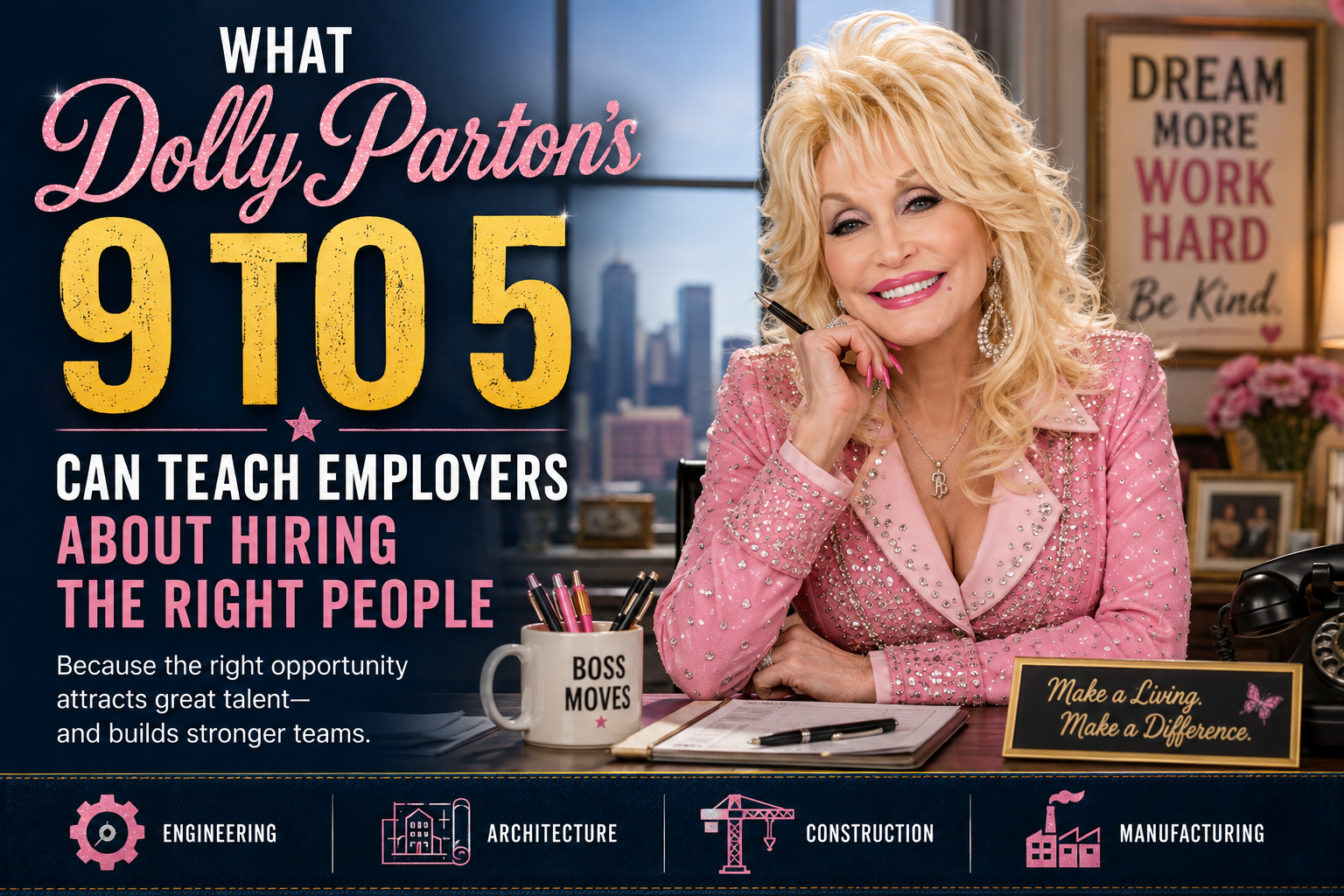
That is where an unlikely hiring lesson can be found in Dolly Parton’s “9 to 5.”
The workplace has changed considerably since the song became a cultural touchstone, but many of the frustrations associated with it remain familiar: employees want to be compensated fairly, respected for their contributions, given opportunities to grow, and treated as though their work matters.
For employers, there is an important lesson here.
Finding someone who can do the job is only part of making the right hire. You also need to give the right person a reason to choose the job—and a reason to stay.
Compensation Matters, but It Isn’t the Whole Job
Salary is important. Employers recruiting technical professionals need compensation that makes sense for the position, required experience, location, and available talent pool.
But compensation alone does not determine whether a qualified candidate accepts an offer.
Candidates may also consider:
- The responsibilities and authority that come with the position
- Opportunities for advancement
- The quality of management and leadership
- Whether strong performance will be recognized
- Flexibility when the nature of the position allows it
- The types of projects or products they will work on
- Company stability and future opportunities
- Team dynamics and workplace environment
This becomes particularly important when recruiting experienced professionals who are already employed.
A successful mechanical engineer or construction project manager may have little reason to leave a secure position simply because another employer has an opening. The new opportunity has to provide a compelling reason to make a change.
Employers therefore need to understand not only “What qualifications do we need?” but also “Why would someone with those qualifications want this job?”
That question can make a significant difference in recruiting.
Great Candidates Are Evaluating the Employer, Too
An interview isn’t a one-way evaluation.
While the hiring manager is determining whether a candidate has the right experience, the candidate is making a decision about the employer.
Strong candidates are likely trying to understand questions such as:
- Why is the position open?
- What will I actually be responsible for?
- What does success look like?
- Who will I report to?
- How much authority will I have?
- Is there room to advance?
- What is the management style?
- Why do good employees stay here?
- Is this opportunity better than the position I already have?
Employers should be prepared to answer those questions clearly.
Consider two companies pursuing the same qualified engineer.
One provides a vague job description, takes weeks between interviews, gives unclear answers about responsibilities, and cannot explain the career path.
The other clearly communicates the position’s purpose, projects, expectations, compensation, leadership structure, and opportunities for growth—and moves decisively when the candidate is interested.
Even if the positions look similar on paper, they may not look similar to the candidate.
Recruiting is partly about identifying talent and partly about communicating why the opportunity deserves that talent.
The Right Hire Requires More Than a Résumé Match
Technical hiring can become difficult because the ideal candidate often needs a very specific combination of qualifications.
An employer may need to consider:
- Technical experience
- Software and systems knowledge
- Licenses or certifications
- Industry experience
- Project type and scale
- Leadership experience
- Client-facing or communication abilities
- Location
- Travel requirements
- Compensation expectations
- Career goals and motivations
That can shrink the realistic candidate pool quickly.
A résumé containing the right keywords does not necessarily mean the candidate can perform the job. Conversely, an experienced candidate who does not perfectly mirror the job description may have transferable skills that make them an excellent hire.
This is one reason specialized recruiting can be valuable for engineering, architecture, construction, and manufacturing employers.
A recruiter who regularly works with technical positions can approach the search as more than a keyword exercise. The objective is to understand which qualifications truly determine success, identify people who fit those requirements, and determine whether the opportunity aligns with what those candidates want next.
Slow Hiring Can Cost You the Candidate
When an important position is vacant, employers often face two competing concerns.
They need someone quickly.
But they do not want urgency to cause a bad hiring decision.
The answer is not necessarily to lower hiring standards. It is to remove unnecessary delays.
Employers can accelerate technical hiring by:
- Define the true requirements before beginning the search. Separate qualifications that are genuinely essential from preferences that unnecessarily narrow the candidate pool.
- Agree on compensation and decision-making authority early. Discovering late in the process that managers disagree about salary or approvals can cost valuable time.
- Schedule interviews quickly. When a promising candidate is identified, unnecessary scheduling delays give other employers an opportunity to move first.
- Provide timely feedback. Recruiters and candidates can respond much more effectively when hiring managers communicate clearly after interviews.
- Remove interview stages that do not improve the decision. Every step should have a purpose.
- Consider specialized recruiting when internal sourcing isn’t producing enough qualified candidates. A difficult search does not necessarily improve simply by leaving the same job posting online longer.
This is where DAVRON can support employers facing hard-to-fill technical positions.
DAVRON specializes in recruiting for engineering, architecture, construction, and manufacturing. Rather than approaching these positions as part of a broad, general staffing market, DAVRON’s recruiting focus is built around the industries where technical qualifications and niche experience frequently matter.
Hiring for Retention Starts Before the Offer
There is another lesson employers can take from the workplace frustrations that made “9 to 5” resonate with so many people.
Recruiting should not be about convincing someone to accept a job at any cost.
It should be about creating an accurate match.
If a position involves extensive travel, candidates should understand that.
If advancement opportunities are limited, employers should not imply otherwise.
If the position requires someone to enter a challenging environment and solve difficult problems, that should be discussed honestly.
Likewise, employers should understand what the candidate expects from the opportunity.
A technically qualified candidate can still be the wrong hire when there is a significant mismatch involving responsibilities, management expectations, career goals, compensation, travel, location, or workplace environment.
Getting those expectations into the open during recruiting gives both sides a better opportunity to make an informed decision.
Retention does not begin on an employee’s first day. It begins with an honest recruiting process.
What Should You Do When the Position Needs to Be Filled Now?
Sometimes an employer does not have months to experiment with different recruiting approaches.
A project may already be understaffed. A critical employee may have resigned. Production needs may have increased. A new contract may require additional technical expertise. Existing employees may be absorbing responsibilities that cannot remain redistributed indefinitely.
When the need is urgent, employers have several options.
Use Your Internal Recruiting Team
For organizations with experienced internal recruiters, established sourcing tools, and a strong pipeline of technical candidates, internal recruiting may be the most straightforward solution.
The key question is whether the team has the capacity and specialized knowledge required for this particular search.
If recruiters are already managing numerous positions—or rarely recruit for the technical specialty involved—the search can take longer than anticipated.
Activate Employee Referrals and Professional Networks
Employees, managers, vendors, industry contacts, and professional associations can sometimes connect an employer with strong candidates.
Referrals can be especially valuable in specialized industries where professionals know others with similar expertise.
The limitation is reach. A referral network may produce an excellent candidate, but it may also produce no one who is both qualified and interested.
Use Direct Sourcing
Instead of waiting for applicants, employers can proactively identify professionals whose experience appears to match the position and contact them directly.
This can expand the candidate pool to people who are not actively applying for jobs.
However, direct sourcing takes time. Someone needs to identify potential candidates, approach them, establish interest, evaluate qualifications, and maintain communication throughout the process.
Reconsider Unnecessary Hiring Restrictions
When a search stalls, review the requirements.
Does the successful candidate truly need every qualification listed in the job description?
Could someone with adjacent industry experience succeed?
Can a particular software package be learned?
Is the requested number of years of experience essential, or is demonstrated capability more important?
This does not mean compromising on qualifications that affect safety, licensing, technical competency, or successful job performance.
It means distinguishing genuine requirements from preferences.
Engage a Specialized Recruiter
When a position is highly technical, difficult to fill, business-critical, or already affecting operations, an external recruiting partner can add another dedicated search channel.
This can be particularly useful when the employer needs access to candidates beyond those responding to job advertisements.
DAVRON focuses specifically on engineering, architecture, construction, and manufacturing recruiting and supports employers searching for hard-to-fill technical professionals. That specialization is particularly relevant when understanding the position and identifying appropriately qualified candidates matters as much as generating applicants.
So, What Does “9 to 5” Really Teach Us About Hiring?
The useful lesson isn’t that workplaces today are identical to those of decades ago.
They aren’t.
Technology has changed. Recruiting has changed. Career paths have changed. Expectations around flexibility, communication, leadership, and advancement have evolved.
But some fundamental questions have remained surprisingly durable.
Am I being compensated fairly?
Does my work matter?
Will my contribution be recognized?
Can I grow here?
Do I respect the people I work for?
Is this somewhere I want to spend a significant part of my life?
Employers who understand those questions can recruit differently.
Instead of viewing hiring solely as a search for someone who satisfies a list of requirements, they can evaluate both sides of the match:
Does this candidate have a compelling reason to succeed here, and does our company have a compelling reason to hire this candidate?
That is a much stronger foundation for a successful hire.
When Does Specialized Recruiting Make Sense?
Not every open position requires an outside recruiter.
If your company has a healthy candidate pipeline, adequate internal recruiting resources, and plenty of qualified applicants, an internal search may work perfectly well.
Specialized recruiting becomes more valuable when:
- The internal search has stalled
- Qualified applicants are scarce
- The position requires niche technical expertise
- Hiring managers are spending too much time sourcing candidates
- The vacancy is affecting projects, production, deadlines, or growth
- The company needs to reach professionals who are not actively applying
- The position needs to be filled quickly without abandoning hiring standards
DAVRON’s recruiting specialization is focused on engineering, architecture, construction, and manufacturing—industries where technical requirements can make the difference between simply finding applicants and finding candidates who actually fit the position.
The ultimate hiring lesson is simple:
Don’t just look for someone willing to work 9 to 5. Look for the right person to do work that matters to your business—and give that person a reason to choose you.
Ready to hire engineering, architecture, construction, or manufacturing professionals?
DAVRON specializes in delivering high-quality candidates in these industries.