
Losing a valuable employee can cost a company far more than the expense of finding a replacement. When an experienced engineer resigns, a construction superintendent leaves midway through a project, or a skilled manufacturing professional accepts another opportunity, the consequences can include production disruptions, missed deadlines, lost institutional knowledge, and increased workloads for the remaining team.
Competitive salaries are important, but compensation alone does not guarantee employee loyalty. Employees also want to know that their contributions matter, their professional growth is supported, and their employer respects their time and expertise.
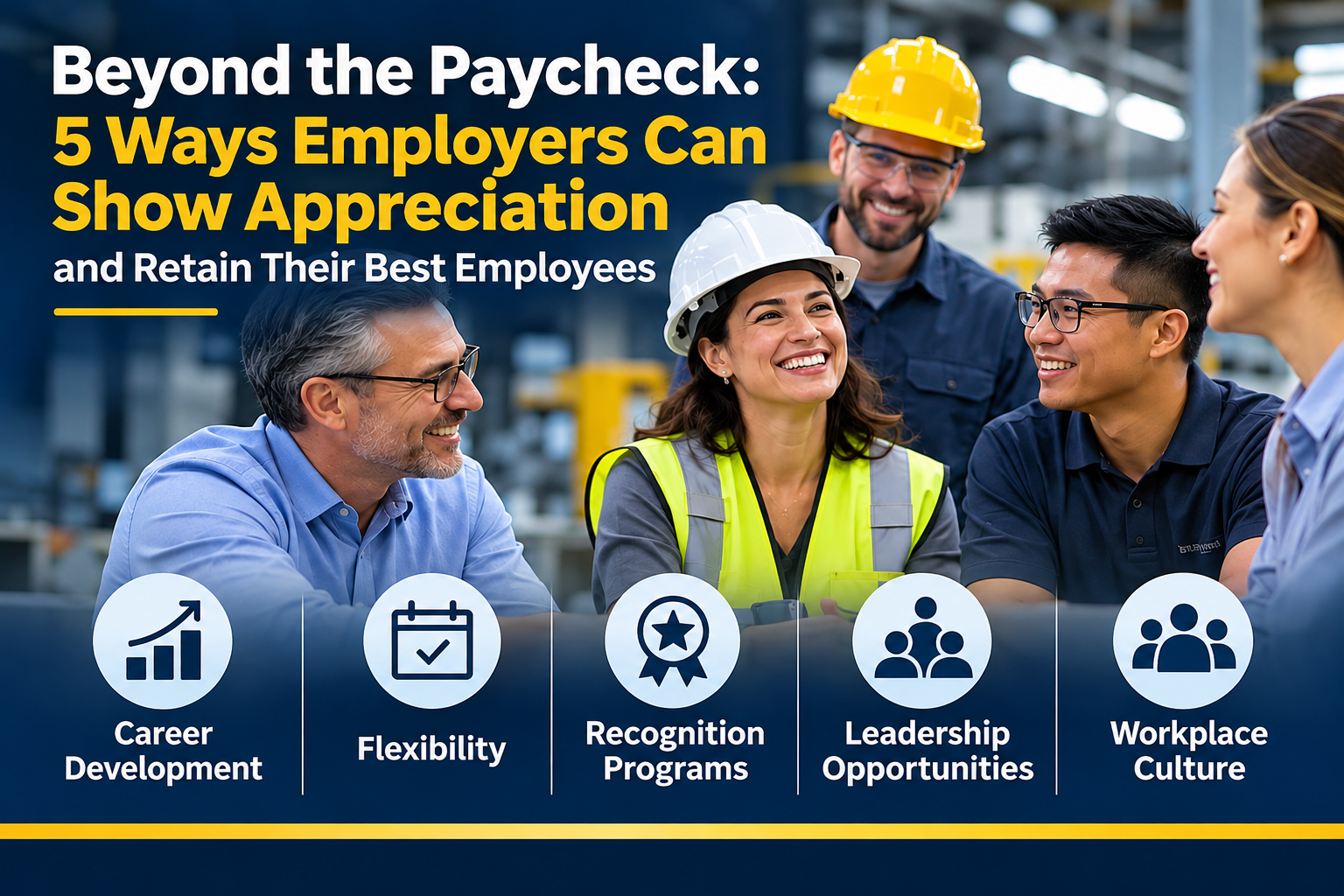
The five most effective ways employers can demonstrate appreciation beyond salary are investing in career development, offering meaningful flexibility, recognizing employee contributions, providing leadership opportunities, and creating a respectful workplace culture.
For companies in engineering, architecture, construction, and manufacturing, these strategies can help protect valuable technical talent, improve workforce stability, and reduce the business risks associated with employee turnover.
1. Invest in Career Development and Professional Growth
One of the most meaningful ways employers can show appreciation is by investing in an employee’s future.
Talented professionals want opportunities to develop new skills, expand their responsibilities, and advance their careers. When employees feel that their professional growth has stalled, they may begin looking elsewhere—even when they are satisfied with their compensation.
Employers can demonstrate their commitment to professional development by:
Funding certifications and continuing education. Support engineers pursuing professional licensure, construction professionals earning project management credentials, and manufacturing employees developing specialized technical skills.
Creating clear advancement opportunities. Help employees understand what qualifications, experience, and performance are required to move into more senior positions.
Offering mentorship programs. Pair less experienced professionals with established technical leaders who can provide guidance and career advice.
Supporting industry conferences and training. Give employees opportunities to learn about new technologies, regulations, processes, and industry developments.
Conducting regular career conversations. Discuss employees’ professional goals before they feel compelled to explore opportunities elsewhere.
For example, a manufacturing company that provides advanced automation training to an experienced maintenance technician demonstrates that it values the employee’s long-term contribution. The company may also benefit from stronger technical capabilities and improved operational efficiency.
Similarly, an engineering firm that supports an employee pursuing a Professional Engineer license can strengthen both the individual’s career prospects and the organization’s technical expertise.
The employer takeaway: Career development communicates that employees are valued as long-term contributors, not simply as people filling immediate staffing needs.
2. Offer Flexibility That Respects Employees’ Lives
Flexibility has become an important consideration for many professionals, but meaningful flexibility does not necessarily mean allowing everyone to work remotely.
For employers in technical industries, flexibility must reflect operational requirements, project schedules, safety responsibilities, and customer commitments.
A construction superintendent cannot supervise an active jobsite entirely from home. A manufacturing technician may need to be physically present to maintain production equipment. However, these realities do not prevent employers from offering scheduling arrangements that improve work-life balance.
Practical approaches include:
Flexible start and finish times: Allow eligible employees to adjust their schedules around personal responsibilities.
Hybrid arrangements: Offer remote work opportunities for engineering, design, estimating, and administrative roles when job responsibilities permit.
Predictable shift schedules: Give manufacturing employees sufficient advance notice of shift assignments and schedule changes.
Thoughtful overtime management: Monitor excessive workloads and provide recovery time when operationally feasible.
Flexible time-off arrangements: Make it easier for employees to manage family obligations, medical appointments, and personal commitments.
Improved project scheduling: Reduce unnecessary last-minute changes that disrupt employees’ personal lives.
For example, an engineering consulting firm might allow design engineers to work remotely on designated days while requiring in-person collaboration for project reviews and client meetings.
A manufacturing facility might improve employee satisfaction by publishing production schedules earlier and reducing unexpected shift changes.
These arrangements can demonstrate respect without compromising business requirements.
The employer takeaway: Flexibility is not about eliminating accountability. It is about giving employees reasonable control over their time while maintaining operational performance.
3. Recognize Employee Contributions in Meaningful Ways
Employees want to know that their work makes a difference.
Unfortunately, many organizations only acknowledge exceptional performance during annual reviews or when major projects are completed. This can leave employees feeling that their everyday contributions go unnoticed.
Effective recognition programs do not need to be expensive or complicated. They need to be consistent, specific, and genuine.
Employers can recognize employees through:
Personalized acknowledgment: Thank employees directly for specific accomplishments rather than relying on generic praise.
Project milestone celebrations: Recognize teams that complete important assignments, meet demanding deadlines, or overcome technical challenges.
Peer recognition programs: Encourage employees to acknowledge colleagues who demonstrate teamwork, reliability, and problem-solving.
Safety recognition: Celebrate employees who identify hazards, improve procedures, or contribute to safer working conditions.
Innovation awards: Recognize ideas that improve efficiency, reduce waste, or solve operational problems.
Service milestones: Acknowledge employees who have contributed to the organization over many years.
Consider an engineer who identifies a design problem before it creates costly rework. A manager who publicly recognizes that contribution reinforces the importance of technical judgment and proactive problem-solving.
Likewise, a manufacturing employee who develops a more efficient production process should receive recognition for the improvement—not simply be expected to produce more.
Recognition is most effective when employees understand exactly what they accomplished and why it mattered.
However, employers should avoid using recognition programs as substitutes for fair compensation, reasonable workloads, or effective management.
The employer takeaway: Meaningful recognition reinforces valuable behaviors while showing employees that their expertise, effort, and contributions are appreciated.
4. Give Employees Leadership Opportunities and a Voice in Decisions
Appreciation is not always expressed through rewards. Sometimes, one of the strongest ways to demonstrate trust is to give employees greater responsibility and influence.
Experienced professionals often want opportunities to shape decisions, improve processes, and contribute beyond their immediate job descriptions.
When organizations consistently exclude employees from decisions affecting their work, they risk overlooking valuable expertise and creating frustration.
Employers can demonstrate appreciation by:
Giving qualified employees ownership of important projects.
Inviting technical professionals to participate in operational planning.
Creating mentorship and team leadership opportunities.
Encouraging employees to recommend improvements to existing processes.
Including frontline employees in discussions about equipment, safety, and workflow changes.
Acting on employee suggestions and explaining decisions when recommendations cannot be implemented.
For example, a construction company might invite experienced superintendents to help improve project scheduling procedures. Their practical knowledge of jobsite operations can help leadership identify problems that are not obvious from an office.
A manufacturing organization might create a continuous improvement committee that includes production operators, maintenance personnel, and engineering staff.
An architecture firm could give a promising project architect responsibility for coordinating a multidisciplinary design initiative under appropriate supervision.
These opportunities can help employees build leadership skills while giving organizations access to perspectives that improve business decisions.
Importantly, additional responsibility should come with appropriate authority, resources, support, and compensation when duties materially expand.
The employer takeaway: Employees who have meaningful influence over their work may develop stronger professional ownership and a deeper connection to the organization.
5. Build a Workplace Culture Where Employees Feel Respected
An occasional employee appreciation lunch cannot compensate for poor management, excessive workloads, or an unhealthy workplace environment.
Employee appreciation must be reflected in how people are treated every day.
For technical organizations, workplace culture has direct implications for collaboration, safety, project execution, and employee retention.
Employers can build a stronger culture by focusing on several essential practices.
Communicate openly and consistently. Employees should understand organizational priorities, project expectations, and changes that affect their responsibilities.
Hold managers accountable. Supervisors should demonstrate professionalism, provide constructive feedback, and address employee concerns respectfully.
Prioritize workplace safety. In construction and manufacturing environments, providing appropriate training, equipment, and safe working conditions demonstrates a fundamental commitment to employees’ well-being.
Manage workloads responsibly. Persistent understaffing and unreasonable deadlines can contribute to burnout, frustration, and turnover.
Encourage collaboration. Create an environment where employees can share knowledge, ask questions, and solve problems without unnecessary conflict.
Respond to employee feedback. Surveys and feedback meetings have limited value unless leadership evaluates concerns and communicates meaningful follow-up actions.
For example, a construction company that consistently listens to field employees about safety concerns demonstrates respect through action.
Similarly, an engineering firm that addresses unrealistic project workloads before employees become overwhelmed shows that leadership values sustainable performance.
A positive workplace culture does not mean eliminating every disagreement or challenge. It means establishing an environment where employees are treated fairly, concerns are addressed professionally, and expectations are clear.
The employer takeaway: Appreciation becomes credible when employees experience respect through daily management decisions, not just occasional recognition events.
How Can Employers Measure Whether Employee Appreciation Is Working?
Employee appreciation should be treated as an ongoing workforce strategy rather than a collection of isolated activities.
To determine whether their efforts are producing meaningful results, employers should monitor several indicators.
| Workforce metric | What employers should evaluate |
|---|---|
| Voluntary turnover | Whether employees are leaving less frequently over time |
| High-performer retention | Whether valuable and difficult-to-replace employees remain with the organization |
| Employee engagement | Whether employees report feeling valued, supported, and respected |
| Internal promotions | Whether professional development is creating advancement opportunities |
| Training participation | Whether employees are using available development resources |
| Exit interview feedback | Whether departing employees identify recurring management or workplace concerns |
| Employee referrals | Whether employees are willing to recommend the organization to other professionals |
Employers should review these indicators regularly and compare results across departments, job functions, and management teams.
For example, if one manufacturing department experiences significantly higher turnover than others, leadership should investigate possible differences in scheduling, supervision, workload, and advancement opportunities.
If an engineering firm loses several experienced professionals despite competitive salaries, the underlying issue may involve career progression, leadership, or project demands.
No single metric proves that an appreciation initiative is successful. However, consistent evaluation can help employers identify workforce problems before they become more expensive.
What Happens When Employee Appreciation Comes Too Late?
One of the greatest mistakes employers can make is waiting until an employee resigns to demonstrate how much that person is valued.
By the time an experienced professional accepts another offer, the organization may have already lost an opportunity to address the concerns that influenced the decision.
For employers in technical industries, the consequences can be substantial.
When a senior engineer leaves, ongoing projects may lose important technical knowledge and continuity.
When a construction superintendent departs unexpectedly, project coordination, subcontractor communication, and scheduling can become more difficult.
When a skilled manufacturing technician resigns, remaining employees may need to absorb additional responsibilities while the company searches for a qualified replacement.
The financial impact can extend beyond recruiting expenses to include:
Reduced productivity during the vacancy.
Overtime costs for remaining employees.
Training and onboarding requirements.
Potential project delays.
Lost institutional knowledge.
Increased pressure on managers and technical teams.
Disruptions to customer or client relationships.
These risks are particularly important when an employee possesses specialized skills that are difficult to replace quickly.
Employers should not assume that appreciation programs alone can eliminate turnover. Employees leave for many reasons, including relocation, retirement, career changes, and opportunities that an existing employer cannot reasonably match.
However, organizations that invest in meaningful appreciation and retention practices may be better positioned to maintain a stable, engaged workforce.
When Retention Isn’t Enough: How DAVRON Helps Employers Strengthen Their Workforce
Even companies with excellent workplace cultures eventually need to replace departing employees, expand their teams, or recruit professionals with specialized skills.
For employers in engineering, architecture, construction, and manufacturing, filling these positions can be particularly challenging when projects are already underway or production demands cannot wait.
An unexpected vacancy in a business-critical role can create immediate pressure. Delaying the hiring process may increase workloads, strain existing teams, and affect operational performance.
This is where working with a specialized recruiting partner can provide valuable support.
DAVRON specializes in recruiting professionals for engineering, architecture, construction, and manufacturing organizations.
Rather than approaching technical hiring as a general staffing exercise, DAVRON focuses on the requirements and hiring challenges associated with these industries.
Employers can work with DAVRON to identify qualified candidates for positions such as:
Mechanical, electrical, civil, and manufacturing engineers.
Architects and architectural professionals.
Construction project managers and superintendents.
Technical and engineering leadership positions.
Manufacturing management and specialized technical roles.
DAVRON’s industry specialization helps employers approach difficult hiring requirements with a recruiting partner familiar with technical positions and their importance to business operations.
For organizations experiencing unexpected turnover, expanding into new markets, or struggling to fill specialized positions, a focused recruiting process can help support workforce continuity.
Employers should continue investing in employee appreciation and retention while also maintaining a proactive strategy for future hiring needs.
The strongest workforce strategies address both sides of the equation: keeping valuable employees and recruiting qualified professionals when new talent is needed.
Frequently Asked Questions About Employee Appreciation and Retention
What are the best ways to show employee appreciation without giving raises?
Employers can demonstrate appreciation through professional development opportunities, flexible scheduling, meaningful recognition, leadership responsibilities, and a respectful workplace culture. These strategies show employees that their contributions and long-term career goals matter. However, appreciation initiatives should complement—not replace—fair and competitive compensation.
How does employee recognition affect retention?
Meaningful employee recognition can strengthen employees’ sense of belonging, reinforce positive contributions, and improve their relationship with managers. When recognition is specific, consistent, and genuine, it can support engagement and retention. Its effectiveness depends on broader workplace conditions, including compensation, management quality, and career opportunities.
What employee appreciation strategies work best in manufacturing?
Manufacturing employers can focus on predictable schedules, technical training, safety recognition, advancement opportunities, and employee involvement in process improvements. Recognizing production achievements and listening to frontline employees can also demonstrate respect for their expertise.
How can construction companies recognize field employees?
Construction companies can recognize field employees by celebrating project milestones, acknowledging safety contributions, providing professional development, improving scheduling practices, and involving experienced field personnel in operational decisions. Recognition should reflect the practical challenges and responsibilities of jobsite work.
Why is career development important for retaining engineers?
Engineers often value opportunities to solve increasingly complex problems, expand their technical expertise, earn professional credentials, and advance into leadership or specialized positions. Employers that provide clear development opportunities give engineers additional reasons to build long-term careers within their organizations.
How can employers measure whether employee appreciation programs are effective?
Employers can evaluate voluntary turnover, employee engagement feedback, internal promotions, professional development participation, and exit interview trends. Comparing these measures over time can help identify whether workplace improvements are associated with stronger retention and employee satisfaction.
What should employers do when valuable employees leave despite strong retention efforts?
Employers should evaluate the reasons for departure, identify opportunities to improve retention, and determine how the vacancy will affect operations. For specialized or business-critical positions, working with an industry-focused recruiting firm such as DAVRON can help employers identify qualified replacement candidates while minimizing unnecessary hiring delays.
Employee Appreciation Is an Investment in Workforce Stability
Showing appreciation beyond the paycheck does not require elaborate programs or expensive perks.
It requires consistent decisions that demonstrate employees are valued, respected, and supported.
Career development helps employees see a future with the organization. Flexibility communicates trust. Recognition acknowledges meaningful contributions. Leadership opportunities encourage professional growth. A respectful workplace culture provides the foundation that makes these efforts credible.
For engineering, architecture, construction, and manufacturing employers, these practices can help strengthen employee relationships and reduce avoidable turnover.
But retention and recruiting must work together.
Companies that prioritize their existing workforce while preparing for future hiring needs are better positioned to maintain the technical expertise, leadership, and operational continuity required for long-term success.
Ready to hire engineering, architecture, construction, or manufacturing professionals?
DAVRON specializes in delivering high-quality candidates in these industries.