
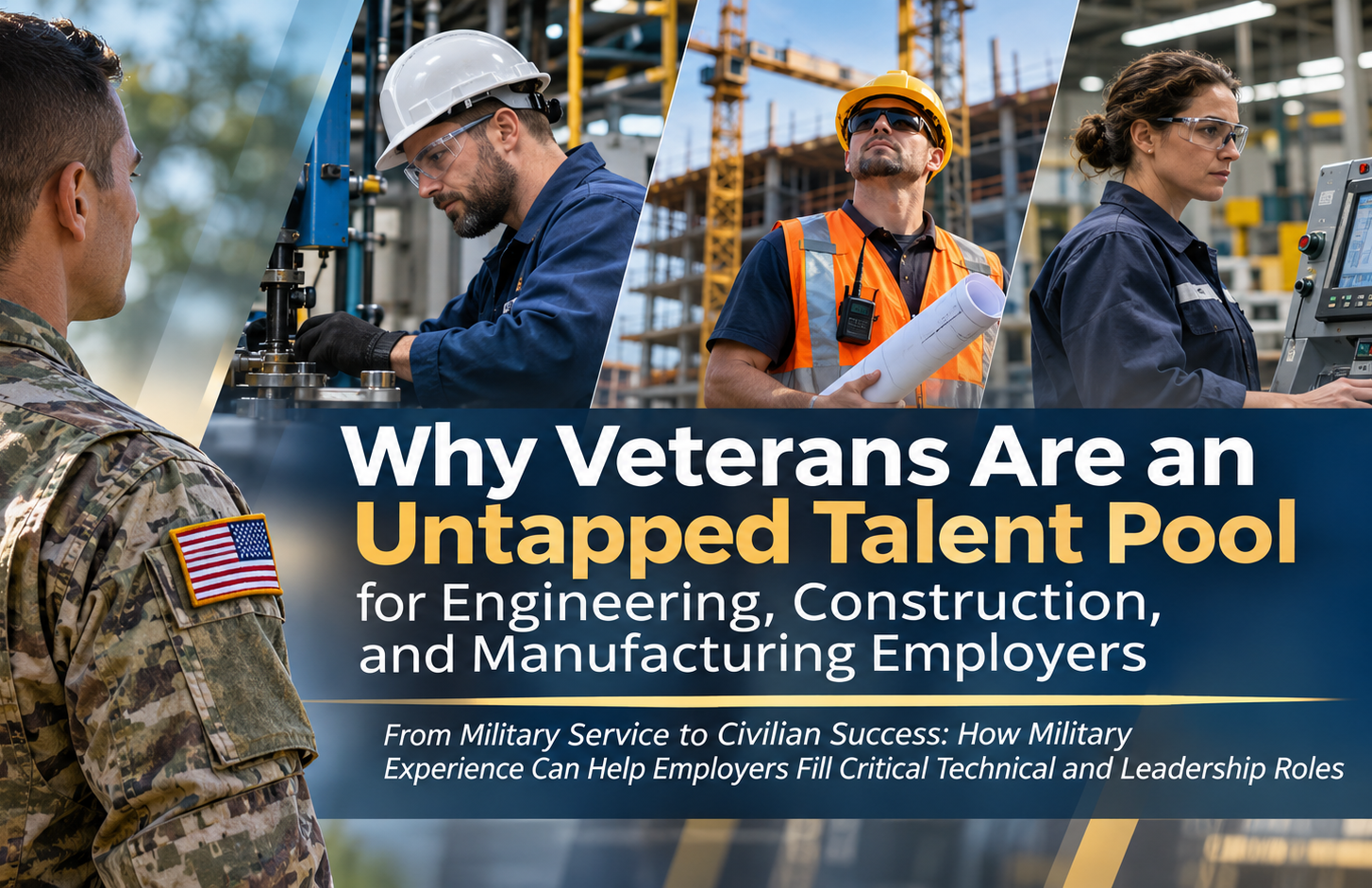
From Military Service to Civilian Success: How Military Experience Can Help Employers Fill Critical Technical and Leadership Roles
Your Next Technical Hire May Have Military Experience
Your manufacturing facility needs a maintenance supervisor. Your construction company needs an experienced field leader. Your engineering department needs someone who can troubleshoot complex equipment, coordinate technical operations, and keep projects moving.
Every week these positions remain vacant can create additional pressure on existing employees, increase overtime expenses, delay projects, and affect productivity.
But what if qualified candidates are being overlooked simply because their experience comes from military service rather than a traditional civilian career path?
Military veterans and transitioning service members represent a valuable source of potential talent for engineering, construction, and manufacturing employers. Many have experience maintaining sophisticated equipment, managing logistics, supervising personnel, following strict safety procedures, and solving technical problems under demanding conditions.
The challenge is recognizing how those capabilities translate into civilian positions.
For employers struggling to fill technical and operational roles, expanding recruitment to include qualified veterans can create opportunities to find capable professionals without compromising hiring standards.
Why Should Engineering, Construction, and Manufacturing Employers Hire Veterans?
Veterans can bring a combination of technical experience, operational knowledge, leadership capabilities, and structured training that aligns with many positions in these industries.
Military organizations operate complex mechanical, electrical, transportation, communications, and infrastructure systems. Keeping those systems functioning requires trained personnel who can inspect equipment, diagnose problems, manage resources, and coordinate operations.
Depending on their military occupational specialty and experience, veterans may have developed capabilities that are directly relevant to civilian employers.
Technical Training and Equipment Experience
Military personnel in technical occupations may work with advanced mechanical systems, electronics, heavy equipment, vehicles, aircraft, communications equipment, and specialized maintenance systems.
For manufacturing employers, this experience may translate into industrial maintenance, equipment troubleshooting, production support, or technical service positions.
For construction companies, relevant military experience may include heavy equipment operation, facilities maintenance, infrastructure support, and field operations.
Leadership and Team Coordination
Many military roles involve supervising personnel, assigning responsibilities, coordinating resources, and maintaining operational readiness.
These responsibilities can align with civilian positions such as production supervisor, maintenance supervisor, operations coordinator, or construction field supervisor.
Employers should evaluate the actual scope of each candidate’s leadership experience rather than assuming that military rank automatically corresponds to a particular civilian management level.
Safety and Procedural Discipline
Military technical operations frequently involve established procedures, equipment inspections, maintenance documentation, and safety requirements.
Veterans with relevant backgrounds may be familiar with following technical instructions, documenting work, identifying hazards, and maintaining accountability for equipment.
These capabilities can be valuable in manufacturing facilities, construction environments, and engineering operations where mistakes can lead to equipment damage, safety incidents, or operational interruptions.
Problem-Solving Under Operational Pressure
Equipment failures, unexpected logistical problems, and changing operational requirements are common challenges in military technical environments.
Veterans who have handled these situations may bring practical troubleshooting experience and an ability to prioritize work when time and resources are limited.
For employers facing equipment downtime, production disruptions, or project deadlines, those capabilities deserve consideration.
The value comes from identifying candidates whose demonstrated experience matches the requirements of the position.
How Do Military Skills Translate Into Civilian Technical Jobs?
One of the biggest barriers to veteran hiring is the difference between military and civilian job titles.
A candidate who maintained aircraft systems may never have held the civilian title of maintenance technician. Someone who coordinated military equipment and personnel may have relevant experience for an operations position without having worked in a manufacturing plant.
Employers who screen exclusively for familiar civilian job titles risk overlooking these candidates.
The following table illustrates potential connections between military experience and civilian technical occupations.
| Military experience | Potential civilian positions |
|---|---|
| Aircraft and vehicle maintenance | Maintenance technician, equipment specialist, maintenance supervisor |
| Military engineering and infrastructure operations | Construction coordinator, field operations specialist, infrastructure technician |
| Logistics and supply operations | Logistics coordinator, materials planner, supply chain supervisor |
| Mechanical and electrical troubleshooting | Industrial maintenance technician, field service technician |
| Military team leadership | Production supervisor, operations supervisor, project coordinator |
| Equipment inspection and safety procedures | Quality technician, safety coordinator, maintenance planner |
| Electronics and communications maintenance | Electronics technician, controls technician, technical support specialist |
| Heavy equipment operation | Construction equipment operator, equipment maintenance specialist |
These connections are starting points for evaluating transferable skills, not guarantees of qualification.
For example, an experienced military equipment technician may have strong diagnostic skills but still require training on specific industrial machinery, programmable logic controllers, or civilian safety standards.
Similarly, military engineering experience does not automatically satisfy the educational or licensing requirements for professional engineering positions.
The most effective approach is to compare demonstrated competencies with the actual technical requirements of the job.
Why Veterans Can Be Valuable in Manufacturing
Manufacturing employers depend on equipment reliability, production efficiency, quality control, and effective supervision.
When critical positions remain vacant, existing employees may have to cover additional shifts, maintenance backlogs can increase, and production schedules may become more difficult to maintain.
Veterans with relevant technical backgrounds may help employers address these challenges.
Industrial Maintenance and Equipment Reliability
Military maintenance personnel may have experience inspecting equipment, performing preventive maintenance, diagnosing mechanical failures, replacing components, and documenting repairs.
These responsibilities can overlap with industrial maintenance positions.
Consider a veteran who spent several years maintaining military vehicles and mechanical systems. That individual may have experience with hydraulic systems, mechanical assemblies, electrical troubleshooting, maintenance schedules, and equipment inspections.
While additional training may be needed for specific production machinery, the underlying maintenance skills could provide a strong foundation.
Production and Operations Leadership
Veterans who supervised technical teams may have experience coordinating personnel, managing schedules, monitoring equipment readiness, and meeting operational objectives.
Manufacturing employers can evaluate this experience for positions involving shift supervision, production coordination, maintenance leadership, and operations management.
The key is determining whether the candidate has the technical knowledge and management capabilities required for the specific facility.
Quality Assurance and Safety
Military equipment inspections and maintenance documentation may provide relevant experience for manufacturing quality and safety functions.
Candidates familiar with inspection procedures, technical specifications, and corrective actions may be suitable for quality technician, inspection, or maintenance planning roles.
Employers should verify familiarity with applicable civilian standards and industry-specific quality systems.
Logistics and Materials Management
Manufacturing operations require accurate inventory, reliable materials availability, and effective coordination between departments.
Veterans with military supply and logistics experience may have managed equipment inventories, coordinated shipments, tracked materials, or supported complex operational schedules.
Those capabilities can translate into materials planning, inventory control, warehouse supervision, and supply chain coordination.
For manufacturers facing hiring challenges, these transferable skills can broaden the available candidate pool.
Why Construction Companies Should Consider Hiring Veterans
Construction projects require coordination between people, equipment, materials, schedules, and safety requirements.
An unfilled superintendent, field supervisor, equipment operator, or project coordination position can affect multiple phases of a project.
Veterans with relevant backgrounds may offer valuable experience in field operations, infrastructure work, equipment management, and team leadership.
Construction and Infrastructure Experience
Some military occupational specialties involve construction, infrastructure maintenance, facilities management, surveying support, and equipment operation.
These candidates may have experience working on physical infrastructure, coordinating technical activities, and operating in demanding field environments.
Employers should evaluate how closely that experience aligns with the types of projects their company performs.
Heavy Equipment and Field Operations
Veterans who operated or maintained military construction equipment may possess relevant mechanical knowledge and practical equipment experience.
Potential civilian opportunities include heavy equipment operation, equipment maintenance, field logistics, and construction support.
However, employers must verify the candidate’s experience with specific equipment, required certifications, and applicable safety regulations.
Crew Supervision and Project Coordination
Construction field leaders must organize work, communicate priorities, coordinate resources, and respond to unexpected problems.
Veterans with substantial personnel and operational leadership experience may have developed comparable capabilities.
For example, a veteran who coordinated equipment, personnel, and supplies across multiple assignments may have relevant experience for a construction logistics or field coordination position.
That does not automatically qualify the candidate to manage a complex commercial construction project.
Experience with building codes, subcontractor coordination, project scheduling software, contract documents, and civilian construction practices may still be necessary.
The opportunity is to identify relevant leadership experience and determine what additional industry knowledge is required.
Can Veterans Qualify for Engineering and Technical Positions?
Yes. Veterans with appropriate education, training, and experience may qualify for a variety of engineering-related and technical positions.
However, employers must distinguish between engineering support roles and positions requiring specific degrees, professional licenses, or other mandatory credentials.
Engineering Technician Positions
Military technical specialists may have experience testing equipment, interpreting technical documentation, troubleshooting systems, and supporting maintenance or engineering operations.
Depending on their qualifications, they may be candidates for positions such as:
Mechanical engineering technician
Electrical or electronics technician
Field service technician
Equipment testing specialist
Technical operations coordinator
Engineering support specialist
Technical Project Coordination
Veterans who managed technical assignments, coordinated personnel, maintained equipment readiness, or supervised maintenance programs may possess experience relevant to technical project coordination.
These positions often require organization, communication, scheduling, and the ability to work with technical teams.
Engineering Operations and Maintenance Management
Veterans with substantial technical and supervisory backgrounds may also qualify for engineering operations, maintenance planning, or technical management positions.
Their suitability depends on the complexity of the equipment, industry requirements, previous responsibilities, and the employer’s expectations.
What About Professional Engineering Requirements?
Military technical experience does not automatically replace an accredited engineering degree, required engineering coursework, or professional engineering licensure.
Employers must continue to verify all legally required qualifications.
The strongest veteran hiring strategies expand access to qualified candidates while maintaining the technical and regulatory standards necessary for the position.
Why Do Employers Overlook Qualified Veterans?
Many employers unintentionally exclude veterans during the earliest stages of recruiting.
The problem is not necessarily a lack of relevant experience. It is often a difficulty recognizing that experience.
Military Job Titles Are Different
Military occupational specialties frequently use terminology unfamiliar to civilian hiring managers.
A candidate may have managed sophisticated equipment maintenance operations without ever holding the civilian title of maintenance manager.
If an employer screens only for conventional job titles, that candidate may never receive an interview.
Applicant Tracking Systems May Miss Transferable Skills
Applicant tracking systems can make it difficult to identify candidates whose resumes use military terminology instead of familiar civilian keywords.
Employers can reduce this problem by screening for specific competencies, equipment experience, technical responsibilities, and relevant qualifications.
Employers May Overemphasize Industry Experience
Some positions genuinely require direct experience with particular equipment, regulations, or project types.
Others can be performed successfully by candidates with transferable technical skills and reasonable additional training.
Employers should distinguish between essential requirements and skills that can be developed after hiring.
Hiring Managers May Not Understand Military Responsibilities
Military job titles alone rarely communicate the full scope of a candidate’s responsibilities.
A better evaluation examines the equipment maintained, personnel supervised, technical systems used, problems solved, and measurable operational responsibilities.
This allows employers to make hiring decisions based on relevant evidence rather than assumptions.
How to Recruit Veterans for Engineering, Construction, and Manufacturing Jobs
Employers do not need to abandon their existing hiring standards to recruit veterans effectively.
They need a process that recognizes relevant military experience and evaluates it consistently.
Step 1: Identify the Essential Skills
Begin with the technical and operational requirements of the position.
For an industrial maintenance technician, these might include mechanical troubleshooting, preventive maintenance, electrical diagnostics, equipment inspection, and safety procedures.
Separate mandatory qualifications from skills that can be learned through onboarding or additional training.
Step 2: Identify Relevant Military Experience
Research military occupational specialties associated with the competencies required.
Resources such as O*NET and military-to-civilian occupation crosswalks can help employers understand possible career connections.
Use these resources to identify candidates for further evaluation rather than treating occupational matches as proof of qualification.
Step 3: Make Job Descriptions More Inclusive of Equivalent Experience
Where appropriate, job descriptions can state that relevant military technical experience will be considered.
For example:
“Candidates with equivalent military experience in mechanical maintenance, electrical systems, equipment troubleshooting, or technical operations are encouraged to apply.”
This makes the opportunity more accessible without lowering standards.
Step 4: Use Skills-Based Interviews
Ask candidates to describe specific technical responsibilities.
Useful questions include:
What types of equipment did you maintain or operate?
How did you diagnose mechanical or electrical problems?
What technical documentation did you use?
How did you prioritize maintenance work?
How many personnel did you supervise?
What safety procedures were required?
How did you respond to equipment failures or operational disruptions?
These questions help hiring managers understand the practical relevance of military experience.
Step 5: Verify Credentials and Technical Capabilities
Evaluate candidates using the same job-related standards applied to other applicants.
Depending on the position, this may involve technical assessments, equipment knowledge evaluations, certification reviews, or structured interviews.
Confirm any required licenses, education, safety training, or industry-specific qualifications.
Step 6: Address Training Gaps
A veteran may possess strong foundational technical skills while needing additional training in civilian equipment, software, regulations, or operating procedures.
Employers should determine whether these gaps can be addressed through a reasonable onboarding plan.
A candidate who can learn a specific system quickly may be a stronger long-term hire than someone whose resume contains the right terminology but lacks the required practical capabilities.
Step 7: Build a Transition-Friendly Onboarding Process
A structured onboarding program can help veterans understand civilian workplace expectations, reporting relationships, terminology, and performance measures.
Assigning a knowledgeable supervisor or mentor can also help new employees apply their existing capabilities in an unfamiliar environment.
The objective is to make effective use of the experience the candidate already brings.
When Should Employers Use a Specialized Recruiter to Find Technical Talent?
Expanding recruiting efforts to include veterans can create additional opportunities, but evaluating unfamiliar military backgrounds requires time and technical understanding.
For employers already struggling with critical vacancies, that additional work can be difficult to manage internally.
A specialized technical recruiter can help employers focus on the competencies that matter most.
Identifying Relevant Experience
A recruiter familiar with engineering, construction, and manufacturing positions can help employers define technical requirements and recognize potentially transferable experience.
This can be especially useful when a candidate’s previous job title does not clearly describe their capabilities.
Evaluating Technical Qualifications
Technical recruiting requires more than matching keywords.
Employers need candidates with the right combination of practical experience, technical knowledge, credentials, and workplace readiness.
A specialized recruiter can support screening and candidate evaluation against the employer’s actual requirements.
Reducing the Burden on Internal Hiring Teams
Hiring managers often have limited time to review resumes, coordinate interviews, and evaluate unfamiliar technical backgrounds.
Recruiting support can help organize candidate searches, screening, and interview coordination while allowing internal teams to concentrate on operational responsibilities.
Supporting Hard-to-Fill Positions
Some engineering, construction, and manufacturing positions require highly specific combinations of experience and technical skills.
A broader candidate search that considers qualified veterans alongside civilian professionals may help employers identify applicants they would otherwise overlook.
How DAVRON Supports Specialized Technical Hiring
DAVRON is a specialized recruiting and staffing firm focused on engineering, architecture, construction, and manufacturing.
Unlike generalist staffing providers, DAVRON concentrates on industries where technical qualifications, specialized experience, and role-specific requirements are central to successful hiring.
For employers evaluating candidates from different professional backgrounds, including relevant military experience, DAVRON’s industry-focused recruiting approach can help clarify position requirements and support the search for qualified professionals.
Whether an employer needs a maintenance supervisor, manufacturing engineer, construction superintendent, engineering technician, or technical operations leader, the priority is identifying candidates who meet the demands of the position.
When a critical vacancy is affecting production, project execution, or operational performance, speaking with a specialized recruiter can be a practical next step.
Frequently Asked Questions About Hiring Veterans
What military jobs translate into manufacturing careers?
Military occupations involving mechanical maintenance, electronics, equipment repair, logistics, quality inspection, and technical supervision may translate into manufacturing positions. Potential roles include maintenance technician, production supervisor, electronics technician, materials planner, and equipment specialist. Employers should verify the specific skills and qualifications of each candidate.
Can military maintenance experience qualify someone for industrial maintenance jobs?
Yes, military maintenance experience can provide relevant foundational skills, including mechanical troubleshooting, preventive maintenance, electrical diagnostics, and equipment inspection. However, employers should evaluate familiarity with industrial machinery, automation systems, safety standards, and any required certifications.
Are veterans good candidates for construction management positions?
Veterans with relevant experience in personnel supervision, infrastructure operations, equipment management, and project coordination may be strong candidates for certain construction leadership roles. Employers should also assess knowledge of civilian construction methods, building codes, scheduling, subcontractor management, and project requirements.
Can veterans work in engineering without an engineering degree?
Veterans may qualify for engineering technician, technical support, maintenance, field service, and engineering operations positions without a four-year engineering degree, depending on employer requirements. Positions requiring an engineering degree or professional engineering license must continue to meet those requirements.
How can employers verify military technical experience?
Employers can review resumes, relevant training records, documented certifications, and authorized military service documentation. Structured technical interviews, practical assessments, and job-related reference checks can help verify capabilities. Any background verification should comply with applicable privacy and employment laws.
What are the biggest challenges when hiring transitioning service members?
Common challenges include translating military job titles, understanding technical responsibilities, evaluating civilian credential requirements, and identifying training gaps. Employers can address these issues through competency-based screening, clear job descriptions, and structured onboarding.
Do veterans need additional certifications for civilian technical jobs?
Sometimes. Requirements depend on the occupation, employer, state, and industry. Certain engineering, electrical, safety-sensitive, or equipment-specific positions may require civilian licenses, certifications, or training that military experience alone does not satisfy.
How can employers find veterans with relevant technical skills?
Employers can use veteran employment programs, military transition resources, workforce development organizations, job boards, and occupation translation tools. They can also broaden technical job descriptions to recognize equivalent military experience and work with recruiting specialists who understand the positions being filled.
When should an employer use a specialized recruiter?
A specialized recruiter may be particularly useful when a technical vacancy is difficult to fill, the employer needs qualified candidates quickly, or internal hiring teams lack the resources to evaluate specialized experience. Recruiters focused on engineering, construction, and manufacturing can support targeted searches and technical candidate screening.
The Bottom Line: Expand Your Talent Pool Without Lowering Your Standards
Military veterans are not a replacement for technical qualifications, relevant experience, or industry-specific credentials.
They are an additional source of potential talent that employers should evaluate more deliberately.
For engineering, construction, and manufacturing companies, relevant military experience may provide a strong foundation in equipment maintenance, technical operations, logistics, safety, troubleshooting, and leadership.
The hiring opportunity lies in recognizing those capabilities and determining how they align with the requirements of specific positions.
Companies that evaluate transferable skills rather than relying exclusively on conventional civilian job titles may uncover qualified candidates who would otherwise be overlooked.
And when an important technical position remains vacant, expanding the candidate pool can be an important part of reducing hiring delays and maintaining operational performance.
DAVRON helps employers navigate specialized recruiting challenges across engineering, architecture, construction, and manufacturing.
Whether a qualified candidate developed their experience in a civilian workplace or during military service, the goal remains the same: find the right professional for the job.
Ready to hire engineering, architecture, construction, or manufacturing professionals?
DAVRON specializes in delivering high-quality candidates in these industries.