
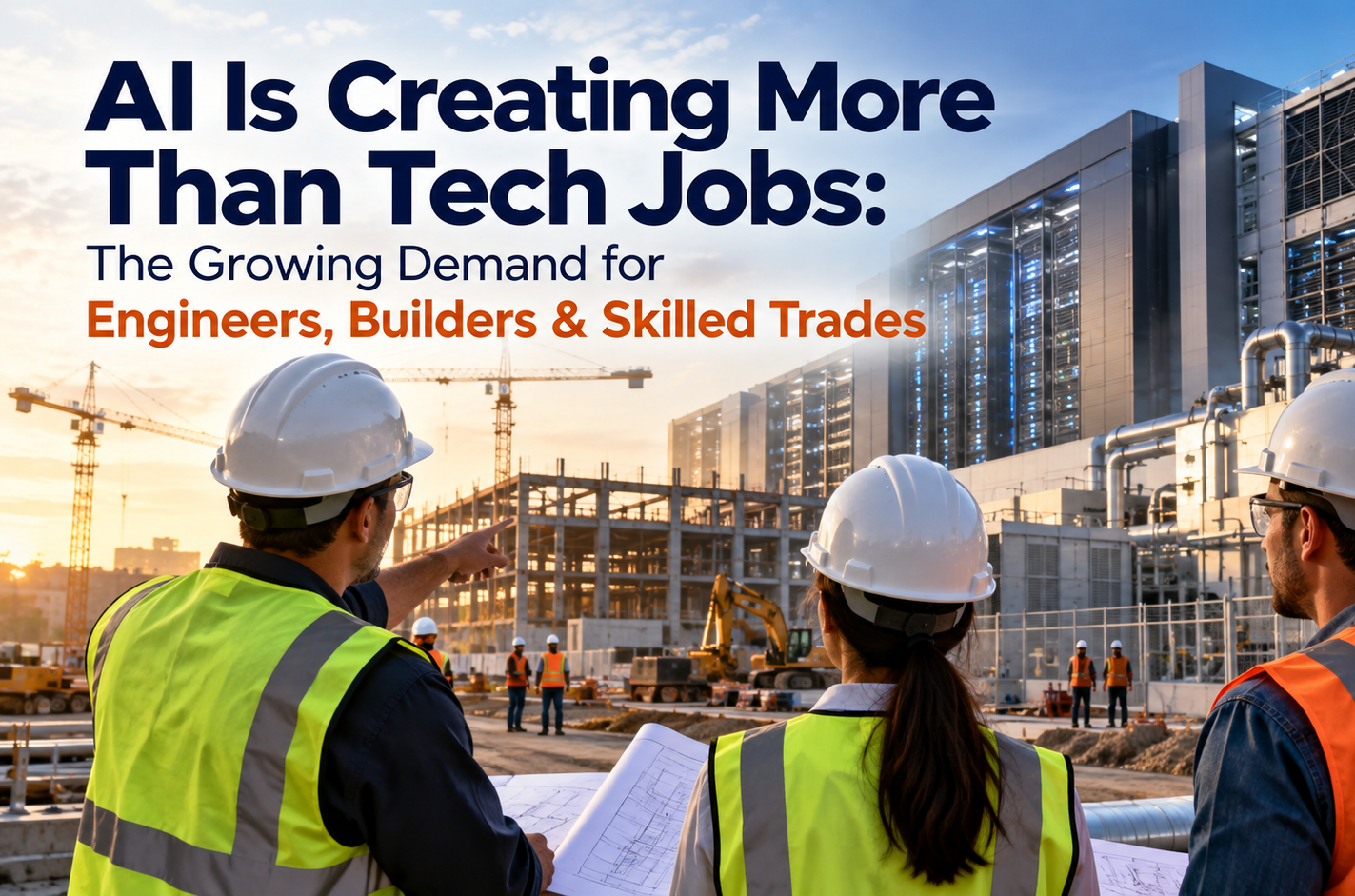
AI may run on software, but the infrastructure behind it is physical.
Data centers have to be designed and built. Electrical capacity has to be delivered. Cooling systems have to handle demanding computing environments. Equipment has to be manufactured. Facilities have to be constructed, commissioned, maintained, and expanded.
That means the growth of artificial intelligence can create hiring pressure far beyond software developers and data scientists. It can increase the need for electrical and mechanical engineers, construction managers, manufacturing engineers, controls specialists, project professionals, and skilled trades.
For employers, the immediate issue is not simply whether AI will create jobs. It is whether companies supporting this infrastructure have enough qualified people to execute the work in front of them.
When a new project, facility expansion, production requirement, or customer commitment requires additional technical talent, waiting months to fill a project-critical position can affect schedules, capacity, production, and revenue.
AI Needs a Physical Infrastructure Behind It
It is easy to think of AI as something that exists entirely in the cloud. In reality, the cloud depends on a substantial physical footprint.
AI workloads require computing infrastructure. That infrastructure requires facilities. Those facilities require electrical power, cooling, controls, structural systems, telecommunications, security, and supporting infrastructure.
The chain can extend much further:
AI and computing demand → data-center capacity → power and cooling requirements → engineering and construction → equipment and component manufacturing → commissioning, operations, and maintenance
Each stage creates work that cannot be completed by software alone.
This does not mean every engineering, construction, or manufacturing job is growing because of AI. Electrification, reshoring, manufacturing investment, infrastructure spending, and other economic forces also influence hiring.
But AI infrastructure adds another source of demand for many of the same technical professionals employers already struggle to recruit.
Which Engineers Are Needed to Build AI Infrastructure?
The engineering workforce behind AI infrastructure is diverse because a modern data center or supporting industrial facility is a complex system.
Electrical Engineers
Electrical capacity is fundamental to AI infrastructure.
Electrical engineers may be needed to design or support power distribution, substations, backup systems, switchgear, facility electrical systems, controls, and connections to the broader power grid.
As facilities become larger and more power-intensive, employers may need engineers who understand not only electrical design but also reliability, redundancy, commissioning, and complex mission-critical environments.
Mechanical and HVAC Engineers
High-performance computing equipment produces substantial heat.
That makes cooling and thermal management critical engineering problems. Mechanical engineers and HVAC professionals can be involved in designing cooling systems, evaluating equipment, improving energy efficiency, and maintaining environmental conditions required by computing equipment.
Employers building sophisticated facilities may therefore find themselves competing for mechanical talent with highly specialized experience.
Civil and Structural Engineers
Before a facility operates, someone has to determine how and where it can be built.
Civil engineers can support site development, grading, drainage, utilities, transportation access, and permitting. Structural engineers help ensure buildings and supporting structures can safely accommodate equipment and facility requirements.
These roles become especially important as developers move from identifying potential sites to executing actual projects.
MEP Engineers
Mechanical, electrical, and plumbing systems are central to complex facilities.
MEP engineers must coordinate systems that cannot be designed independently of one another. That coordination becomes particularly important in mission-critical environments where reliability, redundancy, cooling, and power requirements are unusually demanding.
Controls and Automation Engineers
Modern facilities and manufacturing operations rely heavily on automation.
Controls engineers may work with building systems, industrial equipment, PLCs, instrumentation, monitoring systems, automated processes, and other technologies needed to keep sophisticated operations functioning efficiently.
Manufacturing and Industrial Engineers
The infrastructure buildout also extends into factories.
Manufacturers producing equipment and components for electrical, cooling, automation, construction, and other infrastructure markets may need engineers who can expand production, improve processes, introduce new equipment, maintain quality, and increase throughput.
The result is an important distinction for employers: the AI hiring story is not confined to AI companies.
A manufacturer, engineering consultant, contractor, equipment supplier, developer, or industrial business may encounter AI-related demand without developing an AI model itself.
Construction Professionals Turn Designs Into Operating Facilities
Engineering plans do not build facilities.
Construction teams must coordinate people, materials, equipment, schedules, subcontractors, safety requirements, inspections, budgets, and changing field conditions to turn those plans into completed projects.
That creates potential demand for professionals such as:
Construction project managers
Superintendents
Project executives
Estimators
Preconstruction professionals
MEP coordinators
BIM and VDC professionals
Construction managers
Architects and designers
These are not interchangeable positions.
A superintendent capable of managing a technically demanding project, for example, needs a different combination of field leadership and project experience than an estimator responsible for developing accurate costs before construction begins.
Similarly, BIM and VDC professionals can become particularly valuable on projects where multiple sophisticated building systems must fit together within tight physical and scheduling constraints.
For employers, this creates a recruiting challenge: filling the position is not enough. The person must have experience relevant to the work.
Skilled Trades Build and Maintain the Physical Side of AI
The infrastructure supporting AI also depends on people who install, commission, maintain, troubleshoot, and repair physical systems.
Depending on the project, that workforce can include:
Electricians
HVAC technicians
Pipefitters
Welders
Controls technicians
Equipment technicians
Other specialized trades
A sophisticated data center can contain extraordinary technology, but that technology still depends on electrical systems, cooling equipment, piping, controls, backup systems, and other physical infrastructure.
This creates an important workforce reality: as investment flows into advanced technologies, some of the resulting labor demand can occur in occupations that have existed for decades.
The technology may be new. The need for qualified people who can build and maintain critical infrastructure is not.
Manufacturing Is Another Part of the AI Infrastructure Story
Every major construction and infrastructure expansion creates demand for equipment and materials.
Data centers and supporting infrastructure can require electrical equipment, cooling systems, fabricated components, controls, structural products, machinery, backup systems, and numerous other manufactured products.
When orders increase, manufacturers may face a different version of the same hiring problem.
They may need:
Manufacturing engineers
Quality engineers
Controls engineers
Industrial engineers
Plant and operations leadership
Production professionals
Technical project managers
A manufacturer experiencing higher demand cannot necessarily increase output simply by adding machines.
Someone has to improve processes, commission equipment, manage quality, troubleshoot production constraints, supervise operations, and ensure customer requirements are met.
If technical positions remain vacant, the company’s theoretical production capacity may matter less than its ability to actually deliver.
The Bigger Employer Challenge: Demand Can Move Faster Than Hiring
This is where the AI infrastructure story becomes a recruiting issue.
Companies do not always get months of warning before their hiring needs become urgent.
A contractor may win a major project.
An engineering firm may suddenly have a larger backlog.
A manufacturer may receive significant new orders.
A developer may move a facility into the execution stage.
An existing employee may leave during a critical project.
A business may discover that its current team simply cannot absorb additional work.
At that point, an open technical position can become an operational problem rather than an HR metric.
Leaving critical roles unfilled can contribute to:
Project delays
Scheduling bottlenecks
Excessive workloads for existing employees
Overtime and burnout
Slower facility expansion
Missed production targets
Difficulty meeting customer commitments
Lost opportunities to pursue additional work
This is why employers should think about workforce requirements alongside project pipelines and capacity planning.
If demand is accelerating, recruiting cannot always wait until the organization is already understaffed.
Need Engineers or Construction Professionals Now? Employers Have Several Options
When a position becomes urgent, posting the job and waiting is only one approach.
The right hiring strategy depends on the role, location, available candidate pool, project timeline, and how costly it is to leave the position open.
Accelerate Internal Recruiting and Employee Referrals
Existing employees can be an excellent source of industry connections.
For organizations with strong networks, an immediate referral push may identify qualified candidates quickly. Internal recruiting teams can also prioritize the role, proactively source candidates, and shorten unnecessary steps in the interview process.
The limitation is reach. For a highly specialized position in a limited local market, the organization’s existing network may not contain the person it needs.
Reevaluate the Requirements
Sometimes the search is difficult because the candidate profile is unnecessarily narrow.
Employers should determine which qualifications are truly essential and which are preferences.
They can also examine:
Compensation
Geographic requirements
Remote or hybrid flexibility where practical
Years-of-experience requirements
Transferable industry experience
Relocation assistance
This does not mean lowering standards for a critical role. It means removing requirements that unnecessarily exclude otherwise capable candidates.
Consider Contract or Temporary Support
When the immediate problem is workload rather than permanent headcount, contract support may be appropriate.
Temporary expertise can help organizations manage project peaks, specific technical assignments, or periods when a permanent search is still underway.
The suitability of this approach depends heavily on the position and the nature of the work.
Develop Longer-Term Talent Pipelines
Partnerships with universities, technical schools, apprenticeship programs, industry associations, and professional organizations can strengthen future recruiting.
These strategies are particularly valuable when an employer expects sustained demand rather than a single hiring spike.
But workforce development takes time. It may not solve a vacancy that is affecting a project today.
Use a Specialized Recruiter for Difficult Technical Searches
When a role is urgent, highly technical, difficult to source, or outside an internal recruiting team’s strongest network, specialized recruiting becomes another option.
The advantage is focus.
Instead of approaching the search as a general hiring assignment, a specialized recruiter can concentrate on the relevant occupation, industry, geography, candidate profile, and employer requirements.
DAVRON specializes in recruiting for engineering, architecture, construction, and manufacturing positions.
That specialization is particularly relevant when employers need candidates for technical roles that can be difficult to fill through broad job advertising alone.
Rather than operating as a generalist staffing company serving every possible occupation, DAVRON’s recruiting focus is aligned with the professionals involved in designing, building, and manufacturing the physical systems behind major infrastructure and industrial projects.
For an employer facing an immediate hiring problem, access to recruiters who understand these technical markets can provide another path to qualified candidates while internal teams remain focused on operating the business.
AI Workforce Planning Should Extend Beyond the IT Department
One of the biggest mistakes employers can make is thinking about the AI workforce exclusively in terms of software.
For companies involved in data centers, power, engineering, construction, equipment, industrial facilities, advanced manufacturing, or supporting supply chains, the workforce implications can be much broader.
The practical questions are:
What projects are coming?
What additional capacity will those projects require?
Which positions could become bottlenecks?
How long will those positions realistically take to fill?
Answering those questions before the workload arrives gives employers more options.
Waiting until a critical engineer, superintendent, project manager, or manufacturing professional is needed immediately makes the recruiting challenge considerably harder.
Frequently Asked Questions
Is AI creating jobs outside the technology industry?
Yes. AI depends on physical infrastructure, including data centers, electrical systems, cooling equipment, buildings, manufacturing capacity, and supporting systems. Building and operating that infrastructure can create or intensify demand for engineering, construction, manufacturing, and skilled-trade professionals.
AI is not the only force affecting these occupations, however. Infrastructure investment, electrification, reshoring, construction activity, and manufacturing expansion can also influence demand.
What engineering jobs are needed for AI infrastructure?
Relevant positions can include electrical, mechanical, civil, structural, MEP, HVAC, controls, automation, manufacturing, industrial, and project engineers.
The exact roles depend on the facility, project, equipment, and employer.
Why does AI increase demand for electrical and mechanical engineers?
AI computing infrastructure requires significant electrical capacity and generates heat that must be managed effectively.
Electrical engineers can support power distribution, reliability, backup systems, and facility electrical infrastructure. Mechanical and HVAC engineers can support cooling, thermal management, equipment selection, and facility mechanical systems.
How does data-center growth affect construction hiring?
New and expanded data centers require construction teams to manage technically complex projects.
Depending on the project, employers may need project managers, superintendents, estimators, preconstruction professionals, MEP coordinators, BIM/VDC specialists, architects, and other construction professionals.
What manufacturing jobs could benefit from AI infrastructure investment?
Manufacturers supplying equipment and components for data centers, electrical infrastructure, cooling, automation, construction, and related markets may need manufacturing engineers, controls engineers, quality engineers, industrial engineers, production professionals, technical project managers, and operations leaders.
Actual demand will vary by company and market.
Will AI increase demand for skilled trades?
AI infrastructure can contribute to demand for trades involved in building and maintaining facilities and supporting systems, including electricians, HVAC technicians, pipefitters, controls technicians, welders, and equipment technicians.
Broader construction, energy, and industrial trends also influence demand for these workers.
How can employers hire engineers and construction professionals faster?
Employers can accelerate internal sourcing, activate employee referrals, simplify interview processes, reassess unnecessarily restrictive requirements, improve compensation or flexibility where appropriate, consider contract support, and use specialized recruiters for difficult searches.
For an urgent vacancy, using several approaches simultaneously may be more effective than relying on a job posting alone.
When should an employer use a specialized technical recruiter?
A specialized recruiter can be particularly useful when a position is difficult to fill, business-critical, highly technical, geographically constrained, or needed quickly.
It can also make sense when internal recruiters do not have an established candidate network for the particular occupation.
The AI Boom Is Also a Physical Workforce Story
AI may be one of the defining technologies of this era, but its expansion depends on much more than algorithms.
Behind the computing power are facilities, electrical systems, cooling systems, manufactured equipment, construction projects, engineering designs, and the people responsible for making all of them work.
For employers, that makes workforce planning an important part of infrastructure planning.
Companies that can identify their technical hiring needs early—and move quickly when critical positions become vacant—will be better prepared to execute projects and respond to new opportunities.
And when the required talent is difficult to find, employers do not have to conduct every specialized search alone.
Ready to hire engineering, architecture, construction, or manufacturing professionals?
DAVRON specializes in delivering high-quality candidates in these industries.