
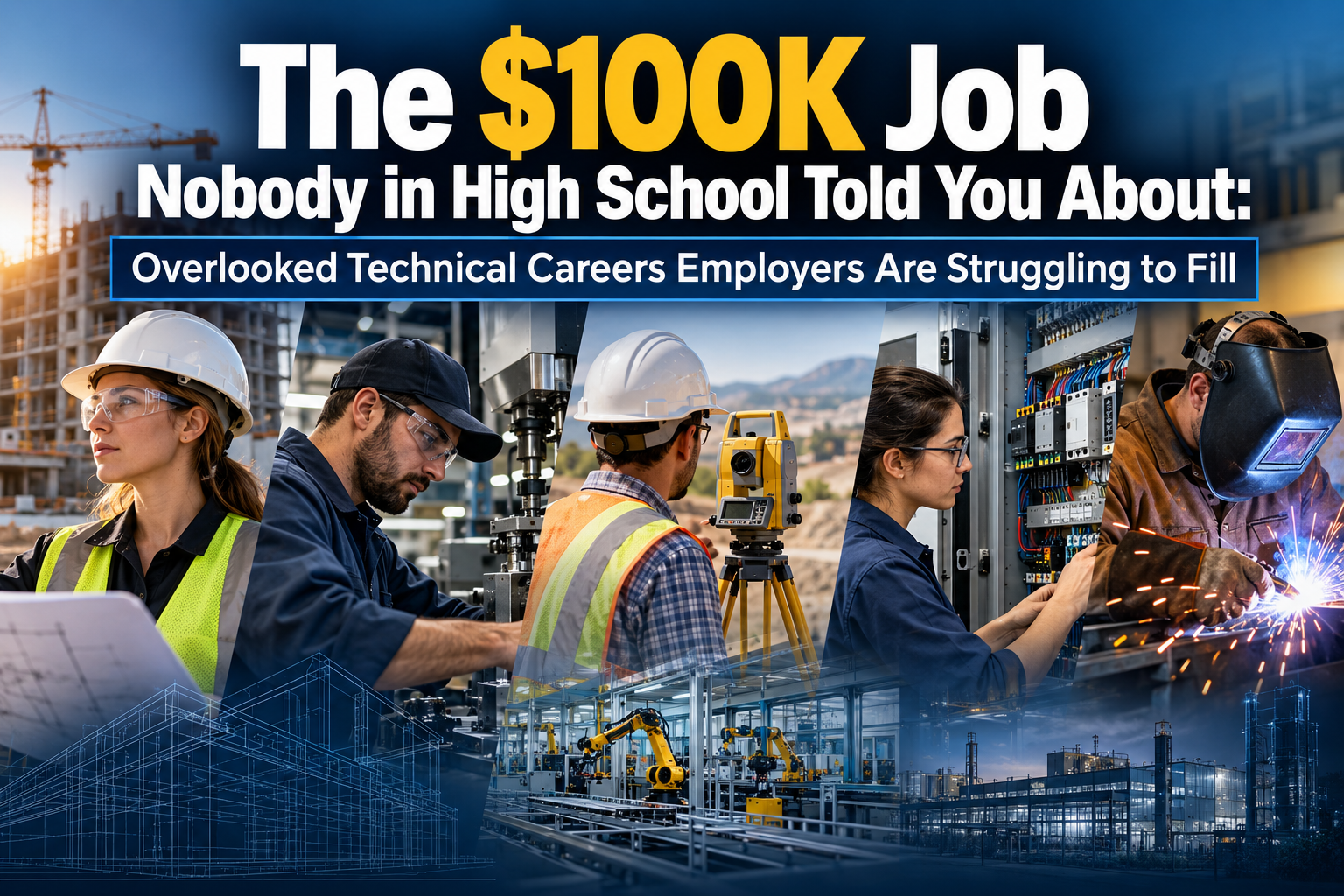
A student can spend four years in high school hearing about doctors, lawyers, software developers, accountants, and traditional college careers without ever hearing the words controls engineer, land surveyor, CNC programmer, commissioning engineer, millwright, or construction superintendent.
That is a strange disconnect from the real economy.
Some lesser-known technical careers already carry median salaries above $100,000. Others can develop into six-figure careers through specialization, licensing, overtime, travel, supervisory responsibility, or years of experience.
And these are not obscure jobs that businesses can simply do without.
They are the people who automate production lines, keep industrial equipment operating, determine property boundaries, coordinate multimillion-dollar construction projects, manufacture precision components, commission complex building systems, and keep critical infrastructure functioning.
When an employer cannot find them, the problem can quickly become bigger than an empty seat.
A missing technical professional can mean a project falls behind schedule. A machine stays down longer. An experienced employee absorbs more overtime. A commissioning date slips. Production capacity goes unused. A contractor becomes reluctant to take on additional work.
For students and career changers, these occupations represent career paths worth discovering.
For employers, they represent talent pipelines worth protecting.
And for both groups, the “$100K job nobody told you about” is not really one job.
It is an entire category of technical careers hiding in plain sight.
First, What Does "$100K Job" Actually Mean?
It does not mean every electrician, surveyor, machinist, engineer, or construction professional automatically earns six figures.
Salary claims need context.
Some occupations genuinely have national median wages above $100,000. According to May 2025 Bureau of Labor Statistics data, construction managers had a median annual wage of $114,990, electrical engineers $120,630, mechanical engineers $104,110, and industrial engineers $102,440.
Other technical occupations have lower national medians but substantial earning potential at higher experience levels or in particular industries and locations.
Surveyors, for example, had a $75,440 national median wage in May 2025, while the highest-paid 10% earned more than $125,590.
Electricians had a national median of $63,190, but the highest 10% earned more than $108,510.
Then there are careers that make the headline surprisingly literal. Elevator and escalator installers and repairers had a $109,910 median wage in May 2025. The typical entry-level education listed by BLS is a high school diploma or equivalent, followed by an apprenticeship; most states also require licensing.
Power plant operators, distributors, and dispatchers had a median annual wage of $105,080, with a high school diploma or equivalent listed as the typical entry-level education and extensive on-the-job training after hiring.
Those examples illustrate the bigger point.
There are more routes to a high-paying technical career than many people realize.
Controls and Automation: The People Who Make Machines Think
Walk through a highly automated manufacturing plant and you may see conveyors moving products, robots positioning components, sensors monitoring processes, motors changing speed automatically, and machines communicating with one another.
Someone has to make all of that work.
That is where controls and automation professionals come in.
Depending on the company and system, titles may include:
Controls Engineer
Automation Engineer
PLC Programmer
Controls Technician
Instrumentation and Controls Technician
Building Automation or BAS Controls Specialist
These professionals live at the intersection of several disciplines.
A controls professional may need to understand electrical systems, programmable logic controllers (PLCs), human-machine interfaces, sensors, instrumentation, motors, drives, networks, mechanical equipment, and troubleshooting.
That combination is exactly what can make the position difficult to recruit.
An employer may not simply need “an engineer.” It may need someone who understands a particular PLC platform, has worked around the company’s equipment, can troubleshoot on the plant floor, understands electrical drawings, and can communicate with maintenance personnel, engineers, and production managers.
The title alone does not tell the whole story.
BLS groups occupations differently than employers do, so there is not one clean national “controls engineer” wage statistic covering every version of the role. But related engineering occupations demonstrate the value of the underlying expertise. Electrical engineers had a $120,630 median annual wage in May 2025, while electrical and electronics engineers collectively had a $125,040 median.
This is also why controls vacancies can become operational problems.
If the person who understands a critical automated system is unavailable, the company may not simply have an HR problem.
It may have a production problem.
Surveying: The Career Hiding Behind Almost Every Development
Before a subdivision is built, a road is widened, a commercial site is developed, or property boundaries are legally established, somebody needs accurate information about the land.
That is the world of surveying and geomatics.
Career paths can include:
Land Surveyor
Survey Party Chief
Survey Technician
CAD or Survey Drafter
GIS Technician
Other geomatics-related positions
Surveyors make precise measurements used to establish property boundaries. Surveying and mapping technicians support this work in the field and office, including gathering measurements and working with GIS, imagery, field notes, and CAD-related data.
It is technical work with direct connections to civil engineering, construction, transportation, infrastructure, land development, utilities, and real estate.
Yet ask a room of high school students to name 20 careers, and “surveyor” probably will not be near the top.
The career path also demonstrates why education requirements cannot be generalized across technical occupations.
BLS lists a high school diploma as the typical entry-level education for surveying and mapping technicians. Surveyors typically need a bachelor’s degree, and surveyors must be licensed before they can certify legal documents and provide surveying services to the public. State requirements matter.
The compensation progression can be meaningful as responsibility and credentials increase. Surveying and mapping technicians had a $54,240 median wage in May 2025, while surveyors had a $75,440 median and the highest-paid 10% of surveyors earned more than $125,590.
For employers, however, salary is only part of the equation.
A company cannot instantly manufacture years of field knowledge or a professional license when an experienced surveyor leaves.
Construction Has Far More Careers Than "Construction Worker"
One of the biggest misconceptions about construction is treating it as a single occupation.
A modern commercial or infrastructure project can involve a network of highly specialized professionals responsible for estimating, scheduling, engineering, coordination, technology, field supervision, safety, quality, and financial performance.
Careers can include:
Construction Superintendent
Assistant Superintendent
Construction Project Manager
Estimator
Project Engineer
MEP Coordinator
BIM Specialist
VDC Specialist
Consider the superintendent.
A strong superintendent is not simply the person “in charge of the jobsite.” Depending on the project, that professional may be coordinating subcontractors, interpreting drawings, sequencing work, monitoring quality, resolving field conflicts, managing schedules, enforcing safety expectations, and communicating constantly with project managers, owners, architects, engineers, and tradespeople.
Experience becomes extraordinarily valuable because construction problems do not always arrive in textbook form.
At the management level, compensation reflects that responsibility. Construction managers had a national median annual wage of $114,990 in May 2025, with the highest 10% earning more than $189,440. BLS also notes that construction managers may earn bonuses in addition to salary.
That does not mean every construction management position pays six figures.
It does mean construction can provide sophisticated, well-compensated career paths that many students never seriously consider.
And when an experienced superintendent or project manager position remains vacant, the cost to an employer can extend far beyond recruiting.
The real issue is who will keep the project moving.
Manufacturing Is Not the Factory Career Your Grandparents Remember
The image many people have of manufacturing is decades out of date.
Modern plants may combine CNC machinery, robotics, automated material handling, machine vision, sensors, sophisticated quality systems, programmable controls, data collection, and complex production equipment.
That creates an enormous range of technical careers.
Examples include:
CNC Programmer
CNC Machinist
Tool and Die Maker
Manufacturing Engineer
Process Engineer
Quality Engineer
Industrial Maintenance Technician
Reliability Technician
Automation Technician
A CNC programmer, for example, is not simply pushing a button on a machine. The work can involve translating specifications into machining operations, determining tool paths and processes, understanding tolerances, and producing parts that may have extremely demanding requirements.
BLS reported a May 2025 median annual wage of $68,120 for computer numerically controlled tool programmers. Machinists had a $58,750 median, while tool and die makers had a $64,050 median.
Those figures are a useful reality check: not every advanced manufacturing career is automatically a $100,000 job.
But manufacturing also contains engineering careers where six-figure compensation is already around the national median. Industrial engineers, for example, had a median annual wage of $102,440 in May 2025.
And the value of a manufacturing professional cannot be measured only by salary.
If a plant needs a person who understands a particular process, machine, quality system, material, control platform, or production environment, finding someone with the right combination can be much harder than finding someone with a similar-looking job title.
Engineering Has Its Own "Hidden" Careers
Most students have at least heard the word “engineer.”
Far fewer understand how specialized engineering becomes.
Beyond the most familiar titles are careers such as:
Controls Engineer
MEP Engineer
Manufacturing Engineer
Civil/Land Development Engineer
Commissioning Engineer
Fire Protection Engineer
Power Engineer
Structural Engineer
Two people with engineering degrees can develop careers that barely resemble each other.
One may design electrical systems for buildings.
Another may program automated manufacturing equipment.
Another may design land-development infrastructure.
Another may spend significant time in the field commissioning complex building systems.
Another may work on manufacturing processes and production efficiency.
That specialization can have significant value.
BLS reported May 2025 median wages of $104,110 for mechanical engineers and $120,630 for electrical engineers. Industrial engineers had a $102,440 median.
Even technical career paths supporting engineers can offer substantial earning potential. Mechanical engineering technologists and technicians had a $74,510 median wage, but the highest 10% earned more than $106,050 in May 2025.
For employers, this specialization creates a recruiting challenge that generic searches can miss.
A company usually does not need just “a mechanical engineer.”
It may need a mechanical engineer with experience designing a particular product, using specific software, working under certain codes, operating in a particular industry, or managing a particular type of project.
The narrower the combination becomes, the smaller the realistic candidate pool may become.
Skilled Trades Can Offer Serious Earning Potential—But Skip the Hype
The skilled trades deserve more career exposure.
They also deserve more accurate career marketing.
Telling every teenager that becoming a welder or electrician is an automatic ticket to $100,000 is no more useful than telling every college student that earning a bachelor’s degree guarantees a high salary.
Compensation varies dramatically.
Electricians had a $63,190 national median wage in May 2025, while the highest 10% earned more than $108,510.
HVAC mechanics and installers had a $61,010 median, and the highest 10% earned more than $95,210.
Industrial machinery mechanics, maintenance workers, and millwrights had a combined median of $64,100.
Welders, cutters, solderers, and brazers had a $53,750 median, and BLS notes that wages vary with experience, skill level, industry, and employer size.
But some specialized skilled occupations genuinely cross six figures at the median.
Elevator and escalator installers and repairers had a $109,910 median annual wage in May 2025. Nearly all learn through an apprenticeship, according to BLS.
Electrical and electronics repairers working on powerhouse, substation, and relay equipment had a $103,020 median.
Power plant operators, distributors, and dispatchers had a $105,080 median.
Those are genuine examples of well-paid careers that rarely receive the cultural attention given to traditional professional occupations.
The tradeoff is that some of these careers can involve demanding schedules, physical work, hazardous environments, extensive training, licensing, travel, overtime, or emergency callouts.
High compensation does not mean easy money.
It often reflects difficult, valuable expertise.
So Why Didn't Anyone Tell Students About These Careers?
There probably is not one villain.
The problem is structural.
Traditional careers are easier to explain.
“Doctor,” “lawyer,” and “accountant” immediately create an image in someone’s mind.
Try doing the same thing with “commissioning engineer.”
Or “VDC coordinator.”
Or “instrumentation technician.”
Or “survey party chief.”
Technical industries contain thousands of job titles that make perfect sense to people inside the industry and almost no sense to teenagers outside it.
Many students also have limited exposure to engineering offices, manufacturing facilities, construction projects, surveying operations, utilities, and industrial plants.
Parents may not know these careers exist either.
Manufacturing still suffers from outdated perceptions of factory work. Skilled trades are sometimes discussed as an alternative to college rather than as a broad collection of technical professions with their own education, certification, licensing, and advancement paths.
The result is an information gap.
People cannot pursue careers they have never heard of.
There Is More Than One Route Into a Technical Career
Perhaps the most useful lesson for students is that technical careers do not all share the same educational pathway.
Some absolutely require a four-year degree.
Electrical and mechanical engineers typically need a bachelor’s degree in engineering or a related engineering field.
Some careers commonly begin with two-year technical programs or associate degrees.
Some begin with apprenticeships.
Some start with a high school diploma followed by extensive employer training.
Some require professional licenses before a worker can perform particular responsibilities independently.
Others allow people to begin in field positions and progress into supervision, management, estimating, programming, design, or other specialties as their expertise develops.
For example, BLS lists an apprenticeship as the typical training path for electricians, while surveying and mapping technicians typically need a high school diploma and may benefit from additional GIS or technology education. Elevator and escalator installers and repairers generally enter with a high school diploma and learn through apprenticeship.
The better question for a student is therefore not simply:
“Should I go to college?”
It is:
“What kind of work am I good at, what career does that lead to, and what education or training does that specific career actually require?”
Those are very different questions.
Why Employers Have Trouble Finding Some of These People
Now look at the same issue from the other side of the hiring table.
An employer may post an opening for a controls engineer and receive dozens of applications.
That does not mean it has dozens of viable controls engineers.
Perhaps the company needs Allen-Bradley PLC experience.
Perhaps it needs someone who has worked in food manufacturing.
Perhaps the engineer needs experience with robotics and motion control.
Perhaps the job requires commissioning and travel.
Perhaps the candidate needs to be comfortable troubleshooting equipment on the plant floor rather than working entirely behind a desk.
The theoretical candidate pool gets smaller with every legitimate requirement.
The same thing happens in construction.
A company does not merely need “a superintendent.” It may need someone who has successfully managed occupied healthcare renovations, high-rise multifamily projects, wastewater facilities, data centers, or another specialized project type.
A surveying firm may need a licensed professional with the authority and experience required for its work.
A manufacturer may need someone who understands a particular machine, process, material, quality standard, or control system.
This is the difference between recruiting by title and recruiting by technical fit.
And when the position is business-critical, waiting has consequences.
A vacant role can contribute to:
delayed projects
production downtime
commissioning delays
excessive overtime for existing employees
slower customer delivery
overloaded project teams
reduced capacity to take on new work
What Should an Employer Do When One of These Positions Is Vacant Right Now?
If a critical engineer, superintendent, surveyor, controls professional, manufacturing specialist, or other technical employee is needed immediately, relying on one job advertisement and waiting may not be enough.
Employers have several options.
Activate industry referrals. Ask trusted employees, former employees, vendors, consultants, and industry contacts who they know. Technical professionals frequently know other people in their specialty.
Re-engage previous candidates. Someone who was unavailable six months ago may be open to a conversation now.
Search niche professional networks. Specialized candidates may not be actively applying to general job postings even when they would consider the right opportunity.
Expand the geographic search. For positions where relocation is realistic, the right candidate may exist outside the immediate commuting radius.
Review the requirements. Separate what the candidate genuinely must know on day one from what a capable technical professional could learn after joining. An unnecessarily restrictive specification can eliminate otherwise strong candidates.
Consider temporary or contract expertise when appropriate. A permanent hire may still be the objective, but project-based or interim expertise can sometimes relieve an immediate operational bottleneck.
Use a specialized recruiter when the internal search is not reaching the right talent.
That final option becomes especially relevant as the required skill combination becomes narrower.
DAVRON specializes in recruiting within engineering, architecture, construction, and manufacturing. That focus matters when an employer is searching for technical professionals whose qualifications cannot be understood from job titles alone.
A specialized recruiting approach can focus the search on the actual combination of experience the employer needs—industry background, technical knowledge, software, equipment, licenses, project experience, leadership responsibility, location, and other job-specific requirements.
It does not eliminate the difficulty of technical hiring.
It gives the employer another way to attack it.
And when a vacancy is affecting production, project delivery, schedules, customers, or existing employees, expanding the search may be considerably more valuable than simply waiting for another applicant.
The Bigger Opportunity: Make the Invisible Careers Visible
There is a career-development problem and a hiring problem hiding inside the same issue.
Students need greater exposure to the enormous variety of technical careers available to them.
They should know that engineering extends far beyond a handful of familiar disciplines.
They should know that construction includes sophisticated management, estimating, engineering, coordination, and technology careers.
They should know that modern manufacturing involves robotics, controls, precision machining, automation, engineering, maintenance, and quality.
They should know that surveying combines fieldwork, technology, measurement, mapping, CAD, GIS, and professional licensure.
And they should know that apprenticeships, technical programs, two-year degrees, four-year engineering programs, certifications, military experience, employer training, and field experience can lead to very different—but potentially valuable—career paths.
Employers have a role in making those careers visible, too.
Waiting until an experienced employee retires or a project-critical position becomes vacant is the expensive way to discover that the talent pipeline is thin.
Companies can build awareness earlier through internships, apprenticeships, technical-school relationships, university partnerships, employee development, career events, and clearer communication about what their technical employees actually do.
Because the $100K job nobody told you about is not really a secret job.
It might be the person programming the production line.
The professional surveying the next development.
The superintendent coordinating a complicated construction project.
The engineer commissioning a building.
The technician keeping critical equipment alive.
The industrial engineer improving a manufacturing process.
Or the skilled tradesperson maintaining infrastructure everyone else takes for granted.
These careers have been here all along.
We just need to get better at telling people they exist—and better at finding the people qualified to do them when businesses need them most.
Ready to hire engineering, architecture, construction, or manufacturing professionals?
DAVRON specializes in delivering high-quality candidates in these industries.