
For employers, the important question about artificial intelligence is no longer whether technical professionals will use AI. It is where AI is useful, which skills still require experienced people, and how those changes should affect hiring decisions.
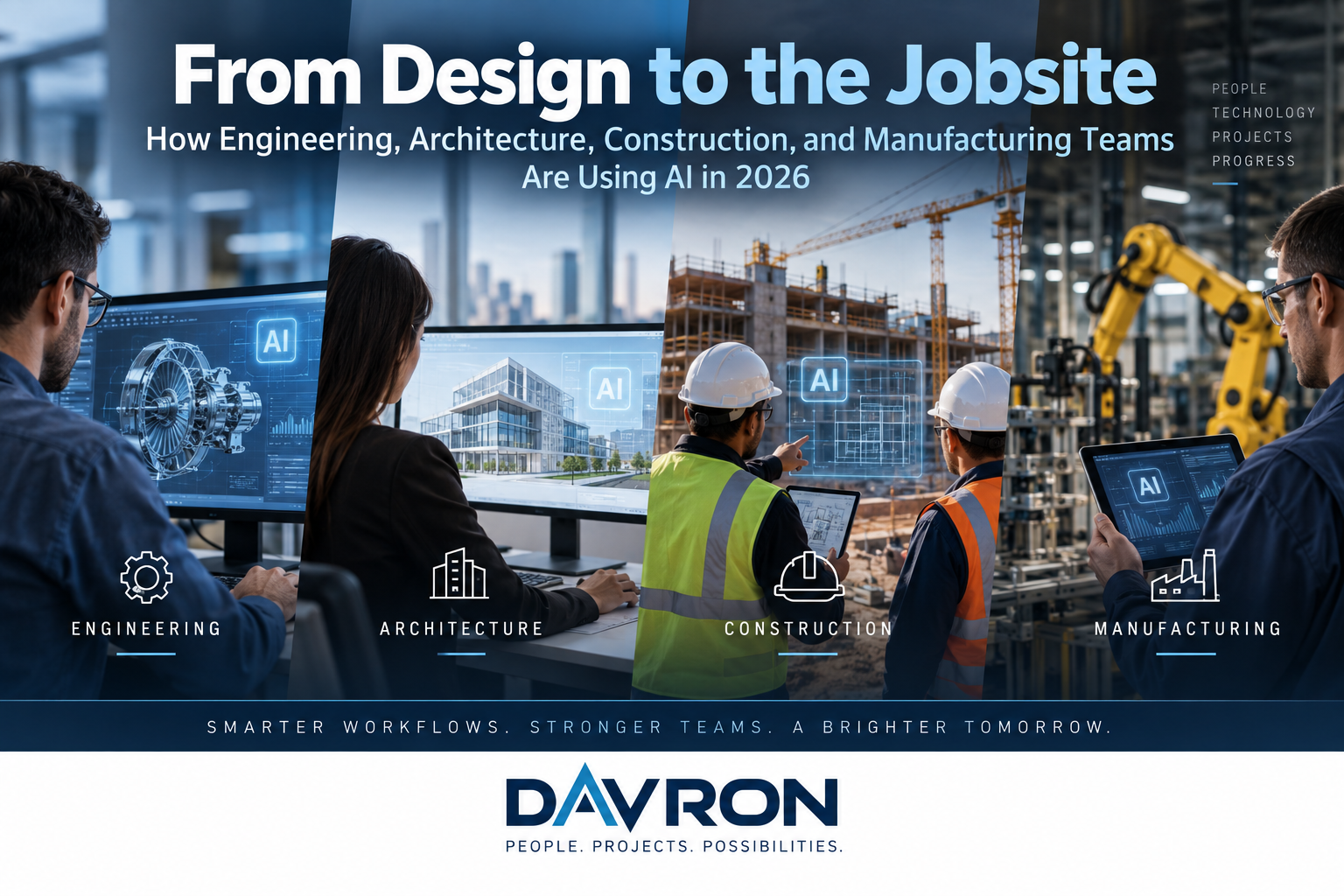
Across engineering, architecture, construction, and manufacturing, AI is moving into everyday workflows. Teams are using it to analyze information, explore design options, search project documents, identify risks, automate repetitive work, improve production processes, and make large volumes of technical data easier to use.
But implementation is uneven. Autodesk’s 2026 research across design-and-make industries found that competitive advantage is increasingly shifting from simply having access to AI toward effectively integrating it with processes, data, systems, and talent.
That distinction matters when hiring.
A mechanical engineer who understands the equipment, calculations, codes, and consequences of a design decision does not suddenly become unnecessary because software can accelerate part of the analysis. A construction project manager still needs to understand sequencing, subcontractors, schedules, contracts, and field conditions even if AI makes project information easier to retrieve. A manufacturing engineer still needs process knowledge when AI helps identify patterns in production data.
For many employers, the emerging hiring priority is therefore not simply “find people who know AI.”
It is:
Find technically strong people who know how, when, and where to use AI—and when not to trust it.
How Are Technical Teams Actually Using AI Right Now?
The most practical applications tend to have something in common: AI helps technical professionals process information or complete time-consuming work faster, while the professional remains responsible for the decision and outcome.
Current applications include:
- Design analysis and iteration
- Environmental and site analysis
- Document and specification review
- Project information retrieval
- Data analysis and pattern recognition
- Estimating and takeoff assistance
- Scheduling and planning
- Risk identification
- Quality and safety analysis
- Production and process optimization
- Predictive maintenance
- Supply-chain and logistics analysis
- Reporting and administrative automation
These are not theoretical uses. Commercial platforms serving architecture, engineering, and construction already incorporate capabilities such as environmental analysis, design assistance, construction risk assessment, specification processing, takeoff assistance, submittal workflows, and natural-language access to project information.
The bigger story, however, is not individual tools. It is the gradual integration of AI into software and workflows technical professionals already use.
How Are Engineering Teams Using AI?
Engineering is particularly well suited to AI-assisted work because engineers routinely work with large amounts of data, constraints, documentation, calculations, models, and competing design requirements.
AI can assist engineers with tasks such as evaluating alternatives, analyzing datasets, accelerating repetitive documentation, searching technical information, supporting simulation workflows, and identifying patterns that would otherwise require substantial manual review.
In architecture and engineering software, current applications include real-time analysis of factors such as wind and noise, site optioneering, drainage modeling, design iteration, and automation of repetitive CAD tasks.
This can change where engineers spend their time.
If software reduces hours spent on repetitive information processing, engineers may be able to devote more attention to evaluating alternatives, coordinating with other disciplines, solving unusual problems, communicating with clients, and making higher-value technical decisions.
But faster analysis does not eliminate the need to understand the analysis.
Engineers still operate within real constraints: codes, specifications, budgets, constructability, material properties, safety requirements, client expectations, and professional responsibilities.
That creates an important hiring distinction.
Knowing how to generate an AI-assisted answer is different from knowing whether the answer makes engineering sense.
Employers evaluating candidates should continue to prioritize fundamentals, technical judgment, relevant project experience, and problem-solving ability. AI proficiency can enhance those capabilities, but it should not automatically substitute for them.
How Are Architecture and Design Teams Using AI?
Architecture has become one of the most visible areas for generative AI because AI can rapidly produce concepts and visualizations.
But practical adoption extends beyond generating images.
Architecture and design teams can use AI-assisted workflows for:
- Early design exploration
- Site analysis
- Environmental analysis
- Design alternatives
- Visualization
- Information retrieval
- Repetitive CAD tasks
- Documentation
- BIM-related workflows
- Coordination and review
For example, Autodesk identifies existing applications including rapid noise and wind analysis, site optioneering, embodied-carbon analysis, and AI-assisted workflows within AutoCAD and other design platforms.
The employer implication is important: generating possibilities and delivering a buildable project are not the same thing.
Architects and designers still need to understand codes, materials, building systems, client requirements, documentation, constructability, budgets, coordination, and how decisions made during design affect the people who eventually have to build the project.
The strongest candidates may increasingly be professionals who can combine both sides: the ability to use technology to explore possibilities faster and the professional knowledge to determine which possibilities deserve to move forward.
How Is AI Being Used in Construction and on the Jobsite?
Construction may provide some of the clearest examples of why AI should be viewed as an operational tool rather than a replacement for experienced people.
A construction project generates enormous amounts of information: drawings, specifications, RFIs, submittals, schedules, photographs, estimates, contracts, daily reports, checklists, observations, emails, and field data.
Finding the right information quickly can itself become a challenge.
Current construction AI applications include automatically extracting information from drawings, processing specifications, identifying quality and safety risks, assisting with takeoffs, organizing project photographs, creating or managing submittal information, and allowing teams to query project information using natural language.
The technology is also moving from simply answering questions toward executing defined workflows. In 2026, Procore announced AI capabilities designed around areas including project search, submittals, RFIs, daily logs, and contract review.
Other applications are emerging around scheduling, forecasting, progress monitoring, safety analysis, and comparing site conditions with project models.
The potential benefit is straightforward: less time digging through information and performing repetitive administrative work can mean more time solving problems.
But construction remains physical.
Someone still has to understand why the schedule is slipping, whether the proposed sequence is realistic, what an RFI means for other trades, whether the installation matches design intent, and how a decision will affect cost and completion.
That is why experienced project managers, superintendents, estimators, project engineers, VDC professionals, and other construction specialists remain central to project execution.
How Are Manufacturers Using AI?
Manufacturing combines physical equipment, production processes, sensors, quality requirements, automation, maintenance, logistics, and large quantities of operational data—making it another natural environment for applied AI.
A 2026 NIST roadmap identifies areas where AI and machine learning are already advancing smart manufacturing, including industrial data analytics, sensing and perception, autonomous systems, digital twins, robotics, supply-chain and logistics optimization, and other applications. The report also emphasizes continuing challenges around data, integration, explainability, reliability, and safety.
Practical uses can include:
- Predicting equipment maintenance needs
- Detecting quality issues
- Analyzing production data
- Improving process performance
- Supporting robotics and automation
- Optimizing production and logistics
- Identifying abnormal operating conditions
- Improving visibility across manufacturing systems
Again, AI does not eliminate the physical realities of manufacturing.
A production line still needs to run. Equipment still fails. Controls need to work. Quality problems need root-cause analysis. Processes need to meet specifications. Automation must integrate with machinery and people.
That means manufacturers may increasingly value professionals who understand both the underlying industrial process and the data and technology surrounding it.
Is AI Replacing Engineers, Architects, Construction Professionals, or Manufacturing Talent?
The more useful question for employers is not whether AI can perform some tasks previously performed by technical employees. It clearly can.
The better question is:
Which parts of the job can be accelerated, and which parts still depend on human expertise?
AI is particularly useful for tasks involving large amounts of information, repetitive processes, pattern identification, first-pass analysis, summarization, classification, and generating alternatives.
Human professionals remain critical where work requires:
- Technical judgment
- Accountability
- Context
- Field experience
- Client communication
- Leadership
- Tradeoffs between competing constraints
- Safety decisions
- Interpretation of unusual conditions
- Verification of outputs
- Coordination between people and disciplines
Even technology providers building AI directly into construction workflows emphasize keeping professionals in control rather than eliminating expert review.
The likely result is not simply “AI replaces technical professionals.”
Individual jobs may change substantially. Some tasks may shrink, others may expand, and employers may expect more output from professionals equipped with better tools.
That makes adaptability combined with technical depth increasingly valuable.
What AI Skills Should Employers Look for When Hiring Technical Professionals?
One of the easiest mistakes employers can make is adding “AI experience” to a job description without defining what that actually means.
A better approach is to identify the workflows AI is affecting inside the organization.
For many technical positions, useful capabilities may include:
- Knowing which tasks are appropriate for AI assistance
- Writing effective instructions or queries
- Reviewing and validating AI-generated information
- Recognizing incorrect or questionable outputs
- Protecting proprietary, client, and confidential information
- Understanding the limitations of AI tools
- Integrating new technology into existing workflows
- Learning new software quickly
- Explaining AI-assisted work to colleagues and stakeholders
Employers should then combine these capabilities with the technical qualifications that actually determine success in the role.
For example, when hiring a mechanical engineer, experience with AI tools might be valuable—but HVAC design knowledge, equipment selection, load analysis, applicable codes, project experience, and coordination abilities may still be far more important.
For a superintendent, familiarity with AI-enabled construction software may help. It does not replace the ability to manage subcontractors, anticipate sequencing problems, maintain safety expectations, read plans, resolve field conflicts, and drive a project toward completion.
This distinction is increasingly relevant because AI-related hiring is growing across design-and-make industries while industry-specific readiness remains a challenge. Autodesk’s 2026 AI Jobs Report found a gap between general familiarity with AI and preparedness for roles requiring industry-specific AI skills.
Should Companies Hire AI Specialists or Technical Professionals Who Know How to Use AI?
It depends on what problem the company is trying to solve.
An organization developing proprietary AI systems, building large-scale data infrastructure, implementing sophisticated industrial analytics, or creating enterprise-wide automation may need dedicated AI, machine-learning, data, software, or automation specialists.
But many employers have a different immediate need.
They need a civil engineer who can use emerging tools effectively.
Or an architect.
Or a project manager.
Or a manufacturing engineer.
Or an estimator.
In those situations, deep domain expertise plus practical technology proficiency may be more useful than AI expertise without sufficient industry knowledge.
Before opening a dedicated AI position, employers should ask:
What outcome do we need this person to produce?
If the answer is fundamentally an engineering, architecture, construction, or manufacturing outcome, the company may need a strong domain professional who can incorporate AI into that work.
If the objective is to build the AI capability itself, dedicated technology expertise may be appropriate.
What Hiring Mistakes Should Employers Avoid as AI Adoption Increases?
The first is prioritizing AI familiarity over technical competence.
Tools change quickly. Fundamental technical knowledge generally changes much more slowly. Hiring someone because they know a particular AI product can be risky if they lack the experience needed to evaluate what that product produces.
The second is creating unrealistic job descriptions. Employers should be cautious about combining the responsibilities of an engineer, data scientist, software developer, automation specialist, and project manager into one position simply because technology is converging.
The third is assuming productivity improvements automatically mean fewer people are needed. Faster individual tasks can change staffing requirements, but they can also increase capacity, allow firms to pursue additional projects, improve responsiveness, or shift employees toward higher-value work.
The fourth is failing to test judgment during interviews. Ask candidates how they would validate an AI-generated result, when they would reject one, and which tasks they would never delegate without appropriate review.
The fifth is ignoring confidentiality and data security. Technical organizations routinely handle proprietary designs, client documents, contracts, drawings, specifications, production information, and other sensitive data. Candidates using AI professionally should understand that convenience does not override company policies or confidentiality requirements.
How Should Employers Adjust Their Hiring Strategy?
Start with the work rather than the technology.
Identify which workflows inside your organization are actually changing because of AI. Then determine whether those changes require new hires, new skills from existing employees, training, different software expertise, or some combination.
Next, separate must-have technical expertise from trainable technology skills.
If you need a structural engineer with specific building experience, do not lose sight of that requirement because one candidate has impressive AI knowledge. If a highly qualified engineer understands the fundamentals and has demonstrated an ability to learn new technology, AI-specific skills may be trainable.
Employers can also improve interviews by moving beyond the question, “Have you used AI?”
Ask:
“Tell us about a technical workflow where you used AI or automation to save time. What did the tool do, what did you personally verify, and how did you know the result was correct?”
That question reveals much more. It tests technical understanding, practical experience, judgment, and the candidate’s attitude toward AI at the same time.
Where Does Specialized Recruiting Fit as Technical Roles Change?
As AI becomes embedded in technical workflows, hiring requirements can become more specific, not less.
An employer may no longer need simply a manufacturing engineer. It may need a manufacturing engineer with experience in a particular production environment, automation systems, process improvement, specific software, and modern data-driven workflows.
A construction company may need a project manager who understands a particular project type and delivery method while also being comfortable working within increasingly digital project-management systems.
An engineering firm may need professionals who combine specialized design expertise with BIM, simulation, automation, data, or AI-assisted workflows.
Those combinations can make an already difficult search narrower.
This is where specialized recruiting can help.
DAVRON focuses specifically on recruiting professionals in engineering, architecture, construction, and manufacturing. That industry concentration is important when employers are searching for candidates whose qualifications cannot be reduced to a generic list of software keywords.
The objective is not simply to find someone who has used AI.
It is to find a qualified technical professional who understands the work, fits the employer’s requirements, and can operate effectively as the tools surrounding that work continue to change. This specialization and employer-focused approach reflect DAVRON’s recruiting positioning.
The Future of Technical Hiring Is About Expertise Plus Adaptability
AI is already moving from experimentation toward practical implementation across design, engineering, construction, and manufacturing. Yet adoption itself is not the competitive advantage it once appeared to be. Increasingly, the differentiator is whether organizations can integrate technology effectively with their data, processes, and people.
For employers, that should change the hiring conversation.
Don’t hire for AI buzzwords.
Hire professionals who understand their discipline deeply, can evaluate technical consequences, learn new tools, validate what technology produces, and recognize when experience and human judgment need to take control.
The tools will continue changing.
The ability to combine technical expertise with those tools is what employers should be hiring for.
Ready to hire engineering, architecture, construction, or manufacturing professionals?
DAVRON specializes in delivering high-quality candidates in these industries.